

How To Install a Growth System for a PE Portfolio Company

To install a growth system in a PE portfolio company, establish growth clarity in the first 90 days, document the ideal customer profile, assign clear ownership for growth, and build a 180-day plan tied to your hold-period targets. The goal is a system the leadership team owns and runs without outside help.
TL;DR
- Start with clarity on how the company actually grows today before funding any new activity.
- Document the ideal customer profile so acquisition spend targets accounts worth keeping.
- Assign one accountable owner for Growth inside the company, not at the firm.
- Build a 180-day plan with milestones mapped to your hold-period targets.
- Install a system the team can run alone, so progress survives the engagement.
Most growth problems inside a portfolio company are not effort problems. The leadership team is busy, the sales reps are working their accounts, and the marketing line item is being spent. Revenue is still flat. The reason is almost always that nobody has a clear picture of where the company actually wins, and no system connects that picture to daily activity.
The villain here is the consulting dependency: a binder of recommendations that lives in an outside firm’s head, produces a flurry of activity for two quarters, and then stalls the moment the engagement ends. The most useful thing a PE firm can install in a portfolio company is a growth system the leadership team owns. That is what survives a key resignation, reports cleanly to the board, and compounds across the full hold period.
Here are the five moves that install it.
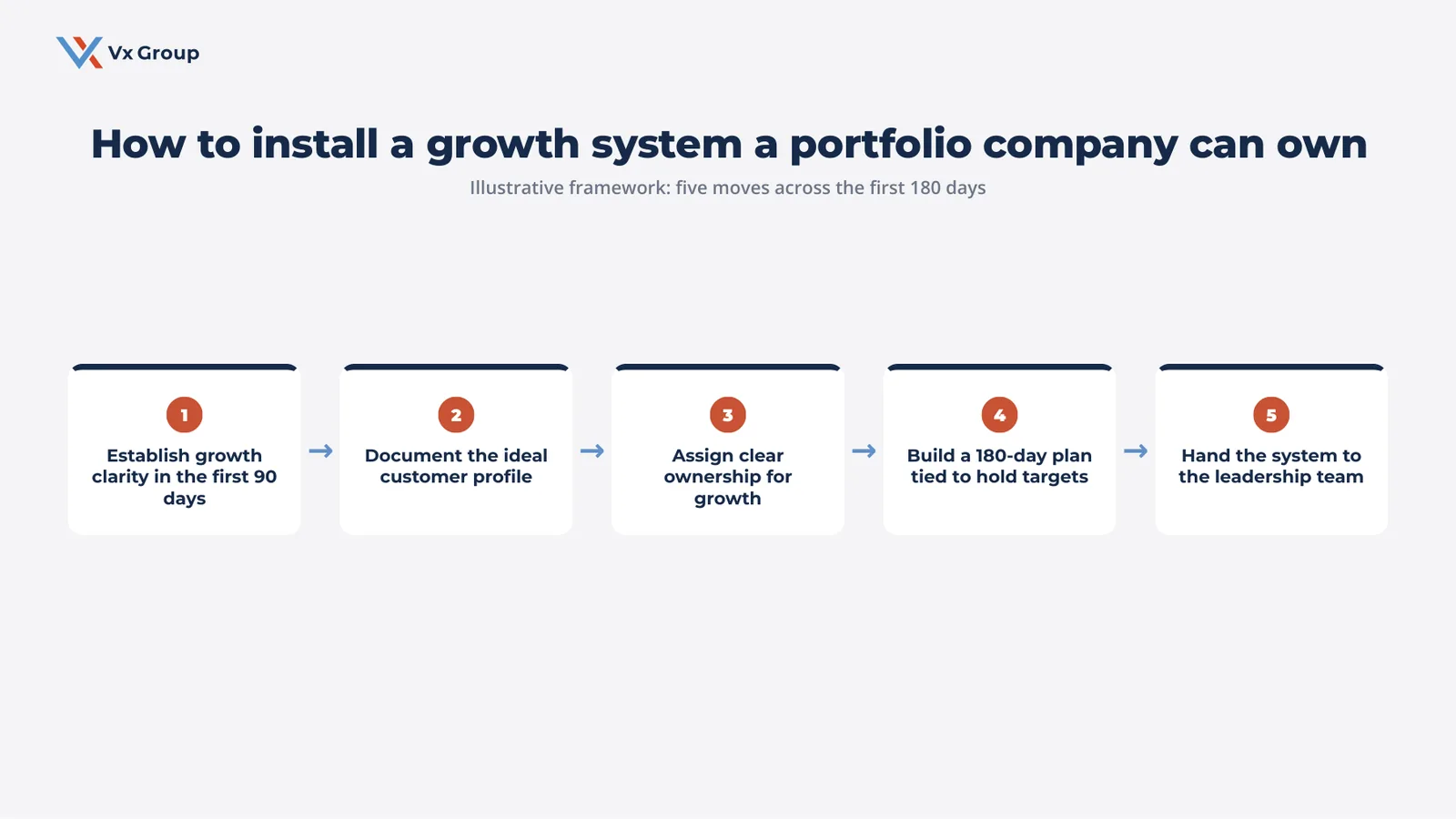
Step 1: Establish growth clarity in the first 90 days
Start by mapping how the company grows today, because you cannot improve a growth model you have not documented. In the first 90 days, get a clear-eyed picture of which customers actually drive revenue, why they chose this company, how revenue moves through the business, and where the friction sits.
Map the real revenue streams, not the org chart
Most legacy portfolio companies grow through a handful of trusted individuals and a few long-standing accounts. Document which relationships carry the revenue, how concentrated that revenue is, and which channels reliably produce new business. Flat or declining growth almost always traces back to a model that depends on a few accounts with no system for replacing or expanding them.
Name the friction that slows new business
Look for the specific points where new relationships stall: a sales process that lives entirely in the founder’s head, proposals that take three weeks to produce, a website that makes the company look smaller than it is. Naming these is the difference between a diagnosis and a guess.
Run a six-point diagnostic before funding anything
Most stalled portfolio companies share one condition: they grew through people and relationships, never through systems. Before approving spend, score the company against six common failure points. The more that are present, the more fragile the revenue you just acquired.
- Growth depends on a specific person rather than a repeatable process.
- Two or three accounts hold the majority of revenue.
- Top-line targets exist, but no documented path connects to them.
- Critical relationships and institutional knowledge live in one or two heads.
- The brand and digital presence make the company look smaller than it has become.
- The sales team has talent, but every rep sells differently with no shared standard.
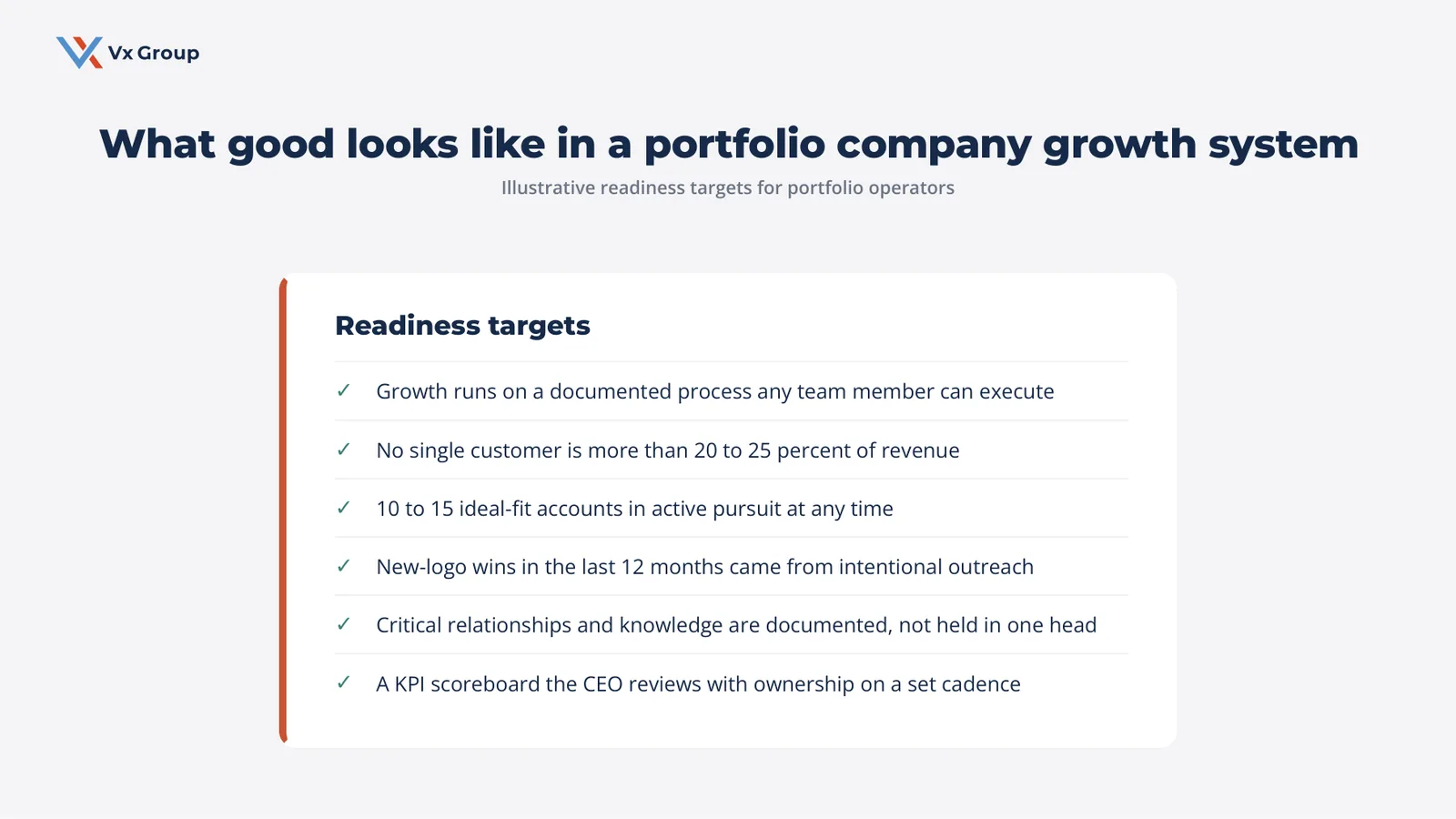
Then measure the company against what a healthy growth system actually produces, so you know how far the install has to go.
Defined term: Growth clarity
A documented understanding of which customers stay, why they buy, how revenue moves through the business, and where growth slows. It turns reactive guessing into directional decisions a leadership team and a board can trust.
Step 2: Document the ideal customer profile
Define the ideal customer profile before you approve another dollar of acquisition spend, because every marketing and sales decision downstream depends on it. The fastest way to build it is to study the relationships the company already values most.
Build the profile from your best existing relationships
Rank the current accounts by relationship quality and lifetime value rather than last year’s revenue alone. The best accounts usually share a pattern: a certain size, a certain industry, a certain way of buying, a certain reason they stay. That pattern is the profile. It tells the team which prospects are worth pursuing and which ones quietly drain margin and attention.
Let the profile decide what to walk away from
A documented profile does two jobs. It points outreach toward accounts worth keeping, and it gives the team permission to decline business that looks like revenue but behaves like a cost. For a portfolio company under pressure to grow, that second job protects margin during the exact period when the temptation is to chase everything.
Set the targets that signal a healthy book of business
Give the leadership team specific numbers to manage toward. In a resilient portfolio company, no single customer accounts for more than 20 to 25 percent of revenue, and the team keeps 10 to 15 ideal-fit accounts in active pursuit at any time. New-logo wins over the last 12 months should trace back to intentional outreach, not inbound referrals alone. These markers separate a company a buyer will pay a premium for from one that carries hidden risk.
Defined term: Revenue concentration risk
The degree to which revenue depends on a small number of customers. A company with 60 percent or more of revenue tied to its top three accounts carries high concentration risk, which suppresses valuation in diligence and turns a single customer departure into an existential event.
Defined term: Ideal customer profile (ICP) A documented description of the accounts a company is best positioned to win and keep, drawn from the shared traits of its highest-value existing relationships. It directs where the company spends time, money, and attention.
Step 3: Assign clear ownership for growth
Name one person accountable for the growth system inside the company, because a system without an owner becomes a document nobody opens. This is where most portfolio-company growth efforts quietly fail. Responsibility is spread across sales, marketing, and the leadership team, so no one owns the outcome.
Decide who owns the system, who runs the plays, and who reports up
Growth ownership splits into three jobs: someone who owns the overall system and its results, someone who executes the outreach and follow-up, and someone who reports progress to the board. In a smaller company one person may hold two of these. What matters is that each job has a name attached to it, not a department.
Keep ownership inside the company
The owner needs to sit inside the portfolio company, not at the PE firm or an outside agency. When growth ownership lives outside the business, the company never builds the muscle, and every reporting cycle starts from zero. Installing ownership internally is what turns a six-month project into a durable capability.
Ready to grow?
Install a growth system that lifts hold-period value, instead of a one-off project that fades.
Step 4: Build a 180-day plan tied to hold-period targets
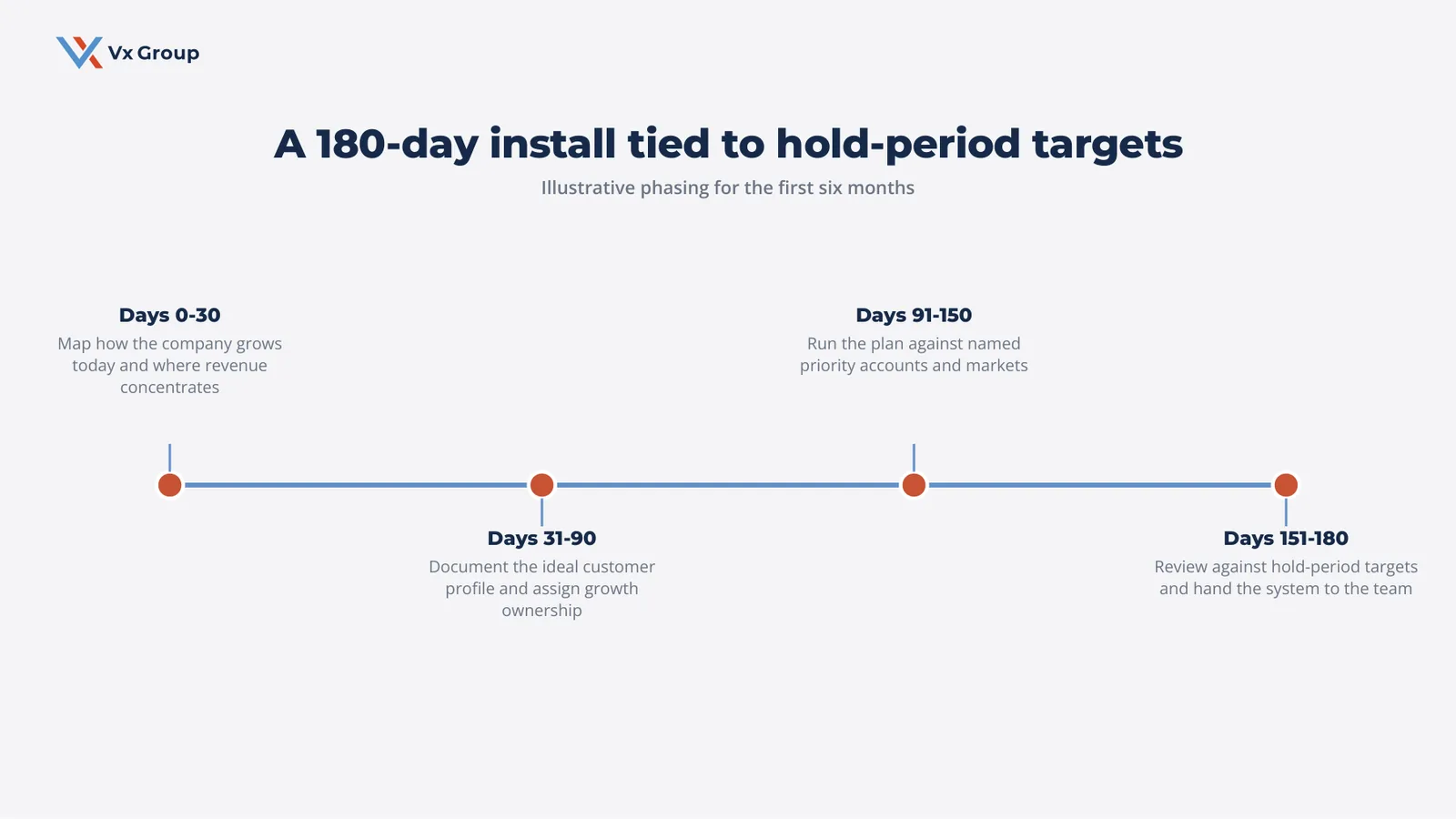
Translate the clarity and the profile into a 180-day plan with a short list of priorities, each mapped to the targets that matter for the hold. This plan becomes the execution layer of the value creation plan the firm built at acquisition. A plan with twenty initiatives is not a plan. Limit it to the few moves that will produce measurable progress in the next two quarters.
Work backward from the exit thesis
Whatever the investment thesis promised, the 180-day plan should ladder up to it. If the thesis depends on expanding into adjacent markets, the plan names those markets and the accounts to pursue. If it depends on deepening existing accounts, the plan documents which relationships to expand and how. Each priority gets an owner, a milestone, and a metric the board can read.
Set milestones the board can verify
Tie each initiative to a checkpoint at 30, 90, and 180 days. This gives the board pipeline visibility and gives the leadership team a way to show progress that is more credible than activity reports. Verifiable milestones also surface a stalled initiative early, while there is still time in the hold to correct it.
Defined term: Hold-period targets
The growth and value-creation goals a PE firm needs a portfolio company to hit across the investment hold. A growth plan earns its place when every priority can be traced back to one of these targets.
Defined term: Value creation plan (VCP) The documented plan a PE firm or family office builds for each portfolio company at acquisition, defining how the business will grow and what it needs to look like at exit. The 180-day growth plan is where the VCP stops being a thesis and starts producing measurable results.
Step 5: Hand the system to the leadership team
Finish the install by transferring the system to the people who run the company every day, because a growth system only creates value if it outlasts whoever built it. The test of a good install is simple: can the leadership team run the next two quarters without the firm in the room?
A system the team owns survives turnover, reports cleanly to the board, and compounds across the hold. A consulting dependency does the opposite. It stalls when the engagement ends and produces motion that looks like progress without moving the company toward its targets.
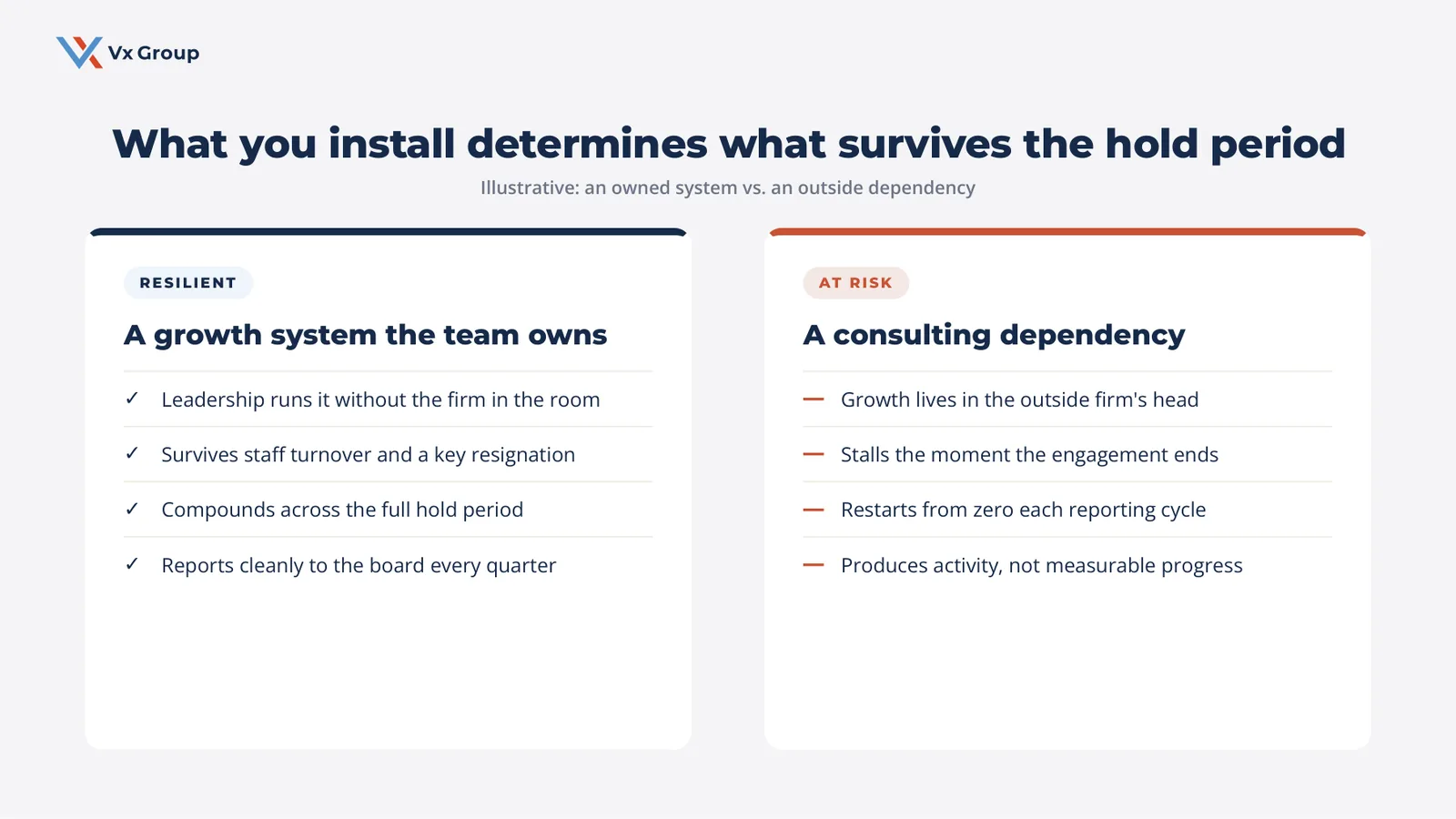
Document the system so it lives in the company, not in a consultant’s notebook: the growth model, the customer profile, the ownership map, the plan, and the cadence for reviewing it. When those five things are written down and owned internally, you have installed something that keeps working after you move on to the next priority in the portfolio.
Field Notes
A lower-middle-market manufacturer in a PE portfolio was growing through two accounts that had been customers for over a decade. When one signaled it was consolidating suppliers, the growth model had no answer. The install started with clarity: the team documented that 60 percent of revenue sat in those two relationships. From there they built a profile of the accounts that looked like their best customers, assigned a single internal owner for new-account growth, and ran a 180-day plan against a named list of priority targets. What they built was a system the leadership team could run on its own once the engagement ended.
What a growth system installs that a one-off project does not
A growth system gives a portfolio company four things a campaign cannot: a documented understanding of how it grows, a profile of the customers worth winning, a named owner accountable for results, and a plan the board can verify. Those four things turn growth from a guessing game into a capability the company keeps.
For a PE firm or family office, that distinction shows up in the valuation at exit. Lower-middle-market companies typically transact at four to eight times EBITDA, and three factors reliably suppress that multiple in diligence: revenue concentration, key-person dependency, and undocumented growth processes. A growth system attacks all three. A company that can show a buyer documented relationships, a diversified pipeline, and a repeatable plan presents far stronger quality of earnings than one whose growth depended on an outside firm that is no longer involved. The system is part of the value you are building.
Defined term: Quality of earnings (QoE)
A diligence analysis of how sustainable and reliable a company’s EBITDA is. Buyers use it to judge whether reported earnings will hold up after the sale. Diversified revenue, documented processes, and relationships that do not depend on one person all strengthen QoE and support a higher price.
Building a growth system a portfolio company can own is the work Vx Group does inside relationship-driven, lower-middle-market businesses. If you have a portfolio company that is growing on instinct and a few legacy accounts, we can help you install something more durable.
Ready to grow?
Hand your portfolio company a growth system the leadership team can run without you.
FAQs
About the Author: David Tisdale
