

How to Build a Value Creation Plan for a B2B Portfolio Company

Build a value creation plan for a B2B portfolio company in five moves: establish growth clarity, document the ideal customer profile from your best existing accounts, define the growth roles that own execution, build a 180-day plan tied to hold-period targets, and set relationship-quality metrics. The plan works only when the leadership team owns and runs it.
TL;DR
- A value creation plan in private equity is the operating plan that turns a hold-period thesis into specific growth moves, named owners, and tracked metrics.
- Most plans fail for one reason: they live in a deck the firm presents at the board meeting instead of in the work the team does every week.
- Start with growth clarity. Name where the company already wins before funding a single new tactic.
- Build the ideal customer profile from the accounts you serve best today, assign one owner to every part of the plan, and tie a 180-day plan to the value targets in the thesis.
- Track relationship quality alongside pipeline volume, and review the plan every 90 days so it compounds across the hold.
A B2B portfolio company rarely struggles for lack of a value creation plan. It struggles because the plan was built once, presented once, and then left in the data room while the business went back to running on instinct. The deck looks sharp. The 100-day plan has owners and dates. Six months later the operating partner asks where the growth initiatives stand and gets a version of “we got busy.”
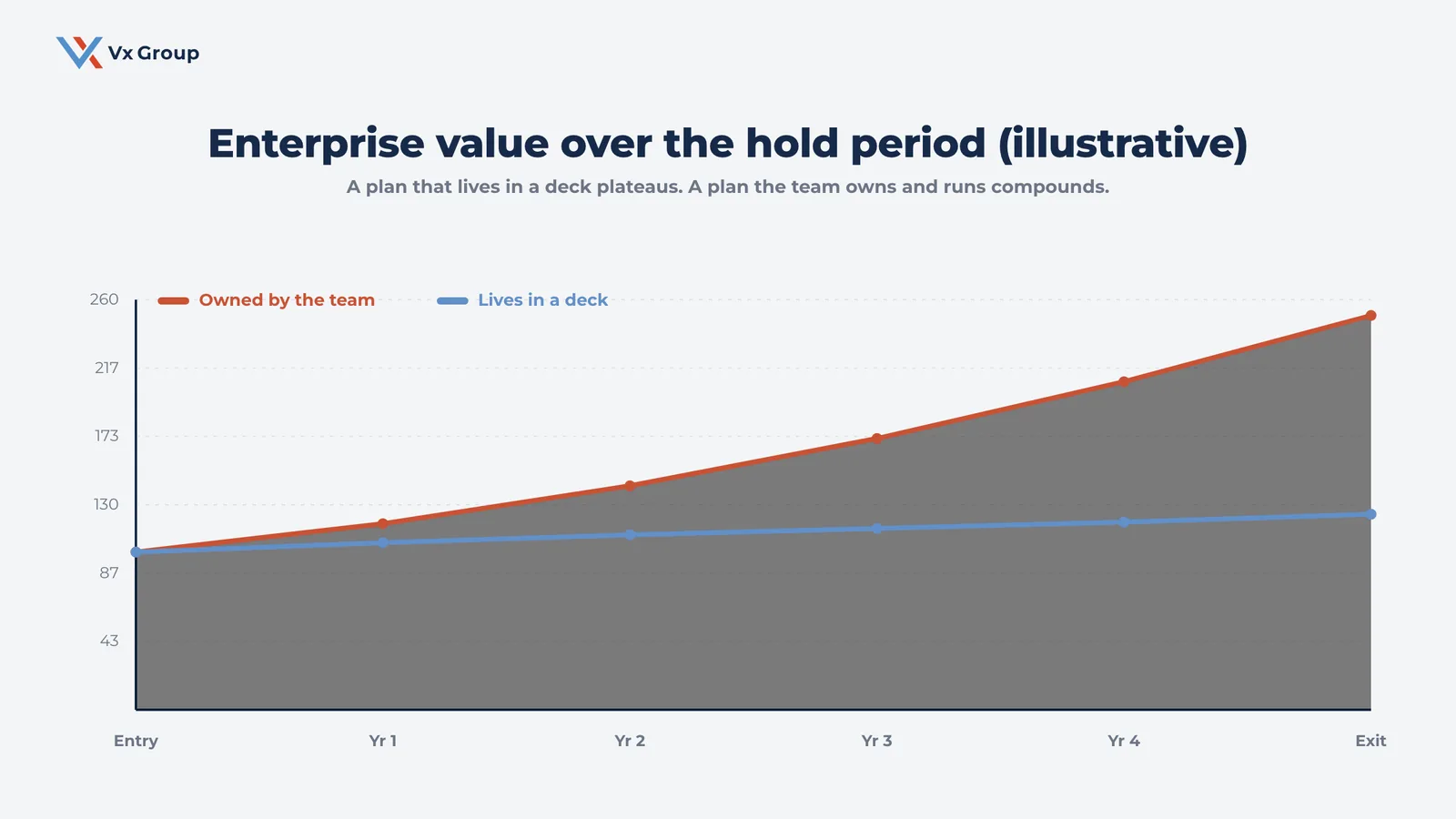
The villain here is the plan that lives in a deck. It is the document that earns approval at the investment committee and then stops mattering the moment the real quarter starts. A value creation plan that lives in a deck cannot compound, because nobody runs it between board meetings. A value creation plan the leadership team owns and runs becomes the operating rhythm of the business, and that is what shows up in the exit multiple.
This guide walks through the five steps to build the second kind. It is written for operating partners and portfolio company CEOs in relationship-driven B2B: manufacturers, distributors, industrial services, specialty B2B firms with long sales cycles, concentrated accounts, and revenue that depends on trust built over years.
The tactics that work for high-velocity SaaS do not transfer cleanly to these businesses, so the plan has to be built around how durable B2B revenue actually grows.
Defined Term: Value creation plan
A written, owned operating plan that translates a hold-period investment thesis into the specific growth moves a portfolio company will run, who is accountable for each, and how progress is measured. The leadership team executes it as part of how the business runs, week to week, through the hold.
What is a value creation plan in private equity?
A value creation plan in private equity is the bridge between the thesis that justified the deal and the work that delivers the return. The thesis says the business can grow from one size to a larger one over the hold period. The value creation plan says exactly how: which customers, which roles, which moves, on what timeline, measured by what. Without it, the thesis is a hope with a purchase price attached.
In a B2B portfolio company, most of the durable upside sits in three places: winning more of the right new accounts, growing the accounts you already have, and protecting the relationships that already carry the revenue. A strong plan addresses all three and resists the temptation to chase volume for its own sake. The point is intentional growth tied to the value targets in the thesis, run by the people who have to live with the results.
The difference between a plan that compounds and a plan that plateaus is not the quality of the analysis. It is ownership. A plan the team runs gets adjusted as the market moves, gets defended when the quarter gets hard, and gets better with every cycle. A plan that lives in a deck gets quietly abandoned.
Why do most private equity value creation plans fail?
Most private equity value creation plans fail because they are treated as a deliverable instead of an operating system. The plan gets built to clear the investment committee, so it is detailed where approval needs detail and silent where execution needs it. Three failure patterns show up again and again in B2B portfolio companies.
The first is the deck problem already named: the plan has no home in the weekly and monthly cadence of the business, so it stops getting touched. The second is the volume trap, where the plan measures activity (calls made, leads generated, shows attended) while ignoring relationship quality and account progression, and the team chases the busy number while real growth stalls. The third is founder dependency, where the plan quietly assumes the founder or one rainmaker keeps producing the relationships, and the moment that person slows down or leaves, the model breaks.
A plan that survives the hold avoids all three. It is small enough to run, measured on outcomes that predict revenue, and built so the company’s relationships live in a system rather than in one person’s head. The five steps below are sequenced to produce exactly that.
Defined Term: Hold-period thesis
The investment case for what the business will become by exit, including the revenue and margin targets and the moves expected to get there. The value creation plan is the operational translation of this thesis into owned, measurable work.
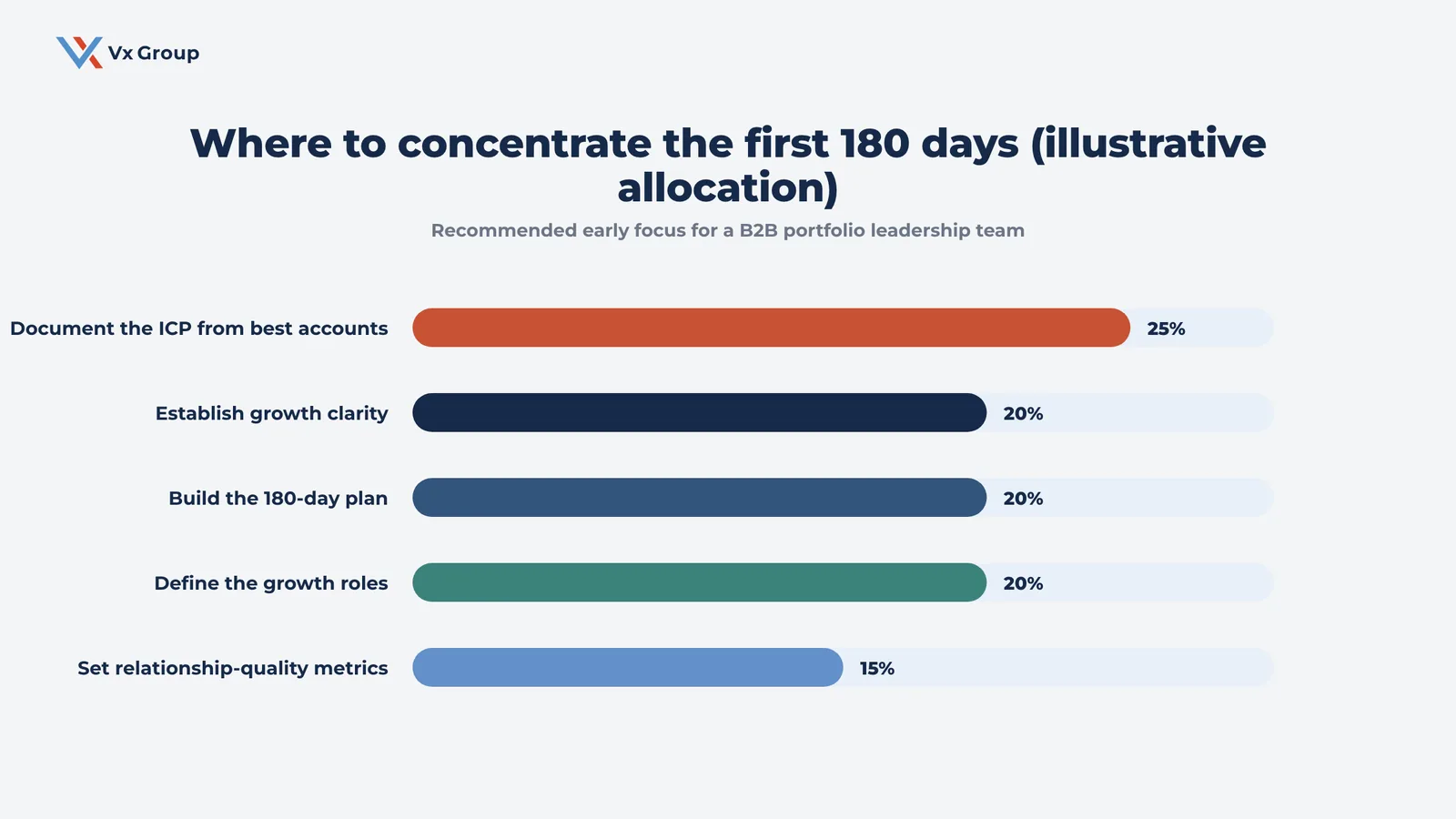
Before the steps, a note on sequence and where to spend the first months. Teams that try to do everything at once usually do nothing well. The early weight should sit on clarity and the customer profile, because those decisions govern everything downstream. The chart below shows a workable starting allocation for a leadership team’s attention in the first 180 days.
Ready to build a plan that compounds?
Vx Group helps portfolio leadership teams turn a hold-period thesis into a plan they own and run through the hold.
Step 1: Establish growth clarity before funding new tactics
Start by getting honest about where the company actually wins, because every later decision depends on it. Growth clarity means the leadership team can state, in plain language and with evidence, which customers the business serves best, why those customers chose it, what the company does better than the alternatives, and where the next dollar of profitable revenue most likely comes from. Until that is written down and agreed, any new spend is a guess.
Defined Term: Growth clarity
A documented, shared understanding of where a company creates the most value, for whom, and why, used as the filter for every growth decision. It replaces instinct and momentum with a stated point of view the whole team can act on.
What does growth clarity actually mean for a portfolio company?
Growth clarity means replacing “we grow through relationships and referrals” with a specific account of the growth engine. For a B2B portfolio company, that includes the few customer types that produce most of the margin, the handful of capabilities that make the company hard to replace, and the realistic paths to more revenue ranked by profitability and effort. Many good companies have never written this down because the knowledge lives in the founder’s head. Getting it out of one head and onto one page is the first real act of value creation.
How do you establish growth clarity in the first 30 days?
Establish growth clarity in the first 30 days by running three structured exercises with the leadership team and the data. First, pull the revenue and margin by account, segment, and product so the picture is grounded in numbers rather than memory. Second, interview the leaders closest to the customer about why the best accounts buy and stay, and look for the patterns that repeat. Third, write a one-page point of view on where the company wins and where it should compete next, and make every leader sign off on it.
If a planned initiative does not fit that page, it does not get funded yet. Companies that skip this step end up with a plan full of activity and short on direction, which is how growth happens by accident rather than on purpose.
Step 2: Document the ideal customer profile from your best existing accounts
Define the ideal customer profile by studying the accounts you already serve best. The most reliable predictor of the next great customer is the pattern inside your current great customers, which beats anything a market report can tell you about who could theoretically buy. Pull the accounts with the strongest margin, the longest tenure, the highest expansion, and the lowest service drag, then find what they share: industry, size, buying trigger, the problem you solve for them, who signs, and why they stay.
Defined Term: Ideal customer profile (ICP)
The documented description of the accounts a company is best positioned to win, serve profitably, and keep, built from the shared traits of its strongest existing customers. It points sales and marketing at more of the right relationships and away from expensive misfits.
How do you build an ICP from existing accounts?
Build the ICP from existing accounts in four moves. First, rank every account by a blended score of margin, tenure, expansion, and ease of service, and take the top decile as your reference set.
Second, document the firmographics and the situation those accounts had in common when they first bought.
Third, capture the buying committee: who championed you, who signed, and what they were trying to fix.
Fourth, write the disqualifiers, the traits of accounts that looked attractive but turned out to be low-margin or high-drag.
The disqualifiers are as valuable as the targets, because they stop the team from chasing revenue that costs more than it returns. For a deeper treatment of the criteria that actually separate good-fit accounts from bad ones, our guide on the B2B enterprise target profile is a useful companion.
Why does the ICP come from current accounts instead of a market study?
The ICP comes from current accounts because real buying behavior beats theoretical addressable market every time. A market study tells you who could buy. Your own book tells you who already did, stayed, and paid well. In relationship-driven B2B, where one account can represent millions in lifetime value, the proof of fit is in the relationships you have already earned. Starting there also gets the sales team to trust the plan, because it describes customers they recognize rather than a persona invented in a conference room.
Step 3: Define the growth roles that own the plan
Assign clear ownership for every part of the plan, because a plan without named owners is a wish list. Growth roles are the specific responsibilities required to run the plan: who owns new-account acquisition, who owns expansion inside existing accounts, who owns marketing and demand, who owns the data and reporting, and who owns the relationships that carry the most revenue. In many B2B portfolio companies these roles are implicit and concentrated in one or two people, which is exactly the dependency a value creation plan needs to remove.
Defined Term: Growth roles
The defined set of accountabilities that keep a growth plan running, each assigned to a named owner. Defining them turns growth from something the founder does into something the organization runs, which protects the value when any one person changes.
Who should own a value creation plan in a portfolio company?
The CEO owns the value creation plan, and a small number of named leaders own its parts. Ownership cannot sit with the private equity firm, because the firm is not in the building running the quarter. The operating partner sponsors and inspects the plan; the leadership team runs it. A practical structure gives one executive accountability for each major growth lever, a single owner for the metrics and the cadence, and the CEO as the person who answers for the whole plan at every board meeting. When everyone owns it, no one owns it, so resist the urge to make the plan a shared committee project.
How do you define growth roles without adding headcount?
Define growth roles by reassigning accountability before adding headcount. Most B2B portfolio companies already have the people; what they lack is clear ownership and a system that makes the work repeatable. Start by mapping each part of the plan to a current leader and writing down what “owning it” means in terms of the outcomes that leader is accountable for.
Where a genuine gap exists, such as no one owning demand generation or no one owning account expansion, that is a hiring decision the plan can justify with a clear return. Adding a system around the existing team usually unlocks more capacity than adding bodies to an unclear one. Systems protect the people and the relationships; they do not replace them.
Step 4: Build a 180-day plan tied to hold-period targets
Translate the thesis into a 180-day plan with specific moves, owners, dates, and the value targets each move serves. A hold period is measured in years, but a plan measured in years never gets run. The 180-day horizon is long enough to deliver real results and short enough to stay concrete, and it forces the team to choose the few moves that matter most right now rather than listing everything that could ever help.
Defined Term: 180-day plan
A focused operating plan covering the next two quarters, listing the specific growth moves, owners, milestones, and the hold-period value targets each move advances. It is rebuilt every two quarters so the plan keeps pace with the business across the hold.
What goes into a 180-day value creation plan?
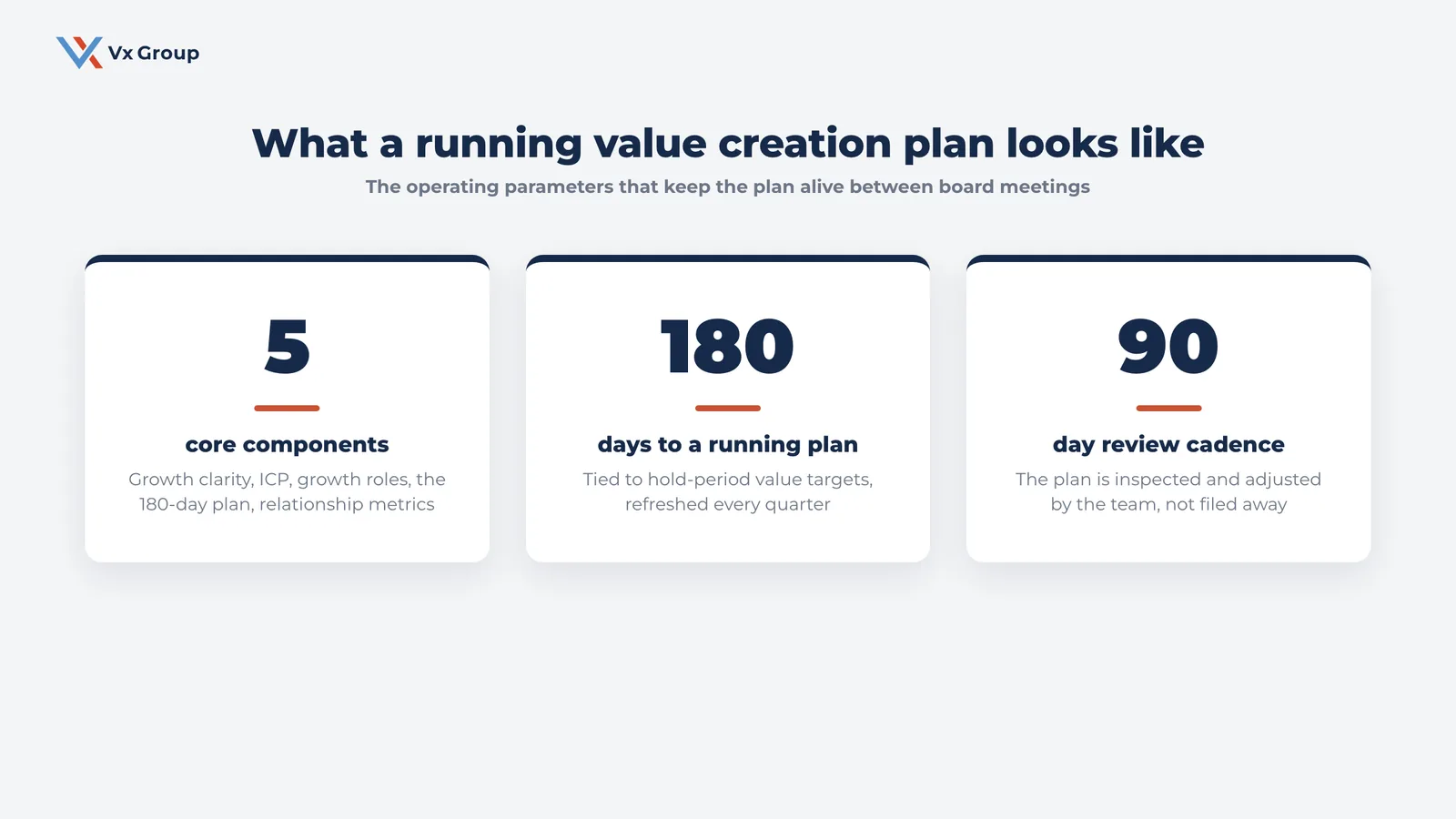
A 180-day value creation plan contains a short list of growth moves, each with one owner, a clear milestone at 90 and 180 days, the resources required, and the hold-period target it serves. Limit it to the five to seven moves that will move the number most, because a plan with twenty initiatives is a plan with none. Tie every move back to the thesis: if the case to invest assumed growth in a specific segment or through a specific channel, the plan should show the moves that produce it. Anything that does not connect to a value target is a distraction wearing the costume of progress.
How do you connect a 180-day plan to the exit?
Connect the 180-day plan to the exit by working backward from the value targets in the thesis to the moves that produce them, then forward again into owned milestones. State the exit-level outcome, name the annual progress that implies, and break the next two quarters into the specific steps that put the company on that path.
Each 180-day cycle should close a measurable gap between where the business is and where the thesis says it needs to be. Reviewed this way, the plan becomes the through-line from the board room to the shop floor, and the board conversation shifts from “are we busy” to “are we on the path.”
Step 5: Set relationship-quality metrics the board can track
Measure relationship quality and account progression alongside pipeline volume, because in relationship-driven B2B the leading indicators of revenue are the health and trajectory of relationships. Volume metrics tell you how busy the team is. Quality metrics tell you whether the business is building the kind of relationships that turn into durable revenue. A plan that tracks only activity will look healthy right up until the revenue does not arrive.
Defined Term: Relationship-quality metrics
Measures of the health, depth, and trajectory of a company’s customer relationships, used as leading indicators of durable revenue. Examples include account expansion rate, retention of top accounts, depth of contact within key accounts, and movement of priority accounts through defined relationship stages.
What metrics belong in a B2B value creation plan?
The metrics that belong in a B2B value creation plan combine a few outcome numbers with a few relationship-quality numbers. On the outcome side: revenue and margin by segment, new-account bookings, expansion revenue from existing accounts, and retention of the top accounts by value.
On the quality side: how many of your priority target accounts have advanced a relationship stage this quarter, how deep your contact map goes inside the largest accounts, and how concentrated revenue is in any single relationship.
The concentration number matters because hidden dependency on one or two accounts is one of the most common risks an acquirer discounts at exit. Tracking quality alongside volume turns the metrics into leading indicators of durable revenue, and keeps the team honest about whether activity is turning into real relationships.
How often should you review the value creation plan?
Review the value creation plan on a 90-day cadence, with a lighter monthly check on the moves in flight. The quarterly review is where the leadership team inspects progress against milestones, adjusts the moves that are not working, and rebuilds the 180-day plan at the two-quarter mark.
The monthly check keeps owners accountable between the larger reviews. This rhythm is what keeps the plan alive: it is inspected, owned, and adjusted by the people running it, rather than dusted off the week before a board meeting. In this cadence the operating partner inspects and supports while the leadership team runs the plan from inside the business.
Defined Term: Field Notes
The portfolio companies that compound through the hold are rarely the ones with the most elaborate plan. They are the ones where the CEO can open the value creation plan on any given Tuesday, point to the five moves in flight, name who owns each, and show the relationship metrics trending in the right direction. The plan is not an artifact they produced for the firm. It is how they run the company.
How do you keep a value creation plan from dying in a deck?
Keep the plan alive by giving it an owner, a cadence, and a small enough scope to actually run. Every failure mode traces back to one of those three being missing. Without an owner, the plan has no one to defend it when the quarter gets hard. Without a cadence, it has no place in the calendar and quietly disappears.
Without focus, it becomes a list too long to execute and the team reverts to instinct. Build the plan so the leadership team carries it forward on its own, and the firm’s role becomes inspecting a living system rather than reviving a dead document at each board meeting.
For relationship-driven B2B portfolio companies, this is the work that separates a thesis that delivers from one that disappoints. The analysis at the deal stage gets the company in the door. The owned, running plan is what builds the value that shows up at exit.
Conclusion
A value creation plan is worth exactly as much as the degree to which the leadership team runs it. Build it in five moves: get clear on where the company wins, document the ideal customer profile from your best accounts, assign growth roles with real ownership, write a 180-day plan tied to the thesis, and measure relationship quality on a 90-day cadence.
Do that, and the plan stops being a slide the firm presents and becomes the way the company grows. That is the version that compounds, and the version an acquirer pays for.
Ready to grow?
If you want help turning a hold-period thesis into a plan your portfolio company’s leadership team will actually own and run.
FAQs
About the Author: David Tisdale
