

Commercial Due Diligence: What It Measures and What It Misses

Commercial due diligence measures the market, the revenue, and the pipeline of an acquisition target. It rarely measures whether the relationships behind that revenue will survive a change in ownership. In relationship-driven B2B, that gap is where investors lose the most value, because the asset they paid for lives in people, not in process.
TL;DR
- Standard commercial due diligence tests market attractiveness and revenue quality. It is good at what it does.
- It is built for businesses where value sits in operations, contracts, and recurring revenue mechanics.
- It is weak at testing relationship durability: who owns the customer relationship, how concentrated it is, and whether it transfers.
- In relationship-driven B2B, the durable value is relational. Standard CDD does not stress-test it.
- The winner: pair standard CDD with relationship-durability diligence. Run both, or you are pricing a business you have only half-measured.
The villain here is a familiar one in lower-middle-market deals. An investor runs a clean commercial process, the numbers check out, the market looks healthy, and the deal closes. Then the founder steps back, a key account manager leaves, and revenue that looked contractual turns out to be personal. The diligence was thorough. It just measured the wrong asset.
What does commercial due diligence measure?
Commercial due diligence measures whether a target’s revenue is real, defensible, and likely to continue. It validates the market, the competitive position, the customer base, and the growth assumptions behind the investment thesis.
A standard commercial diligence process covers four areas well.
Market attractiveness comes first. The team sizes the market, maps the growth rate, and tests whether the tailwinds in the thesis actually exist. This work is rigorous and well-developed.
Revenue quality comes second. Diligence teams break down revenue by customer, by product, and by recurrence. They separate one-time work from repeatable work and flag how much of the base is contracted versus discretionary.
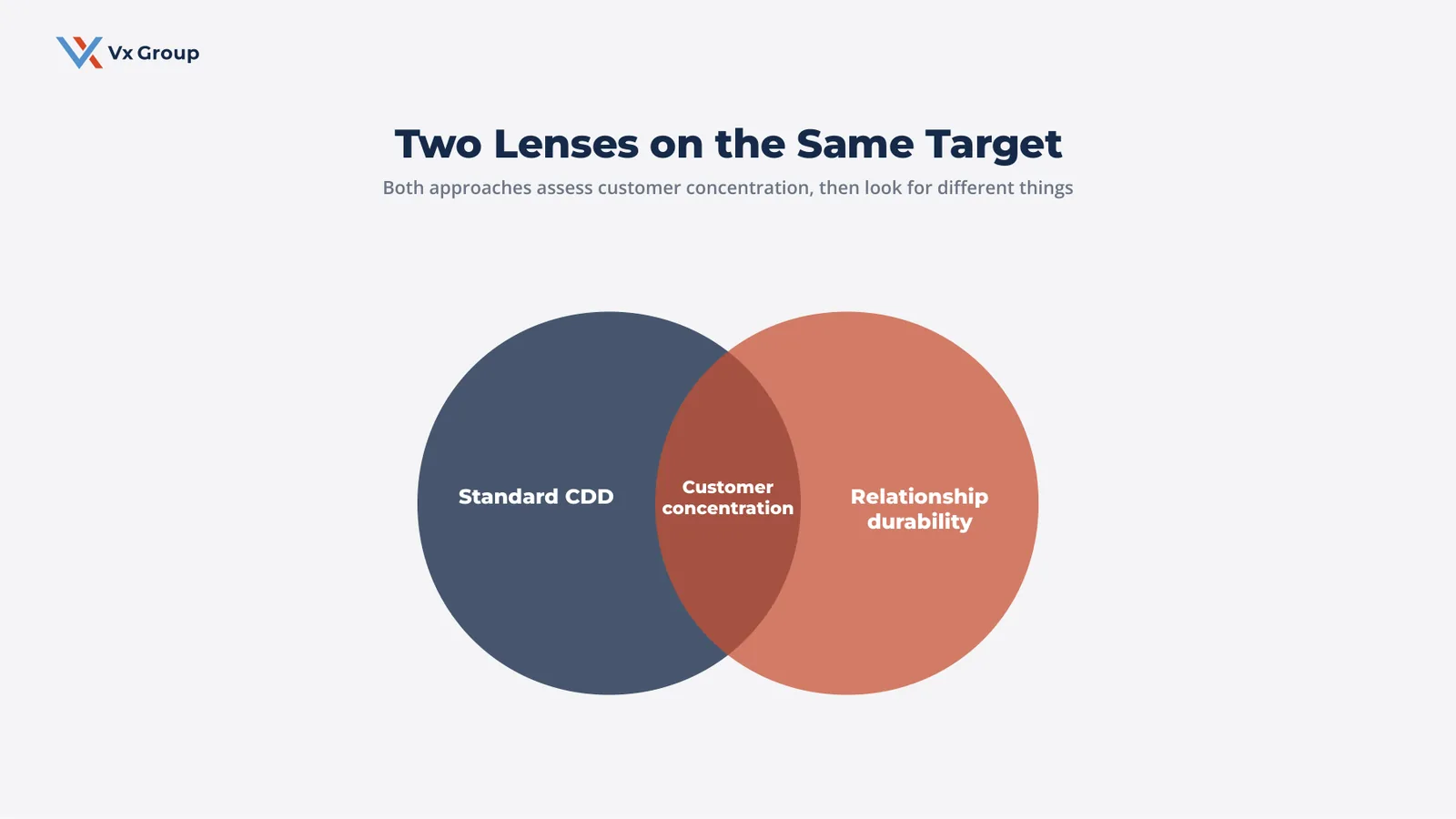
Customer concentration comes third, at least on the surface. Most CDD reports show a top-ten-customer table and a concentration percentage. They identify that 60 percent of revenue runs through eight accounts and they note the risk.
Competitive position comes fourth. The team assesses win rates, pricing power, switching costs, and the moat. For product-led and contract-led businesses, this analysis is sharp.
Defined term: Commercial due diligence (CDD)
The investor-side analysis that validates a target’s market, revenue quality, customer base, and competitive position before a deal closes. CDD answers whether the revenue is real and likely to continue under the existing business model.
For a software business or a contract-heavy services firm, this is enough. The value sits in the product, the contracts, and the recurring-revenue mechanics. Those things are visible, measurable, and transferable. Standard CDD measures them accurately.
Where does standard commercial due diligence fall short?
Standard commercial due diligence falls short when the value of the business lives in relationships rather than in operations. It can see that revenue is concentrated. It struggles to see whether that revenue is personal, who controls it, and whether it walks out the door when ownership changes.
This is the blind spot that matters most in lower-middle-market, relationship-driven B2B: privately held manufacturers, distributors, packaging firms, industrial suppliers, and specialty services businesses that grew over decades on trust and reputation.
Three failures show up again and again.
The first is treating concentration as a number instead of a relationship. A CDD report will tell you that eight customers drive most of the revenue. It rarely tells you who inside the target owns each of those eight relationships, how long they have been built, and what happens to them if that person retires six months after close. The percentage looks like a risk you can model. The reality is a risk you cannot, because it is human.
The second is mistaking continuity for durability. Long-tenured accounts look like proof of stickiness. In relationship-driven businesses, long tenure often means the opposite of contractual lock-in. The customer stays because of a person, a history, and a level of trust that no purchase order captures. Pull the person, and the tenure offers no protection at all. In companies built over decades, these are often generational customers, buyers whose loyalty traces to a founder or a longtime rep, not to the organization that employs them.
The third is missing the founder dependency entirely. In many lower-middle-market targets, the founder is the relationship. Top customers call the founder directly. Pricing exceptions, escalations, and the handshake that renews the work all run through one office. Standard CDD records the founder’s compensation and plans for their transition. It rarely measures how much revenue is actually attached to that one set of relationships. That gap mirrors what customer concentration risk analysis surfaces in direct sales: both diagnostics ask which accounts are institutional and which are personal, and in relationship-driven B2B, the answer is usually the same.
Defined term: Relationship durability
The degree to which a company’s revenue-generating relationships will survive a change in ownership, leadership, or key personnel. Durable relationships are documented, distributed across the organization, and transferable. Fragile ones live in one person’s head.
Standard CDD vs. relationship-durability diligence
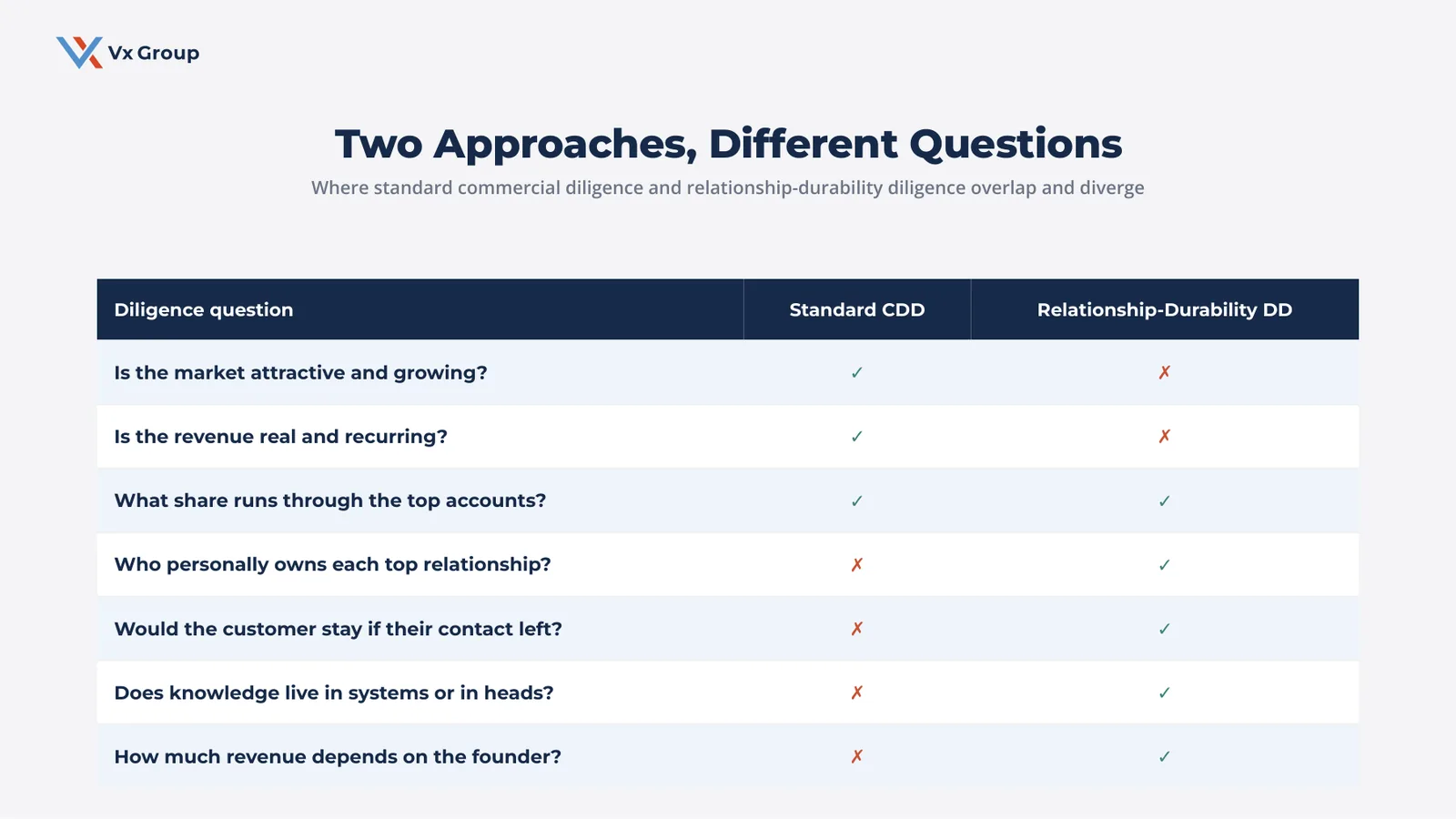
The clearest way to see the gap is side by side. Standard commercial diligence and relationship-durability diligence ask different questions about the same target.
| Dimension | Standard Commercial DD | Relationship-Durability DD |
|---|---|---|
| Core question | Is the revenue real and likely to continue? | Will the relationships behind the revenue survive a transition? |
| Concentration view | What percentage of revenue runs through the top accounts? | Who owns each top relationship, and what happens if they leave? |
| Tenure read | Long tenure signals stickiness | Long tenure may signal personal dependency rather than lock-in |
| Customer interviews | Validate satisfaction and spend | Test loyalty to the company versus loyalty to a person |
| Founder role | A transition cost to plan for | A concentration of relationship value to measure |
| Knowledge | Assumed to live in systems | Tested for whether it lives in people or in process |
| Output | Revenue quality and market thesis | Transferability of the relationships under the revenue |
Standard CDD is the stronger tool for testing the business model. Relationship-durability diligence is the stronger tool for testing whether the value you are buying comes with the company or comes with the people who might leave.
Neither replaces the other. A relationship-durability review with no commercial diligence would be naive about the market and the numbers. A commercial diligence process with no relationship-durability lens, run on a relationship-driven target, prices an asset it has not fully measured.
Ready to grow?
Pressure-test how durable a target’s customer relationships really are, before the deal closes.
What does relationship-durability diligence actually test?
Relationship-durability diligence tests whether the trust that generates revenue is owned by the company or by individuals, and whether it can transfer to new ownership intact. It turns the customer-concentration line in a CDD report into a set of human questions with financial consequences.
The work centers on a few specific tests.
It maps relationship ownership account by account. For each major customer, it identifies who holds the relationship, how deep the bench is behind that person, and how exposed the revenue is if that person leaves. A single name behind a multi-million-dollar account is a different risk than a relationship held across a team.
It separates loyalty to the company from loyalty to a person. Customer reference calls in standard CDD confirm that the customer is happy. Durability diligence probes a harder question: would the customer stay if their main contact moved to a competitor? The answers reshape the concentration picture.
It tests how much knowledge lives in systems versus heads. When pricing logic, account history, and the informal rules of a relationship exist only in one person’s memory, the company carries a hidden liability. A resignation can erase years of context overnight, and with it the ease that kept the customer renewing.
It examines the founder’s true footprint. Not the org chart role, but the share of revenue that actually depends on the founder’s personal relationships, and whether any structure exists to carry those relationships forward.
Defined term: Generational customer
A long-standing, high-value account, often built over a decade or more, that anchors a meaningful share of a company’s revenue. Generational customers are the strongest evidence of a company’s trustworthiness and frequently its largest undiagnosed concentration risk.
Field Notes: the deal that looked clean
A common pattern in lower-middle-market manufacturing deals shows how the gap plays out.
A private equity firm evaluates a precision components manufacturer. The commercial diligence is strong. The market is growing, margins are healthy, and the top accounts have purchased consistently for over fifteen years. Concentration is flagged at roughly 65 percent across the top six customers, noted as a risk, and priced in. The deal closes.
Within a year, the founder transitions out as planned. Two of the top six accounts begin testing alternative suppliers. Both relationships had run through the founder personally for two decades. The purchase orders were real. The loyalty was to a person who was no longer answering the phone.
The numbers in the diligence report were accurate. The thing they could not measure, who actually owned those fifteen-year relationships, was the thing that determined the return. A relationship-durability lens would have priced that risk before close, not discovered it after.
*(The scenario above is an illustrative composite of patterns common in lower-middle-market manufacturing acquisitions, not a single named transaction.)*
Which approach is right for your deal?
The right approach depends on where the target’s value actually lives, and most lower-middle-market B2B targets need both lenses.
Run standard commercial due diligence on every deal. It is the foundation. You need a validated market, a clear read on revenue quality, and an honest competitive assessment before anything else.
Add relationship-durability diligence when the target shows the markers of a relationship-driven business: high revenue concentration in a handful of long-tenured accounts, a founder or small group who personally hold the top relationships, a sales motion built on trust rather than transactions, and institutional knowledge that appears to live in people rather than systems.
Those markers describe most privately held and family-owned lower-middle-market B2B companies. Manufacturers, distributors, packaging firms, and specialty industrial suppliers almost always carry value that standard CDD measures incompletely.
For an investor whose thesis depends on long-term value creation, the durability of relationships often determines whether the investment performs. It deserves the same rigor as the market and revenue analysis rather than a single line near the end of a report. Measuring it before close is the difference between a risk you priced and a surprise you absorbed.
The good news is that relationships that look fragile in diligence are often fixable in the hold period. A business whose value lives in a founder’s head can be re-engineered so that relationships are documented, distributed across a team, and owned by the company. Diligence tells you where that work is needed. The hold period is where the value gets protected.
For investors building a portfolio of relationship-driven B2B companies, that protection is a repeatable discipline, not a one-time fix. The firms that treat relationship durability as a core part of both diligence and value creation tend to be the ones whose lower-middle-market deals hold up after the founder leaves.
Keep measuring what actually drives the return
A clean commercial diligence report and a durable business are not the same thing. The market can be attractive, the revenue real, and the numbers fully validated, while the relationships that produce that revenue sit in a handful of heads that may not stay. Standard commercial due diligence is built to measure the model. In relationship-driven B2B, the model is only half the asset.
Investors who add a relationship-durability lens price the other half before close. They learn who owns the relationships, how exposed the revenue is, and where the hold-period work needs to happen. That is how you turn a concentration percentage on a slide into a risk you have actually measured.
Ready to grow?
Pressure-test the durability of a relationship-driven target before you commit capital.
FAQs
About the Author: Eric Zoromski
