

AI for Manufacturing: What It Changes in Sales and Growth
AI for manufacturing is already entering the sales side of the business through CRM automation, account intelligence, and outreach personalization. It speeds up research, reporting, and follow-up. What it cannot do is run the long-cycle, relationship-heavy buying that defines the sector, and it produces almost nothing for a manufacturer whose sales process lives in one person’s head instead of a documented system.
TL;DR
- AI for manufacturing shows up in sales as three things: faster account research, automated CRM and follow-up, and personalized outreach at scale.
- It improves the mechanical work around selling. It does not replace the trust, plant visits, and multi-year relationships that actually close industrial deals.
- The first move is documenting the systems and sales knowledge the tool needs to run on, well before you buy the tool.
- A manufacturer with founder-dependent sales and no written playbook gets very little from AI, because the model has nothing reliable to learn from.
- The manufacturers who win with AI are the ones who already wrote down how they sell, then pointed AI at that foundation.
- Clean CRM data and a documented buying process are worth more than any single AI feature.
- Start with a 90-day foundation: document the process, centralize account knowledge, standardize data, then automate.
Defined Term: AI for manufacturing
The use of artificial intelligence tools, including CRM automation, generative outreach, and predictive account intelligence, to support how a manufacturer researches, reaches, and grows its customer relationships. In a sales context it augments the research and administrative work around selling; it does not conduct the relationship itself.
Most manufacturers are being sold AI backwards. A vendor demos a tool that promises to write emails, score leads, and forecast the pipeline, and the pitch lands because every leader feels the pressure to “do something with AI.” So the tool gets bought, a few reps poke at it for a month, and then it quietly dies in the tech stack. The villain here is the sequence: buying the technology before the business has anything for it to run on. Random acts of AI produce the same result random acts of marketing always have: activity, a line item, and no growth.
The manufacturers seeing real returns did the unglamorous work first. They wrote down how they actually win, put their account knowledge somewhere other than a founder’s memory, and cleaned up the data before they automated anything. That is the argument of this guide, and it is the same principle behind how the B2B growth engine works in a manufacturing company: the system comes first, and the tools multiply a system that already works.
What is AI for manufacturing, and where does it show up in sales?
AI for manufacturing, in a sales and growth context, is the set of tools that automate research, communication, and reporting so a small commercial team can cover more ground without losing the personal touch. On the plant floor, AI means predictive maintenance and quality inspection. On the commercial side, which is what this guide covers, it shows up in three specific places, and naming them makes the rest of the conversation concrete.
The three places AI enters manufacturing sales are account intelligence, CRM automation, and outreach personalization. Account intelligence pulls together everything known about a target account, including recent news, buying signals, and org structure, so a rep walks into a conversation informed. CRM automation handles the administrative tax of selling: logging activity, updating records, scheduling follow-up, and flagging deals that have gone quiet. Outreach personalization drafts tailored messages at a scale a two-person sales team could never hit by hand.
Defined Term: Account intelligence
Software that aggregates and interprets signals about a target account (news, hiring, technology changes, buying behavior) to tell a seller who to contact, why now, and what is likely on their mind. It replaces the manual research; the judgment about what to do with it stays with the seller.
None of this is exotic anymore. The same shift is playing out across the sector, which we cover more broadly in AI in sales. What matters for a manufacturer is understanding exactly which parts of the selling motion AI touches, because that determines what you need to have in place before it helps.
What can AI actually do for a manufacturer’s sales and growth?
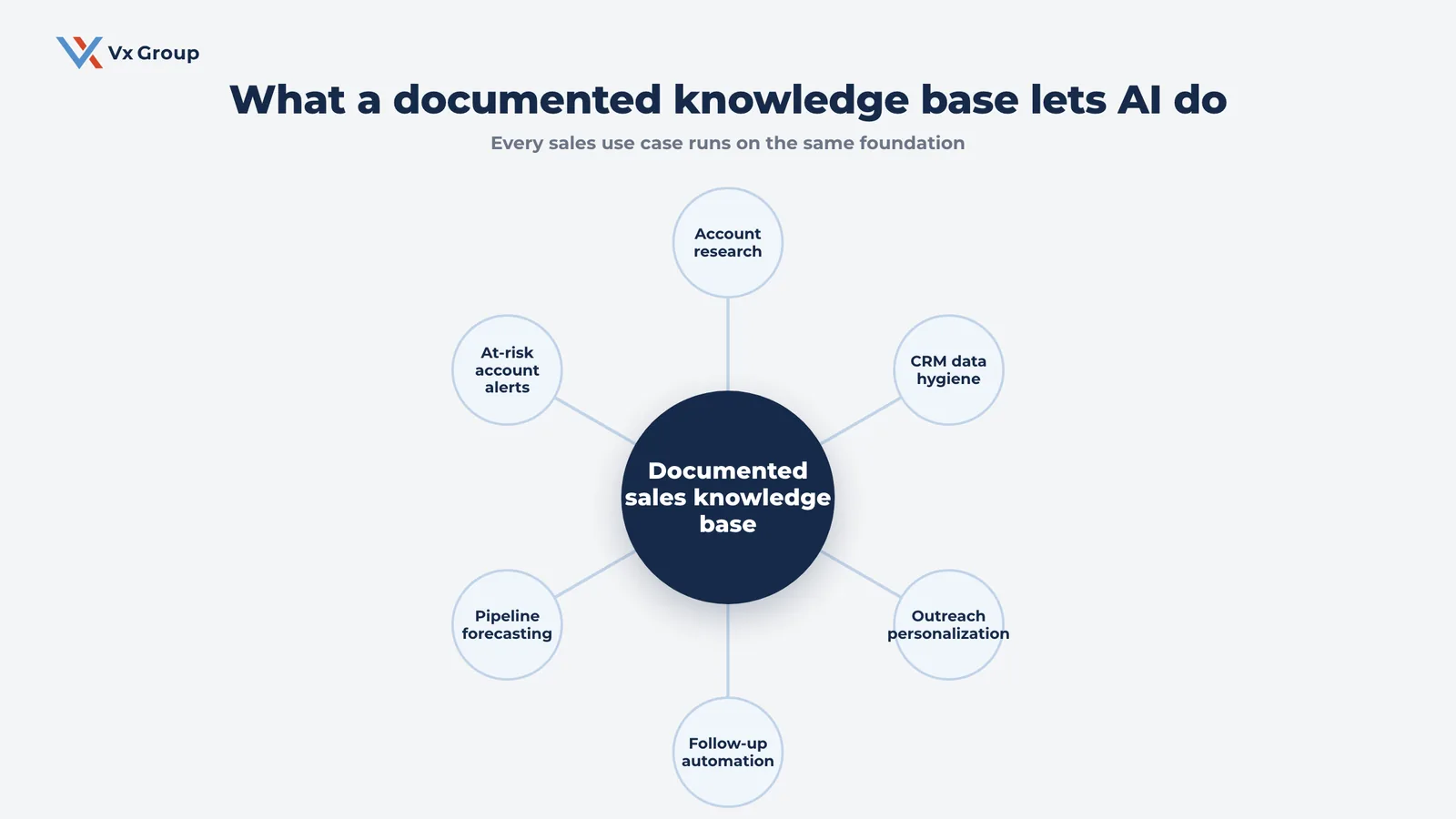
AI can compress the time your team spends on research, data entry, follow-up, and reporting, which frees your best salespeople to spend more hours in front of customers. That is the honest version of the promise. It does not sell for you. It removes the drag around selling so the human part happens more often and better prepared. Here is where it earns its place, and each of these is something you can put a rep on this quarter.
Speed up account research before every conversation
Point AI at a target account and have it produce a one-page brief: recent company news, leadership changes, likely pain points, and the last several interactions your company logged. A task that took a rep thirty minutes of digging becomes a two-minute read. The output you want is a standard brief format every rep gets before every meeting, so preparation stops depending on who is diligent that week.
Automate the CRM hygiene that reps hate
Use AI to log call notes, update deal stages, and fill in contact records from email and calendar activity. This matters for one reason: a manufacturer’s pipeline is only as trustworthy as its data, and reps under-maintain CRMs everywhere. Automating the entry means the pipeline you manage reflects reality instead of optimism. The output is a CRM that stays current without a rep spending Friday afternoon catching up.
Personalize outreach without sounding like a robot
Have AI draft first-pass outreach that references the specific account, then let a human edit and send. Done well, this is the difference between a generic blast and a message that reads like you did your homework. Done carelessly, it produces the exact spray-and-pray volume that erodes trust in a tight industrial market. The discipline that keeps it human is the same one behind consultative selling: the message has to show you understand the buyer’s problem, which AI can support but not fake.
Surface follow-up and at-risk accounts before they slip
Let the system watch for deals that have gone quiet and accounts whose engagement is dropping, then prompt a rep to act. For a manufacturer whose revenue concentrates in a handful of large, long-tenured accounts, an early warning that a key relationship is cooling is worth more than any new-logo tool. This is directly relevant to the risk we describe in why multi-generational B2B companies are more fragile than they look: concentration is a strength until the day it is a liability, and AI can help you see the liability coming.
Here is a simple way to hold the line between what AI does and what your people do:
| Sales task | What AI does | What stays human |
|---|---|---|
| Account research | Compiles the brief in minutes | Deciding what the account actually needs |
| CRM upkeep | Logs and updates records automatically | Reading what the data means for strategy |
| Outreach | Drafts personalized first passes | The relationship, the trust, the judgment |
| Forecasting | Flags at-risk and stalled deals | The conversation that saves the account |
| Reporting | Assembles the numbers on demand | Deciding what to do about them |
What can’t AI do in long-cycle industrial selling?
AI cannot build the trust that carries a twelve-month, seven-figure manufacturing deal, because that trust is built in person, over time, by people. This is the part vendors gloss over. The buying that defines this sector is high-consideration, multi-stakeholder, and relationship-heavy. A plant manager choosing a new supplier is making a decision they will live with for years, and they buy from the company they believe will still answer the phone in year three. No model closes that gap.
Specifically, AI does not walk the plant floor and notice the workaround nobody mentioned. It does not read the room when the CFO goes quiet. It does not earn the referral that opens a competitor’s largest account. It does not sit across from a family-owned distributor and understand that the real decision-maker is the founder’s son who was not on the call. These are the moments that decide industrial deals, and they remain stubbornly, valuably human. The honest framing of the whole AI question in sales is covered in will AI replace salespeople: the answer is no, and the reasons are sharpest in exactly this kind of long-cycle, relationship-driven selling.
The practical takeaway is that AI is a force multiplier on a strong commercial team, and a multiplier of zero is still zero. If the relationship engine underneath is weak, faster research and cleaner data will not create growth. They will just document the absence of it more efficiently.
Ready to grow?
See what a documented, AI-ready sales foundation would look like inside your manufacturing business.
Why does AI fail without documented systems in place first?
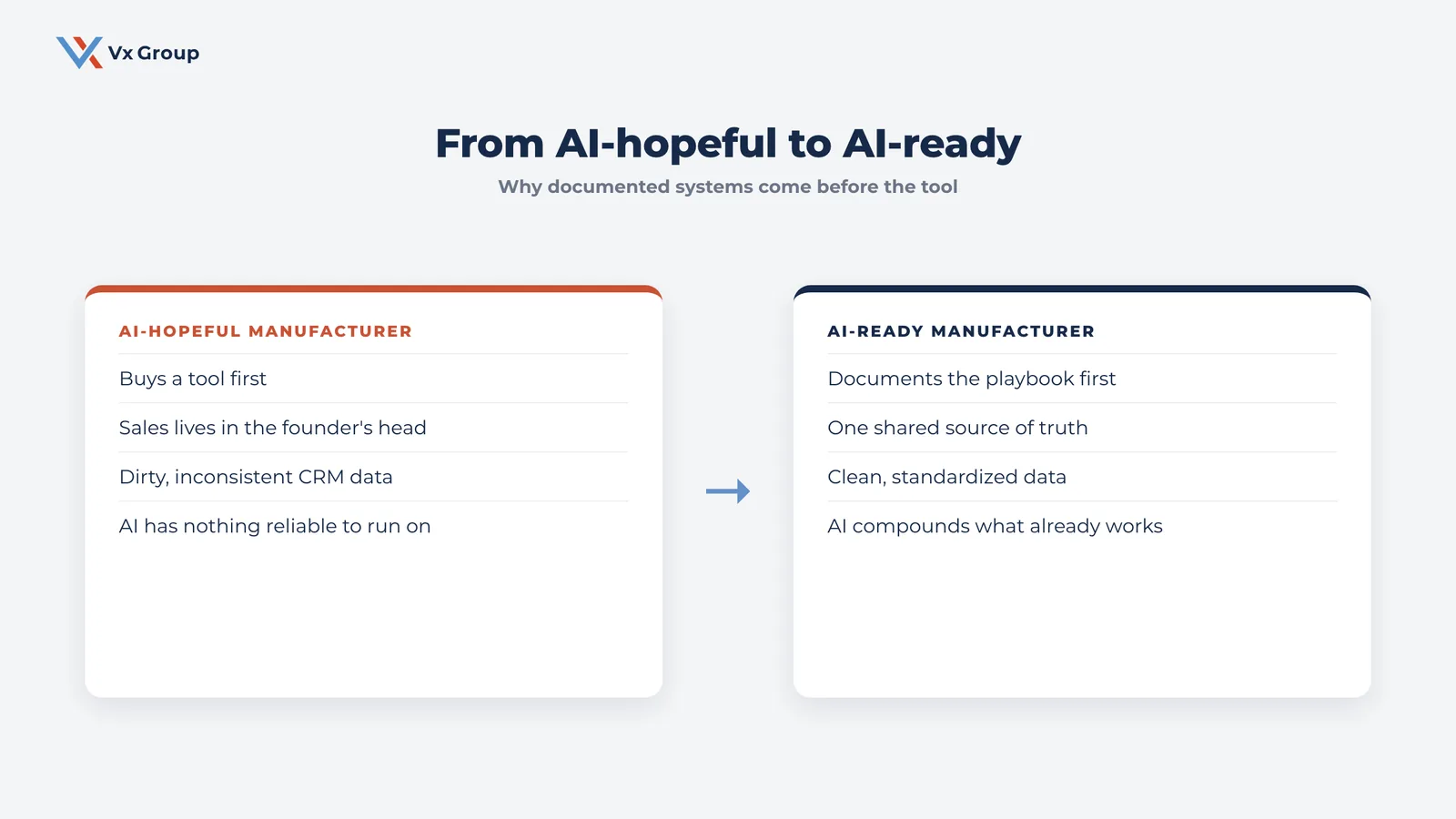
AI fails in manufacturing when the business has no documented systems because the model has nothing reliable to learn from or act on. An AI tool is only as good as the process and data you feed it. If your sales approach lives in the founder’s head, if every rep sells differently, and if the CRM is half-empty and inconsistent, then AI inherits all of that and magnifies the mess. Garbage in does not become insight out just because a model is involved.
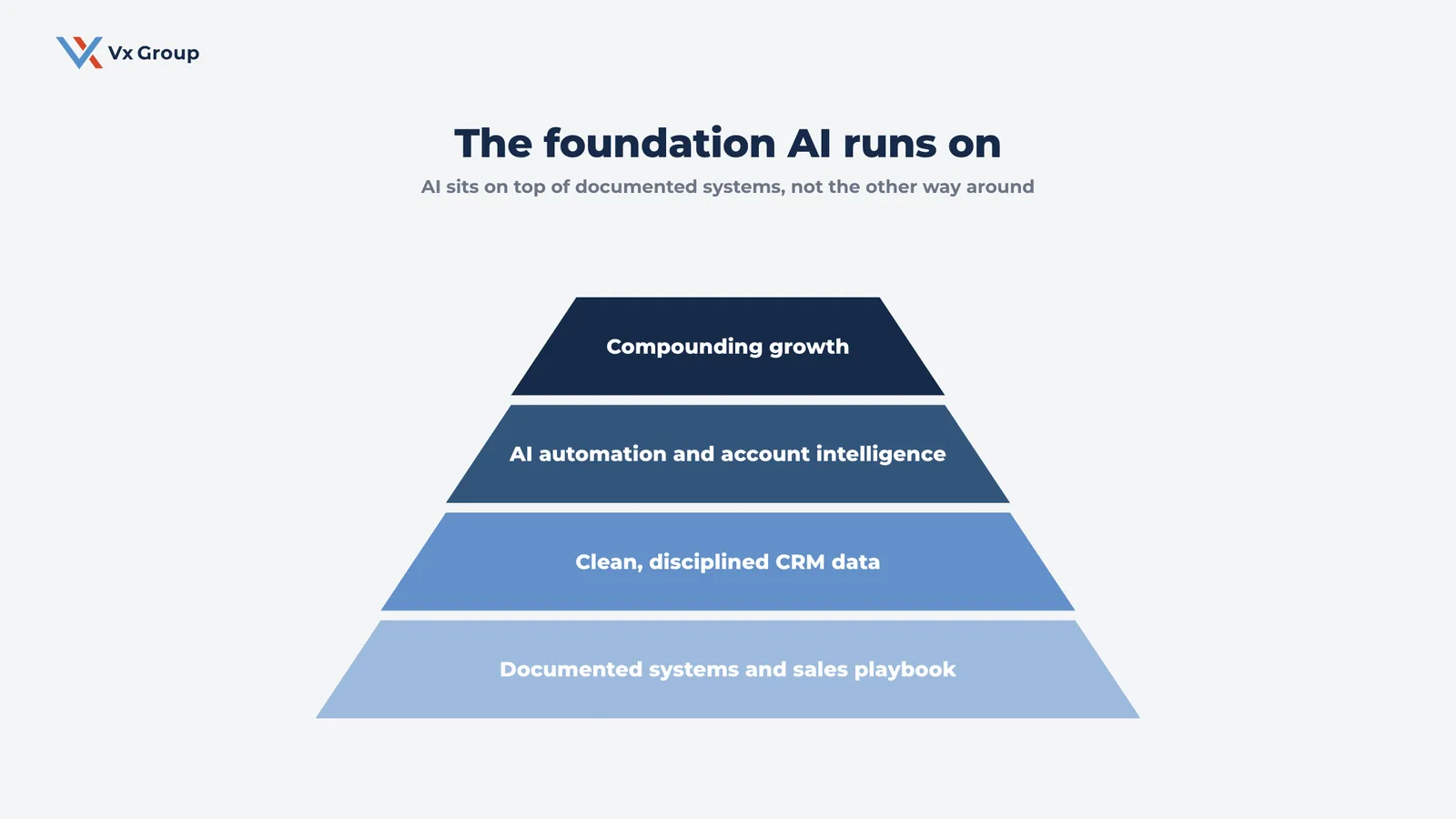
Think of it as a stack. At the base sits your documented sales system: how you qualify, how a deal moves stage to stage, what a good account looks like, and how you follow up. Above that sits clean, disciplined CRM data. Only above both of those does AI automation belong, and only then does it compound into growth. Skip the base and you are stacking automation on sand. This is why the first investment is the documentation, well ahead of any tool.
There is a second reason documentation comes first, and it is about fragility. When the knowledge of how you sell lives only in a few key people, a single resignation can erase years of relationship value overnight. Documenting the system protects the business, and it happens to be the exact same asset AI needs to function. You do the work once and get two returns: a more durable company and a foundation AI can actually run on.
Defined Term: Field Notes
A mid-sized industrial equipment manufacturer we spoke with bought an AI sales assistant after a slick demo. Six months later, adoption was near zero and leadership was frustrated. The problem was not the tool. Their entire sales process lived in the head of one veteran rep who had been there twenty-two years. There was no documented qualification standard, deal stages meant different things to different people, and the CRM was a graveyard of half-finished records. The AI had nothing consistent to work from, so its outputs were generic and its forecasts were guesses. The fix had nothing to do with software. They spent a quarter documenting how that one rep actually sold, standardized it across the team, and cleaned up the CRM. When they turned the same AI tool back on against that foundation, it finally produced briefs and forecasts the team trusted. The lesson: the AI was never the variable. The documented system was.
How do you build the documented foundation AI can run on?
You build the foundation by writing down how you sell before you automate any of it, in four concrete pieces: an account profile standard, documented deal stages, a single source of truth for relationships, and data-entry rules. Each one produces an artifact you can hand to a new rep or point an AI tool at, and together they turn selling from a personal talent into a company asset.
Write the one-page ideal account profile
Document, on a single page, what your best accounts have in common: industry, size, the problem you solve for them, the buying roles involved, and why they chose you over an alternative. This is what lets both a rep and an AI tool tell a good-fit account from a distraction. The output is a written standard rather than a gut feel, so research and targeting stop depending on tenure. If you sell through partners, the same profile discipline applies to your dealer network strategy.
Map your deal stages with real exit criteria
Write down the stages a deal moves through and the specific, observable thing that has to be true to advance each one. A stage should be defined by what the buyer did: “buyer confirmed budget and named the decision-maker” is a real stage, while “proposal sent” only records what the rep did. When stages are defined by buyer behavior instead of rep optimism, your pipeline data becomes trustworthy, and trustworthy data is the precondition for any AI forecast. The output is a documented stage map every rep and every tool reads the same way.
Build one source of truth for every key relationship
Centralize the history, contacts, commitments, and context for each major account in one place the whole team can see, rather than scattered across inboxes and memories. For a manufacturer whose value concentrates in a few generational customers, this is both risk protection and the raw material AI needs to surface at-risk accounts. The output is an account record complete enough that a new owner could take over the relationship without dropping it.
Set the data-entry standards before you automate
Define what gets logged, how, and by when, so the CRM is consistent enough for automation to build on. Decide the required fields, the naming conventions, and the rule that a deal cannot advance with empty fields. This is unglamorous and it is the step most companies skip, which is exactly why their AI underperforms. The output is a short data standard the whole team follows, so when you point AI at the CRM, it finds signal instead of noise.
Where should a manufacturer start with AI in the first 90 days?
Start with the foundation before the tool, on a 90-day timeline that documents your system first and automates last. Trying to do everything at once is how these efforts stall. Sequencing it protects the momentum and gives you something usable at each step. Here is the order that works for a manufacturer with a lean commercial team.
- Days 1 to 30: Document how you sell. Capture the ideal account profile, the deal stages with exit criteria, and how your best rep actually wins. Interview the people who hold the knowledge and write it down. This alone reduces founder dependency, whether or not you ever add AI.
- Days 31 to 60: Clean and standardize the CRM. Set the data standard, fix the worst gaps in your key accounts, and get the team entering data consistently. Do not automate a mess; fix the mess so automation has something to work with.
- Days 61 to 90: Automate one thing, well. Pick a single high-drag task, usually CRM logging or account research, and put AI on it against your now-documented foundation. Prove the value on one use case before expanding. A structured way to gauge where you stand before you begin is our 6-step AI readiness assessment.
The manufacturers who follow this order end the quarter with a documented system, cleaner data, and one working AI use case they trust. The ones who buy the tool on day one usually end the quarter explaining to the board why the AI initiative did not take. The difference is sequencing, and sequencing is a choice. It is the same discipline that separates real growth from activity across industrial B2B marketing as a whole.
Ready to grow?
We help relationship-driven manufacturers build the documented systems that make AI actually work.
Subscribe to Insights → for practical B2B growth playbooks like this one.
FAQs
About the Author: David Tisdale
