

How To Build a B2B Growth Engine in a Manufacturing Company

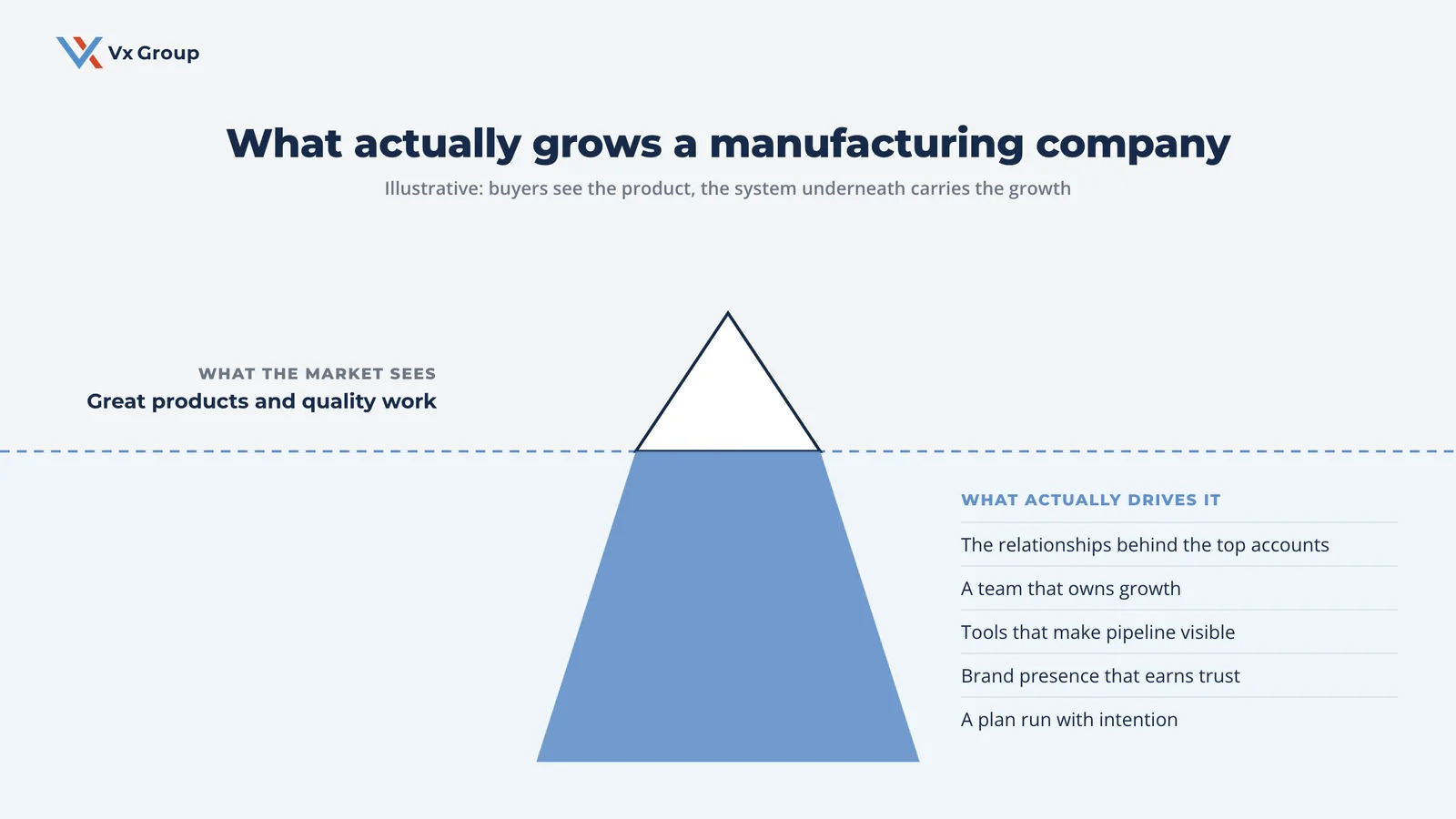
B2B marketing for manufacturers works when four areas operate together: the team that owns growth, the tools that make relationships and pipeline visible, the reach that helps new buyers find you, and the relationships that already produce most of your revenue. When those four connect, growth becomes repeatable instead of a series of disconnected campaigns.
TL;DR
- Manufacturers grow through long relationships and complex buying decisions, so the high-volume lead generation playbook built for software companies rarely fits.
- Most manufacturing revenue is concentrated in a handful of accounts and a few people’s relationships, which is both the strength of the business and its biggest risk.
- A working growth system covers four areas: team, tools, reach, and relationships.
- The most common gap is reach. Excellent manufacturers stay invisible to buyers who now research online long before they ever call.
- Protecting and expanding existing relationships usually returns revenue faster than chasing new logos.
- Trade shows are relationship events, and treating them as badge-scanning exercises wastes the budget.
- Start by making your current relationships and pipeline visible, then fix the weakest area first.
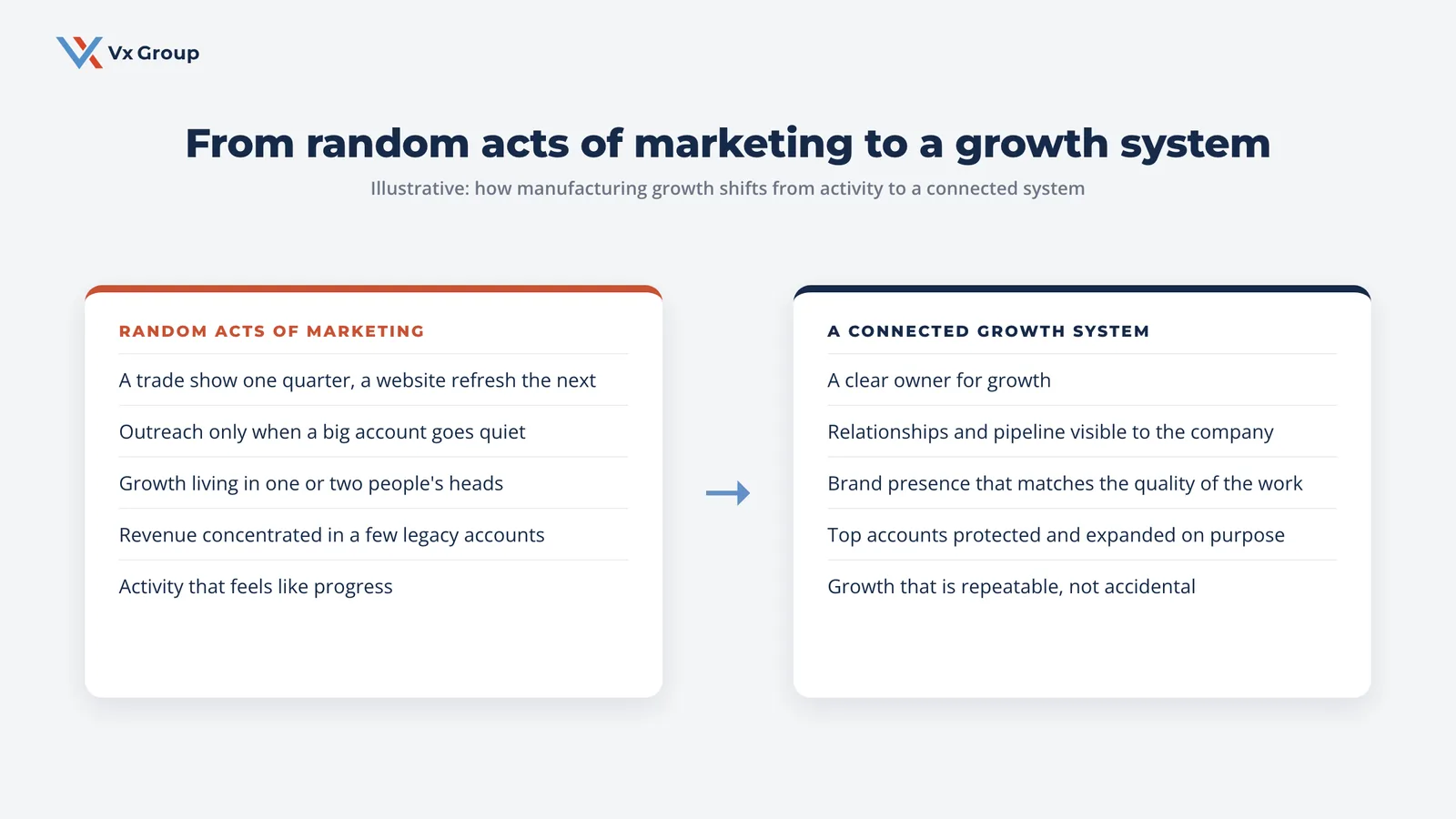
Walk into most manufacturers that feel stuck and you find the same thing: random acts of marketing. A trade show one quarter, a website refresh the next, a burst of outreach when a big account goes quiet, none of it connected to a plan. Revenue comes from relationships that took decades to build, the owner or a long-tenured sales lead carries most of those relationships personally, and a large share of profit sits with two or three accounts that have been buying since the founder ran the floor. That arrangement built the company. It also makes the company fragile, and it caps how fast the business can grow.
The work is almost never the problem. The missing piece is a system around the work, so that growth does not depend on one person’s memory, one big customer’s loyalty, or one good year at a show. B2B marketing for manufacturers becomes useful at the point it stops being a set of disconnected campaigns and becomes a system the company can run on purpose.
Why does B2B marketing work differently for manufacturers than for other industries?
B2B marketing for manufacturers works differently because the sales cycle is long, the buying decision runs through a committee, and the customer relationship often outlasts the people managing it. A purchase can take months or more than a year, and during that window a single inquiry is not a transaction waiting to close. It is the early stage of a relationship that may run for a decade or longer.
That changes what marketing is for. In a high-velocity software business, marketing fills the top of a fast funnel and volume wins. In a manufacturing or distribution company, the buyer is rarely one person clicking “buy.” Engineering wants to know it will work. Operations wants to know it will not disrupt the line. Procurement wants terms and a second source. Finance wants the number to make sense. Each of them carries a different fear about being the one who got it wrong.
Defined Term: Buying committee
The group of people inside a customer who shape a purchase decision. In manufacturing this commonly includes engineering, operations, procurement, and finance, each asking a different question and each able to slow or stop the deal.
Borrowing the software playbook for a relationship-driven manufacturer is a mistake that costs real money. The tactics that work for short cycles and self-serve products do not transfer to 12-month decisions, high switching costs, and customers who stay for twenty years. The table below shows where the two worlds part ways.
| Dimension | High-velocity software playbook | Relationship-driven manufacturer |
|---|---|---|
| Sales cycle | Days to weeks | Months to over a year |
| Who buys | One owner or a small team | A committee across engineering, operations, procurement, and finance |
| Main growth lever | Volume of new leads | Depth and expansion of existing accounts |
| What marketing does | Fills the top of a fast funnel | Builds trust and visibility across long cycles |
| Cost of switching vendors | Low | High, tied to tooling, specs, and qualification |
| Biggest risk | Customer churn | Revenue concentrated in a few long-standing accounts |
What does a growth system inside a manufacturing company actually look like?
A growth system inside a manufacturing company has four working parts: the team that owns growth, the tools that make relationships and pipeline visible, the reach that helps new buyers find and trust you, and the relationships that already produce most of your revenue. Marketing is one input across all four, not a department that operates on its own.
The reason most growth efforts stall is that companies invest in one part while ignoring the others. A new website with no one accountable for following up on inquiries produces nothing. A strong sales team with no brand presence spends its energy explaining who the company is before it can sell anything. The four parts have to connect, because each one props up the others. The sections that follow take them one at a time.
Who should own growth in a manufacturing company?
Growth needs a clear owner, and in most manufacturers it defaults to the founder or a single senior salesperson, which is the first thing worth fixing. When one person holds the customer relationships, the pricing instincts, and the pipeline in their head, the company has a ceiling set by how many hours that person has and how long they plan to stay.
Defined Term: Founder-dependent sales
A growth model where the most valuable customer relationships live with the founder or one long-tenured leader. When that person slows down, retires, or leaves, the relationships and the revenue can leave with them.
Fixing this does not mean pushing the founder out of customer relationships. It means building a function around them. That includes a defined owner for growth, a sales process that more than one person can run, and a habit of recording what is known about each account so it does not evaporate when someone retires. Sales and marketing work as one motion here, because in a long cycle the line between “marketing built trust” and “sales closed the deal” is impossible to draw. When that knowledge stays locked in one person, the business quietly becomes one of those multi-generational companies that look stable but are more fragile than they appear, and the fix starts with the team.
Name one person accountable for growth
Pick a single owner for the growth number, even if they keep selling too. Give them authority over the pipeline, the marketing budget, and the follow-up process, so growth has a desk to land on instead of living in everyone’s spare time.
Write down what lives in the founder’s head
Run a standing account debrief: after every meaningful customer conversation, the relationship owner records who was in the room, what they care about, and what happens next. Within a quarter you have a record the company can act on if anyone leaves.
What tools and systems make manufacturing growth repeatable?
The tools that matter most are the ones that take relationship knowledge out of individual heads and put it where the whole company can see and act on it. A CRM that the team actually uses, a pipeline anyone in leadership can read, a quoting process that does not depend on one estimator’s memory, and a record of who matters inside each top account. None of this is glamorous, and all of it is what separates a company that can grow without its founder from one that cannot.
Systems protect the human side of growth rather than replacing it. The fear that writing things down kills the personal relationship gets it backward. When a relationship lives entirely in one person’s head, a single resignation can dissolve years of trust overnight. A system makes the trustworthy behavior repeatable and the knowledge survivable. The same logic applies to the digital infrastructure a buyer checks before they ever call: the website, the spec sheets, the case studies, the proposal. Each of those is part of the toolset, and each one signals whether the company looks like it belongs in the room. Get the systems right and you can finally run a pipeline that does not live in one person’s head.
Make the pipeline readable in five minutes
Set up your CRM so any leader can open it and see every active opportunity, its stage, its next step, and its owner without asking a question. If reading the pipeline requires a meeting, the tool is not doing its job yet.
Audit the quote and proposal process
Time how long a quote takes and how many people it depends on. If one estimator is the bottleneck, document the inputs and templates so a second person can produce the same quality. Speed and consistency here win deals that price alone does not.
How do manufacturers get found by new buyers today?
Manufacturers get found when their brand presence matches the quality of their work, because industrial buyers research online long before they contact a sales team. By the time a buying committee reaches out, they have already formed an opinion from the website, search results, and whatever third parties say about the company. A manufacturer that has underinvested in how it shows up has already lost ground in conversations it never knew were happening.
Defined Term: Best-kept-secret problem
When a company is excellent at the work but underinvests in how it shows up, capable buyers either never find it or assume it is smaller and less serious than it is. The gap is not the product. It is the presence.
This is where the most common and most fixable gap sits. Closing it means treating brand as the first trust deposit: a current website, clear technical content that answers the questions engineers and buyers actually search, case studies that prove the work, and visibility for the terms that matter in the category. For most manufacturers that work starts with modernizing a brand that has fallen behind the business and getting deliberate about how industrial companies win new business.
Open the website as a buyer would
Look at your homepage as if you were a procurement lead who has never heard of you. If it looks dated, hides what you actually make, or buries the proof, that is the impression every silent buyer already forms. Fix it before the next campaign, not after.
Treat every trade show as a relationship plan
Trade shows belong in the reach conversation too, and they deliver the most when treated as relationship events with a plan for who to see, what to say, and how to follow up. Before the show, list the specific accounts you want to deepen and the conversations you want to have. After it, follow up within 48 hours with something useful rather than a generic thank-you. A team that walks the floor scanning badges is optimizing for volume and measuring the wrong thing. A team that arrives with that plan builds momentum competitors cannot buy.
Better than your market knows?
If your company is better than your market currently knows, Vx Group helps you close the gap between the work and how you show up.
How do manufacturers protect and grow their most valuable relationships?
The fastest revenue in most manufacturing companies comes from protecting and expanding the relationships they already have, rather than chasing new logos. The lifetime value concentrated in a company’s top ten accounts often exceeds the entire pipeline of new prospects, yet those accounts are frequently the least actively managed, because everyone assumes they are safe.
Defined Term: Generational Customer
A customer relationship that spans decades and often more than one generation of leadership on both sides. These accounts carry enormous lifetime value, and when left unmanaged they carry enormous concentration risk.
Treating the top accounts as a growth strategy means knowing who the real decision-makers are now, where the relationship is exposed, and what the account could buy that it does not yet. It also means being honest about concentration. A company with most of its margin in two or three accounts is one acquisition or one retirement away from a very bad year. Reducing that risk is a growth activity, because the same work that protects an account also surfaces room to expand it. That is the case for treating your top ten customers as a growth strategy and for tackling customer concentration risk before it forces your hand.
Build a one-page plan for each top-ten account
For each of your ten largest accounts, write down the current decision-makers, the single biggest risk to the relationship, and one realistic way to expand it this year. One page per account turns “they’re loyal” into something the company can actually manage.
Put a number on your concentration risk
Calculate what share of revenue and margin your top three accounts represent. If losing one would cause a bad year, that figure is your most urgent growth metric, and reducing it becomes a project with an owner and a deadline.
Defined Term: Field Notes
A pattern we see often in manufacturing: a profitable company doing strong eight-figure revenue, respected by the customers who know it, and nearly invisible to everyone who does not. A few accounts carry most of the margin. The owner holds those relationships personally. There is a website, but it has not been touched in years and makes a serious company look small. Nothing feels broken, which is exactly why nothing changes, until one of those accounts is acquired and the new owner puts the contract out to bid. The company was excellent at the work the entire time. It had simply never built a system around it.
How do you start building B2B marketing for a manufacturer?
Start by making your current relationships and pipeline visible, then fix the weakest of the four areas first rather than launching several campaigns at once. Growth in a manufacturing company comes from clarity before activity, and the companies that move fastest are usually the ones that spent two weeks understanding where they actually win before spending another dollar.
A practical sequence:
- Map your top accounts and be honest about how concentrated your revenue is.
- Get the key relationships out of individual heads and into a system the company can see.
- Audit how you show up to a new buyer: website, search visibility, proposals, first impressions.
- Name the single area holding growth back, whether that is the team, the tools, the reach, or the relationships.
- Build a plan for that area and run it consistently, then move to the next.
None of these steps require a campaign. They require a clear-eyed look at the business and the discipline to fix one thing well before starting the next.
A manufacturing company grows on purpose or by accident
Most manufacturers have spent decades getting the hard part right. The product works, the customers stay, and the reputation is earned. What holds the next stage of growth back is rarely the work itself. It is the absence of a system around the team, the tools, the reach, and the relationships that the company already depends on. Build that system and growth stops being a matter of luck, a good show, or one irreplaceable person.
Ready to grow?
Build a growth system that fits how manufacturers actually win, instead of another round of random acts.
FAQs
Related posts
About the Author: Jacob Camhi
