

Voice of Customer Analysis: Turn Sales Calls Into a Content Plan

Voice of customer analysis means collecting what customers and buyers say in their own words, sorting it into themes, and ranking the themes by how often they come up and how much they matter. For an owner, the best source is your recorded sales calls. AI can sort a month of them in an afternoon.
TL;DR
- Voice of customer analysis turns what buyers say into ranked themes you can act on. Your sales calls, testimonials, reviews, and emails already hold the raw material.
- AI can read call transcripts, tag every buyer question and complaint, and group the tags into themes in a few hours.
- There are five steps. Collect the calls, run the transcripts through AI, sort the lines, rank the themes, and check the top ones against keyword research.
- Buyers now ask AI assistants long questions in their own words. A page that answers a real call question in that language has a better chance of being cited.
- You end up with a ranked list of pages to publish. They use your buyers’ words and answer questions that came up in real deals.
- Relationships still come first. The analysis shows what your best customers keep asking. The page you publish saves your team from answering it a fortieth time.
What this guide covers
- What is voice of customer analysis?
- Why should an owner run it on sales calls?
- How do you collect the raw material?
- How do you run sales call transcripts through AI?
- How do you sort what buyers said into themes?
- How do you group and rank the themes?
- How do you check the top themes against keyword research?
- How do you turn the themes into a content plan?
- How do you use the same findings in sales and quoting?
- How often should you repeat the analysis?
- What mistakes do owners make?
- Where should an owner start this week?
Most content calendars start in a conference room. Someone lists topics that sound right. Someone else checks a keyword tool. The calendar fills with posts your buyers never asked about.
Meanwhile your sales team records thirty calls a month. On those calls, buyers tell you in plain words what worries them. The calls sit in a folder while the guessing goes on.
The pages that rank for this topic mostly come from customer-experience software vendors and research firms. Most of them focus on surveys and large feedback programs. This guide is for the owner of a private manufacturer or B2B firm with a sales team of one to ten people. It starts from the sales call. In our October 21 webinar, How to Make AI Buy From You, we pressed one point hardest. Your own data beats guesses about what AI wants to see. This is the method behind that point.
What is voice of customer analysis?
Voice of customer analysis is the structured study of customer feedback from calls, emails, reviews, and surveys. It finds the themes that come up most and matter most to revenue. The result is a ranked list of what buyers want to know, fear, and compare.
Defined Term: Voice of customer analysis.
The practice of gathering what customers and buyers say in their own words, tagging each statement by type, grouping the tags into themes, and ranking the themes by frequency and deal value. Teams use the ranking to decide what to fix, what to say, and what to publish.
The software vendors that dominate search results for this term describe a similar loop of collecting, analyzing, and acting. The loop works at any size. For an owner-led company, the source material and the person doing the work are different.
A large company runs surveys and buys text-analytics software. An owner already has richer material in recorded calls. Buyers speak freely when they are deciding whether to trust you.
| Source | What it holds | Where an owner finds it |
|---|---|---|
| Recorded sales calls | Buyer questions, objections, comparisons, and the exact words used | Your call recorder or video meeting tool |
| Testimonials and case notes | What a happy customer says you did well | Your files, your website, your account managers |
| Online reviews | Praise and complaints, unprompted | Google, industry directories, review sites |
| Email threads with buyers | Written questions before and after a quote | Your sales team’s inboxes, with permission |
| Support and service tickets | What breaks and what confuses people after the sale | Your service desk or shared inbox |
Start with sales calls. They hold the questions that stand between a buyer and a purchase order.
Why should an owner run voice of customer analysis on sales calls?
An owner should run voice of customer analysis on sales calls because buyers now research in full sentences. The sentences they say to you match the ones they type into an AI assistant. A page that answers a real call question in the buyer’s wording is easier for people and for AI to match.
A July 2026 Semrush survey of 519 B2B buyers who use AI at work found that 92% say AI shaped their shortlist and 83% say it shaped their final pick. Our guide to AI in procurement explains what that means for a supplier.
Two things follow for an owner.
First, buyers ask AI assistants long, specific questions, such as “Which job shop can hold a 0.002 inch tolerance on 316 stainless in eight weeks?” Your sales calls are full of questions like that. Our guide to LLM SEO explains how AI systems break a long prompt into smaller searches. Each small search can land on a page you wrote.
Second, your team answers the same questions on every call, and the answers live in a few heads. A page written from those answers lets a buyer’s AI repeat your answer accurately. It also lets a new hire learn what buyers ask. Our guide to how to rank in ChatGPT covers the test of asking AI about your company directly.
The problem here is the guessed content calendar. Topics get chosen by whoever spoke last in the planning meeting, with no tie to a real deal.
How do you collect the raw material?
Collect 20 to 30 recent recorded sales calls. Add any testimonials, reviews, and buyer emails from the same period. A set that size is large enough to show repeating themes. One person can prepare it in a morning.
Pull 20 to 30 recent calls from the last six months
Choose calls from first meetings through quote reviews, and include some from deals you lost. Lost deals show you the questions that went unanswered. If you record only some calls, take every recorded call from the period and add the notes your reps wrote for the others.
Export transcripts as plain text. Most call recorders and video meeting tools produce them. Label each file with the date, the deal stage, and whether the deal was won, lost, or still open.
Add testimonials, reviews, and buyer emails
Put every testimonial, review, and written buyer question from the same period into a second folder. These show the words customers use after the sale. Those often differ from the words prospects use before it. A customer who says “they always picked up the phone” is telling you what to publish about responsiveness.
Check privacy and recording rules before you paste anything into an AI tool
Before you load a transcript into a public AI tool, check your own policy on customer names, pricing, drawings, and contract terms. Check the recording-consent rules that apply to your calls. Replace buyer and company names with labels such as “Buyer 14, mid-size OEM.” Write the rule down so the whole team follows it.
How do you run sales call transcripts through AI?
Run the transcripts through an AI assistant one call at a time, with the same instructions each time. Ask it to return every buyer statement with a type label and a short quote. The same prompt every time keeps the output uniform enough to count.
Load one call at a time with the same instructions
Paste a single transcript per chat, and use the same prompt for every call. Mixed prompts produce mixed labels, and mixed labels make counting unreliable. Name the file at the top of your paste so you can trace each line back to a call.
Use a prompt that returns quotes and labels
Here is a prompt that works. Change the labels to fit your business:
- “Read this sales call transcript. List every statement the buyer made that is a question, a worry, a comparison, a requirement, or a compliment.”
- “For each statement, give the exact quote, a label from this list: Problem, Question, Objection, Comparison, Requirement, Praise, and one line on what the buyer seems to need.”
- “Do not summarize or rephrase the quote. Return a table with columns for quote, label, and need.”
- “If a statement could fit two labels, choose the one that describes what the buyer would do next.”
The exact-quote rule matters most. Quotes give you the buyer’s words. Those words become your page titles and headings later.
Keep a single sheet of coded lines
Paste every table into one spreadsheet with a column for the call, the deal outcome, and the deal value. Thirty calls usually produce 150 to 300 lines. A person should read through the sheet once and delete lines the AI misread. AI makes mistakes on jargon and on sarcasm, so a human pass keeps the sheet accurate.
How do you sort what buyers said into themes?
Sort the lines by label first and by theme second. The label tells you what kind of statement you have. The theme tells you what it is about. Both come from the sheet. You need only a spreadsheet and an AI assistant.
Tag each line with one label
Keep to the six labels in the prompt. A Problem is something the buyer is trying to fix. A Question is something the buyer wants answered. An Objection is a reason the buyer might say no. A Comparison names a competitor or an alternative. A Requirement states a spec or a condition. Praise is anything the buyer liked.
Filter the sheet by label and read each group on its own. The Objection group often surprises owners. The objections buyers voice are rarely the ones the team prepares for.
Name each theme in the buyer's own phrase
Ask the AI to propose a theme name for every group of similar lines, and tell it to use the buyer’s wording. “Lead time” can stay as a short tag. The working label should be something like “Can you hold the date?” That working label becomes the question you answer on the page.
Merge themes that mean the same thing
Buyers phrase one concern many ways. “How fast,” “when can I get it,” and “what about rush orders” belong in one theme. Merge themes until you have five to eight. Fewer than five usually means the labels are too broad. More than eight means the sheet needs another pass.
Ready to grow?
Bring ten of your recent call transcripts and we will help you rank the themes and pick the first three pages to publish.
How do you cluster and rank the themes?
Group the lines by theme, count them, and then weight each theme by the deal value attached to it. Frequency tells you what comes up most. Deal value tells you what costs you the most when it goes unanswered.
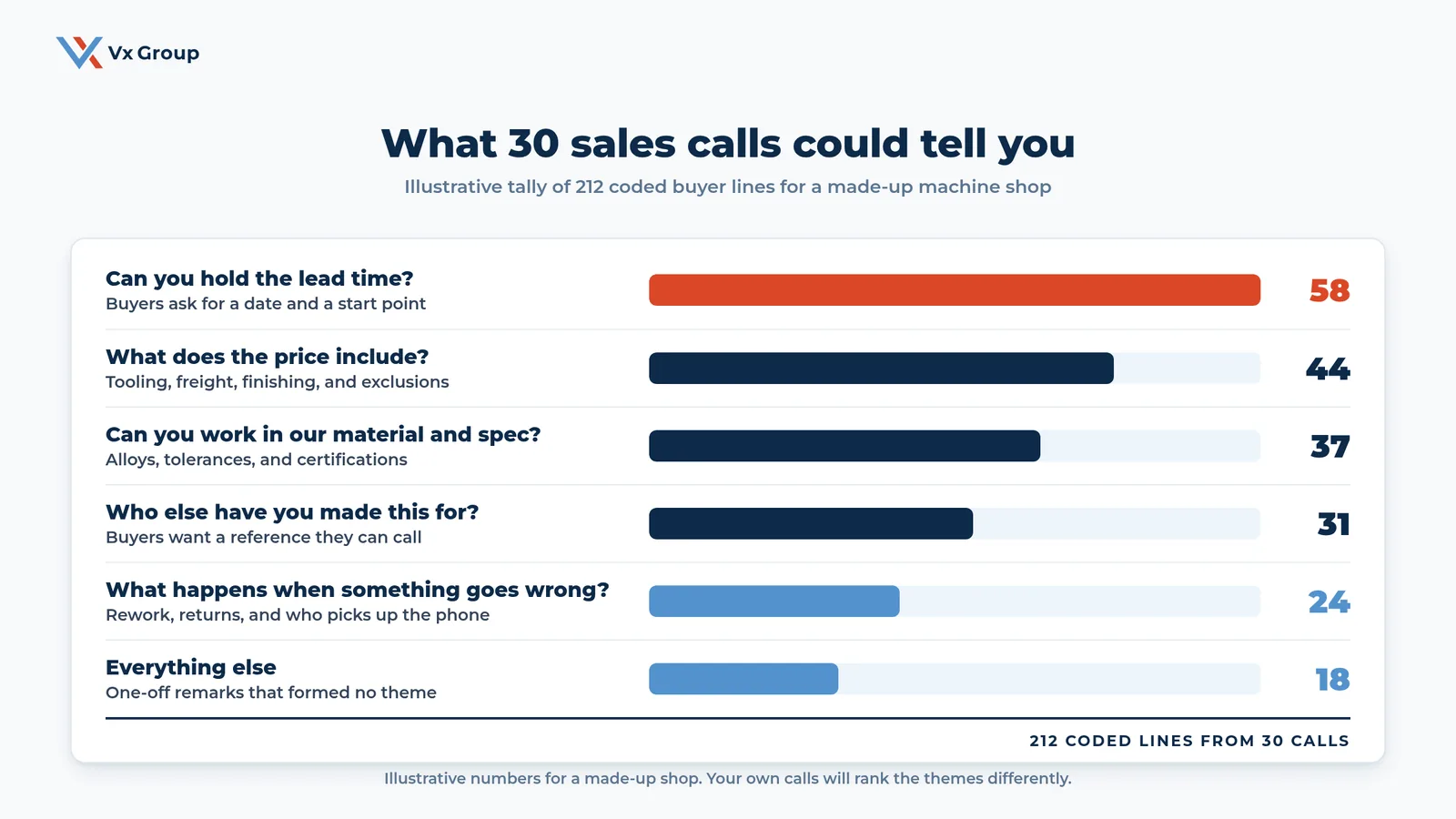
The chart shows an example tally for a made-up machine shop. Across 30 calls, the team coded 212 buyer lines. Lead time questions came first with 58 lines. Price detail had 44, and materials and specs had 37. References drew 31, problem handling drew 24, and 18 lines fit no theme.
Count the lines in each theme
Use a pivot table on the sheet, or ask the AI to count the lines per theme and return a table. Check the counts yourself against two or three themes. If the totals look off, the label column has stray spellings.
Weight each theme by the value of the deals it appeared in
Add the deal value for each call where a theme came up, and list that figure beside the count. A theme with 20 lines spread across five large quotes can outrank a theme with 40 lines on small orders. Sort by deal value first and by count second. Let the top three themes drive the plan.
Test the ranking against five people who know the customers
Show the ranked list to your head of sales, a service lead, and two account managers. Ask each of them one question: “Which of these would you bet we hear every week?” If they disagree with the order, find out why. Sometimes the sample missed a season. Sometimes the team has answered a question so often that it has stopped hearing it.
How do you check the top themes against keyword research?
Check each top theme in a keyword tool such as Semrush. See whether buyers also search for it and how crowded the results are. Use the check to set the order of your pages and to find the phrases buyers type. The calls already told you the themes matter.
A keyword tool can report a small monthly volume for a phrase that comes up in half of your sales calls. Volume figures also lag behind how people now ask AI assistants. They often use full sentences, and tools report those as little or no volume.
Search the buyer's phrase and its short form
Take the working label for each top theme and type the short version into the keyword tool, such as “machine shop lead time.” Note the monthly volume, the difficulty rating, and which kinds of pages rank. If the results are vendor glossaries or software pages, add the phrase to your page as a heading and keep your angle on your buyers.
Use volume to set the order of the pages
When two themes have similar deal value, publish the one with more search volume first. When a theme has high deal value and little or no reported volume, publish it anyway. A page that answers a question from 20 sales calls pays for itself through the deals it helps win.
Look at the questions the results already answer
Review the “People also ask” box and the related searches for each theme. Add any question that matches a line in your sheet to the page as an H2. Put the ones that match nothing in your sheet on a separate list. They may point to a theme your sample missed.
How do you turn the themes into a content plan?
Turn each top theme into one page that answers the buyer’s question in the buyer’s words. Assign an owner and a date, and link the page to the pages around it. Five to eight themes make a plan of five to eight pages. That is a quarter’s work for a small team.
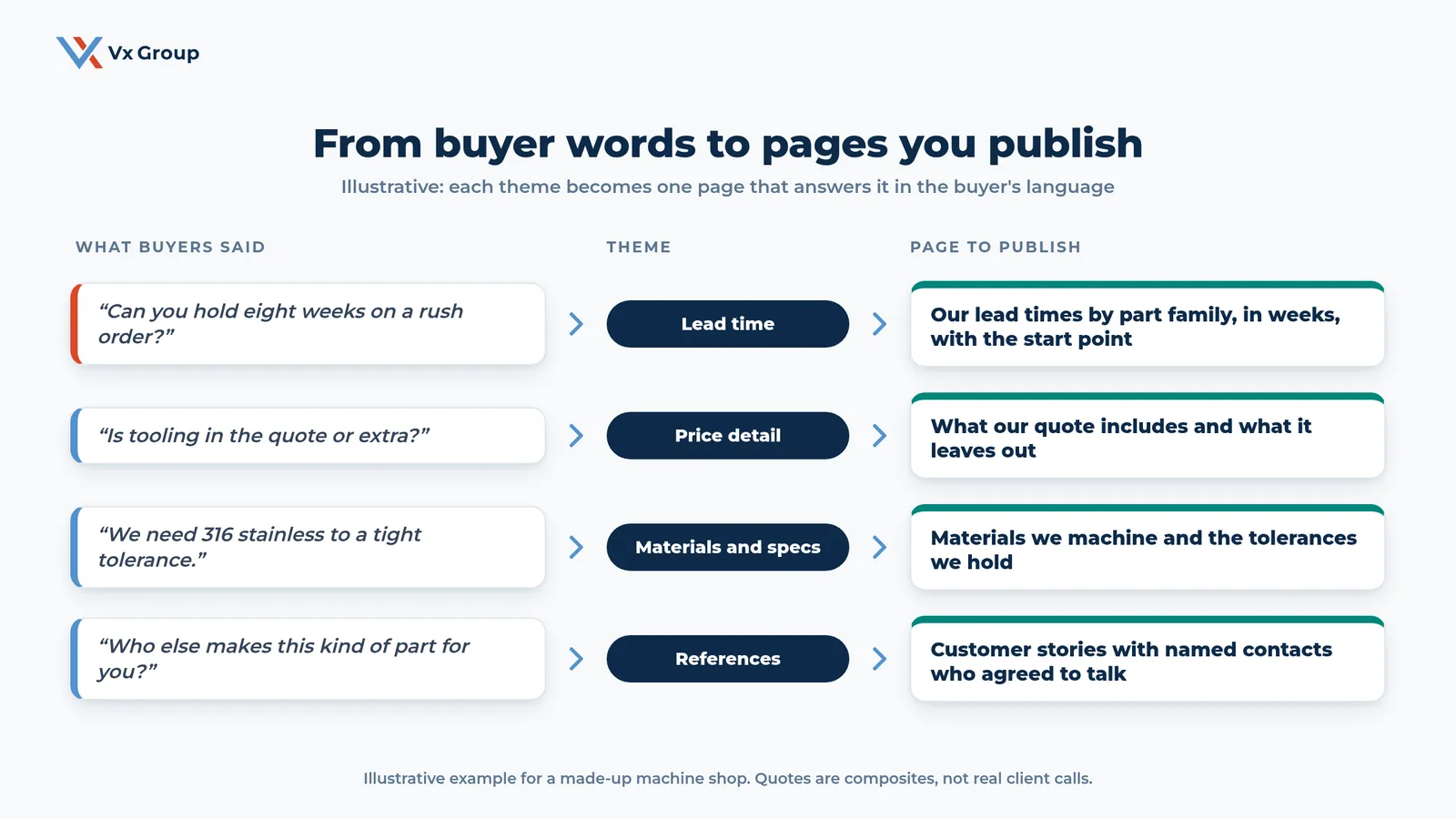
The graphic above shows four examples. “Can you hold eight weeks on a rush order?” sits in the lead time theme. It becomes a page of lead times by part family, in weeks, with the start point named. “Is tooling in the quote or extra?” sits in price detail. It becomes a page on what a quote includes and what it leaves out. The quotes are composites for a made-up shop.
Write the page title from the buyer's quote
Start with the quote, clean it up, and use it as the working title. “Can you hold eight weeks on a rush order?” becomes “Rush Orders: What We Can Ship in Eight Weeks.” A title in the buyer’s phrasing matches what the buyer types or says to an AI assistant.
Answer in the first two sentences and then show proof
Put the direct answer at the top of the page, with the number, the date, or the policy. Follow it with a table, a short example, and a named customer if you have permission. Our guide to PDF SEO explains why the facts need to sit in text and out of scanned catalogs.
Assign an owner and a publish date for each page
Give every page one owner, one reviewer, and a date. The owner is the person who answers that question best on calls, usually a rep, an engineer, or a service lead. Ask that person to read the page aloud before it goes live. If it does not sound like the call, rewrite it until it does.
Link the new pages to the pages around them
Link each new page to the guides it supports and to your contact page. If you have a page on SEO for manufacturing companies, it should send readers to the specific page for each theme. Internal links tell AI systems and search engines which pages belong together.
How do you use the same findings in sales and quoting?
Use the ranked themes to fix the places where buyers meet you first: your quote template, your follow-up email, and your first-call agenda. A theme that ranks first on calls usually points to a gap on page one of your quote.
The sample machine shop would act on three findings right away. Lead time questions came first, so every quote would name the lead time in weeks with a start point. Price detail ranked second, so the quote would list line items and exclusions. Reference requests ranked fourth, so the sales team would line up two named customers who agreed to take calls.
Our guide to supplier evaluation shows how a buyer’s AI scores a quote on those same facts. Our guide to the sales follow-up email covers how to send the summary that confirms them right after the first meeting.
The findings also help you work with the people on the buyer’s side. Our guide to the B2B buying committee maps the roles that ask different questions. Your sheet will show which roles ask which ones. Our guide to the mutual action plan shows how to carry the answers into a document the buyer can share inside their company.
Run the same coding on your long-cycle deals separately. A buyer in month nine asks different questions than a buyer in week one. Our guide to sales cycle stages names the stages to tag them by.
How often should you repeat voice of customer analysis?
Repeat the analysis every quarter with a fresh set of 20 to 30 calls. Compare the ranked list with last quarter’s. Move the themes that climbed to the top of the plan, and retire the pages whose themes faded.
| How often | What to do | Time it takes |
|---|---|---|
| Every quarter | Pull 20 to 30 new calls, code them, and rank the themes | One to two days for one person |
| After each new page goes live | Ask the team whether the question still comes up on calls | A ten-minute check at the weekly sales meeting |
| Once a year | Re-read the reviews and testimonials and add new themes | Half a day |
| After a product, price, or policy change | Re-check the pages that touch the change | An hour per page |
Comparing quarters shows you whether the method works. When a theme drops after you publish its page, the page is probably working. If the theme holds its rank, sharpen the answer at the top of the page.
Keep every quarter’s sheet. In a year you will have four ranked lists that show how your buyers’ concerns shift. That helps with pricing, hiring, and product decisions beyond the website.
What mistakes do owners make in voice of customer analysis?
Most mistakes come from small samples, vague labels, and skipping the human check. These seven appear most often:
- Using five calls. Five calls give you anecdotes. Repeating themes start to show at around twenty to thirty.
- Letting the AI rename the quotes. A paraphrase loses the buyer’s words, and those words are what you want.
- Skipping the lost deals. Lost deals hold the unanswered questions.
- Counting lines and ignoring deal value. A theme on small orders can outrank a theme on your biggest quotes.
- Treating zero search volume as a verdict. A question from 20 calls deserves a page whatever the keyword tool says.
- Pasting customer data into a public tool without a rule. Set the policy first and strip names.
- Publishing the findings and never re-running them. Buyer concerns shift. A quarterly pass keeps the plan current.
Each mistake has a one-line fix. Each fix is a habit you can build into your week.
Where should an owner start this week?
Pull ten recorded calls from the last quarter, including two you lost, and export the transcripts. Run each one through an AI assistant with the prompt in this guide. Paste the results into one sheet. The first pass will take an afternoon, and it will show you the three questions your buyers ask most.
Then write one page. Pick the top theme, use the buyer’s quote as the working title, and answer it in the first two sentences. Ask the rep who handles that question best to read it aloud.
Your sales calls already told you what to write. In a first conversation, we usually help an owner see which of those questions carry the most revenue. Then the plan starts with the page that matters most.
Ready to grow?
Bring a few transcripts and we will help you find the themes and sequence the first pages.
FAQs
About the Author: Jacob Camhi

Table of Contents
- What this guide covers
- What is voice of customer analysis?
- Why should an owner run voice of customer analysis on sales calls?
- How do you collect the raw material?
- How do you run sales call transcripts through AI?
- How do you sort what buyers said into themes?
- How do you cluster and rank the themes?
- How do you check the top themes against keyword research?
- How do you turn the themes into a content plan?
- How do you use the same findings in sales and quoting?
- How often should you repeat voice of customer analysis?
- What mistakes do owners make in voice of customer analysis?
- Where should an owner start this week?
- FAQs