

Distributor vs Wholesaler for B2B Manufacturers
A distributor buys your product, stocks it, and sells it to business customers with technical support attached. A wholesaler buys in volume and resells it with little product help. A manufacturer with a technical product that needs application support almost always does better with a distributor. A manufacturer with a simple, high-volume product can do well with a wholesaler.
TL;DR
- Distributors carry a defined set of lines, know the product, and help the customer choose and use it. Wholesalers move volume and add little product advocacy.
- If your buyer needs specs, samples, or application help, pick a distributor. If your product ships as ordered in large lots, a wholesaler is a fair choice.
- Many resellers act as both. Judge them by what they do with your line, because the name on the door tells you little.
- Ask who sells your line, what they stock, and who owns the customer before you sign anything.
- Many manufacturers run both: distributors for technical accounts and a wholesaler for volume and reach.
Many owners hear the two words used as if they mean the same thing. A rep from a large reseller calls the company a distributor, and the first contract says wholesale. Six months later, the owner finds out nobody at the reseller can explain the product to a customer.
That gap costs real money. A reseller that only moves boxes will sell your product when the buyer already knows what to order. It will sell a competitor’s product just as happily when a customer asks for advice. One type gives you a local sales team. The other gives you shelf space and a truck.
This article compares the two for manufacturers of $5 million to $50 million in revenue. It covers what each one does, how the money works, who owns the customer, and how to choose. It also covers the middle ground, since many resellers sit in between.
What is the difference between a distributor and a wholesaler?
A distributor has an ongoing relationship with a manufacturer, carries a limited set of lines, and sells to business customers with stock, service, and often credit. A wholesaler buys goods in bulk and resells them to retailers or other resellers, usually with less attention to any single product line.
The practical difference shows up in the people. A distributor employs salespeople who learn your line, visit customers, and answer technical questions. A wholesaler employs buyers and order takers who keep shelves full and trucks moving.
Defined Term: Distributor.
A reseller that buys from a manufacturer under an ongoing agreement, holds stock, and actively sells and supports a defined set of product lines to business customers.
Defined Term: Wholesaler.
A reseller that buys goods in volume and resells them, often to retailers or other resellers, with little product advocacy and a wide range of lines.
Our guide to what a distributor is covers how a distributor makes money and where dealers and reps fit. This article starts one step later, with the choice between the two types.
How do a distributor and a wholesaler compare side by side?
The table below compares the seven points that matter most when you sell a technical product. Each row names the question an owner should ask a reseller.
| Question | Distributor | Wholesaler |
|---|---|---|
| Who takes title to the goods? | The distributor buys and owns the stock | The wholesaler buys and owns the stock |
| Who holds inventory? | Usually a focused range of your parts | A wide range, often many brands |
| Who gives technical support? | Distributor staff, often with your training | Rarely offered |
| Whose salespeople push your product? | Named people assigned to your line | Few or none |
| What margin do they expect? | Usually higher, to pay for selling and support | Usually lower, for volume |
| How common is exclusivity? | Common by territory or segment | Rare |
| Who owns the end-customer relationship? | Shared, and you can negotiate access | Mostly the wholesaler, with little visibility to you |
Margin figures vary widely by industry, so ask your own sales team and two or three resellers what they expect before you set a price. Our post on distributor pricing strategy walks through how to protect your margin while you pay for the support you need.
What does a distributor do well?
A distributor does well where buyers need help. It sells a product the customer cannot choose from a catalog page alone.
Three strengths stand out.
Look for product knowledge in the field
Distributor salespeople visit plants, review drawings, and recommend the right part. A customer with a failing seal or a new line layout calls the distributor first. If the distributor knows your product, you are the answer. If it does not, a competitor is.
Count on stock close to the customer
A regional distributor keeps your fast-moving parts on the shelf nearby. A plant that goes down at 2 p.m. can have the part by morning. That service keeps the customer loyal to the distributor, and through the distributor, to you.
Use the distributor as your local sales team
A distributor with ten outside salespeople gives you ten people who know the local accounts. You cannot hire that coverage for the margin you give up. Our guide to how to build a distribution strategy shows how to decide how many of these partners you need.
The cost is control. A distributor sells several brands, and its loyalty goes to whoever makes it the most money and gives it the best support. You earn attention by making your line easy to sell and rewarding to carry. Our post on managing a distributor network explains how.
What does a wholesaler do well?
A wholesaler does well where the product is simple and the order is large. It gives you reach and cash flow without the cost of building a sales relationship in each market.
Be fair to this option. It fits many products.
Use a wholesaler for reach into many small buyers
A wholesaler with a warehouse network serves thousands of retailers and small resellers you could never call yourself. If your product sells by catalog number and the customer knows what they want, that reach has real value.
Count on volume and steady cash
Wholesalers buy in large lots and pay on terms. For a plant with fixed costs and open capacity, a large recurring order from a wholesaler can stabilize the schedule. That matters when a good month can follow a slow one.
Accept the limits on visibility
A wholesaler sells to its own customers and often keeps their names to itself. You may see monthly totals and little else. You will know how many units moved, and you will not know who bought them or why. For a commodity item that is fine. For a product that depends on relationships, it is a real loss.
Defined Term: Two-tier distribution.
A channel where the manufacturer sells to a wholesaler or master distributor, who then sells to smaller distributors or dealers, who sell to the end customer.
Two-tier distribution adds reach and removes visibility. Each tier takes a margin, and each tier sits further from the people who use your product.
Which is right for you: a distributor or a wholesaler?
Choose a distributor when your customers need help to buy or use the product. Choose a wholesaler when the product sells as ordered and volume matters more than advocacy.
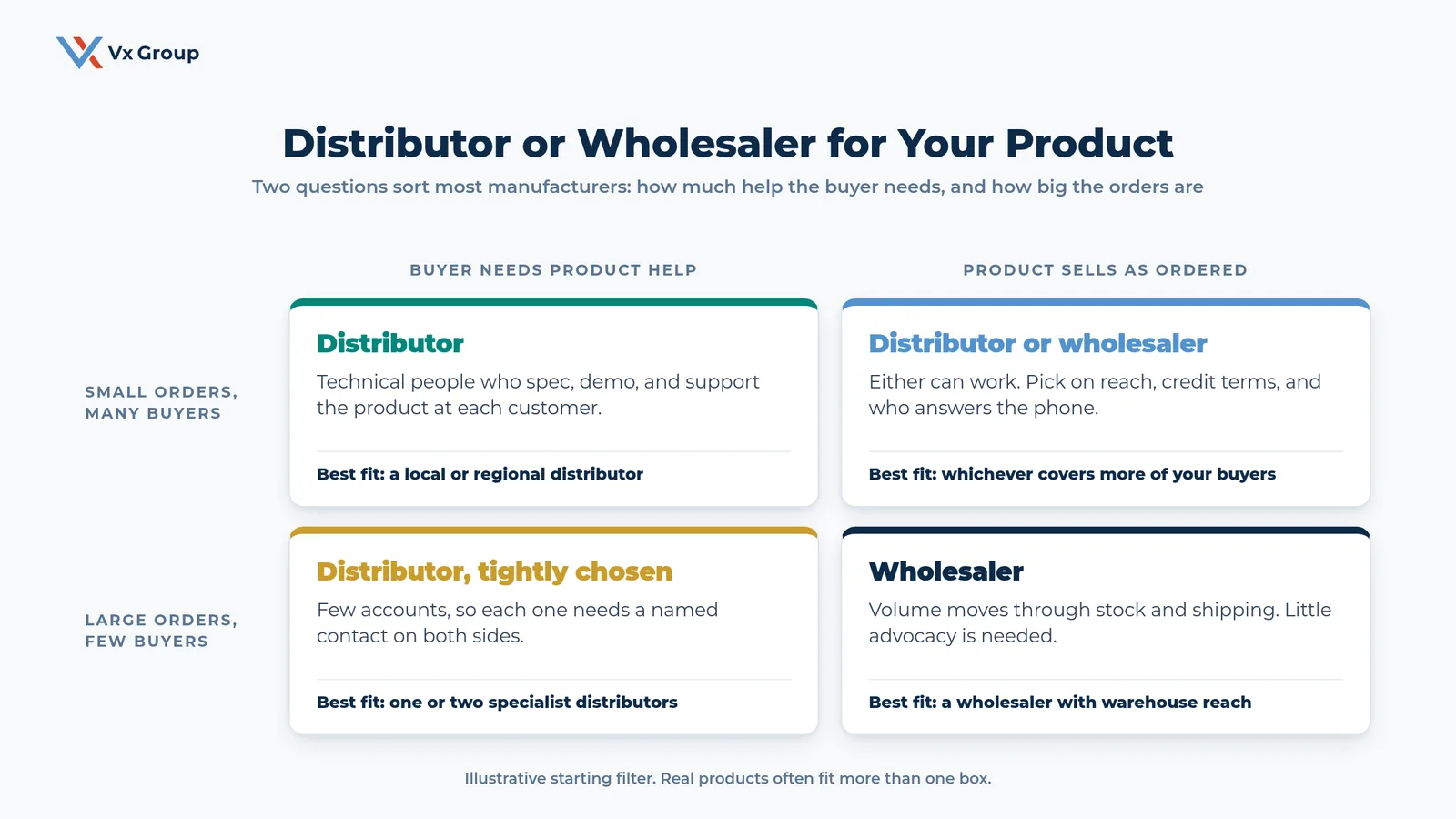
The chart sorts the choice by two questions. Buyers who need product help point to a distributor, whether orders are small or large. Buyers who need none and order in large lots point to a wholesaler. Small orders from many buyers with no help needed could go either way, so decide on reach, credit terms, and who answers the phone.
Use these three tests to place your own product.
Test the product's complexity
Ask how often a customer calls with a question before ordering. If most orders come with a drawing, a spec, or a trial, you need a distributor. If most orders come as a part number on a purchase order, a wholesaler can handle them.
Test the order size and frequency
Large, steady orders suit a wholesaler’s buying model. Small, frequent orders from many plants suit a distributor with local trucks and stock. Look at your last twelve months of orders and sort them by size.
Test how much support the customer needs after the sale
Ask who will answer when the product fails, wears out, or needs a different setup. If the answer is “someone who knows it,” you need a distributor. Our post on product distribution covers how to match channels to the way your customers buy.
Ready to grow?
Get a second opinion on which reseller type fits your product and your customers.
How do you tell a real distributor from a wholesaler that uses the name?
Judge a reseller by what it does with your line. Many companies use the word distributor and behave like wholesalers, and some wholesalers support products the way a distributor would.
Run these checks before you sign.
Check for named salespeople on your line
Ask for the names of the people who will carry your product. A real distributor can name them, show where they work, and tell you how many customers each one visits. A reseller that cannot name anyone has no sales team behind the logo.
Check the shelf
Ask which of your part numbers they stock and how many weeks of cover they carry. Then visit the warehouse. Stock on the shelf shows commitment better than a signed letter.
Check who answers the technical call
Call the reseller as a customer and ask a technical question about a similar product. Time how long it takes to reach someone who can answer. Our post on how to find distributors gives a longer list of places to search and ways to vet each candidate.
What questions should you ask a reseller before you sign?
Ask six questions before you sign a reseller of either type. The answers show how the reseller will treat your line and your customers.
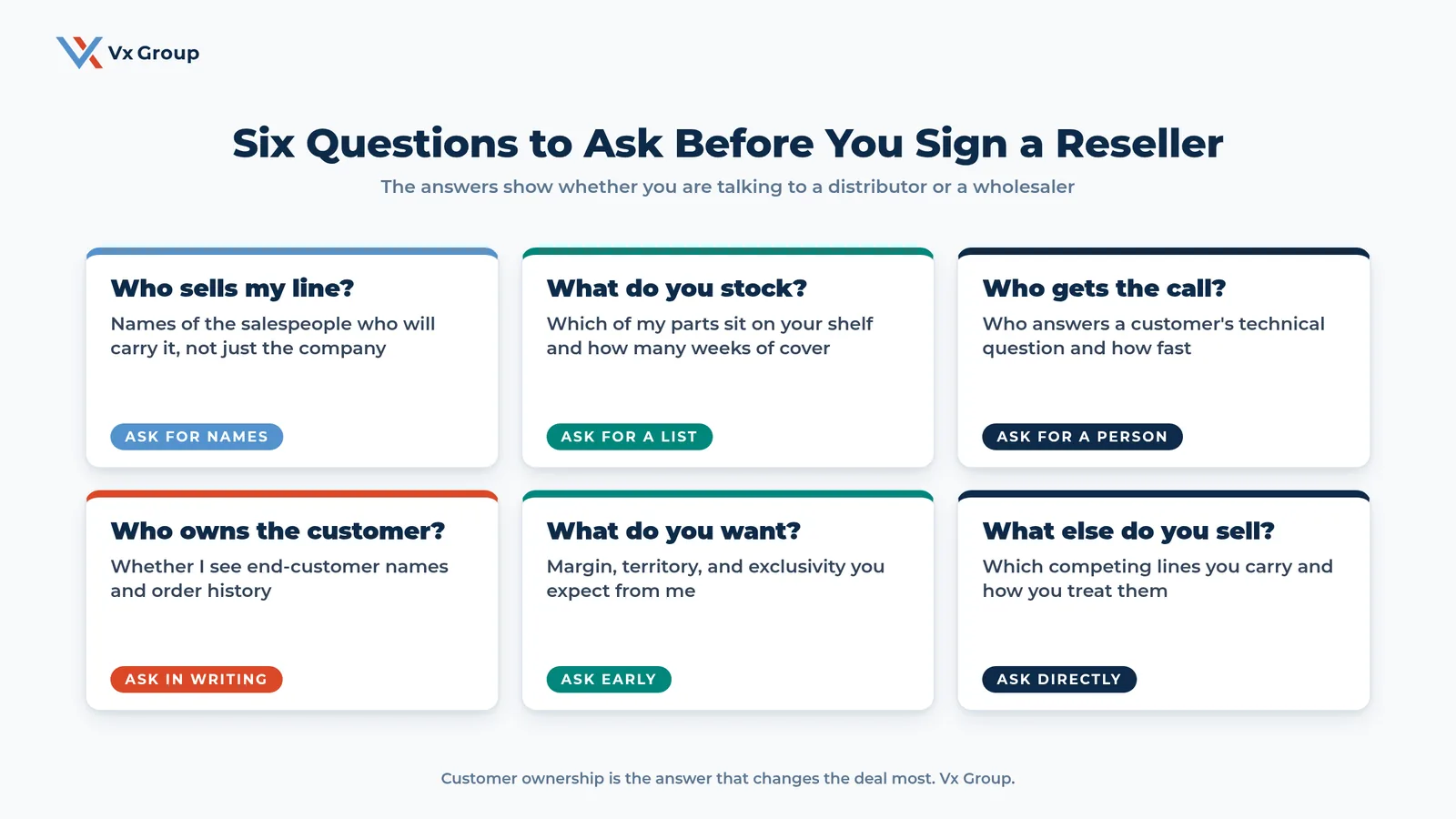
The cards cover who sells your line, what they stock, who handles technical calls, who owns the customer, what they expect from you, and what else they sell. The fourth question changes the deal most. Ask for end-customer names and order history in writing, and get the answer before you agree to price or territory.
Write down what each reseller says. Compare the answers across two or three candidates. A reseller that answers quickly and in detail has usually done this before. One that avoids the customer question probably plans to keep the customer.
How do margin and price differ between the two?
A distributor usually expects a higher margin than a wholesaler because it pays for salespeople, stock, and support. A wholesaler works on thinner margins and makes it up in volume.
The right number depends on your product and market, so avoid copying a figure from an article. Ask three questions of any reseller before you set a price list.
- What does the reseller spend to sell and support one order of my product?
- Which of those costs would I carry myself if I sold direct?
- What share of the price is left for me after margin, freight, and returns?
A higher distributor margin can still leave you with more profit if the distributor opens accounts you could not reach and keeps them. A low wholesaler margin can look attractive and still drain profit if price pressure spreads to your other channels. Keep one rule: the reseller’s margin should pay for work you would otherwise do yourself.
Who owns the customer relationship?
The reseller owns the daily relationship in both models. You own the relationship only to the extent the agreement lets you. This is the most important point in the choice, and many owners settle it too late.
Distributors usually share customer information when the relationship is strong and the agreement says so. Wholesalers sell to their own customers and often keep the names to themselves.
Settle four points in writing before the first order:
- Whether you can see end-customer names and order history.
- Whether you can call on key accounts jointly with the reseller.
- What happens to the customer if the agreement ends.
- How the reseller handles complaints and warranty claims.
Our post on what belongs in a distributor agreement gives the full list of terms to settle. When two resellers both want the same account, channel conflict follows quickly, so set the rules before a dispute starts.
Can you use both a distributor and a wholesaler?
Yes. Many manufacturers use both. Distributors handle technical accounts and local service. A wholesaler handles volume and reaches buyers who do not need help.
The arrangement works when each partner has a clear lane. It breaks when the same customer can buy from both at different prices.
Draw the lines by product, account, or region
Assign by product line, by customer type, or by territory. For example, give the distributor your engineered products and give the wholesaler your standard catalog items. Put the rule in each agreement.
Hold one price list for all channels
Publish one price structure and one set of discount tiers. If the wholesaler sells below the distributor’s cost, the distributor stops supporting your line and starts pushing someone else’s. Our post on dealer network strategy covers how to keep a mixed channel in balance.
Review the split every year
Markets change. A wholesaler that began as a volume partner may add technical staff. A distributor may drop a line or merge. Set a yearly review with each partner and check sales, stock levels, and customer feedback.
What does the choice look like for a real manufacturer?
Here is an illustrative example, not a client story. A manufacturer of engineered hydraulic fittings sells to maintenance buyers at about 400 plants. Each order starts with a drawing or a failed part, and about half need a recommendation before purchase.
The owner talks to two resellers. The first is a regional wholesaler with three warehouses and no outside salespeople. The second is a distributor with six outside salespeople who already call on the same maintenance buyers.
The wholesaler offers a lower margin and a larger first order. The distributor asks for a higher margin and a smaller first order, and it names the two salespeople who will carry the line.
The owner picks the distributor for the engineered line. She keeps the wholesaler in mind for her standard catalog fittings, which ship by part number and need no advice. She sets one price list for both and writes a customer-data clause into the distributor agreement.
The same owner might have chosen the wholesaler for everything and taken the bigger first order. Within a year she would have seen volume on the report and no change in how many plants knew her brand. The choice depends on what her buyers need, and her order data showed it.
Use the same method on your own line. List your products, mark which ones need help to sell, and match each group to a reseller type.
How do you run a trial with a new reseller?
Run a trial in one region for six to twelve months before you commit to a wider agreement. A trial shows how the reseller treats your line when real orders arrive.
Set targets you can check each quarter
Agree on three numbers before the start: units or dollars sold, number of active accounts, and stock on the shelf. Keep the list short so both sides can track it.
Train the reseller's people early
Hold a product session for the reseller’s salespeople in the first month, with samples and a one-page guide to your line. A distributor’s team sells what it understands. A wholesaler’s buyers order what they can find in the system, so give them clean part numbers and data.
Meet each quarter and decide what comes next
Review the numbers, the customer feedback, and any disputes. Extend, adjust, or end the trial based on what happened. Our guide to managing a distributor network covers how to run those reviews.
What mistakes do manufacturers make when choosing between the two?
Four mistakes show up most often.
- Choosing on the name. The reseller calls itself a distributor, so the manufacturer assumes it sells and supports. Verify the sales team and stock before you sign.
- Choosing on margin alone. The cheapest reseller costs the most when it never calls a customer.
- Skipping the customer-data clause. The first order ships, the second order ships, and a year later the manufacturer cannot name one end customer.
- Signing exclusivity too early. An exclusive territory can lock you to a partner that underperforms. Tie exclusivity to targets and a review date.
A fifth mistake sits underneath the rest. Many owners decide on price and leave relationship questions for later. Our work with owner-led manufacturers shows that the reseller you choose becomes your sales team in that market, so choose it like a hire.
Where should you start?
Start with your own orders. Pull the last twelve months and sort them by customer, order size, and the number of calls each one needed before purchase. The pattern will show whether your product needs a distributor, a wholesaler, or a mix.
Then take these steps over the next month:
- Write a one-page profile of your best customer and what they need from a reseller.
- List three to five candidates and score each on the six questions.
- Visit the warehouse and meet the salespeople for your top two.
- Draft the customer-data and territory terms before you talk price.
- Start with a trial period and a review date for one region.
Ready to grow?
Bring your order data and we will help you decide which reseller type fits and how to structure the first agreement.
Our guide to channel marketing for manufacturers and distributors shows how to support whichever partners you choose.
FAQs
About the Author: David Tisdale
