

Market Development Funds: How to Spend Co-Op Money That Actually Sells

Market development funds (MDF) are money a manufacturer sets aside to help distributors, dealers, and reps market its products. The manufacturer usually approves each request. It pays upfront or after the activity. Co-op funds work differently. The partner earns them as a percentage of its purchases. The partner gets paid back after it shows proof of spend.
TL;DR
- MDF is money you approve request by request. Co-op funds build up from partner purchases and get paid back after the spend.
- MDF gets wasted when the budget expires in December and no request has to name a customer.
- A request is worth approving when it has four fields: named accounts, the activity, expected qualified conversations, and a follow-up owner.
- Count the conversations MDF produced with the accounts you named. Then count the orders those accounts placed in the next two quarters.
- A partner who cannot name the customers an event is for has not planned the event yet.
Many channel programs repeat the same thing every December. The MDF budget is about to expire, and partners know it. The requests that arrive are for booth space at a regional show, a box of branded jackets, and a sponsorship at the dealer golf outing. Your regional rep approves them because saying no feels like insulting a partner who has sold your product for fifteen years.
The money gets spent and the relationship stays where it was. Nobody can say which customer was reached, which conversation started, or which order followed. For an owner-led manufacturer, the MDF line is one of the few marketing budgets you can redirect with a single decision. That makes it the cheapest place in the channel to fix.
This guide covers what MDF is and how it differs from co-op. It covers how to set eligibility and what the money should and should never buy. It also covers how to approve a request so it gets better, and how to measure the return.
What are market development funds?
Market development funds are a pool of money a manufacturer sets aside to help channel partners market its products in their territory. The manufacturer decides how large the pool is. It also decides which partners can draw on it and which activities count as approved uses.
The idea is simple. Your distributor knows the local buyers and you do not. You pay part of the cost of reaching those buyers, and the distributor does the reaching. Typical approved uses include customer events, trade show participation, local advertising, training sessions for the partner’s sales staff, product demonstrations, and targeted outreach campaigns.
The guides that rank for this term come mostly from channel-software vendors. They describe the same steps: set the budget, receive a proposal, approve it, run the activity, then pay back or reconcile. Those steps are sound. The guides skip the question that decides whether the money works: which named customers is this spend meant to reach?
Defined Term: Market development funds (MDF).
A budget a manufacturer gives to channel partners such as distributors, dealers, and reps. It pays for marketing and sales activity that grows demand for the manufacturer’s products. MDF is usually discretionary, approved per request, and tied to a program or partner tier.
Industrial manufacturers have used this for decades under other names: marketing allowances, channel marketing funds, partner marketing dollars. The label matters less than how the money works. Read your own program documents before you assume your partners and you mean the same thing.
Our guide to channel partner marketing covers the wider program that MDF sits inside. This article looks closely at the money itself.
How do MDF and co-op funds differ?
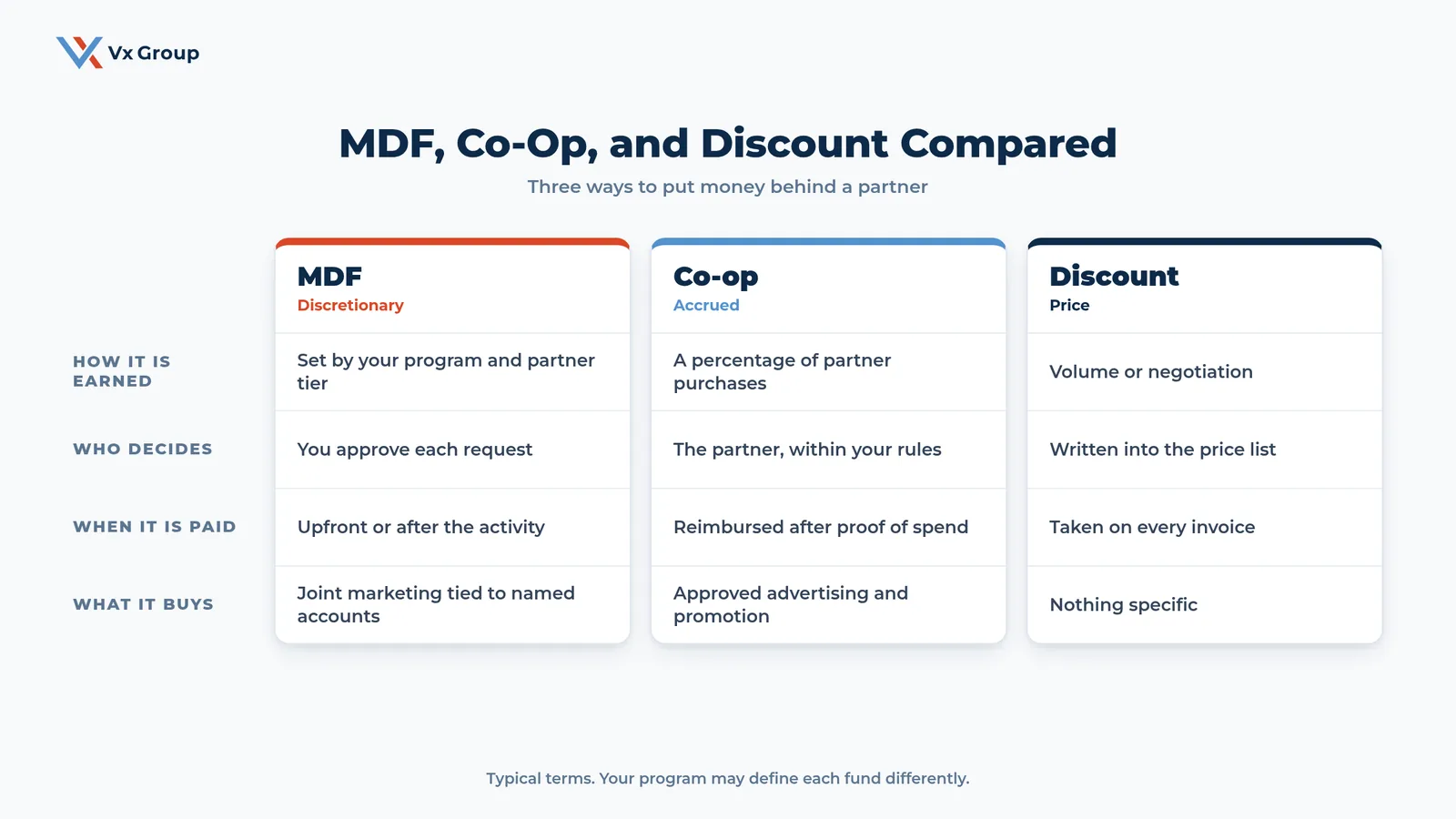
The manufacturer awards MDF at its own discretion and approves it activity by activity. Sometimes it pays upfront. The partner earns co-op funds as a percentage of its purchases. The manufacturer pays them back after the partner proves it spent the money on an approved activity.
In practice, many people use the two terms as if they were the same thing. Some programs define them in their own way. The table below describes the most common setup. Check how your program and your partners’ agreements define each one.
| Feature | MDF | Co-op funds | Discount |
|---|---|---|---|
| How it is earned | Set by your program and the partner’s tier | Builds up as a percentage of partner purchases | Negotiated or tied to volume |
| Who decides how it is used | You approve each request | The partner chooses, from your approved list | The partner decides |
| When it is paid | Upfront or after the activity | Paid back after proof of spend | Taken on every invoice |
| What it buys | Joint marketing tied to named accounts | Approved advertising and promotion | Nothing specific |
| What you can require | A plan, named accounts, and a result report | Proof of spend and use of your brand standards | Nothing beyond the order |
| Best fit | Pointing partner effort at specific accounts | Rewarding purchase volume with predictable marketing support | Competing on price when visibility is acceptable |
Defined Term: Co-op funds.
Marketing dollars a partner earns as a percentage of its purchases from a manufacturer. The partner spends the money on approved promotion. It gets paid back once it sends in proof of the spend. Co-op funds are also called co-operative advertising funds.
A discount belongs in the comparison because most owners reach for it first. A discount lowers the price, and the partner spends the savings however it likes. You cannot see where the money went. That is why distributor pricing decisions need their own rules. Our guide to distributor pricing strategy shows how to protect margin when partners ask for more.
Here is a simple rule for choosing among the three:
- Use co-op when you want a predictable reward that grows with partner purchases and takes little work on your side.
- Use MDF when you want to point partner effort at specific accounts, regions, or product lines you have chosen.
- Use a discount when price is what you want to change and you accept that you will not see where the money lands.
Most healthy programs run co-op as the base and keep a smaller MDF pool for the activities that matter most. Partners get something they can count on. You get something you can aim.
Who is eligible for MDF, and how is the fund earned?
The manufacturer sets MDF eligibility. It usually uses partner tier, a signed agreement, and a performance threshold. The fund is earned in one of three ways: a fixed amount by tier, a percentage of partner purchases, or a mix of both.
Choose how the fund is earned
Pick one of the three setups. Write it in a single sentence your partners can repeat.
- Fixed allocation: Each tier gets a set annual amount. Gold partners get one amount and silver partners get a smaller one. This is easy to explain and easy to budget.
- Accrual: The fund grows as a percentage of the partner’s purchases. This rewards volume, but it starts to look like co-op.
- Mixed: Each tier gets a fixed base, plus a bonus that builds up above a purchase target. This works well when you want every active partner to have something to plan around and your best partners to earn more.
Do the math on one page before you announce anything. Take the total you can afford. Count the partners who actually move your product. Weight the pool by tier. Check the result. If the money is spread so thin that no partner can run a real activity with it, shorten the list of eligible partners. A pool that funds ten real customer events does more good than the same pool split into sixty small amounts that each cover a box of pens.
Write the eligibility checklist
Eligibility belongs in a short list that a partner can check without calling you. Here is a workable version:
- A signed distribution or dealer agreement is on file. If yours is out of date, our guide to managing a distributor network covers what a current agreement should settle.
- The partner has met its purchase level for the tier over the last twelve months.
- The partner’s sales staff completed your product training.
- The partner reports sell-through, or shares enough sales data for you to see which accounts bought.
- The partner keeps a customer list you can check when approving requests.
The fourth and fifth items matter most. A partner that shares sell-through and customer data gives you what you need to judge a request. A partner that shares neither is asking you to approve spending on trust. That is where giveaway budgets begin.
Tie the fund to the tier you already track
Most manufacturers already rank their partners, even informally. Use that ranking. If you have a formal structure, our channel partner program guide shows how to build tiers that mean something. The dealer network strategy guide covers the same question for dealer-led businesses. Link MDF to those tiers. A partner who moves up sees the fund grow, and a partner who slips sees it shrink.
Ready to grow?
See how your MDF budget could be tied to the named accounts that matter most to your growth plan.
What can MDF be spent on, and what should it never cover?
MDF should pay for activity that puts your product in front of named customers, in a setting where a conversation can happen. It should never cover the partner’s general overhead, price concessions, or anything the partner would have bought without your money.
The test is the same for every request, and it takes ten seconds. Can the partner name the customers this activity is for? Can they say what will happen with each one afterward? If yes, the request deserves a real look. If the answer is a vague reference to “the market,” send it back.
Write the approved-activity list on one page
Give partners a list so they can shape requests before they send them. Here is a workable list for a manufacturer selling through distributors:
- Customer events hosted at the partner’s location, with a guest list of named accounts.
- Product demonstrations and plant or job-site visits for named accounts.
- Training sessions where the partner’s sales staff learn your product, paired with a plan for which accounts they will visit next.
- Targeted outreach campaigns (mail, email, or calls) to a named account list, with a stated follow-up date.
- Trade show participation when the partner books meetings with named accounts before the show and has a follow-up plan after it. Our guide to measuring trade show ROI covers how to prove a show worked.
- Co-branded literature and web content that supports one of the activities above.
Set a rule for the gray-zone items
Some requests show up every year and need a stated rule:
- Booth space: Approve it when the request lists the accounts the partner will meet and the date of each meeting. Decline it when the request says only “visibility.”
- Branded merchandise: Approve it as a leave-behind at a scheduled meeting. Decline it as a giveaway at a table.
- Sponsorships: Approve them when a named account is in the room and someone owns the follow-up. Decline them when the benefit is a logo on a banner.
- Local advertising: Approve it when it points to a specific offer or event for a named customer group. Decline it when it only builds general brand awareness.
Name what MDF will never pay for
Print this list with the approved activities. Then nobody has to argue a case after the fact:
- The partner’s salaries, rent, or routine overhead.
- Price reductions or rebates on a specific deal.
- Activity that took place before the request was approved.
- Spend with no proof of completion.
- Anything the partner has already committed to buy for itself.
Our broader guide to channel marketing programs shows how these rules fit inside a program that partners actually use.
How do you approve an MDF request in a way that improves it?
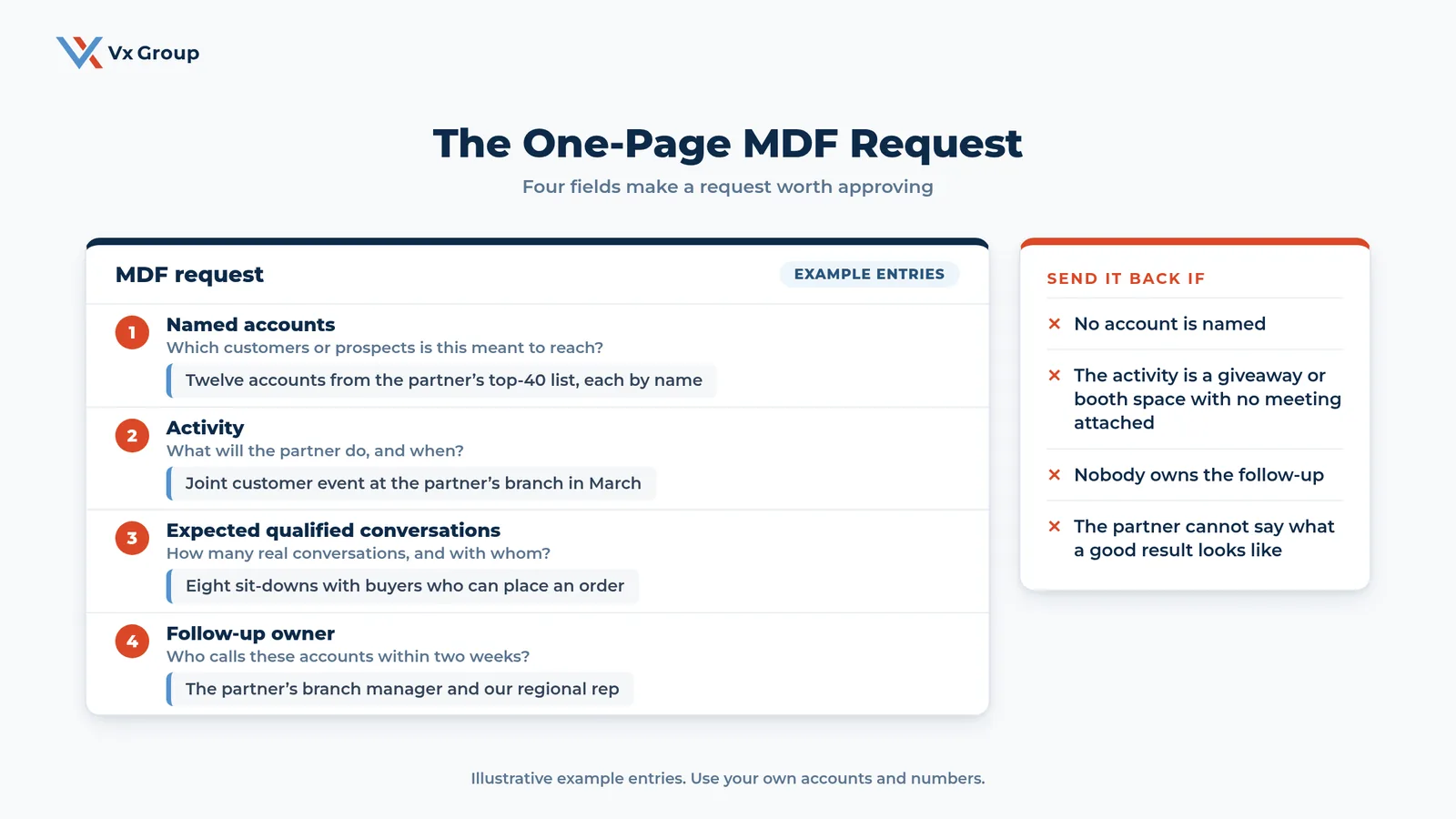
Require four fields on a one-page form: the named accounts, the activity, the expected qualified conversations, and the follow-up owner. A request that fills in all four is ready to approve. A request that leaves any blank goes back for revision. That usually makes the activity better.
Ask for the named accounts first
List the customers or prospects the spend is meant to reach, by company name. A list of twelve company names gives you something to check. “Our top customers” gives you nothing to check. A partner that knows its best accounts can write this list in ten minutes. A partner that struggles to write it has told you something useful about itself.
Replace any activity that has no meeting attached
Read the activity line and ask where a conversation with a named buyer happens. A customer breakfast has one. A banner ad has none. When an activity has no meeting in it, propose a replacement that keeps the budget and adds the meeting. Here is a line that works:
“I can approve this if we attach it to the twelve accounts on your list. Can we sit down Thursday and pick the three you most want to see this quarter?”
Set the expected qualified conversations as a range
Ask the partner how many sit-downs the activity should produce with buyers who can place an order. A range such as six to ten works better than a single number, because it forces an honest estimate. Record it. You will compare it to the real result later.
Assign the follow-up owner by name
Every approved activity needs one person who calls the accounts within two weeks. That person is usually the partner’s branch manager or lead rep, sometimes paired with your regional rep. A named follow-up owner is one of the cheapest ways to raise the odds that an event turns into orders.
Reply within five business days
Slow approvals teach partners to ask for easy things. Commit to a five-business-day response and hold to it. If a request needs revision, send the specific question that would make it approvable. Partners who get fast, specific feedback send better requests the second time.
Field Notes:
This is a composite from the channel programs we see. A regional industrial distributor sent in its usual year-end MDF request: a block of trade show booth space and a run of branded jackets. The manufacturer’s regional rep asked one question: which customers will you meet there? The distributor named four. The rep and the distributor’s branch manager looked at the list together. They agreed that none of the four attended that show. They moved the budget to a joint customer event at the distributor’s branch. They invited twelve named accounts, including those four, and put the branch manager’s name on the follow-up. The event produced real conversations about reorders and a product line the accounts had never been shown. The distributor asked to run the same format the next quarter. The only change to the original budget was the question the rep asked before approving it. The example is illustrative and carries no client results.
How do you measure MDF return?
Follow the money through five steps: dollars spent, named accounts reached, qualified conversations held, opportunities opened, and orders placed. Report each step against what the request promised. Review orders at 90 and 180 days, because relationship-driven sales take longer than most marketing reports assume.
Track five numbers for every approved request
| Measure | Definition | When to check |
|---|---|---|
| Reach rate | Named accounts that attended, responded, or took a meeting, divided by named accounts targeted | Within 30 days |
| Conversation yield | Qualified conversations held, divided by the expected qualified conversations on the request | Within 30 days |
| Cost per qualified conversation | MDF dollars spent, divided by qualified conversations held | Within 30 days |
| Opportunities opened | Quotes or proposals started with a named account because of the activity | At 90 days |
| Orders from named accounts | Order value placed by the named accounts, compared with the same accounts in the prior period | At 90 and 180 days |
A qualified conversation is a sit-down, call, or visit with a buyer who can place an order and who discussed a real need. Agree on that definition with your partners before the first request. Then everyone counts the same way.
Compare each result to the promise on the form
The request form gave you an expected range of conversations. After 30 days, put the actual result next to it. A partner who beat the range gets more room on the next request. A partner who fell short gets a talk about why. That talk usually shows whether the account list, the activity, or the follow-up was the weak spot.
Review the whole pool by partner and by activity
Once a quarter, sort every approved request by cost per qualified conversation and by orders from named accounts. Two patterns show up quickly. Some partners turn nearly every dollar into conversations, and they should get more. Some activity types, often the booth and the sponsorship, rarely produce a conversation at all. They should leave the approved list.
Our guide to channel sales strategy shows how to connect these measures to the wider channel plan. The channel marketing for manufacturers and distributors guide covers how marketing and sales share the scorecard.
Report one page to the owner each quarter
An owner should be able to read the MDF results in two minutes. Use one page, five numbers, and three sentences: what the money bought, which partners earned more, and which activities leave the list. Our channel marketing programs guide includes a scorecard layout that fits this format.
What should you do with your next MDF dollar?
Start with last year’s approved requests and sort them by one question: did the request name a customer? You will likely find that few of them did. Those dollars are where to start.
Then take four steps this quarter:
- Tag last year’s requests. Mark each approved request from the last year as named-account or no-named-account. Total the dollars in each group.
- Publish the approved list. Put the approved activities and the never-pay-for list on one page. Send it to every eligible partner.
- Adopt the form. Require the four fields on every new request, starting with the next one that arrives.
- Set the review date. Put a 90-day order review on the calendar for each approved request before the activity happens.
These steps need no new software and no larger budget. They need a rep who asks which customers an activity is for. They also need an owner who backs the rep when the answer is vague.
Channel sales management and partner enablement sit next to MDF in a healthy program. Each works better once the money has a named account behind it.
Ready to grow?
Tell us how you spend channel marketing money today and we will show you where the named accounts fit.
Subscribe to Insights → for more on growing through distributors, dealers, and reps.
FAQs
About the Author: David Tisdale
