

How to Build a Value Creation Plan for a Portfolio Company

A value creation plan turns an acquisition thesis into a short, owned list of operating priorities for the first year of a hold. The strongest plans name three or four priorities, assign a real owner to each one, set milestones a board can actually check, and protect the relationships that produce the revenue the thesis depends on.
TL;DR
- A value creation plan is a written, owned operating plan the company’s leadership actually runs day to day.
- Start from the acquisition thesis. The plan should read like a decision the team made, with specifics attached.
- Every priority needs one named owner. A plan with no owner is a wish list.
- Milestones belong on a dated calendar: 30, 90, 180, and 360 days.
- The plans that hold up protect the customer relationships the thesis depends on. Plans built entirely on cost cuts and multiple expansion tend to erode those same relationships.
- Review the plan on a fixed cadence, or it quietly turns into a document nobody manages.
What is a value creation plan?
A value creation plan is the written, owned plan a private equity firm or family office builds for a portfolio company at acquisition, laying out how the business will grow and what has to be true by exit for the deal to work. It is shorter than most of the paperwork produced before the deal closes and more specific than most board presentations. It names the three or four things that have to happen, who owns each one, and how the firm will know by when.
Defined Term: Value creation plan.
A written, owned operating plan that translates an acquisition thesis into a short list of priorities, named owners, and dated milestones for the hold period, distinct from the memo that justified the deal before closing and the board deck that reports on it.
Most portfolio companies already have a version of this plan. It usually lives in a slide from the investment committee memo, a spreadsheet from the pre-close review, and whatever the operating partner remembers from the closing dinner. None of that is a plan the company can run. A plan the company can run fits on one or two pages, names names, and gets checked on a schedule.
The first draft is usually best written jointly, in one room, over a working session rather than an email thread. The operating partner or deal lead brings the thesis and the numbers behind it. The CEO and two or three functional leads bring the operational reality of what the company can actually execute in a year. That joint session is what turns the plan into something the leadership team helped build, which is the difference between a plan people run and a plan people file.
The firms that get this right treat the plan as an artifact the company’s own leadership owns and runs day to day. That distinction shapes almost every step below.
What goes wrong when a value creation plan skips the relationships?
Name the failure mode before the steps: a plan built entirely on cost cuts and multiple expansion. It looks disciplined on a spreadsheet. Trim overhead, raise prices, run the same playbook that worked on the last three deals, and wait for the multiple to catch up.
The problem shows up eighteen months in. The plan hit its cost targets and the company is worth less, because the relationships that produced the revenue quietly eroded while everyone was watching the P&L. A key account’s champion left and nobody at the company knew it had happened until the renewal came in soft. A founder who used to personally call the top ten customers stepped back after the earnout, and the calls stopped. The plan never asked who owns those relationships or whether the business would survive losing the person who holds them.
A value creation plan that protects and grows the relationships driving revenue builds a company that is worth more because it produces more. Whatever review happened before the deal closed almost never counted this asset properly, and that gap is exactly why relationship ownership belongs at the center of the plan, sitting right alongside the cost and pricing work from day one.
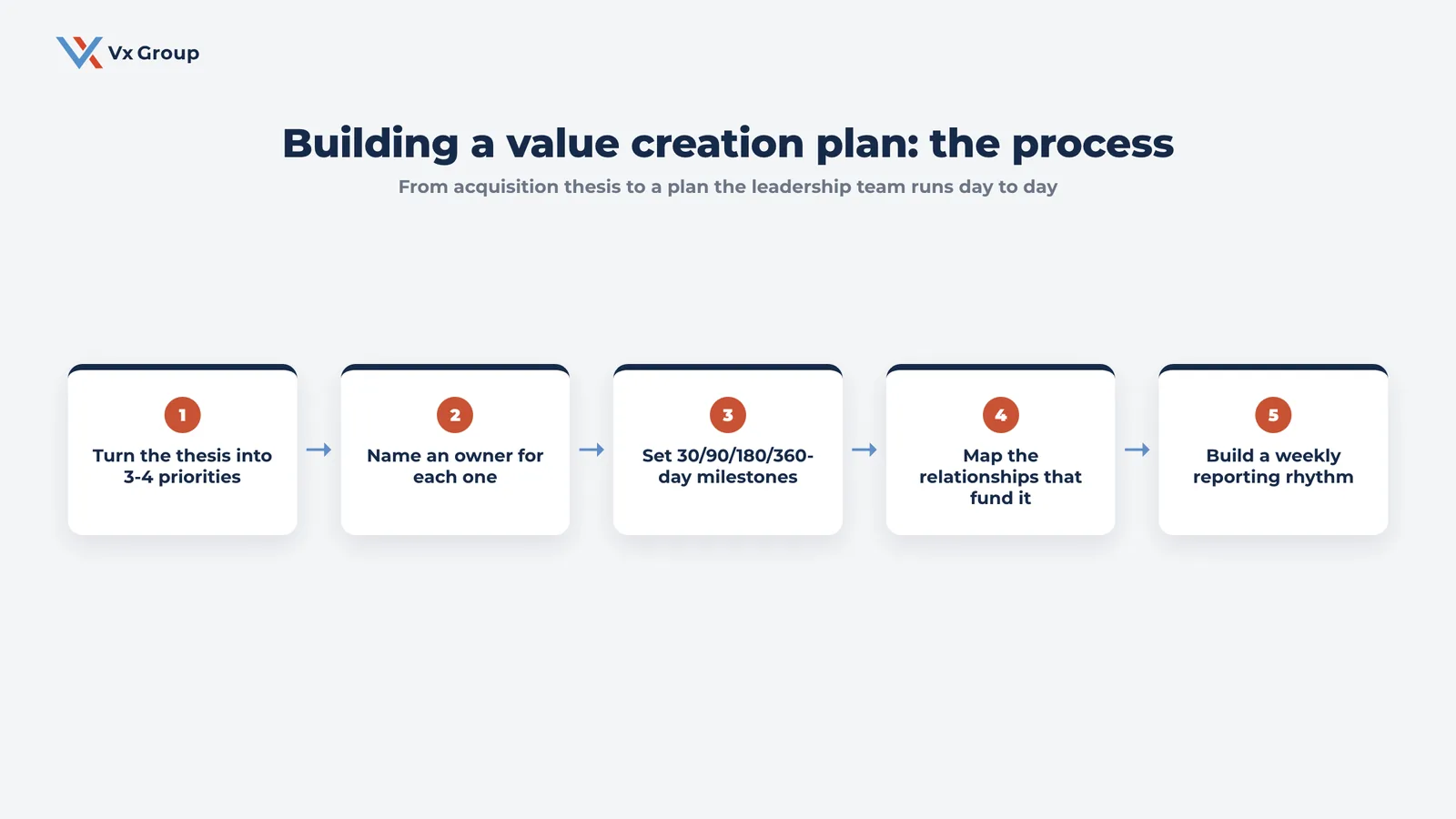
1. Turn the acquisition thesis into three operating priorities
Every deal gets bought on a thesis: a specific reason this business, at this price, will be worth more in three to five years. The first step in building a value creation plan is translating that thesis into a short list of things the company will actually do.
Write the one-page priority list
Take the investment thesis and force it into three or four operating priorities, written as verbs someone can act on this quarter: “renegotiate the top five supplier contracts by Q2,” “add four new accounts in the Midwest manufacturing vertical this year.” A priority written as a category, like “margin expansion” or “grow the customer base,” still describes a thesis. Write it specifically enough that the reader can picture someone doing it on a Monday morning, and it becomes a plan.
Write these on one page. If the list runs past four or five items, the plan has stopped being a priority list and started being a wish list. Cut it back to what genuinely has to happen for the thesis to hold.
Bring three things into the working session where this list gets built:
- The original investment thesis, in whatever form it exists (memo, deck, or notes from the closing call).
- The top-line financial model, so every priority can be tied back to a specific dollar figure.
- A list of the company’s functional leads, so the group can start assigning owners in the same session instead of scheduling a second meeting for it.
Rank each priority by dollar impact
Every operating team will hand you a list of urgent items: the ERP migration, the new hire in finance, the customer complaint from last week. Urgency and value are two different measures. Rank the priority list by the dollar impact each item has on the thesis, and let that ranking decide what gets attention first, regardless of who is loudest in the room.
A simple test: if a priority disappeared from the plan entirely, would the deal’s return still work? If the answer is yes, move it to someone’s task list and keep the value creation plan itself focused on what the thesis actually requires.
2. Name an owner for every priority
A priority with no owner is a hope. The second step is assigning one real person, by name, to each item on the list, and writing down exactly what they are accountable for.
Match the owner to the work
The instinct is to hand every growth priority to the CEO or the head of sales, because that is who shows up in board meetings. That instinct produces a plan where one person owns everything and nothing gets done, because nobody has the bandwidth or the specific expertise every priority actually needs.
Match the owner to the priority itself. The person who should own “protect the top ten accounts” is often a different person than the one who should own “stand up a new sales region.” Look for whoever already has the relevant relationships or the technical depth, regardless of title or seniority.
Write the one-line accountability statement
For each priority, write a single sentence: who owns it, what they deliver, and by when. “Maria owns the supplier renegotiation and delivers signed contracts with the top five vendors by June 30.” A plan full of these sentences is checkable. A plan full of paragraphs describing “a renewed focus on vendor relationships” only sounds like progress.
Ready to grow?
See how a documented ownership map holds up against your own portfolio company’s plan.
3. Set milestones and a review rhythm for the first year
A value creation plan without dates is a set of intentions. The third step is putting real checkpoints on the calendar before the deal team needs them, so nobody is scrambling to explain a stalled priority at a board meeting.
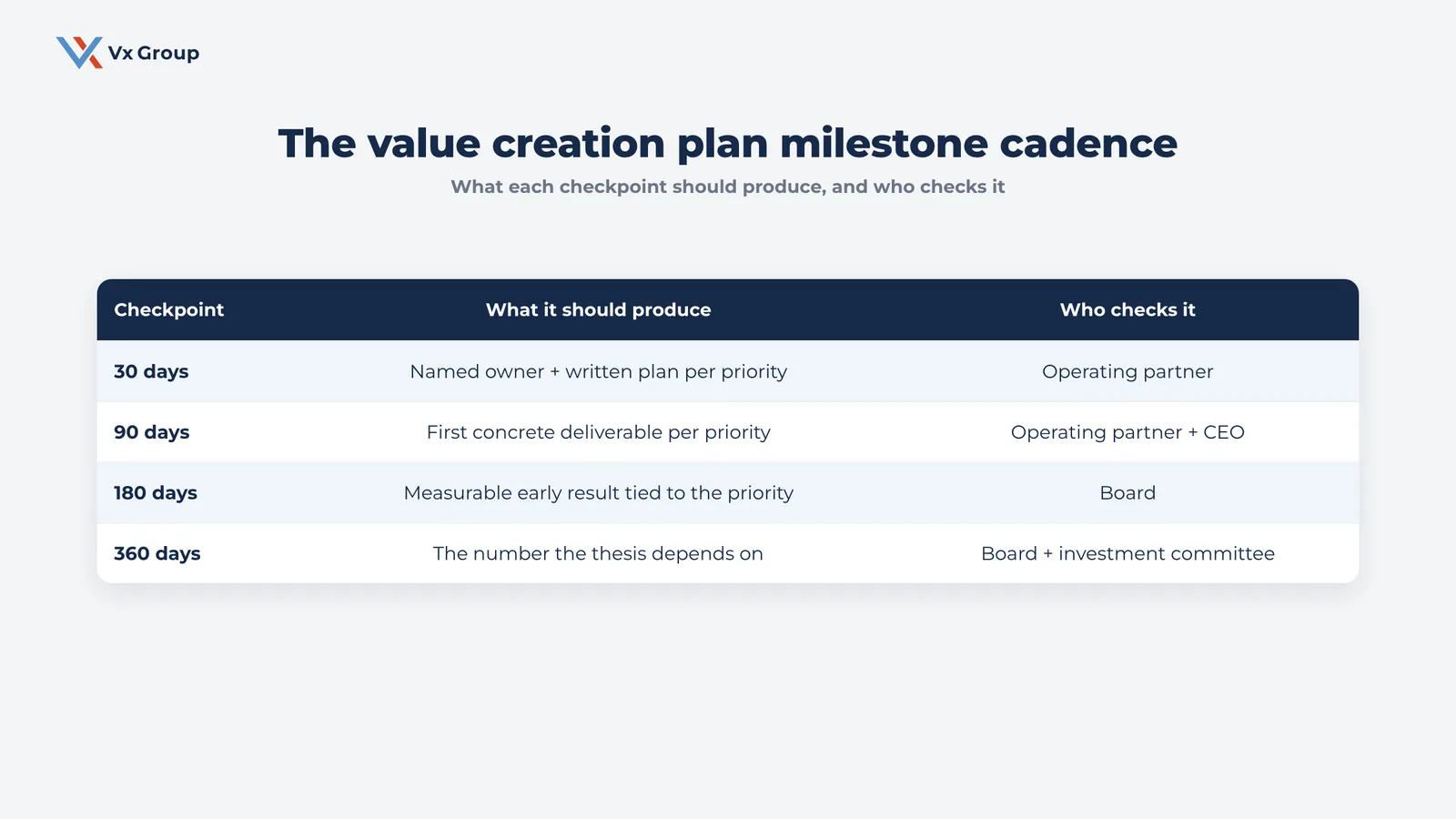
Build the 30/90/180/360-day milestone table
Every priority gets at least one milestone at each of four checkpoints: 30 days, 90 days, 180 days, and 360 days. The 30-day milestone is usually a decision or a hire. The 90-day milestone is usually a documented plan or a signed agreement. The 180-day milestone is usually a measurable result. The 360-day milestone is the number the thesis actually depends on.
| Checkpoint | What it should produce | Who checks it |
|---|---|---|
| 30 days | A named owner and a written plan for each priority | Operating partner |
| 90 days | The first concrete deliverable per priority (a signed contract, a documented profile, a hire) | Operating partner and CEO |
| 180 days | A measurable early result tied to the priority | Board |
| 360 days | The number the thesis depends on, or an honest account of why it did not land | Board and investment committee |
Put the review rhythm on the calendar before you need it
Decide, at the same time the plan is written, exactly when it gets reviewed: monthly with the operating partner, quarterly with the board. Put those dates on the calendar immediately. A plan that only gets discussed when someone remembers to ask about it will quietly slide, because urgent always beats important when nobody scheduled the check-in.
Treat a missed milestone as useful information the plan surfaced early, exactly what a milestone is supposed to do. When a 90-day deliverable slips, the review rhythm is what catches it while there is still time to adjust the plan, reassign the priority, or pull a related milestone forward to compensate. Plans that only get checked at the board meeting tend to discover a missed milestone two quarters after it happened, when the fix costs far more than it would have at 90 days.
4. Map the priorities to the relationships that actually fund them
This is the step most value creation plans skip entirely, and it is the one that determines whether the plan protects what it just bought or accidentally erodes it.
List the ten relationships the thesis depends on
Pull the top ten customer relationships by revenue, and separately, the top ten by strategic importance (a reference account, a channel partner, a supplier that can dictate terms). For each one, write down who owns the relationship inside the company today, how long they have held it, and how it was won.
Most pre-close reviews never produce this list in a usable form. It usually exists as a spreadsheet of account names and revenue figures, with no column for who actually holds the relationship or how fragile it is.
Name the single point of failure for each relationship
For every relationship on the list, answer one question: if the person who owns this relationship left tomorrow, what happens to the account? If the honest answer is “we don’t know” or “it would probably leave with them,” that relationship is a risk the value creation plan has to address directly, with a named priority and an owner, before the hold period tests it.
This is where the plan earns its keep. A priority like “add executive-level involvement to the top five accounts” or “document the account transition plan for our two largest customers” belongs on the same page as the growth priorities, ranked by the same dollar-impact test.
Field Notes:
A manufacturing portfolio company we worked with had one account that made up close to a fifth of revenue, owned entirely by a salesperson nobody at the executive level had met in person. The value creation plan added a standing quarterly visit from the CEO within the first ninety days. Eighteen months later, when that salesperson left for a competitor, the account stayed, because the relationship no longer lived in one person’s contact list.
5. Build the reporting rhythm the leadership team will actually use
A value creation plan that only exists as a board deck gets opened once a quarter and ignored the rest of the time. The fifth step is building a version of the plan the operating team actually checks every week.
Pick three to five metrics that move before the P&L does
Financial results lag the decisions that produce them by months. Pick three to five leading indicators tied directly to the priorities: pipeline in the target vertical, renewal conversations completed with at-risk accounts, contracts signed with renegotiated suppliers. These are the numbers that tell the team whether the plan is working before the quarterly financials confirm or deny it.
Put the whole plan on a single page
Take the priorities, owners, milestones, and leading indicators, and fit them on one page. A one-page plan gets pulled up in a five-minute check-in. A forty-slide plan gets opened once a quarter, right before the board meeting, and closed again immediately after.
6. Check the plan against the cost-only failure mode
Before the plan is final, run it through one more filter: does every priority still make sense a year after the cost cuts are done?
Run the “what does this actually protect” test on every priority
For each priority, ask what it protects or grows, specifically. “Reduce headcount in operations by 15 percent” protects margin for exactly one year and then has nothing left to give. “Document the account transition plan for our two largest customers” protects revenue for the life of the hold and beyond it. A plan weighted entirely toward the first kind of priority is optimizing for a number the buyer at exit will discount the moment they see it.
Protect the relationship that took a decade to build
The fastest way to destroy value in a relationship-driven B2B company is to treat a twenty-year customer relationship the same way you would treat a software subscription: assume it renews on its own and redirect the attention it used to get toward something that shows up faster on a dashboard. The plans that hold up put a real priority, with a real owner, behind protecting exactly the relationships that took the longest to build and would be the hardest to replace. Run every priority on the plan through this filter before calling the plan finished, so the relationship work sits in the same document as the cost work, ranked by the same dollar-impact test.
What derails a value creation plan after it is written?
Most value creation plans fail quietly. Nobody tears them up. They just stop being the thing that runs the company.
| Failure pattern | What actually happens | The fix |
|---|---|---|
| No owner, only a topic | “Improve customer retention” sits on the plan with nobody accountable | Assign one name per priority, with a written accountability statement |
| Milestones with no dates | Progress gets discussed in generalities at board meetings | Put 30/90/180/360-day dates on the calendar when the plan is written |
| Plan built to impress the investment committee | The plan is a forty-slide deck nobody at the operating company opens between board meetings | Rebuild it as a one-page working document the leadership team checks weekly |
| All cost, no relationship protection | Margin improves for a year, then the top accounts erode and revenue softens | Add relationship ownership and transition planning as a named priority, ranked by dollar impact |
| Plan gets written once and never revisited | The plan still reflects the thesis from eighteen months ago | Set a fixed quarterly review and update the plan document itself, alongside the report on it |
How to keep the plan alive after year one
A value creation plan keeps working only if it keeps changing. It gets revisited every quarter and rewritten, in part, every year. As priorities get delivered, replace them with the next set of priorities the thesis now requires. As relationships shift, owners, and risk levels change, update the relationship map before it goes stale. The plan that survives to exit is the one that looked meaningfully different at month eighteen than it did at month one, because the team actually used it.
The plans built this way tend to produce a better story to tell a buyer almost as a side effect. A buyer evaluating the business at the end of the hold period wants evidence the growth will hold up after the sale closes. A documented, actively managed value creation plan that protected its key relationships is exactly that evidence.
Building one from scratch, or auditing the one you already have against a plan that actually gets used, is worth a real conversation.
Ready to grow?
Get a second set of eyes on the value creation plan for your next portfolio company.
About the author: Eric Zoromski is the Founder and CEO of Vx Group, where he works with private equity firms, family offices, and the operating companies they back on growth systems built to survive a change in ownership. He built the Measured in Millions® methodology after two decades of watching relationship-driven B2B companies grow, and plateau, on exactly the same pattern.
Related reading:
- The Private Equity 100-Day Plan: A Growth-First Playbook
- How To Install a Growth System for a PE Portfolio Company
- How Private Equity Creates Value in Relationship-Driven B2B Companies
FAQs
About the Author: Eric Zoromski
