

Customer Retention Strategies for Relationship-Driven B2B Companies

The most effective customer retention strategy for a relationship-driven B2B company is to manage each existing relationship as an asset long after the contract is signed. Assign clear ownership of every key account, track relationship health the way you track pipeline, and keep a documented rhythm of contact that deepens trust before any problem appears. Retention done this way protects revenue you already have and opens expansion you would otherwise miss.
TL;DR
- Retention is the highest-return growth work most B2B companies underfund.
- The value concentrated in your top accounts often exceeds your entire new-business pipeline.
- Customers churn when the relationship goes quiet, and price becomes the excuse they cite on the way out.
- Every key relationship needs a named owner accountable for its health and growth.
- A documented contact rhythm outlasts turnover, vacations, and busy quarters.
- Expansion inside existing accounts closes faster and cheaper than net-new acquisition.
- Retention and expansion are the same motion, run by the same system.
Why is customer retention undervalued in B2B?
Most B2B companies pour their growth budget into acquisition while leaving the relationships that already pay them unmanaged. The math behind that choice rarely holds up.
For a company whose revenue concentrates in a few dozen long-term accounts, the lifetime value sitting in the existing base usually dwarfs the entire new-business pipeline. Yet acquisition gets the attention, the headcount, and the urgency. Retention gets whatever time is left over. This is the activity illusion at work: new logos feel like progress, renewals feel like maintenance, and so the team optimizes for the thing that feels like winning while quietly underinvesting in the thing that actually funds the business. Companies that grow by accident tend to make this trade without ever deciding to.
Why are the relationships you already have your most undervalued asset?
The accounts that have stayed with you for years carry more than revenue. They carry referrals, market credibility, product feedback, and the kind of trust that took a decade to build and cannot be bought back once it is lost.
When one of those relationships erodes, the company loses far more than a line item. It loses the compounding value that relationship would have produced over the next ten years. This is why your top accounts function as a growth strategy in their own right, and why letting them go unmanaged is one of the most expensive habits in B2B.
What does customer retention mean for a relationship-driven B2B company?
Customer retention is the work of keeping and growing the accounts you already have. For a relationship-driven B2B company, that definition carries more weight than it does for a high-volume, transactional business. Your revenue does not come from thousands of interchangeable customers. It comes from a concentrated set of relationships built over years, where a single account can represent a meaningful share of annual revenue and a decade of compounding trust.
That concentration changes what retention has to accomplish. Keeping a logo on a renewal list is the floor. The real goal is keeping the relationship healthy enough that it continues, deepens, and expands. A customer who renews but has quietly stopped trusting you is already most of the way out the door, whatever the contract says.
Defined Term: Customer Retention
In a relationship-driven B2B company, customer retention is the active practice of protecting and expanding existing accounts over their full lifetime, measured by the revenue those relationships sustain and grow rather than by logo counts alone.
What actually causes B2B customers to leave?
B2B customers rarely leave over price. They leave because the relationship went quiet and a competitor showed up with more attention.
The pattern is consistent. A long-term account stops hearing from anyone except at renewal time. Small frustrations go unspoken because no one is asking. A new contact arrives on their side who has no relationship with your company and no reason to stay loyal. By the time the warning signs reach leadership, the decision has usually already been made.
Defined Term: Relationship Drift
The slow erosion of a customer relationship that happens when contact becomes transactional and infrequent. Drift is rarely visible in any single quarter, which is why it is so dangerous. It compounds quietly until the account is already at risk.
Do B2B customers really leave over price?
Price is usually the explanation a departing customer gives because it is the easiest one to say out loud. The underlying cause is that the relationship was not strong enough to justify paying more. A customer who trusts you and feels well served will absorb a price difference. A customer who feels neglected will reach for price as the reason on the way out.
What are the most effective customer retention strategies for B2B?
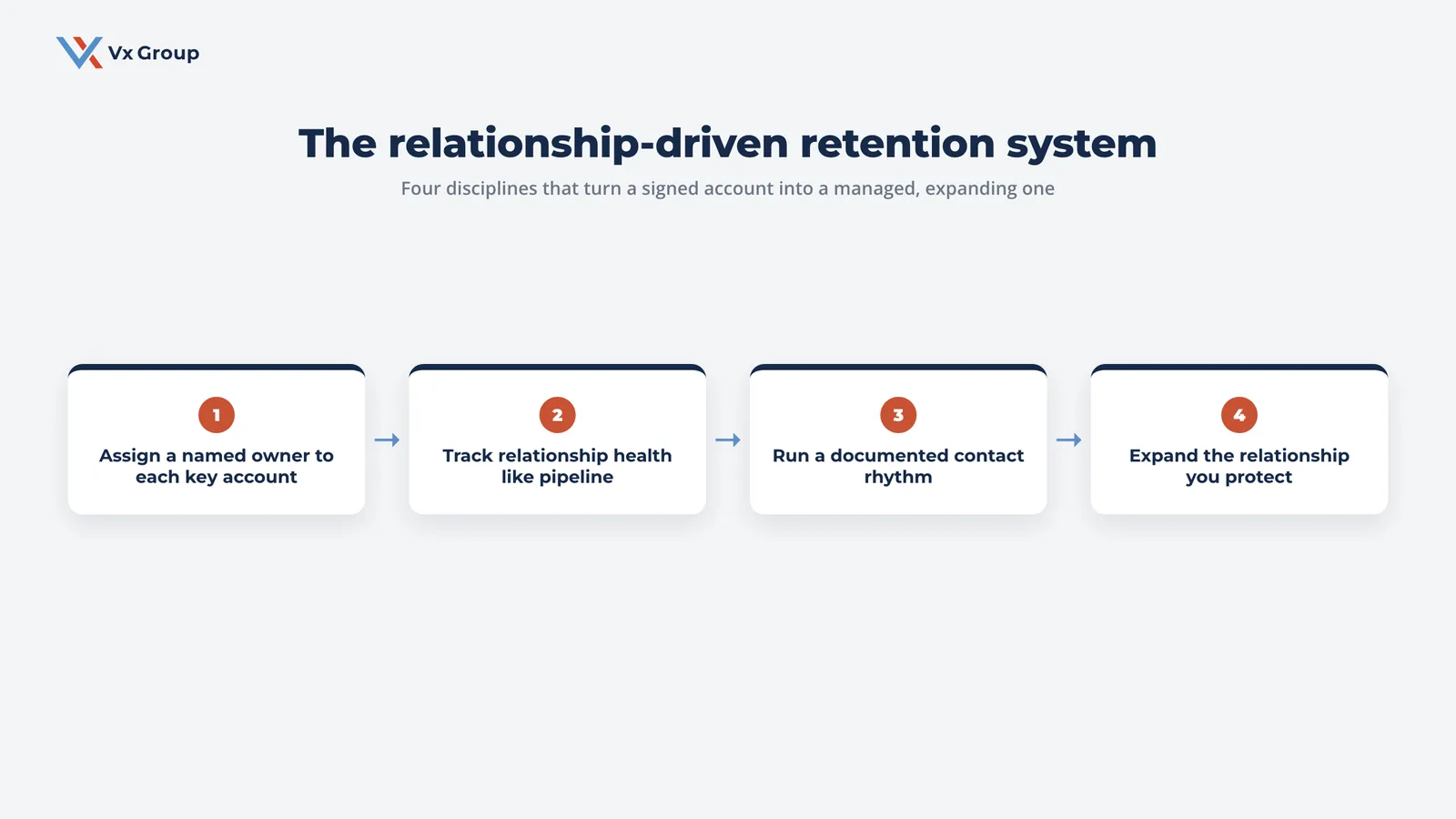
A retention strategy works when it stops depending on individual goodwill and becomes a system that runs the same way regardless of who is in the seat. That system has four parts: ownership, visibility, rhythm, and expansion.
How do you assign ownership of a key account?
Make one person accountable for the health and growth of each important account, and make sure it is not the same person whose job is winning new ones. Originating new relationships and developing existing ones are different disciplines with different instincts. When one person carries both, the urgent work of chasing new deals always crowds out the quieter work of tending the relationships you already have.
Name the owner. Make the expansion and retention of that account their primary measure of success. This single structural change does more for retention than any tool.
Defined Term: Account Ownership
A defined model where one person is responsible for the long-term health, retention, and growth of a specific set of customer relationships, measured on the revenue those relationships sustain and expand over time rather than on new logos won.
How do you track relationship health like pipeline?
Give your existing relationships the same visibility you give deals you are trying to win. Most companies have detailed reporting on open opportunities and almost none on the accounts they are trying to keep. Reverse that imbalance.
For each key account, track the signals that predict drift before it becomes departure: how recently a real conversation happened, whether the relationship spans more than one contact, whether issues are surfacing and getting resolved, and whether the account is growing or flat. Review these on a regular cadence, the way you review the sales pipeline, with someone accountable for acting on what the review surfaces.
How do you build a contact rhythm that does not wait for problems?
Stay in contact when nothing is wrong. The companies that retain best reach out with something useful, like a relevant introduction or a heads-up about something happening in the customer’s world, and they show up well before the renewal conversation comes due.
Document the rhythm. Define what a meaningful touch looks like for a tier-one account versus a smaller one, how often it should happen, and who owns it. A documented rhythm survives turnover, vacations, and busy quarters, which is more than you can say for a rhythm that lives only in one person’s memory.
Defined Term: Contact Rhythm
A documented schedule of meaningful, non-transactional touchpoints for each tier of account, specifying what a quality touch looks like, how often it happens, and who is responsible for it, so relationship-building continues regardless of who is in the role.
How do you turn retention into expansion?
Use the relationship you already have to earn the expansion you are missing. Retention and expansion are the same motion. A well-managed relationship naturally surfaces adjacent opportunities: other divisions, other locations, additional product lines, and contacts who move to new companies and want to bring you with them.
The company that is present and trusted hears about these openings first. The company that only shows up at renewal hears about them after a competitor already has.
| Retention Approach | Reactive Model | Relationship-Driven Model |
|---|---|---|
| Trigger for contact | Renewal date or a problem | Documented ongoing rhythm |
| Who owns the account | Whoever closed it, if anyone | A named owner measured on its growth |
| Visibility into risk | Discovered at renewal | Tracked continuously like pipeline |
| Primary goal | Keep the logo | Deepen trust and expand the relationship |
| Result | Slow drift, surprise losses | Compounding value, early warning |
Ready to grow?
See how relationship-driven companies turn these four disciplines into a working retention and expansion system.
How do you measure whether your retention strategy is working?
Measure retention by the health and revenue of each account. A renewal checkbox confirms the logo is still on the books and tells you nothing about whether the relationship is strengthening or quietly heading for the exit.
Useful signals are concrete. How recently did a real conversation happen, beyond a support ticket or an invoice? Does the relationship reach more than one person, or does it rest entirely on a single contact who could leave tomorrow? Are issues surfacing and getting resolved, or has the account gone silent? Is spend growing, flat, or slipping? Each of these is a leading indicator, and together they give you a read on account health long before a renewal is at risk.
Defined Term: Revenue Expansion
The growth in revenue generated from an existing account over time, through additional product lines, new divisions or locations, and deeper adoption. For relationship-driven companies, expansion within the base is often the clearest single measure that retention is working.
How do you keep a key relationship from living in one person’s head?
When a key relationship lives entirely in one person’s head, the company is one resignation away from losing it. The salesperson who has owned an account for fifteen years carries the history, the personal rapport, and the unwritten context of how that customer likes to work. When that person retires or leaves for a competitor, the relationship can walk out the door with them.
Systems protect against that. Documenting who the contacts are, what matters to them, what has been promised, and what the account has bought and considered makes the relationship something the company owns rather than something an individual rents to it. A documented account history makes the next conversation better, because whoever is in the seat starts with context instead of a blank page. The worry that systemizing relationships strips out the human part has it backwards. The system is what keeps the human knowledge from evaporating the day someone hands in their badge.
Field Notes: the account no one owned
A mid-market manufacturer counted one of its largest customers as rock-solid. The relationship was a decade old and had never been at risk. No one was formally responsible for it, because no one thought it needed managing. The original champion at the customer retired.
The new decision-maker had no history with the manufacturer and, within eighteen months, consolidated spend with a competitor who had been actively building the relationship the whole time.
The loss was seven figures in annual revenue, and the first real warning anyone noticed was the RFP that did not include them. The fix was not complicated. The manufacturer assigned ownership of its top accounts, built a quarterly health review, and started showing up between renewals. Within a year, two of those accounts had expanded.
The discipline that would have saved the lost account became the discipline that grew the others.
How does customer retention connect to growth?
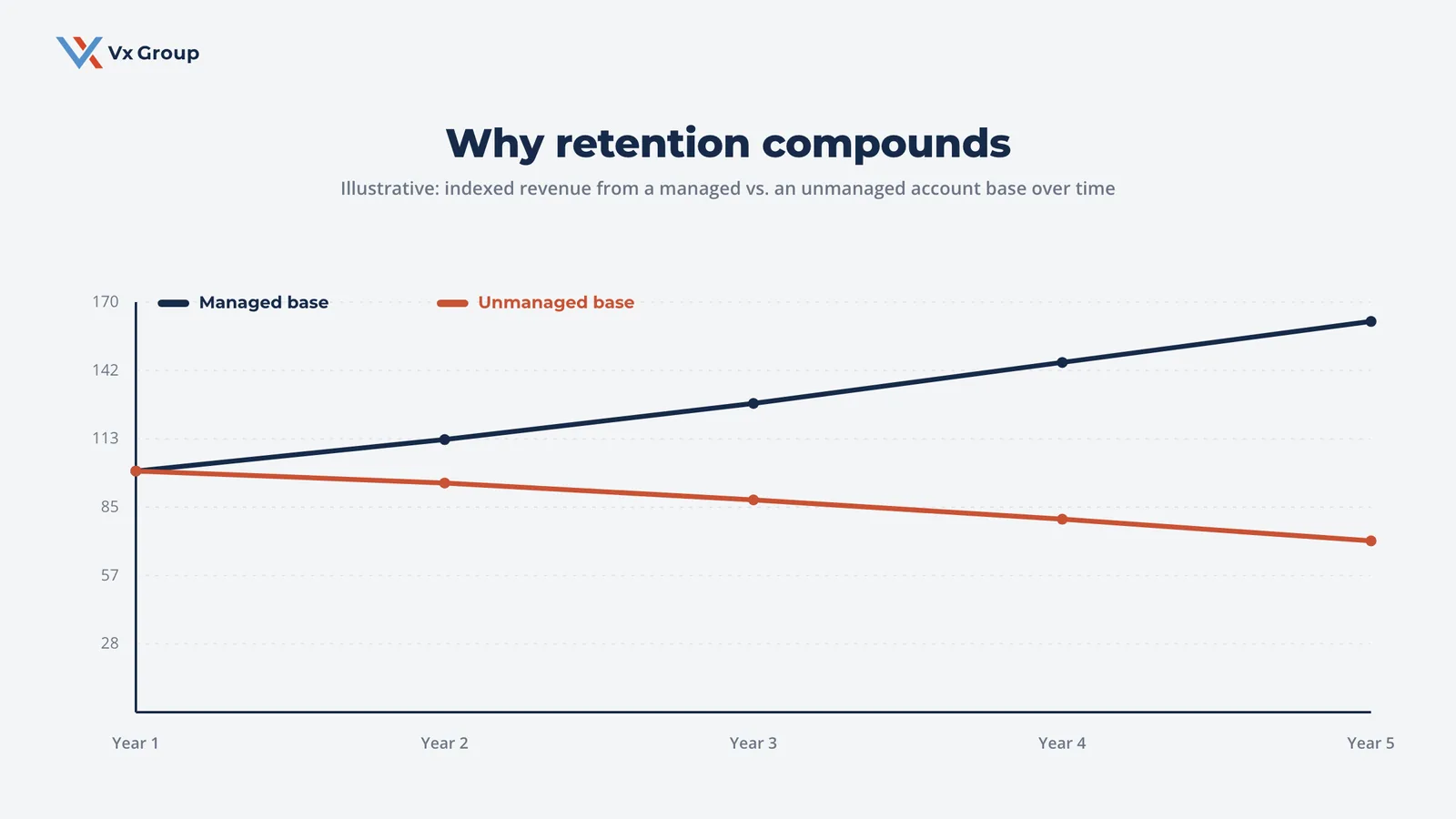
For relationship-driven B2B companies, retention is the most reliable source of growth they have. Growth from existing accounts costs less, closes faster, and compounds more predictably than growth from net-new acquisition. The trust is already built, the buying process is already understood, and the next sale starts from a position no cold prospect can match.
A company that retains and expands its base builds on a foundation that strengthens every year, while the one that churns its base to chase new logos spends heavily just to hold steady. The companies that grow with the least drama are usually the ones that decided to protect and develop what they already had before spending another dollar trying to replace it.
Ready to grow?
See how relationship-driven B2B companies build retention and expansion into a system that protects revenue and compounds it.
Subscribe to Insights →
FAQs
About the Author: Jacob Camhi
