

The Roll-Up Strategy: Why Relationships Decide If It Works

A roll-up strategy combines several smaller companies in a fragmented market into one larger platform, capturing cost savings, cross-selling, and a higher exit multiple than any single company could command alone. That math only holds up when the customer relationships behind each acquired company’s revenue survive the change in ownership, which is where most roll-ups quietly lose value.
TL;DR
- A roll-up strategy buys several smaller companies in a fragmented market and combines them into one platform to capture scale and a higher exit multiple.
- The model creates value through cost synergies, cross-selling, and multiple expansion, but only holds up if the combined company actually integrates.
- Roll-ups tend to fail for one of three reasons: overpaying for targets, an integration that never really happens, or losing the customer relationships that drove the acquired company’s revenue.
- Revenue in relationship-driven businesses often sits with a founder or a handful of long-tenured people, and a change of ownership can quietly break the trust that held those accounts.
- Protecting that value takes three moves: check how much revenue rides on one person before the deal, document the relationships you’re buying, and install a growth system the platform owns.
How does a roll-up strategy create value?
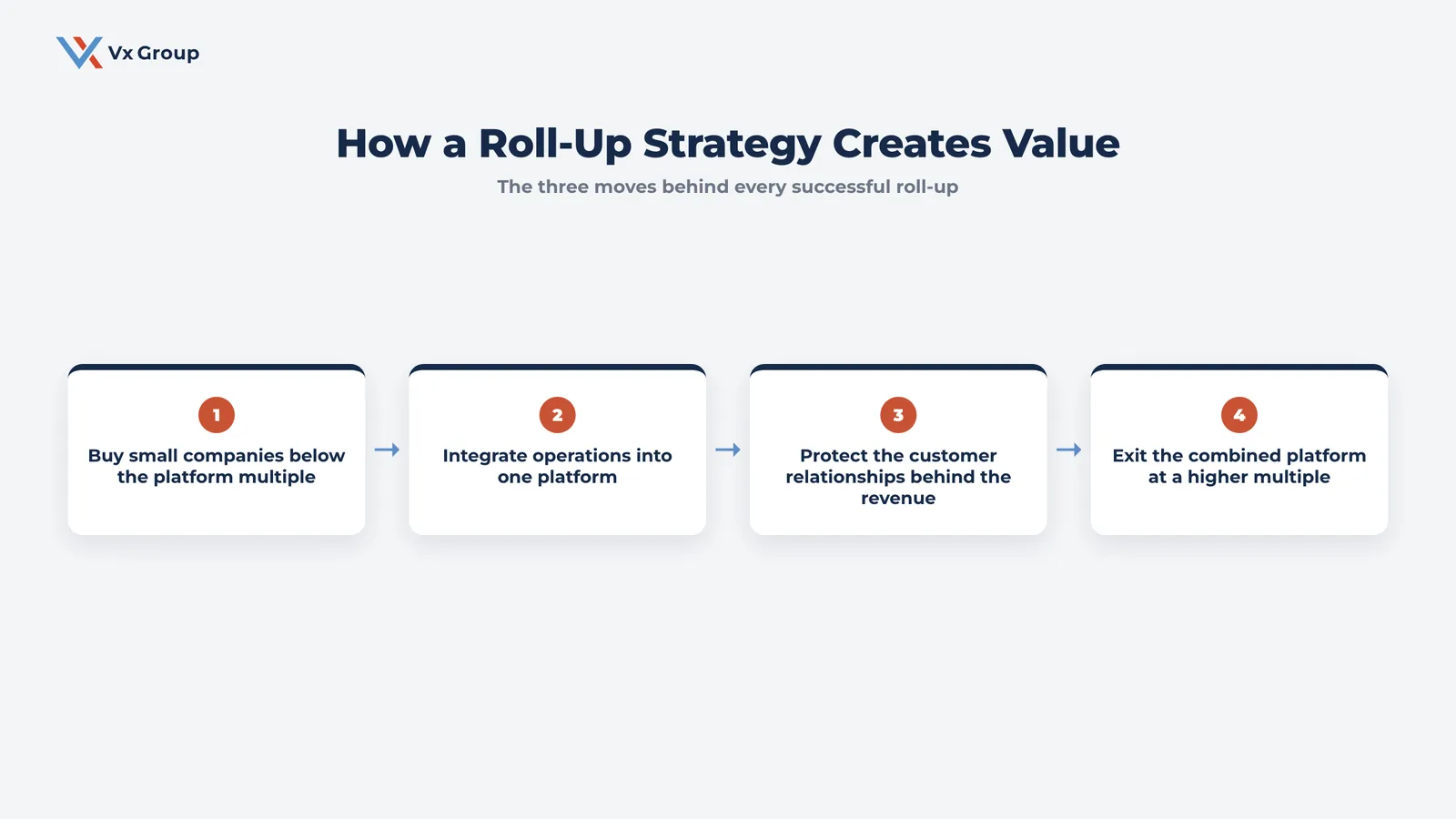
A roll-up creates value the same way in almost every deal: buy several companies below the multiple a larger, combined business would command, integrate them into one platform, and sell the combined company later at that higher multiple. The mechanics are simple. The execution, and the risk, live in the integration step in the middle.
A roll-up is one specific version of the broader buy and build strategy: buying at scale inside a single fragmented market rather than assembling different capabilities across markets.
Buy small companies below the platform multiple
Small, privately held companies in fragmented industries typically sell for lower multiples than a larger, more diversified platform commands. A distributor doing $8 million in revenue might trade at four or five times earnings. A platform doing $80 million in similar revenue, with a broader customer base and a management team in place, can command seven or eight times the same earnings.
Defined Term: Multiple arbitrage.
The gap between the lower price paid for a small, standalone company and the higher price the same revenue commands once it becomes part of a larger, more diversified platform. Roll-ups are built specifically to capture this gap.
That gap is the entire premise of a roll-up. Buy the small company at its small-company price. Fold its revenue into a bigger, more valuable structure. The arithmetic looks compelling before a single integration decision has been made, which is exactly why so many roll-ups get greenlit on the strength of the math alone.
Sellers accept these lower multiples for reasons that have little to do with the acquirer’s strategy. A lot of them are founders without a succession plan, facing retirement with no family member or employee positioned to take over.
Some are tired of running the business alone through every downturn and want liquidity while the company still has real value. A few simply lack the capital or the appetite to make the next round of investment their industry now requires. None of that changes what the acquired company is worth. It just explains why the seller is willing to sell at a price the buyer considers a bargain.
Integrate operations into one platform
Buying the revenue is the easy part. Integration is where a roll-up either becomes a real business or stays a collection of acquisitions sharing a logo. Real integration usually means:
- One finance and back-office system instead of five.
- One CRM and one customer database, so account history does not live in five different spreadsheets.
- Shared vendor contracts and purchasing power across the combined companies.
- A single go-to-market motion, so sales teams from different acquisitions are not quietly competing for the same accounts.
Every one of these is a project with its own timeline, its own resistance, and its own way of quietly stalling. Most integration plans budget six to twelve months for systems consolidation on a single acquisition. In practice, the timeline usually slips because the acquired company’s employees are still learning new tools while also trying to keep customers happy through the transition, and something has to give.
That something is almost always the pace of integration. Slowing integration down to protect customer relationships during the transition is the right trade in the short term, and it becomes a real risk only if the platform treats the slower pace as permanent instead of a deliberate, time-limited choice.
A platform that skips integration and simply holds the acquisitions as separate entities under one ownership structure has built a holding company with extra debt, layered on top of the same fragmented operations that existed before the deal.
Exit the combined platform at a higher multiple
The payoff shows up at the exit. A buyer looking at the combined platform is paying for one larger company with a diversified customer base, a management team, and, in theory, systems that do not depend on any single person.
Scale and diversification are exactly what commands the higher multiple, which is why the entire strategy depends on the platform genuinely looking like one company by the time a buyer shows up. Five acquisitions still running independently under a shared name will not earn that premium, no matter how well the original math worked on paper.
The next buyer’s own team checking the business over before they pay for it will look for the same signals a platform should have been tracking all along: one set of financials instead of five, a management team that can answer questions about the whole business rather than just their original company, and customer relationships documented and owned by a defined role rather than left inside whichever founder happened to close the original sale.
A platform that can produce clean answers on all three sells faster and at a stronger multiple than one that cannot.
What makes a roll-up strategy work?
A roll-up works when three conditions are all true at once: the market is genuinely fragmented, the integration process is repeatable, and someone is actually running the combined platform day to day. Miss any one of the three and the model stops compounding.
Target a market that’s actually fragmented
Not every industry is a good roll-up candidate. The strategy depends on a large number of small, similar businesses, none of which has real scale advantages over the others.
Signs of genuine fragmentation include a large count of local or regional competitors serving similar customers, few or no national players with dominant share, and owners who compete mostly on relationships and service rather than price or proprietary technology.
Distribution, specialty manufacturing, home services, and veterinary practices have all supported roll-ups for this reason: lots of owner-operated businesses, similar economics, and no single company big enough to already own the consolidation. A market with a handful of large, entrenched competitors is a worse fit.
There is less to buy, targets cost more, and the arbitrage gap between small-company and platform multiples is narrower to begin with.
This is why the roll-up business model has become such a common private equity playbook in the lower middle market specifically. A single acquisition of an $8 million distributor is a modest deal on its own.
Ten of them, bought over three or four years and combined into one $80 million platform, is a materially different investment thesis, and the fee structure and hold period of a typical private equity fund reward exactly that kind of programmatic acquisition.
The roll-up acquisition model works because it turns a market too fragmented for any single company to consolidate into a series of individually manageable deals.
Build an integration process you can repeat
The first acquisition in a roll-up almost always takes longer and costs more than expected, because the platform is learning the process for the first time. The value of a roll-up strategy comes from doing that integration faster and more cheaply on the second, third, and tenth acquisition than on the first.
That requires an actual playbook: a standard 100-day integration plan, a defined order of operations for systems consolidation, and a team whose job is integration across every deal, building experience acquisition after acquisition rather than starting fresh each time. Track a simple metric across deals to know if the playbook is actually working: days from close to full systems integration.
If that number is not shrinking as the platform completes more acquisitions, the playbook is not repeatable yet, it is just a folder of notes from the last deal.
Install a platform team that runs the business day to day
A roll-up needs an actual management layer: a CEO or president running the combined platform, or an outside operating partner brought in to run it, plus functional leaders overseeing sales, operations, and finance across every acquired unit, and a clear reporting structure so the leadership team at each acquired company knows who they answer to now.
Without that team in place before the second or third acquisition closes, decisions default back to whoever ran the acquired company before the deal, and the platform never becomes more than the sum of its separate parts.
Founders who were promised a smooth transition often end up running their old company almost exactly as they did before the deal, just with a new logo on the invoice and a private equity firm as the new majority owner.
The platform pays for consolidation and gets a loosely affiliated group of independent operators instead, which shows up later as inconsistent pricing, duplicated vendor relationships, and sales teams that have never met each other despite technically working for the same company.
Why do roll-ups fail?
Roll-ups fail for a small number of predictable reasons: paying too much for targets, an integration that never actually happens, and losing the customer relationships that drove the acquired company’s revenue before the deal even closed. That last reason is the one most deal models never account for.
Most roll-up models account for cost synergies, cross-sell opportunity, and a target exit multiple. Few account for where the acquired company’s revenue actually lives day to day: inside a founder, inside a handful of long-tenured salespeople, or inside a single account manager who has called on the same customers for fifteen years.
A change of ownership, a rebrand, or a new sales process can quietly break the trust that held those accounts in place, and the balance sheet has no line item for that.
Field Notes:
We’ve watched this play out inside more than one platform. A distributor gets acquired as the third bolt-on in a roll-up. Six months later, the founder who signed the deal takes his earnout money and leaves, exactly as planned. Nobody had planned for this part: the founder’s largest account, a relationship he had personally managed for over a decade, had never been formally introduced to anyone else at the company. Within a year, that account had moved most of its business to a competitor. The deal model had underwritten the acquired company’s full revenue run rate. The actual revenue walked out the door with the one person who held the relationship.
The pattern repeats because roll-up models are built by people who think in multiples and synergies, and the businesses being rolled up were built by people who think in relationships. Those are two different mental models of the same company, and the deal terms usually reflect only one of them.
How do you protect relationship value in a roll-up?
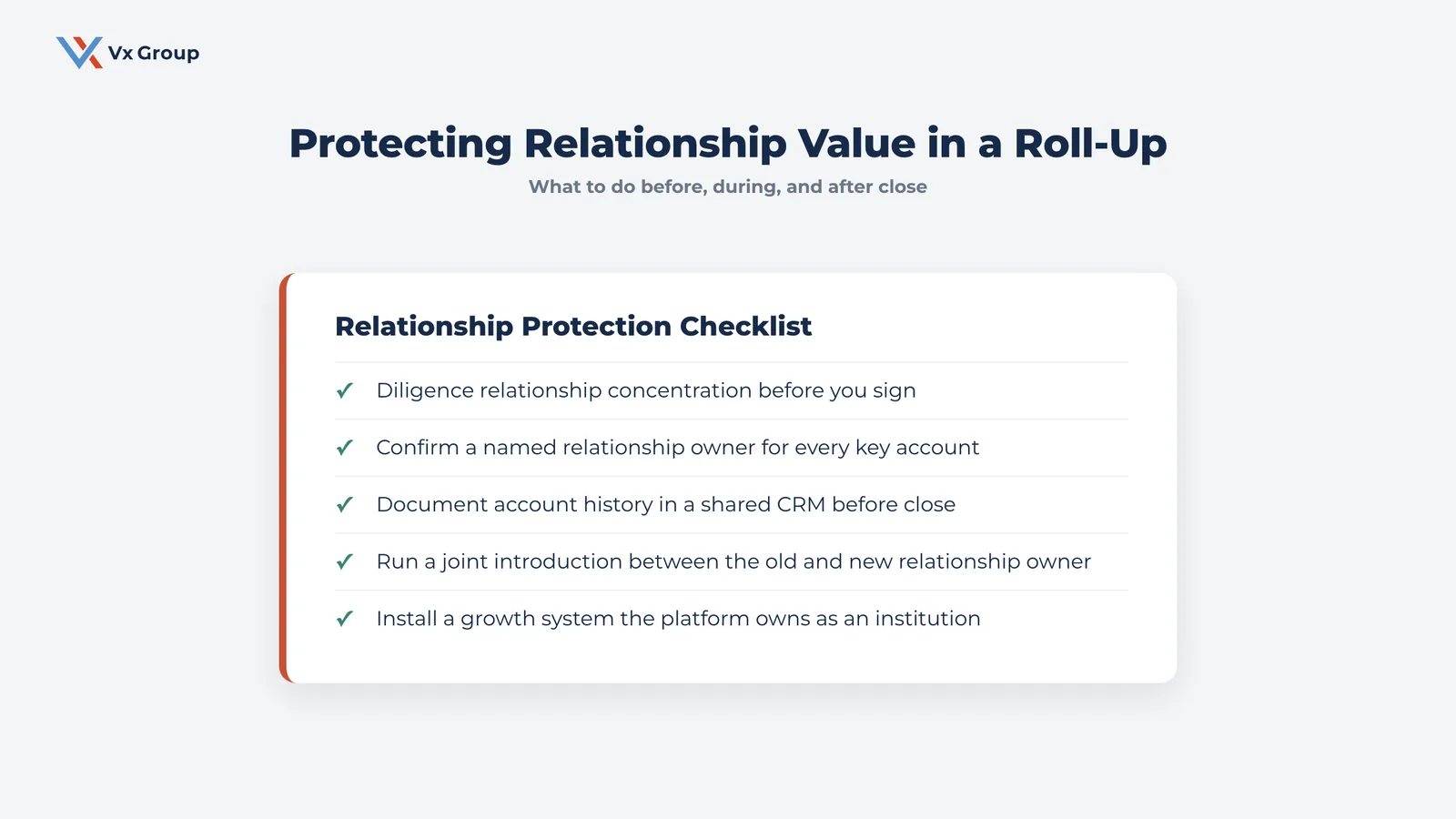
Protecting relationship value in a roll-up takes three deliberate moves: check how much revenue rides on one person before you sign, document the relationships you’re buying, and install a growth system the platform owns rather than leaving it with any one person. None of the three is complicated. All three are easy to skip when a deal is moving fast.
Check how much revenue rides on one person before you sign
Before closing, find out exactly how much revenue sits with each customer, and exactly who at the target company owns that relationship. Before you sign, get answers to:
- What percentage of revenue comes from the top five accounts?
- How many of those accounts have a relationship with only one person at the company?
- How long has that person held the relationship, and how close are they to retirement, burnout, or an earnout payday?
- Has the target company ever lost a top account before, and what caused it?
Defined Term: Relationship concentration.
The share of a company’s total revenue that sits with accounts controlled by just one person, whether that’s a founder, an account manager, or a single longtime salesperson. The higher the number, the more revenue is at risk if that person leaves.
Turn the first two answers into that single working number. A target where 40 percent of revenue sits with three accounts, each managed exclusively by a founder planning to leave after close, carries a fundamentally different risk profile than a target with the same revenue spread across a documented account team.
Most buyers check overall revenue by account and stop there, without ever connecting that revenue back to the one person holding each relationship.
Document the relationships you’re buying
Once the deal is signed, get the account knowledge out of individual heads and into a system before the transition creates any reason for a customer to reconsider. That means building, for every top-20 customer:
- A written account profile: who the actual decision-makers are, what they buy, why they buy it, and what has almost caused them to leave in the past.
- Contact history captured in a shared CRM that every relevant person on the team can access, so account history stops living in one person’s inbox or paper files.
- A named internal relationship owner for every key account, confirmed as part of the deal itself, before close.
- A joint introduction plan, where the departing or transitioning contact personally introduces the new relationship owner to the customer in person or on a call, so the customer hears about the change from someone they already trust.
This work is not glamorous, and it rarely makes it into a 100-day integration plan built around systems and cost savings. It is also the single most valuable step available for protecting the revenue the deal actually paid for.
Install a growth system the platform owns
The long-term fix is structural. A roll-up that depends on documentation alone will drift back into founder-dependence the next time a key person leaves, because documentation is a one-time snapshot and relationships keep evolving after it is written down.
A growth system, owned by the platform as an institution, keeps that information current: a defined contact cadence for every key account, a shared record of relationship health, and a clear owner for every account that survives personnel changes without depending on whoever happens to hold the relationship this year.
Platforms that install this early treat every subsequent acquisition the same way, which is also how the integration playbook from earlier in this article gets built.
Protecting relationship value and building repeatable integration are, in practice, the same discipline applied to two different problems, and both feed directly into what actually drives value in a company after the deal closes, long after the closing paperwork is filed away.
Relationship risk does not show up on the same timeline as integration risk. A botched systems integration surfaces in month three. A lost account because no one transferred the relationship can take a year or more to show up, often first as a competitor showing up in an RFP the platform was not expecting to lose.
Where roll-up value really comes from
A roll-up strategy is a bet that a combined platform is worth more than the sum of its parts. That bet only pays off if the parts being combined still work the way they did before the deal, which for most of these businesses means the customer relationships that generated the revenue in the first place.
Buying five companies and losing three of their top accounts in the transition produces a platform worth less than the sum of its parts, carrying a much larger integration bill on top of the lost revenue. The roll-ups that compound are run by teams who treat relationship continuity as seriously as the integration plan and the exit multiple.
That means checking past the revenue number to who actually owns it, documentation that survives a founder’s earnout and departure, and a system the platform owns that keeps every account relationship visible long after the ink on the deal is dry.
None of this shows up as a separate line item in a deal model, which is exactly why it gets skipped under deal timeline pressure. Those extra questions before you sign take a few extra days. The documentation work takes a few weeks per acquisition. The growth system takes longer to install than either. Measured against the cost of losing even one of the accounts the deal was underwritten on, all three are cheap.
Ready to grow?
See how a growth system protects relationship value in your next roll-up or bolt-on.
FAQs
About the Author: Eric Zoromski
