

Thought Leadership as a B2B Growth Strategy: What It Is and Isn’t

Thought leadership is a documented point of view, published on a fixed schedule, that earns a buyer’s trust before your sales team ever makes contact. Occasional LinkedIn posts and conference talks rarely build that kind of trust on their own, because they lack the specificity and consistency a real reputation requires. Done with intention, thought leadership shortens long B2B sales cycles by doing the credibility-building work that would otherwise happen, slowly and inconsistently, across a dozen sales calls.
TL;DR
- Thought leadership works as demand generation when it has a specific, differentiated point of view. Generic “insights” content does not move pipeline.
- The search term “thought leadership PR strategy” gets about 40 searches a month, and the top-ranking competitor content is thin. The people running that search are decision-makers doing real diligence.
- Content marketing informs. PR earns coverage. Thought leadership builds a reputation attached to a named person or company, and that reputation is what shortens the sales cycle.
- Most companies fail at this because they publish sporadically, chase virality instead of specificity, and never connect the content to an actual sales conversation.
- A real thought leadership strategy can be built and tested in 90 days, without a PR retainer or a content team.
What is a thought leadership PR strategy?
A thought leadership PR strategy is a deliberate plan to build a company’s or executive’s reputation around a specific point of view, using owned content (articles, LinkedIn posts, speaking) and earned coverage (press, podcasts, guest features) working together toward the same message. The “PR” half is the distribution and third-party validation. The “thought leadership” half is the actual point of view being distributed.
Defined Term: Thought Leadership. A documented, differentiated point of view on a specific problem, published consistently enough and specifically enough that buyers associate the company or executive with that point of view before they ever speak to sales.
Most companies searching for a “thought leadership PR strategy” already sense that a generic content calendar will not do this. They are right. A content calendar produces volume. A thought leadership strategy produces a reputation, and a reputation is the thing that gets a company invited into conversations it would otherwise have to cold-call its way into.
For relationship-driven B2B companies, this matters more than it does for transactional businesses. Sales cycles run six, twelve, eighteen months. A distributor, a PE investor, and an executive buyer often all weigh in before a deal closes, and each one does their own homework first. A company researched before a first call needs to show evidence that it understands the buyer’s problem better than the last five vendors who pitched them, and a slogan does not do that.
Why do most B2B thought leadership efforts fail to generate pipeline?
Most B2B thought leadership fails because it is random acts of marketing wearing a nicer outfit. A founder posts on LinkedIn when they feel like it, a marketing team ghostwrites something generic once a quarter, and nobody connects any of it to a specific buyer’s problem. The activity looks like thought leadership. It functions like noise.
Three patterns show up again and again in companies that treat thought leadership as a vanity project instead of a growth strategy:
- No point of view, just observations. The content restates industry trends everyone already knows (“AI is changing B2B sales”) instead of taking a position on what to do about it. Buyers cannot cite a restated trend to their boss. They can cite a specific, arguable claim.
- No consistency. Fifteen posts in one active month, then silence for a quarter. Reputation compounds the way relationships do, which means it requires a steady cadence sustained over months.
- No connection to the sales conversation. The content exists on a separate track from the sales process. Nobody on the sales team references it, links to it, or uses it to reframe an objection. It sits on the website earning traffic and doing nothing for pipeline.
- Borrowed opinions instead of earned ones. A lot of “thought leadership” is a summary of what three other people already said, restated in the company’s own words. Buyers can tell. A point of view built from what the company has actually observed inside its own client work reads differently than a rehash of someone else’s framework, and it is the difference between content that gets forwarded and content that gets scrolled past.
The fix requires a narrower, sharper point of view, published on a cadence the company can actually sustain, with a direct line from the content to the sales conversations it is supposed to be shortening. Adding more content without fixing those three problems only produces more noise.
What is the difference between thought leadership, PR, and content marketing?
The three overlap in practice but do different jobs, and confusing them is a common reason companies invest in the wrong one. Content marketing informs and educates at scale. PR earns third-party validation through press and media placement. Thought leadership builds a reputation around a specific point of view, and it is the only one of the three that a buyer remembers as belonging to a person or company rather than a publication.
| Primary job | Owned or earned | What buyers take away | |
|---|---|---|---|
| Content marketing | Educate at scale, support SEO and top-of-funnel traffic | Owned | “This company explains things clearly.” |
| PR | Earn third-party coverage and validation | Earned | “A publication I trust mentioned this company.” |
| Thought leadership | Build a reputation around a specific, differentiated point of view | Owned and earned together | “This person or company sees the problem the way I do, and I trust their read on it.” |
Content marketing and PR are both useful. Neither one, on its own, does the specific job that shortens a long B2B sales cycle: making a buyer feel, before the first call, that they already understand and trust how a company thinks. That is thought leadership’s job, and it is why a company can run an excellent content marketing program and still have zero real thought leadership.
The search data backs this up. The current top-ranking content for “thought leadership PR strategy” comes from a competitor sitting at position 99, which is to say barely ranking at all. Search volume is modest at roughly 40 searches a month, but the people running that search are not casual readers. They are operators and executives trying to figure out how to do this correctly, which makes this one of the clearer openings in B2B brand strategy work: low competition, high buyer intent, and a topic almost nobody has covered with any real specificity.
Ready to grow?
About building a thought leadership strategy tied directly to your sales cycle.
How does thought leadership shorten B2B sales cycles?
Thought leadership shortens sales cycles by moving the trust-building work earlier, into a stage where the buyer is reading on their own time instead of sitting across from a salesperson who has fifteen minutes to make an impression. A buyer who has already read a company’s point of view on their exact problem walks into the first call asking sharper questions instead of asking the company to explain what it does.
This is where the connection to what B2B growth consulting actually solves for gets concrete. Long, relationship-driven sales cycles do not compress because a salesperson talks faster. They compress because less of the cycle has to be spent establishing basic credibility, and thought leadership is the mechanism that does that work in advance, at scale, without a salesperson in the room.
Three specific ways this plays out:
- It pre-answers objections. A well-argued piece on why a common approach fails removes that objection before a prospect raises it on a call.
- It earns the right conversation. A distributor, PE operating partner, or executive buyer who has read a company’s actual reasoning is more willing to have a substantive first call instead of a scripted discovery call.
- It travels without the company in the room. A buyer forwards an article to a colleague. A salesperson cannot forward themselves. Content extends the company’s argument into rooms it was never invited to.
None of this requires virality. A single well-argued piece, read by the three or four people who actually influence a buying decision, does more for a sales cycle than ten thousand anonymous LinkedIn impressions.
What does a real thought leadership strategy look like for a B2B company?
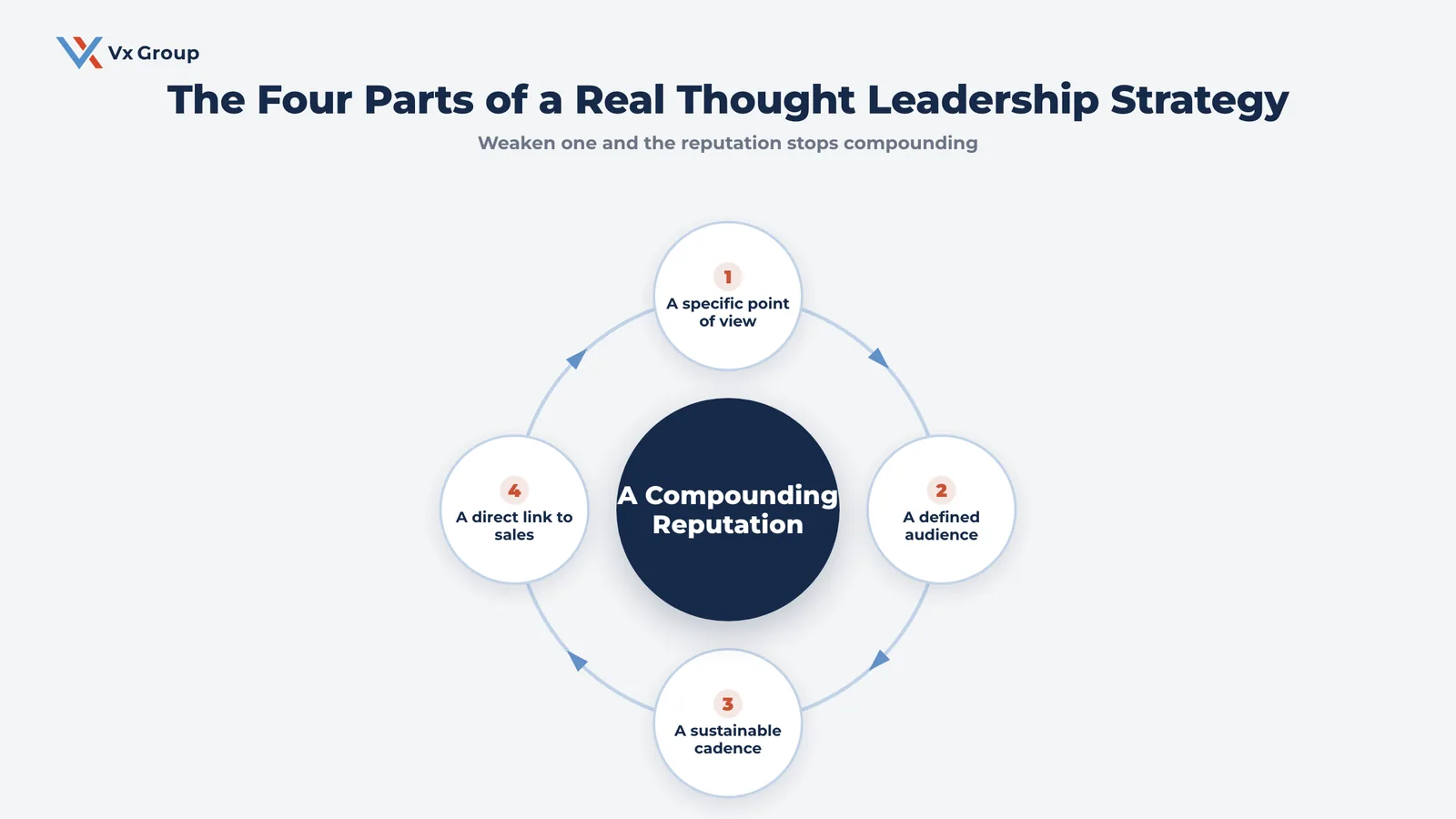
A real thought leadership strategy has four components working together: a specific point of view, a defined audience, a sustainable cadence, and a direct link to the sales process. Remove any one of the four and the strategy degrades back into random content.
What makes a point of view specific enough to work?
A vague claim like “we care about customer relationships” commits to nothing and earns no attention. An arguable claim does the job instead: “Most B2B companies measure trade show success by badge scans, and that is why their trade show ROI looks bad.” Vague statements that nobody would disagree with are platitudes, and platitudes have nothing specific enough to repeat.
How do you define the right audience for B2B thought leadership content?
Owner-operators, PE operating partners, and hired CEOs read differently and respond to different proof. An owner-operator wants a peer’s hard-won judgment. A PE operating partner wants a framework they can apply across a portfolio. A hired CEO wants language they can reuse in a board update. Writing for all three at once produces content that lands with none of them, which is why the audience has to be picked before the first sentence gets written.
What cadence should a B2B company publish thought leadership content on?
Weekly is better than monthly. Monthly, done consistently for a year, beats weekly for six weeks followed by silence. A good quarter never tests the plan, so the company should pick the pace it can sustain during its busiest stretch, since that is the real test of whether the cadence holds.
How do you connect thought leadership to the actual sales process?
Sales should know which pieces exist, when to send them, and which objections each one answers. If sales cannot name three pieces off the top of their head, the content and the sales process are not actually connected, and the strategy is running as a marketing initiative instead of a growth lever.
Defined Term: Reputation Compounding. The effect where a consistently published point of view becomes more valuable over time, because each new piece adds to a body of work buyers can reference instead of starting the trust-building process over from zero with every new prospect.
These four pieces reinforce each other, and weakening any one of them weakens the others. A sharp point of view aimed at the wrong audience earns attention from the wrong people. A well-targeted argument published sporadically never compounds into a reputation. A consistent cadence with no link to sales produces a company blog with healthy traffic and no measurable effect on revenue. The strategy works as a system. Four separate initiatives assigned to four separate people who never compare notes will not produce the same result.
An ideal customer profile does double duty here. It defines who the company should sell to, and it defines who the thought leadership should be written for. A company that has not done this work tends to write generic content because it has not decided, specifically, whose respect it is trying to earn.
How do you measure whether thought leadership is working?
Thought leadership is working when it changes the substance of sales conversations. Pageviews and follower counts are the easiest numbers to pull, and they are also the least useful for judging whether the strategy is doing its actual job.
| Signal | What it tells you | How to track it |
|---|---|---|
| Inbound requests referencing specific content | Buyers are self-selecting based on the point of view | Ask “how did you hear about us” and log the answer |
| Sales citing content mid-cycle | The content is doing real work in live deals | A shared tracker sales updates after calls |
| Replies and DMs from named buyers | The point of view is landing with the right audience | Manual review of who actually engaged |
| Time from first contact to substantive conversation | The sales cycle is actually compressing | Compare cycle length for leads who engaged with content versus those who did not |
| Repeat engagement from the same accounts | A reputation is taking hold with specific buyers | Track engagement at the account level |
Vanity metrics (likes, impressions, follower growth) are not worthless, but they are lagging noise if nothing on this table is moving. A piece with modest reach that gets forwarded inside three target accounts and referenced on two sales calls has done its job. A piece with ten thousand impressions and zero downstream sales impact has not, regardless of how it performs in a monthly report.
What are the most common mistakes companies make with thought leadership?
The most common mistake is treating thought leadership as a content volume problem instead of a point-of-view problem. Companies hire a ghostwriter, commit to a posting schedule, and wonder six months later why none of it produced a single qualified conversation. Volume without a specific argument produces noise instead of a reputation.
Other patterns worth naming directly:
- Writing to impress peers instead of buyers. Content optimized for industry-insider approval rarely resonates with the operator actually deciding whether to hire the company.
- Chasing every platform at once. Five channels run at 20% effort each lose to two channels run at full effort. Depth on the channels a buyer actually reads beats breadth across ones they do not.
- Outsourcing the entire point of view. A ghostwriter can capture a voice, but they cannot invent conviction the company does not already have. The argument has to come from someone who has actually lived the problem, and no amount of skilled writing substitutes for that.
- No connection to B2B demand generation. Thought leadership that never feeds a nurture sequence, a sales conversation, or a follow-up email is a reputation-building exercise with no mechanism for converting that reputation into pipeline.
- Abandoning it before it compounds. Paid ads produce results on a schedule. Reputation builds slowly, and then, if the point of view is sharp and the cadence held, it produces inbound interest that looks sudden but was months in the making. Companies that quit at month three never see month nine.
What channels actually work for B2B thought leadership?
The channels that work for B2B thought leadership are the ones a buyer already trusts, which is usually a mix of one owned channel for depth and one or two earned or borrowed channels for reach. Chasing every platform at once is a common way companies dilute a point of view that would otherwise land.
| Channel | Best for | Trade-off |
|---|---|---|
| LinkedIn (personal profile) | Owner-operators and executives building a personal reputation buyers can follow directly | Only works when a specific named person posts consistently |
| Company blog or Insights hub | AEO and long-term search value, and arguments too long for a social post | Slower to build an audience without a distribution channel driving traffic to it |
| Podcast guesting | Borrowed credibility from an established host’s existing audience | Depends on being invited, and it is intermittent rather than scheduled |
| Trade press and bylined articles | Third-party validation from a publication the buyer already trusts | Slower production cycle and editorial gatekeeping |
| Speaking at industry events | Direct access to a concentrated, high-intent room | Infrequent, and reach is capped by the size of the room |
A branded company LinkedIn page can amplify a point of view. It cannot originate one, because a reputation attaches to a specific named person instead of a company logo. The companies that build real thought leadership almost always route it through a specific named executive first, then repost and support it through the company’s other channels.
Who should be the face of a company’s thought leadership?
The face of a company’s thought leadership should be the person closest to the actual point of view, which is usually the founder, CEO, or the executive who has personally lived the problem being written about. Buyers extend trust to specific people they can name instead of a department or a brand account, and a reputation built around an anonymous “company voice” undercuts the entire mechanism that makes thought leadership work.
This does not mean only one person can ever publish. It means each voice needs its own specific lane instead of rotating through generic company updates. An operations leader writing about what actually breaks during a system rollout carries more weight than a marketing team writing about it secondhand, because the reader can tell the difference between someone who did the work and someone who interviewed the person who did.
Smaller, owner-led companies often resist putting the founder’s name on content, worried it looks self-promotional. The opposite risk is larger: content published under no one’s name in particular reads as marketing collateral, and marketing collateral does not earn the kind of trust a buyer extends to a specific, credible person willing to put their name on an argument.
Does a B2B company need a PR budget or agency to do this well?
A B2B company does not need a PR retainer to start a thought leadership strategy. The point of view, the writing, and the first year of publishing are work a founder, CEO, or in-house marketing lead can do directly, and doing it directly is often what keeps the voice specific instead of sanded down into agency-safe language.
A PR agency earns its budget at a different stage: once a point of view is established and the goal shifts to earned coverage at scale, journalist relationships, and placement in publications the company cannot reach on its own. Hiring that support before the point of view exists usually produces polished press releases with nothing distinctive inside them, because an agency can distribute an argument but it cannot manufacture one that was never there.
| Situation | Where to focus first |
|---|---|
| No documented point of view yet | Build the argument internally before spending on distribution |
| A point of view exists but reach is capped | Add owned channels (LinkedIn, the company blog) before hiring outside help |
| The point of view is working and needs earned press at scale | This is where a PR agency or freelance publicist starts to pay for itself |
| A single executive needs media training for interviews | A narrow, short-term engagement instead of a full retainer |
The search term “thought leadership PR strategy” tends to attract two different searchers: companies looking to hire this out immediately, and companies trying to understand what the term even means before they spend anything. For the vast majority of relationship-driven B2B companies, the honest answer is to build the point of view first, prove it moves sales conversations, and only then decide whether an agency retainer buys enough additional reach to justify the cost.
How do you build a thought leadership strategy in 90 days?
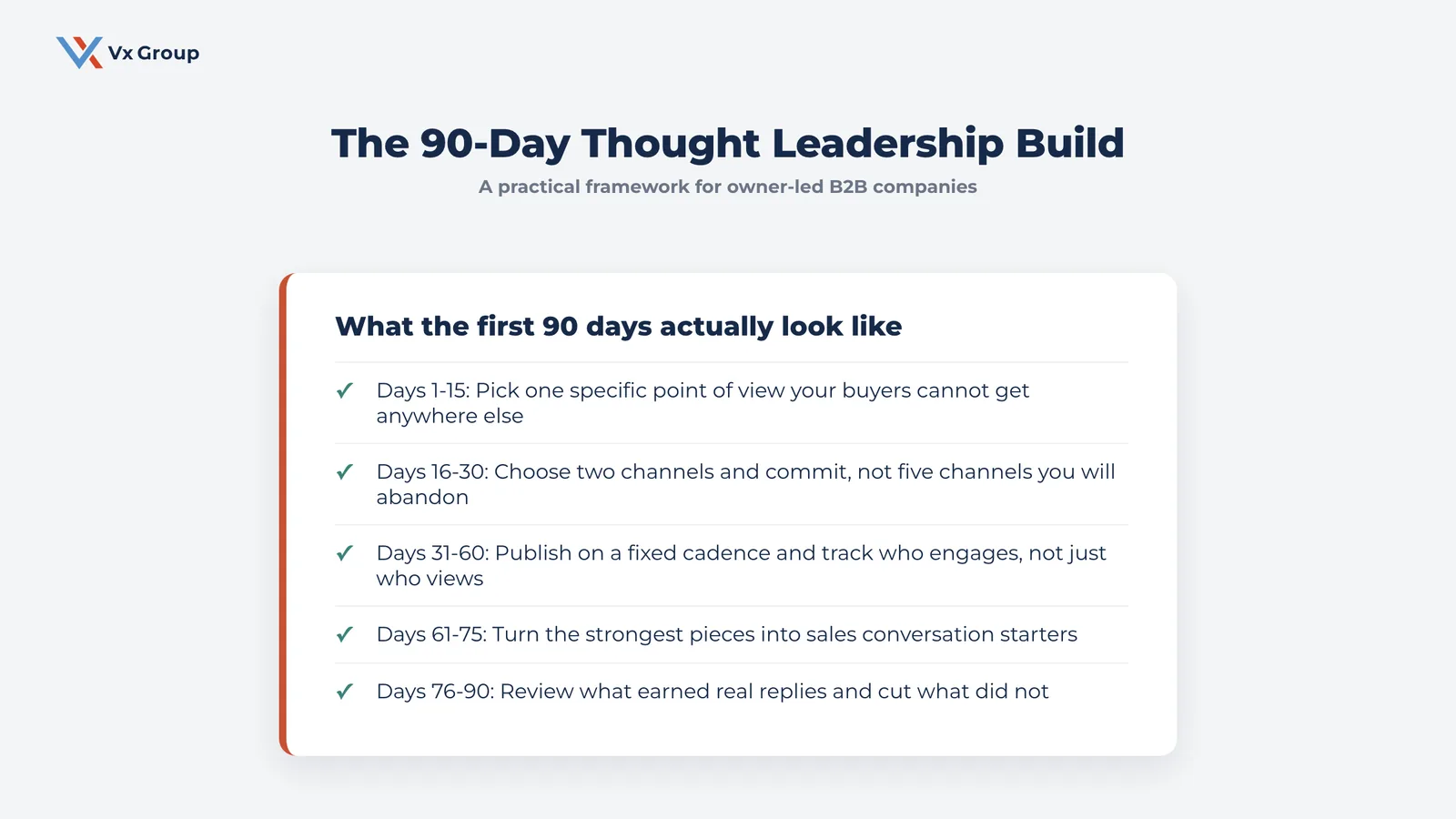
A B2B company can stand up a working thought leadership strategy in 90 days by narrowing scope early and testing before scaling. The mistake most companies make is trying to build the full program (five channels, a content calendar, a PR retainer) before testing whether the underlying point of view actually resonates with anyone.
What should the first 30 days of a thought leadership strategy focus on?
The first 30 days are about narrowing the point of view before publishing anything. Most companies skip straight to publishing and end up with content that says everything and commits to nothing. Picking one specific point of view and one or two channels forces the discipline that a scattershot approach never will.
What happens during days 31 to 60 of the build?
Days 31 to 60 are where consistency starts to matter more than quality. A cadence held for a month, even an imperfect one, teaches a company more about what resonates than a single polished piece ever will. This is also the point where sales should start seeing the content and flagging which pieces are actually useful in real conversations.
How do the final 30 days connect the content to revenue?
The final 30 days are about connecting the content to revenue and being honest about what worked. Not every piece will land. The ones that get forwarded, replied to, or cited on a sales call are the signal. The ones that got published and disappeared are the noise, and they should be cut rather than defended.
Defined Term: Field Notes
A mid-sized industrial distributor spent two years posting generic “5 tips” content with no measurable impact on pipeline. When they narrowed to a single point of view (that their industry’s standard warranty terms actively worked against the buyer) and published it consistently for one quarter, their sales team reported it came up unprompted in three separate late-stage conversations. This example is illustrative, built from patterns Vx Group has observed across engagements instead of a single verified case study.
Thought leadership rewards a real point of view, held consistently
The companies that get this right treat thought leadership the way they treat their most valuable customer relationships: with intention, consistency, and a clear sense of who they are trying to earn trust with. The companies that get it wrong treat it as one more marketing checkbox, and their results reflect exactly that level of commitment.
A specific point of view, published on a cadence the company can sustain, connected directly to the sales process, is worth more than any volume of generic content. It is also one of the few growth levers available to a B2B company that does not require a bigger ad budget, a bigger sales team, or a bigger anything. It requires a real opinion and the discipline to keep saying it, publicly, on a schedule, long after the first few posts stop feeling novel.
For an owner-led company sitting on twenty years of hard-won judgment about its own industry, that opinion already exists. It usually just lives in the founder’s head, repeated one prospect at a time on sales calls, instead of published where the next hundred prospects can find it before they ever pick up the phone.
Ready to grow?
About building a thought leadership strategy tied directly to your sales cycle.
Subscribe to Insights → for more on what actually drives growth in relationship-driven B2B companies.
FAQs
About the Author: Jacob Camhi
