

What Is B2B Growth Consulting (And When Does Your Company Actually Need It)

B2B growth consulting helps established companies build a structured, repeatable approach to growing revenue from the right customers. It differs from marketing agencies and sales training by addressing the whole system: strategy, team structure, customer focus, and the relationships that drive long-term revenue. Companies typically need it when growth has stalled, plateaued, or become too dependent on a few key accounts or individuals.
TL;DR
- B2B growth consulting addresses the system behind growth, not just individual tactics or channels
- The right time to engage is before a crisis, not during one
- Most stalled companies lack a clear picture of where they actually win, not the will to act on it
- The consultant’s job ends when the leadership team can run the growth system without them
- Company size, ownership model, and revenue concentration all affect which type of engagement makes sense
What does a B2B Growth consultant actually do?
A B2B growth consultant helps companies figure out why growth is stalling, where it is actually coming from, and how to build a system that produces it reliably. The starting point is almost always the same: clarity before activity.
Most companies that call a growth consultant are not short on effort. They have people working hard, campaigns running, sales conversations happening. What they are missing is a clear picture of which customers they win, why those customers stay, and what would need to be true to grow that base intentionally. The consultant’s job is to surface that picture and help the leadership team act on it.
Unlike an agency, a growth consultant is not producing campaigns. Unlike a sales trainer, the focus is not on individual technique. A growth consultant works on the whole system: how the team is structured, which markets deserve priority, how new relationships are being developed, and whether the company’s brand and tools reflect the business it has become. The deliverable is a plan the leadership team can own and execute.
When does a B2B company actually need a growth consultant?
There are five situations where B2B companies reliably benefit from outside growth expertise, and most share a common thread: the people inside the business are too close to it to see the pattern clearly.
1. Growth has been flat for two or more years
Flat growth is often a structural problem, not a sales problem. Revenue concentrated in a handful of long-standing accounts, a sales approach built on referrals and reputation, no documented strategy for how new relationships get built and developed: these are signs the business has grown as far as its current architecture can take it. A consultant can identify which ceiling has been hit and what it would take to build past it.
2. Growth depends on one person
When the founder, the top salesperson, or a single account manager carries the majority of the company’s relationships, the business has a single point of failure. This pattern is common in lower-middle-market companies and genuinely dangerous. When that person takes a vacation or leaves, the company finds out how much of its revenue was personal rather than institutional. A growth consultant helps systematize what lives in someone’s head so the organization stops being held hostage to individual tenure.
3. The company is too dependent on a few key accounts
When 60 or 70 percent of revenue flows through two or three accounts, those relationships carry real risk alongside their value. A shift in purchasing, a leadership change on the customer’s side, or a competitive displacement can fundamentally threaten the business. Growth consulting helps companies develop the next tier of relationships with intention, so the business compounds rather than concentrates.
4. A PE firm or board is asking for a growth plan that does not exist yet
Many privately held companies operate without a documented growth strategy. The founders know intuitively how the business wins, but that knowledge has never been formalized into something the full leadership team can execute against. When a private equity partner, a new board member, or a potential acquirer asks for a growth plan, the absence of one becomes visible fast. A growth consultant helps leadership get that clarity documented before external pressure makes it urgent.
5. The company is preparing for a significant transition
Ownership transitions, leadership succession, geographic expansion, and major investment decisions all require a clear-eyed picture of how the company grows and what its growth depends on. A growth consultant helps leadership stress-test the business before the transition.
Key concept: Generational Customer
In relationship-driven B2B companies, a small number of long-standing clients often represent a disproportionate share of both revenue and trust. These accounts are the proof of concept for what ideal growth looks like. Understanding why they chose the company, why they stayed, and what made them expand is the foundation of any serious growth strategy. Most companies have never studied this pattern. Growth consulting starts there.
What separates a good B2B growth consultant from a bad one?
They diagnose before they prescribe
A growth consultant who leads with their solution before understanding your situation is a red flag. Good consultants ask a lot of questions first: how the business grows today, who the best customers are and why, how the team is structured, where the real constraints are. The diagnosis takes time, and anyone who skips it is selling a product rather than solving a problem.
They work on the system, not just the tactics
Tactics are easy to sell and easy to escape accountability for. When a strategy fails to produce results, a tactic-first consultant can always point to a list of things the client did not execute perfectly. A consultant who works on the system takes a different kind of responsibility: building something the company can run independently, rather than creating an ongoing dependency.
They transfer capability rather than create dependency
The goal of a serious growth engagement is to leave the leadership team better equipped than they were before. After the engagement, the company should understand its ideal customers more clearly, know how new relationships get built and developed, and have the tools and documentation to run that process without outside support. A consultant who is structurally motivated to extend the engagement indefinitely has the wrong incentives.
They have worked inside companies like yours
B2B growth strategy for a $20M industrial manufacturer operates differently than growth strategy for a software company. The sales cycles are longer, the relationships are older, the buying decisions are more complex. Consultants who have real experience inside these types of companies bring pattern recognition that no generic framework can replicate.
Key concept: Compounding Architecture
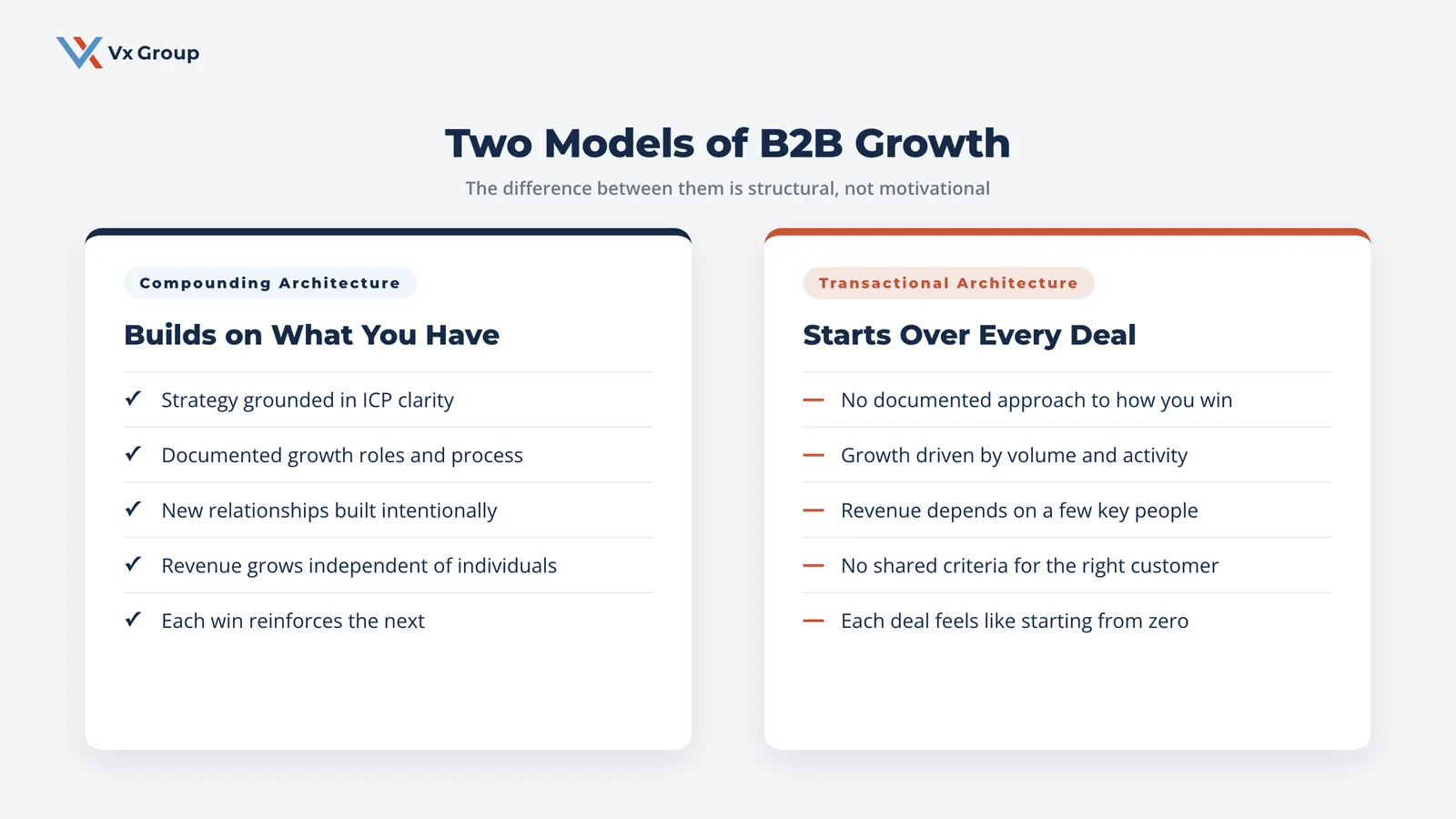
Companies that grow intentionally build a Compounding Architecture: a system where every customer relationship, every interaction, and every team member’s effort builds on what came before. Companies running on Transactional Architecture start each deal from zero, with growth driven by volume rather than depth. These two models have very different ceilings, and the difference between them is structural, not motivational.
Ready to grow?
Bring in a growth consultant who installs a system and transfers it, instead of advice that fades.
What should a B2B growth engagement actually produce?
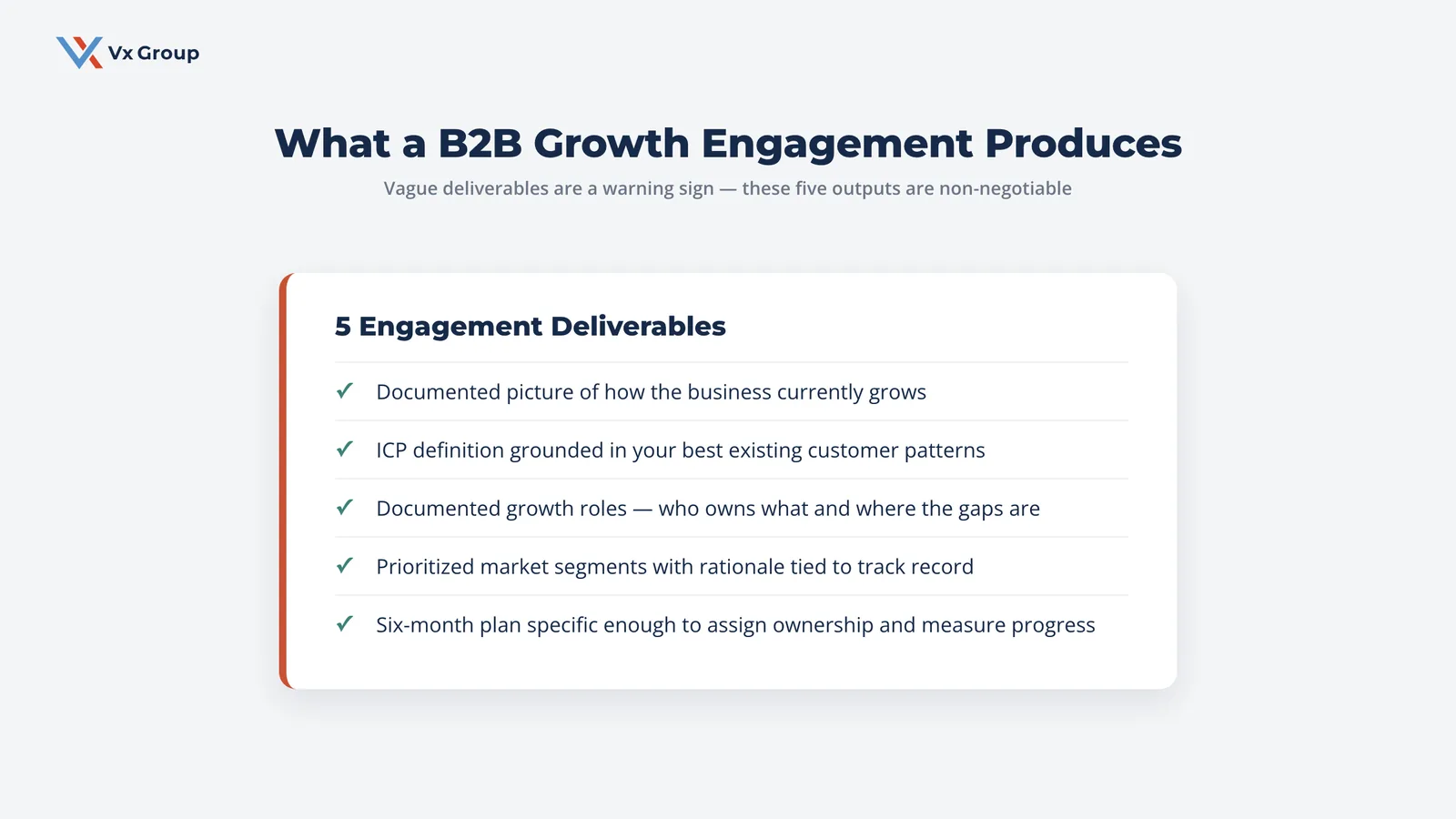
Vague deliverables are a warning sign. Any serious growth engagement should produce outputs the leadership team can put to work:
- A documented picture of how the business currently grows, including revenue streams, customer concentration, and team structure
- A clear definition of the ideal customer profile, grounded in the patterns of the company’s best existing relationships rather than a generic demographic description
- Documented growth roles: who is responsible for developing new relationships, who owns existing account expansion, and where the gaps are
- A prioritized list of markets or segments to focus on, with a rationale tied to where the company has the strongest track record
- A plan for the next six months, specific enough to assign ownership and measure progress
A marketing campaign, a new website, and a social media strategy are not on this list. Those may follow. The growth consulting engagement itself produces the clarity that makes everything downstream more effective.
How much does B2B growth consulting cost?
Project-based engagements
A fixed-scope engagement that produces specific deliverables over a defined period. For most companies, this is the right entry point: a clear picture of what is being delivered, what it will cost, and when it ends. A structured six-week discovery and strategy engagement typically runs $8,000 to $15,000, depending on company complexity and depth of output.
Ongoing advisory retainers
Monthly retainers work well when a company is in active execution against a growth plan and wants outside perspective to stay on track. This model is less appropriate as a first engagement, because there is no defined endpoint and therefore less accountability for outcome. Retainers range from $3,000 to $20,000 per month.
Performance-based arrangements
Some consultants tie compensation to revenue or pipeline outcomes. This sounds appealing but creates a structural problem: growth in relationship-driven businesses is slow to materialize and hard to attribute cleanly. A consultant who needs a quick win to trigger their compensation has an incentive to push for short-term activity over long-term relationship quality. Be cautious with this model unless the metrics and timeline are precisely defined.
What questions should you ask a B2B growth consultant before engaging?
- What does the engagement produce, specifically? Ask to see an example of a deliverable, not just a description of one.
- How do you measure success, and on what timeline?
- Who has primary ownership of the work, and who will you actually be working with day to day?
- What do you need from our leadership team for this to work?
- After the engagement ends, how should the company be able to run the growth system without you?
- What types of companies have you worked with that are similar to ours, and what did the outcome look like?
A consultant who answers these questions directly is worth a next conversation. One who pivots to a pitch before answering them probably does not have the answers.
B2B growth consulting vs. a marketing agency: what is the difference?
Marketing agencies execute campaigns, manage paid media, produce content, and run digital programs. Their accountability is to activity and output: impressions, clicks, leads generated. They are rarely responsible for whether those leads become long-term customers, and they are not working on the team structure, sales process, or customer strategy that determines whether any of that activity converts.
A B2B growth consultant works at the level of strategy and system, alongside the leadership team rather than the marketing manager. The deliverable is a plan the leadership team can execute, built around a clear understanding of who the right customers are and how to develop them. Many companies need both functions. The failure mode is confusing one for the other: an agency engaged when strategy is what is actually needed produces activity without direction, and a consultant engaged when execution capacity is what is needed produces clarity.
The right growth consultant changes the trajectory of the business
Companies that get the most from B2B growth consulting tend to recognize the pattern early: growth is plateauing, the strategy is undocumented, the business is too dependent on a few relationships, or the next phase requires a different approach than what worked before. Bringing in outside perspective on those questions is a sign that the leadership team is serious about growing with intention. The right consultant brings a framework, a clear process, and the objectivity that comes from having worked inside dozens of companies facing the same challenge.
Ready to grow?
Get an outside operator who changes your growth trajectory, not a deck that sits on a shelf.
FAQs
Sales training focuses on how individual salespeople interact with prospects and customers: techniques, messaging, objection handling. Growth consulting addresses the system those salespeople operate within: who they are calling on, how the company positions itself in its markets, and how relationships are built and expanded over time. Both have a role, and sales training without a clear strategy tends to be the harder road.
Companies in the $5M to $100M revenue range tend to benefit most. They have enough complexity to make the work meaningful and enough leadership access to make it actionable. Enterprise companies have different dynamics and typically require a different kind of consulting support.
Yes, and PE-backed companies are a common client profile. The dynamics differ slightly: a defined hold period, board-level growth expectations, and sometimes a leadership team that is new to the business. The most useful engagements in this context focus on building a Growth System the leadership team can own and execute against a defined set of targets, rather than producing strategic analysis that sits in a deck.
A structured discovery and strategy engagement typically runs four to eight weeks. Execution-focused advisory work that follows a clear strategy can run six to twelve months. Companies that engage a consultant for years without a defined endpoint usually lack a clear deliverable in mind. Define the output before the duration.
No. Many companies that benefit most from growth consulting are the ones without a formalized team yet. The engagement helps define what the team should look like, what roles need to exist, and in what order to build them. A large marketing team executing against an unclear strategy tends to compound the problem rather than solve it.
About the Author: Eric Zoromski
