

How to Increase EBITDA Without Cutting Headcount

To increase EBITDA without cutting headcount, point your team’s time at four things: selling more to your best accounts, fixing price and product mix, cutting rework and rush freight, and holding overhead flat while revenue grows. Cutting people raises EBITDA once. These four levers raise it every year.
TL;DR
- Cutting a position lowers payroll once. Revenue and margin gains from the same people compound each year.
- In one illustrative example, three managers freed one day a week. Cutting that time saves about $432,000 over five years. Using it on key accounts adds about $2M a year of EBITDA by year five.
- Four levers raise EBITDA on the team you already have: more sales to top accounts, better price and mix, less rework and rush freight, and flat overhead.
- Start by logging where your best people lose hours to detail work, then price those hours.
- Track the result with a short weekly, monthly, and quarterly routine, and review it at 90 days.
- The numbers in this guide are examples. Replace them with your own.
Most owners know the fast way to raise EBITDA. Take out a salary and the number moves the next month. The trouble is that it moves once.
The second year looks the same as the first, minus one person. If that person was the one who called your biggest customers about next year’s volume, the loss can cost more than the salary saved.
This guide is for owners and presidents of privately held manufacturers, roughly $5M to $50M in revenue. It shows four ways to raise EBITDA with the team you have, and how to set up the numbers so you can see the result.
What does it mean to increase EBITDA?
To increase EBITDA means to raise your earnings before interest, taxes, depreciation, and amortization. In plain terms, EBITDA is the profit your operations make before financing and accounting charges. Lenders and buyers use it to size a company.
Defined Term: EBITDA.
Earnings before interest, taxes, depreciation, and amortization. It starts with net income and adds those four items back, so it shows what the operation earns from making and selling product.
You can raise EBITDA in only three ways: earn more revenue, keep more of each sales dollar, or spend less to run the business. Each lever in this guide fits one of those three.
Some searches use the term “EBITDA improvement” for the same idea. Either way, the work is the same: change something in operations that shows up in the number every period.
Why does cutting headcount raise EBITDA only once?
Cutting headcount lowers payroll one time. After that, the cost line sits at a new lower level and stops improving. Growth in revenue and margin adds to EBITDA every year and compounds.
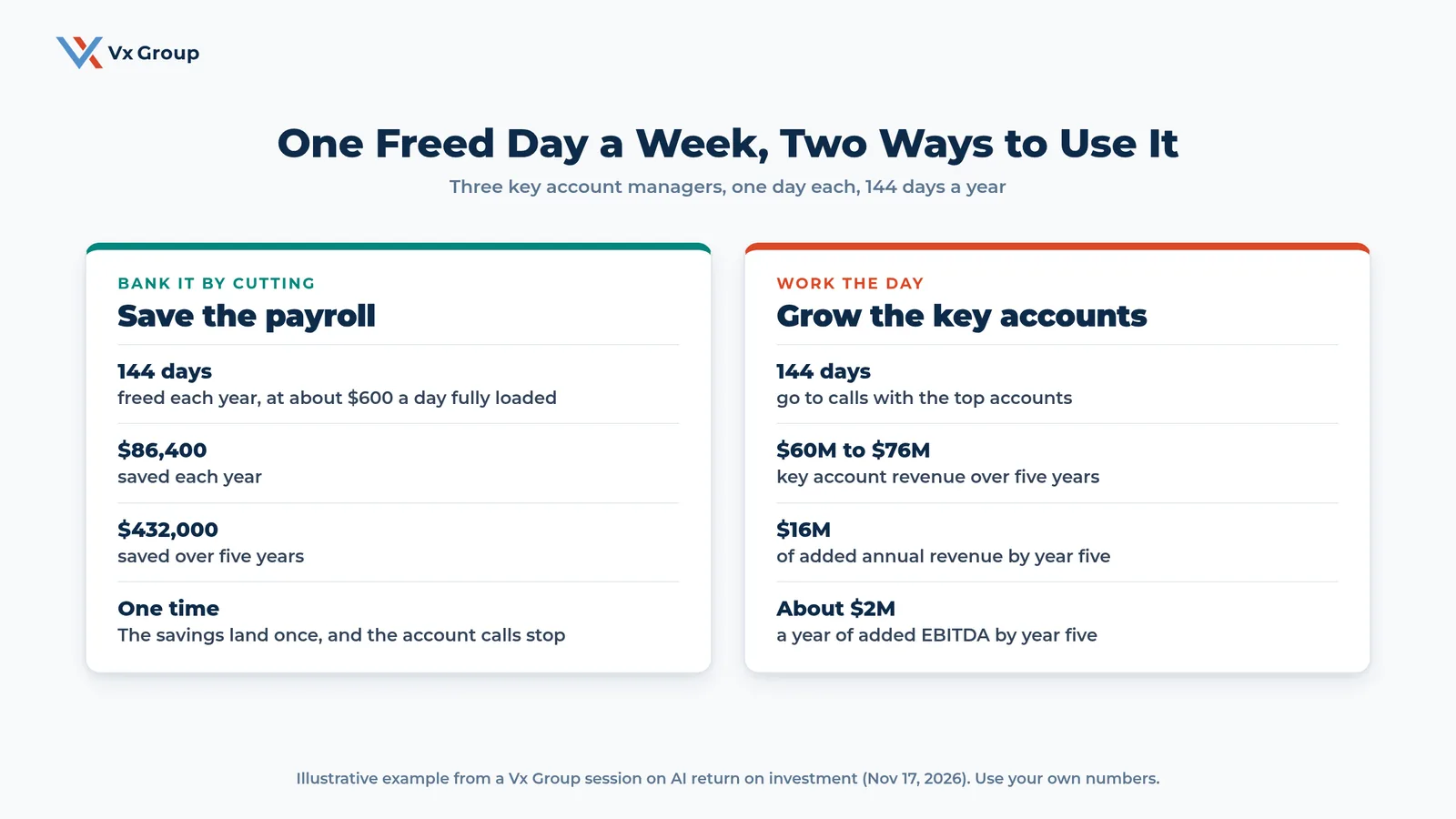
The graphic above compares the two paths. It comes from an example Eric Zoromski, the CEO of Vx Group, walked through in a Vx Group session on AI return on investment on Nov 17. Three key account managers each get one day a week back. That is 48 days a year each, or 144 days across the three.
Take the first path. At about $600 a day fully loaded, 144 days is $86,400 a year. Over five years, cutting that time saves about $432,000. The savings are real, and they land once.
Take the second path. The same 144 days go to calls with the key accounts. Those accounts grow from $60M to $76M over five years, which adds $16M of annual revenue. If the added revenue earns about 12.5% EBITDA, that is about $2M a year of added EBITDA by year five.
The example is illustrative, so use it to see the method and swap in your own figures. The gap is large because a freed day can be sold twice: once to payroll, or once to customers.
How much EBITDA does the growth path add over five years?
The growth path adds about $6M of EBITDA over five years in this example, compared with $432,000 from cutting. The $2M a year figure is where the year-five run rate lands, and the earlier years build toward it.
To check the math, assume revenue grows evenly. The $16M of added revenue then arrives at about $3.2M a year. At 12.5% EBITDA on the added sales, each year’s growth adds about $400,000 of EBITDA, and every earlier year’s gain stays in place.
| Year | Added revenue to date | EBITDA added that year |
|---|---|---|
| Year 1 | $3.2M | $0.4M |
| Year 2 | $6.4M | $0.8M |
| Year 3 | $9.6M | $1.2M |
| Year 4 | $12.8M | $1.6M |
| Year 5 | $16.0M | $2.0M |
| Five-year total | $6.0M |
This is an even-growth assumption chosen to make the arithmetic easy to follow. Real accounts grow unevenly, and some years will be better than others.
Two things matter in the table. EBITDA from growth builds on itself, because each year starts higher than the last. And a lender or buyer who values the business on EBITDA is valuing the run rate, so the $2M a year counts for more than the year it lands. Our guide to quality of earnings explains how buyers test whether earnings like these will repeat.
What are the four levers that raise EBITDA?
Four levers raise EBITDA on the team you already have: selling more to top accounts, fixing price and mix, cutting rework and rush freight, and holding overhead flat as revenue grows. Each one has a number you can read on a report you already see.
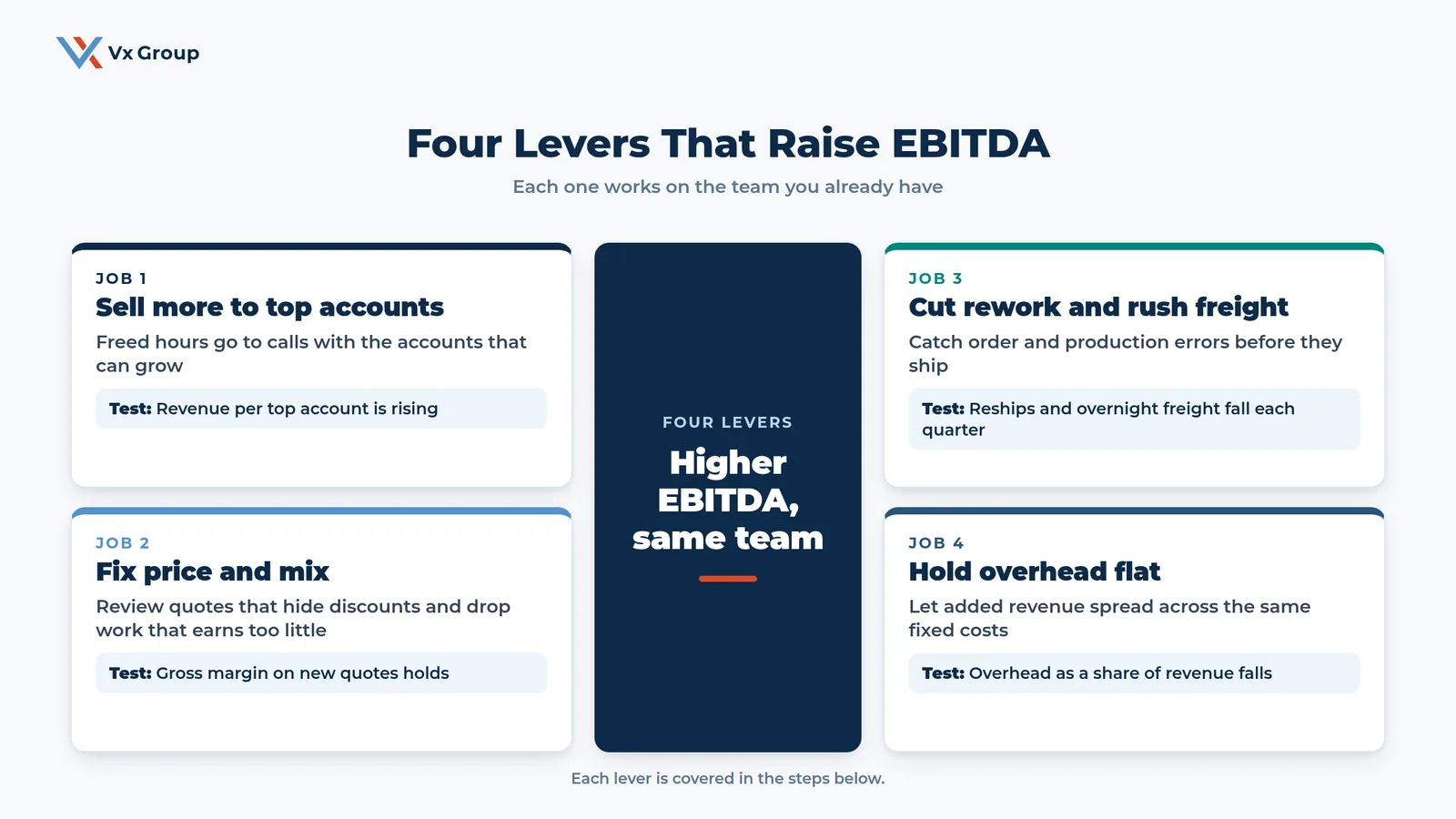
The graphic above names each lever and the test that tells you it is working. The steps below walk through them in order. Step 1 comes first because it frees the time the other levers need.
| Lever | What changes | Where you see it |
|---|---|---|
| Sell more to top accounts | Revenue rises on accounts that can grow | Revenue per top account |
| Fix price and mix | Each sales dollar keeps more margin | Gross margin on new quotes |
| Cut rework and rush freight | Cost of making and shipping falls | Reships and overnight freight |
| Hold overhead flat | Fixed costs spread over more revenue | Overhead as a share of revenue |
Step 1: How do you find the hours your best people lose to detail work?
You find the hours by asking each key account manager and sales lead to log one full week of what they actually do. Most of them lose a day or more to quotes, system entry, chasing answers, and internal meetings. That lost time is the raw material for every lever.
Log one week by task
Give each person a simple sheet with five rows: customer calls and visits, quotes, CRM and portal entry, chasing answers, and internal meetings. Ask them to log hours at the end of each day for ten working days. A longer log is better than a guess, because people remember their week as more productive than it was.
Price the hours at a fully loaded rate
Take pay, taxes, benefits, and bonus, divide by the hours worked, and use that rate. In the session example, a key account manager cost about $600 a day. Multiply the hours spent on detail work by that rate. The result is what the work costs you today.
Pick the one task to attack first
Choose the task with the most hours and the least judgment, such as copying values into customer portals or building first-draft quotes. AI tools can draft quotes, log call notes, and track order status. A person still checks the price and calls the customer. Our guide to AI for manufacturing covers where these tools fit.
Ready to grow?
See where your own key account managers lose hours and what that time could grow.
Step 2: How do you point the freed hours at accounts that can grow?
You point the hours at your top accounts by deciding, before the time is freed, which customers get the calls. Freed time with no plan fills up with new email. A short list of named accounts, each with one question to ask, turns the hours into revenue.
Name the five accounts that can grow most
Look at each key account and ask where your share of their spending could rise. A customer that buys three of your product lines and uses eight is a better target than one that already buys everything. Our guide to account planning shows how to build a plan for each one.
Write one question per account
Each account gets one question for the next call. Examples are “Which part do you buy elsewhere today?” and “What would a longer contract change for you?” A good question opens a conversation about next year, which is where growth comes from.
Block the freed time on the calendar
Put the calls on the calendar for each manager. A day that is protected for customers stays a day for customers. Our guide to key account management covers how to run these accounts over the long term.
Step 3: How do you fix price and product mix?
You fix price and mix by reviewing what you quoted, what you won, and what each job earned. Small price gains go almost straight to EBITDA, and dropping work that earns too little frees capacity for work that earns more.
A 1% price gain on $20M of sales is $200,000. If volume holds, nearly all of it reaches EBITDA, because the cost of making the product has not changed. That is why price is the fastest lever once you have the data.
Review the last 50 quotes for hidden discounts
Pull your last 50 quotes and mark each one as won or lost. Then list the discount given on each. You will often find that the same customers get the same discounts every time, whether or not they asked. Our guide to distributor pricing strategy shows how to set price tiers that hold up.
Rank product lines by gross margin
Sort your product lines from highest to lowest gross margin. Look at the bottom of the list. If a line earns little and takes a lot of shop time, it is a candidate to reprice or drop. Be careful with lines that bring in accounts that buy higher-margin work later.
Send a price letter with a reason
When costs rise, a clear letter to customers protects margin. Our template guide on a price increase letter covers what to say and how to say it.
Step 4: How do you cut rework and rush freight?
You cut rework and rush freight by finding where errors enter the order and fixing them before the product ships. Each reship, remake, and overnight freight bill is a cost with no revenue behind it, so every one you remove adds to EBITDA directly.
Here is an illustrative case. A plant reships 40 orders a year, and each reship costs $2,500 in product, labor, and freight. That is $100,000 a year. Cutting those errors in half adds $50,000 of EBITDA with no change in sales.
Trace each reship to its first mistake
Take the last ten reships and ask where each one went wrong. Common sources are a wrong part number on the quote, a drawing revision that did not reach the floor, and a ship date promised without checking the schedule. Group them by source and fix the most common one first.
Check orders against the quote before release
Have someone compare the order to the quote and customer terms before it reaches the floor. AI tools can flag mismatches in part numbers and quantities for a person to review. The check takes minutes and catches the error at its cheapest point.
Track rush freight by cause
Log every overnight and expedited shipment with a reason. Late supplier material, a missed schedule, and a customer change each call for a different fix. After a quarter, the log shows which cause costs the most. Our guide to cost of sales shows how to read the selling side of the same picture.
Step 5: How do you hold overhead flat as revenue grows?
You hold overhead flat by setting a rule that new revenue has to be handled by the current team first, and by adding cost only when the work proves it is needed. Overhead then spreads across more revenue, which raises EBITDA. This effect is called operating leverage.
Defined Term: Operating leverage.
The effect of fixed costs spreading across more revenue. When sales rise and fixed costs stay level, a larger share of each added dollar reaches profit.
Here is an illustrative example. Overhead is $3.0M on $20M of revenue, which is 15%. Revenue grows to $23.2M and overhead stays at $3.0M. Overhead is now about 12.9% of revenue, and EBITDA is higher by the added gross profit.
Set a hiring trigger tied to workload
Write down the trigger for each open role before you post it. An example is “we hire a second estimator when open quotes stay above 40 for six weeks.” A trigger gives you a number anyone can check, so “we are busy” no longer decides the hire.
Look at freed time before adding a role
When someone says they need help, check first whether the detail work from Step 1 is eating their week. A person who reclaims a day may not need another hire. When the work is real, hire, and the plan has already shown you can afford it.
Review fixed costs once a year
Look at software licenses, leases, and service contracts each year. Cancel the ones nobody uses. These items rarely get a second look, and they add up.
Step 6: How do you track whether EBITDA is rising?
You track it with a short routine: a few numbers each week, a few each month, and a full EBITDA review each quarter. The same measures, in the same order, let you see which lever moved. Without them, a better quarter has no explanation.
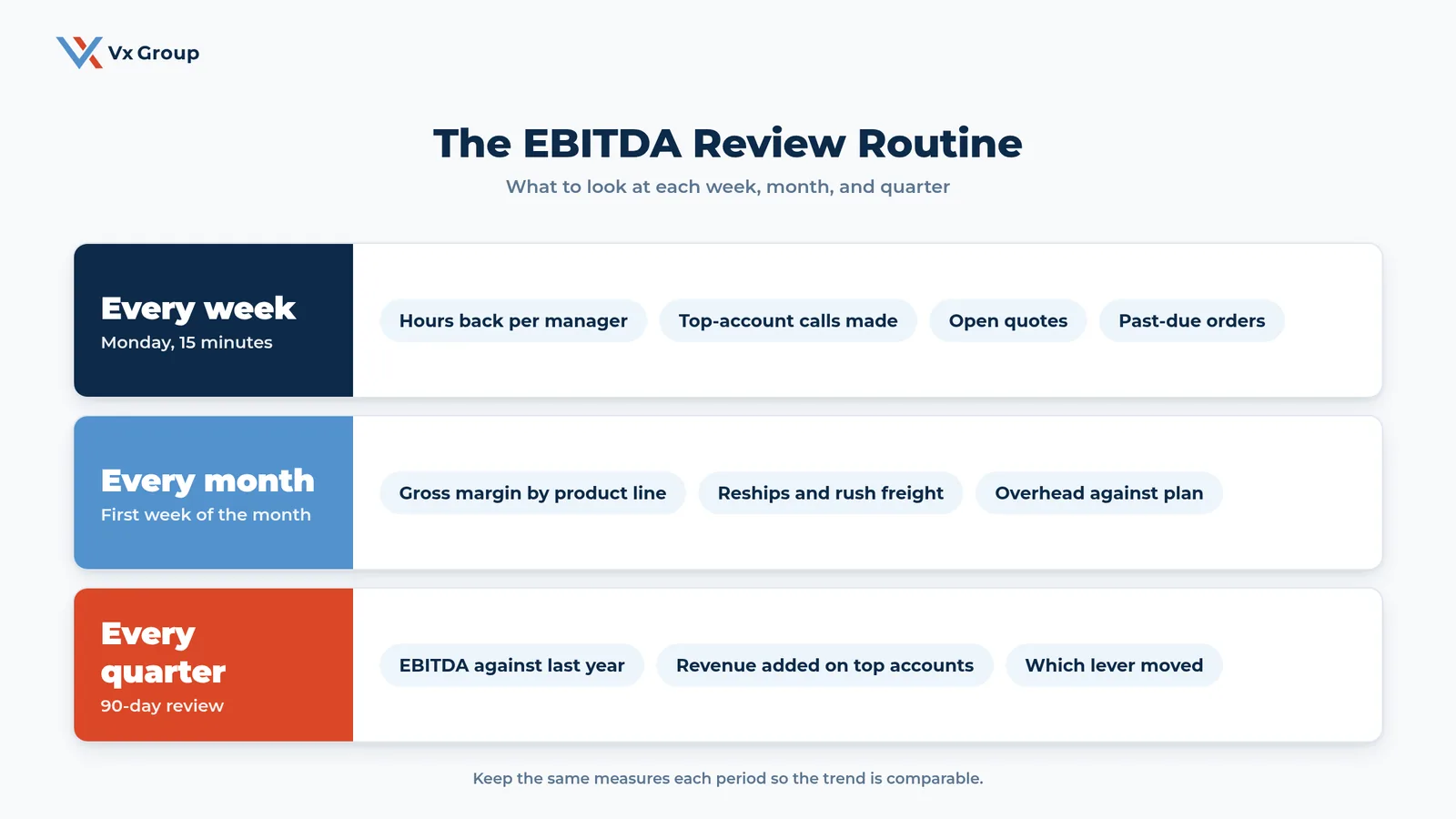
The graphic above shows the routine. Each week, spend 15 minutes on hours back per manager, top-account calls made, open quotes, and past-due orders. Each month, check gross margin by product line, reships and rush freight, and overhead against plan. Each quarter, compare EBITDA with last year, the revenue added on top accounts, and which lever moved.
Set a baseline before you change anything
Record this quarter’s numbers first: EBITDA, gross margin by line, reships, rush freight, overhead as a share of revenue, and hours on detail work. These become the comparison for everything that follows.
Set one target per lever
Pick a number for each lever. Examples are “five hours a week per manager on customer calls,” “gross margin on new quotes at or above last year,” and “reships cut by a third.” A target that cannot be checked will not change behavior.
Hold a review at 90 days
Put the review on the calendar when you set the targets. At 90 days, ask which lever moved, what the team learned, and what to change. Our guide to working capital management covers the cash side of the same review.
What mistakes keep EBITDA from rising?
Four mistakes cause most of the stalls: counting hours saved as dollars saved, skipping the baseline, adding overhead before the freed time is used, and changing the measures every quarter.
- Counting hours as dollars. A freed hour lifts EBITDA only when it goes to customers or when spending falls. Otherwise the hour disappears into email.
- Skipping the baseline. Without starting numbers, no improvement can be shown, and the team will stop believing the effort.
- Adding overhead early. A new role added before the freed time is used raises cost before the gain arrives.
- Changing the measures. A trend is only readable when the measures stay the same from one quarter to the next.
There is a team side to this too. If people expect job cuts, they will hide how much time they spend on detail work. Say plainly that freed hours go to customers. Our article on whether AI will replace salespeople speaks to this fear directly.
Where should an owner start this month?
Start with the time log. It takes about two weeks to gather and costs nothing. It shows how many hours your best people lose, what those hours cost, and which lever to work first.
A plan for the first month looks like this:
- Week one: Ask each key account manager and sales lead to start the ten-day time log. Pull your last 50 quotes and your last ten reships.
- Week two: Finish the log. Price the hours at the fully loaded rate.
- Week three: Choose the first task to hand to an AI tool and the five accounts that get the freed calls. Write one question per account.
- Week four: Record your baseline numbers, set one target per lever, and put the 90-day review on the calendar.
Eric Zoromski went through the full five-year example in the AI return on investment session. You can watch the replay to see the numbers built step by step.
If your longer-term plans include a sale or a new lender, EBITDA that comes from growth holds up under review. Our guide to preparing a business for sale covers what buyers check.
What should you remember about raising EBITDA without cuts?
Cutting headcount raises EBITDA once. Four levers raise it every year: more sales to top accounts, better price and mix, less rework and rush freight, and flat overhead. All four start with finding the hours your best people lose to detail work.
Log the week this month. Set a target for each lever. Review the result in 90 days.
Ready to grow?
Bring your last twelve months of numbers and we will help you find the first lever to pull.
FAQs
About the Author: David Tisdale
