

How to Write an Account Plan for Your Key Customers

To write an account plan, put one page on each key customer. List the people on their buying committee and who knows them. Write what they want this year in their words. State where you stand today. Set two or three goals with a number. Name actions with an owner and a date. Put review dates on the calendar.
TL;DR
- An account plan is a written plan for growing one customer over the next year. It covers who buys, what they want, where you stand, what you will do and who owns each action.
- Keep it to one page. A 14-page plan gets filled out once, filed, and never opened.
- Start with the buying committee. Mark every person you have no relationship with. Those gaps are the first thing to fix.
- Write the customer’s goals in their words. Set your own objectives with a number attached.
- Every action gets one owner and one date.
- Review the plan every quarter. A plan that is reviewed is the only kind that changes what people do.
Somewhere in your company there is an account plan that took a week to build. It has 14 pages. It sits in a template nobody chose. Someone filled it out the Friday before an annual review, and nobody has opened it since.
That plan does more harm than having none. It gives leadership the feeling that the account is being managed. Meanwhile the customer’s plant manager retires, a new buyer shows up, and nobody on your side knows until the next order is late in coming.
This guide is for owners and presidents of privately held B2B manufacturers, roughly $5M to $50M in revenue. It shows how to write a one-page account plan for your biggest customers in six steps. It includes a full worked example and a review schedule your team can keep.
What is account planning, and what should an account plan include?
Account planning is the work of writing down how you will grow one customer over the next 12 months. An account plan is the document that comes out of it. A useful account plan has six parts: the buying committee, the customer’s goals, your current position, your objectives, your actions, and a review schedule.
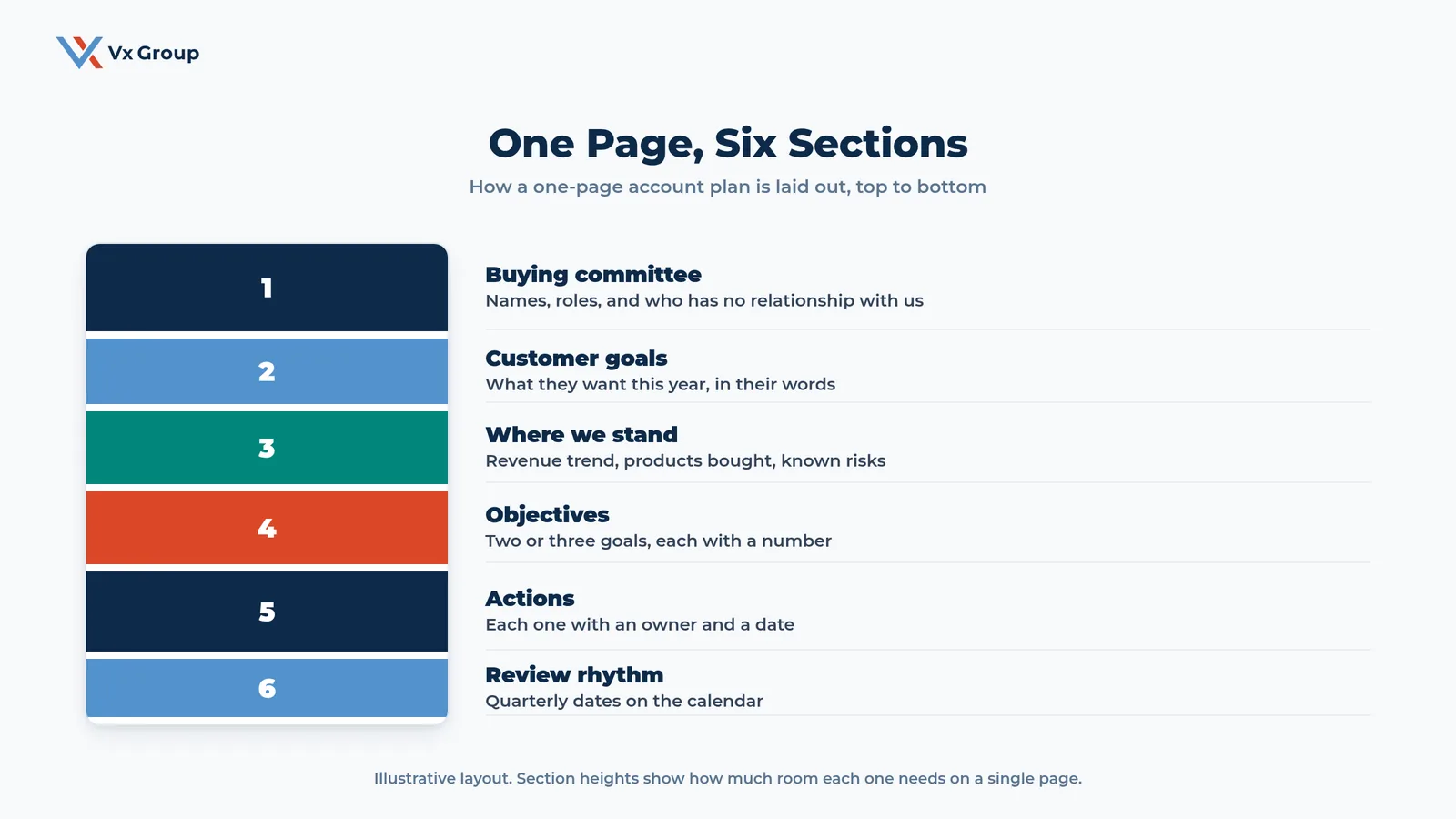
The graphic above shows the six parts in the order you write them. The buying committee comes first because every other part depends on knowing who you are dealing with. Each part gets only a few lines, so the whole plan fits on one page.
Defined Term: Account plan.
A one-page written plan for growing one customer over the next year. It names the people who buy, what the customer wants, where the relationship stands, the goals for the year, and who does what by when.
An account plan is different from a few other documents people mix it up with:
| Document | What it covers | How often it changes |
|---|---|---|
| Account plan | One customer, one year, one page | Every quarter |
| Sales forecast | Expected orders across many customers | Monthly |
| CRM record | Contacts, notes and order history | Daily |
| Key account program | Which accounts get plans, who runs them, how they are chosen | Once a year |
The program decides which customers get a plan. This guide covers the plan itself. For the program side, see our guide to key account management.
Why do most account plans fail?
Most account plans fail because they are built to satisfy a review, and nobody uses them to run the account. A template with 40 fields gets filled in once a year. The fields describe the customer’s industry and your history. Almost none of them tell a person what to do on Monday.
Three habits cause most of the damage:
- The template belongs to someone else. Sales leadership or a software vendor picked it. The people who own the account never chose a single field.
- The plan is written in a rush. It gets built the week before a review. Nobody checks it against what happened last quarter.
- Nobody reviews it. With no review date, the plan has no consequences. It drifts out of date within a month.
A one-page limit fixes the first two. A review date fixes the third. Everything else in this guide builds on those two rules.
One more point on length. When you only have one page, you cannot list every contact, every product and every idea. You have to choose. Choosing is the work. A team that cannot fit the plan on one page does not yet know what matters about the account.
Step 1: How do you map the buying committee in an account plan?
To map the buying committee, list every person at the customer who has a say in buying from you. Write each person’s name, role, and what they care about. Then record who on your team knows them and how well. Mark the people nobody on your team has met. Those are your coverage gaps.
For a manufacturer, the committee at a mid-size customer usually runs four to seven people. The buying committee is bigger than most owners expect. For more on how these groups decide, see our guide to the B2B buying committee.
Build the relationship map table
Open a blank table with five columns: name, role, what they care about, who on your team knows them, and relationship strength. Fill in one row per person. Use three words for strength: strong, some, or none.
Here is a relationship map for Hartwell Machine, a made-up customer of a $22M contract fabricator:
| Name | Role | What they care about | Who knows them | Strength |
|---|---|---|---|---|
| Dana Reyes | Plant manager | On-time delivery, fewer line stops | Owner | Strong |
| Mike Ostrander | Purchasing manager | Price, clean paperwork | Sales rep | Some |
| Priya Nair | Engineering lead | Tolerances, fast design feedback | Nobody | None |
| Tom Hartwell | Owner | Margin, supplier reliability | Nobody | None |
| Lena Brandt | Quality manager | Audit results, traceability | Quality lead | Some |
| Carlos Vega | Maintenance supervisor | Spare parts lead time | Nobody | None |
Only one of the six people at Hartwell has a strong relationship with the fabricator, and three have none. That is the most useful finding on the page, and it came from ten minutes with a table.
Mark every gap with a name
Write the word “none” in the strength column where it is true. Do not soften it to “light contact.” If your best contact leaves Hartwell next month, the account depends on whoever else knows the company. In this example, that is Mike Ostrander, and he knows the fabricator only a little.
Customers also change people. A retirement or a promotion can cut a relationship overnight. A plan that shows who else knows the account tells you how exposed you are. Our guide to customer concentration risk covers what to do when too much revenue sits with one account.
Ask the owner and the sales rep to fill it in separately
Have the owner and the account’s sales rep each fill in the table on their own. Then compare. They usually disagree on two or three rows. Those disagreements show where the company’s picture of the account is thin.
Step 2: How do you write down what the customer wants this year?
Write the customer’s goals for the year in their words, based on conversations you have had with them. Use one to three short statements. Skip anything you inferred from their website. If you do not know their goals, the first action in your plan is to ask.
Use their phrasing even when it sounds plain. “Cut scrap on the Line 4 housings” tells you more than “improve operational efficiency.” You can act on the first. The second could mean anything.
Pull the goals from real conversations
Look back through your last three meetings or calls with the account. Write down every time someone at the customer said what they were trying to fix, finish or avoid. Put those on the page in a sentence each. Tag each one with the person who said it.
Leave a blank where you do not know
A blank line that reads “unknown, ask Priya in March” is a useful entry. It turns a gap into an action. Teams that fill every blank with a guess end up planning around things the customer never said.
The customer’s goals also decide which of your offers matter. If Hartwell wants shorter lead times this year, a price cut will not interest them much. A faster turnaround on rush orders will. The plan should connect your objectives back to what they said.
Step 3: How do you state where you stand with the account today?
State your current position in a short block. Include revenue for the last two years, what they buy from you, what they buy from someone else, and the known risks. Write it honestly. This block is for your team, so flattering numbers only hurt you.
Write the revenue trend in two numbers
Put last year’s revenue and the year before. Add the share of the customer’s spend you think you hold, if you can estimate it. If you cannot, write “unknown.” Share of wallet matters because a customer who spends $1.4M with you may spend $6M on the same category in total. Our guide to share of wallet shows how to estimate it.
List what they buy and what they do not
Write down the products they buy from you. Then write the ones you make that they buy elsewhere. In the Hartwell example, the fabricator sells five product lines and Hartwell buys two. The three they do not buy are the starting point for objectives.
Name the known risks plainly
List every risk you know: a competitor in the account, a price complaint, a late delivery last quarter, a contact who is about to retire. Write each in one line. If the list is empty, you have not looked hard enough. Every account has at least two or three.
Ready to grow?
Bring us the plan for your largest customer and we will show you where the gaps are.
Step 4: How do you set account objectives with a number attached?
Set two or three objectives for the year and put a number on each. A good objective names what will change, by how much, and by when. “Grow the account” is a wish. “Move Hartwell from two product lines to three by September” is an objective.
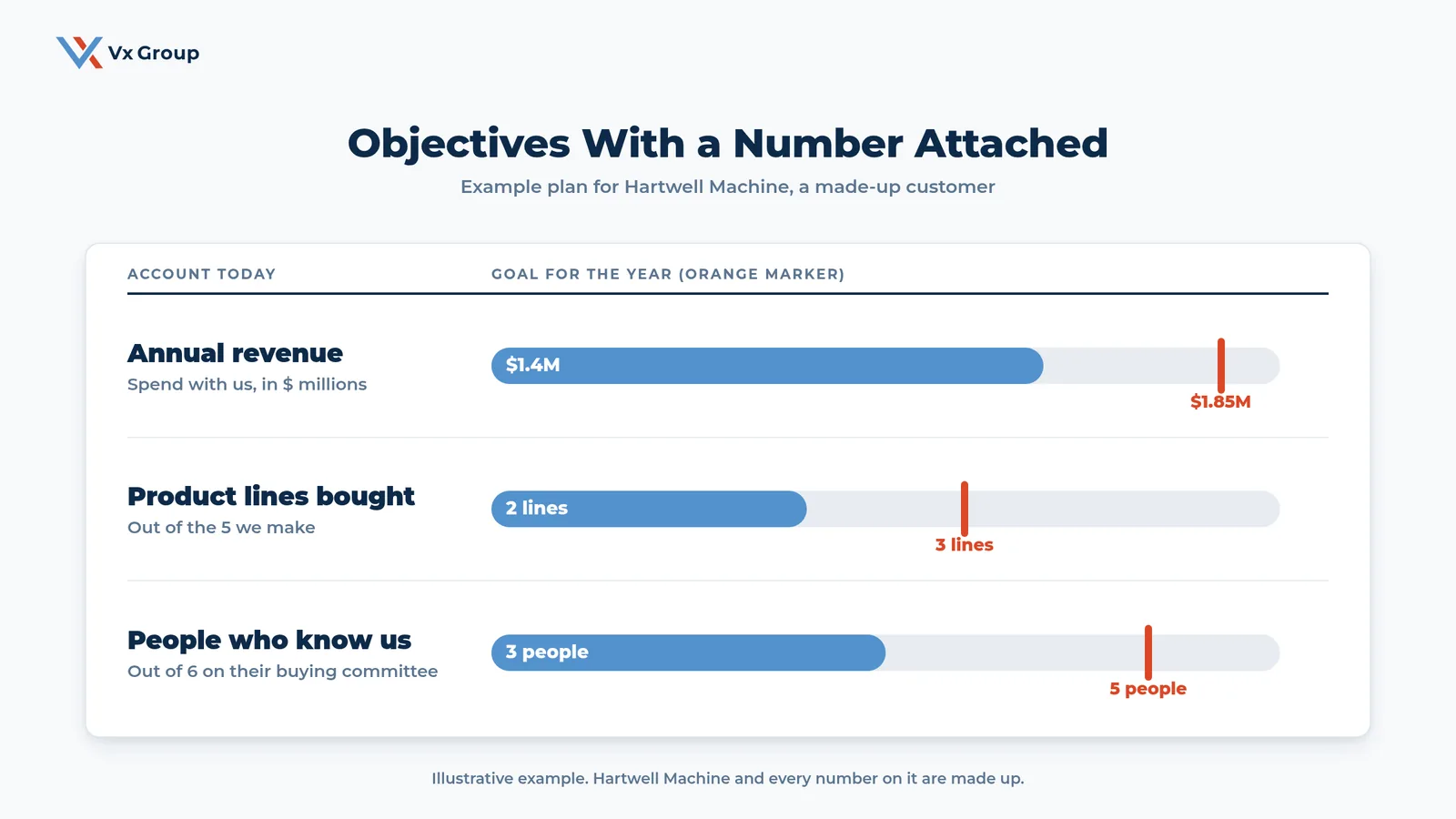
The graphic above shows three objectives for the made-up Hartwell account. Revenue goes from $1.4M to $1.85M. Product lines bought go from two to three. People on the buying committee who know the fabricator go from three to five of six. Each has a starting point and a target you can check.
Pick one objective for revenue, one for breadth and one for relationships
Revenue is the result you want. Breadth, meaning how many of your products they buy, is usually how you get there. Relationships protect it. Using one of each keeps the plan balanced. If you only set revenue goals, the team chases the next order and ignores coverage.
Write each objective as a sentence a stranger could check
Use this pattern: “By [date], [measure] goes from [now] to [target].” For example: “By December 31, annual revenue with Hartwell goes from $1.4M to $1.85M.”
A reader who finds the page in six months can tell whether it happened. If it takes an argument to decide, rewrite it.
Cap it at three
A fourth objective dilutes the other three. If you have five ideas, pick the three that move the account most and leave the rest for next year.
Step 5: How do you list the actions with owners and dates?
List the specific actions that will reach each objective. Give every action one owner and one date. An action without a name beside it will not happen, and an action with two names will not happen either. Write six to ten actions in total for a key account.
Turn each objective into two or three actions
Take the objective to add a third product line at Hartwell. The actions might be: ask Priya Nair for a plant tour (owner: engineering lead, date: February 15), send a sample of the third product line to her team (owner: sales rep, date: March 20), and quote the first order (owner: sales rep, date: April 30). Each can be done or not done.
Close each coverage gap with a first meeting
For every “none” in the relationship map, add an action to meet that person. Name who on your team will do it. Then name the reason for the meeting, because “say hello” is a weak reason. In the example, the owner asks Tom Hartwell for a 30-minute call about next year’s volume. That gives both sides something to talk about.
Check the actions list for owners with too many
Count the actions per person. If one person owns seven of ten, the plan will stall on that person’s calendar. Spread the work or cut the actions.
Step 6: How often should you review an account plan?
Review each key account plan every quarter. In a 30-minute meeting, the account team checks actions, compares results with the objectives, and updates the page. A plan that gets reviewed four times a year changes what people do, because the team has to answer for it each quarter. A yearly review only records what already happened.
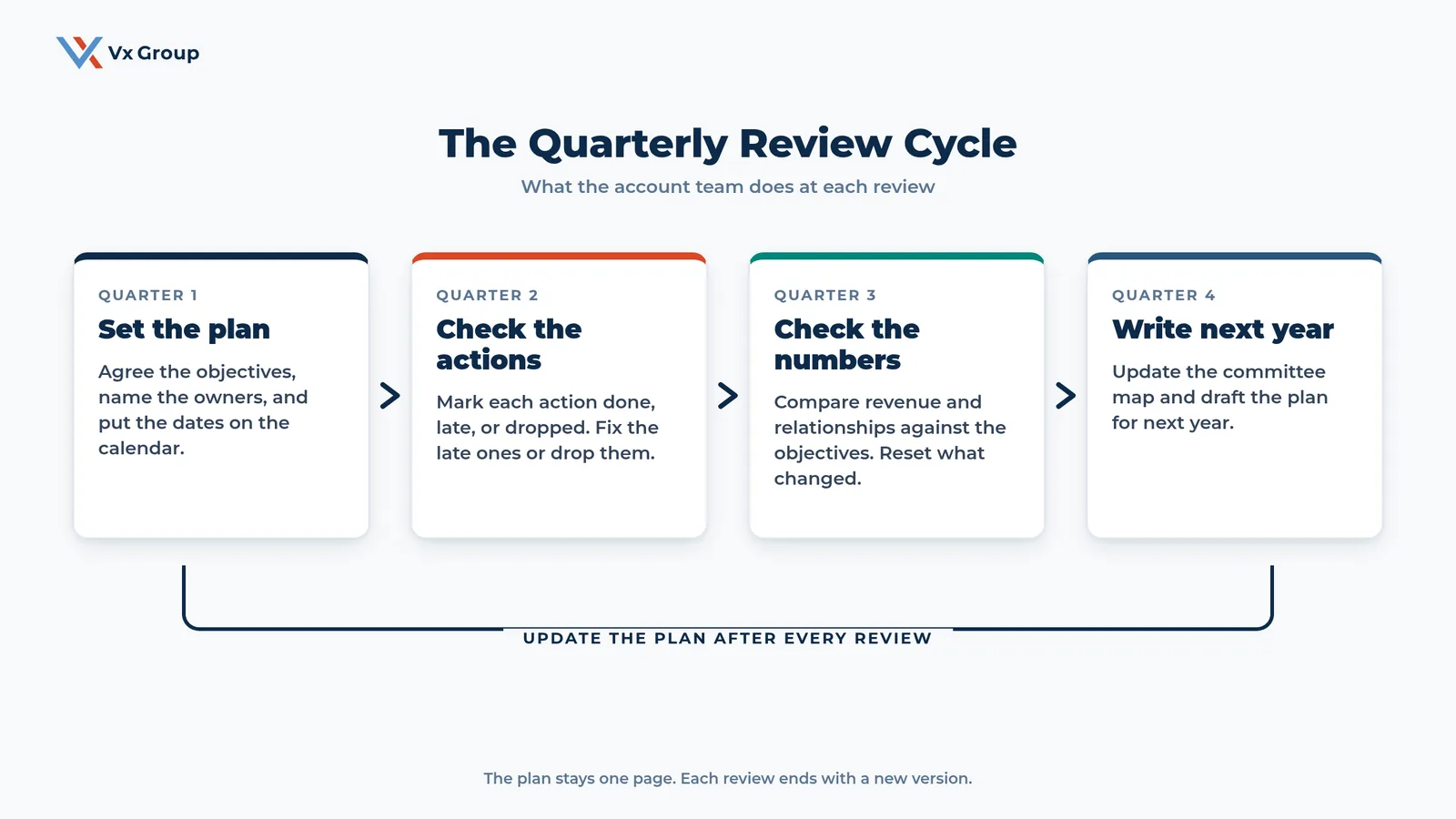
The graphic above shows what each quarterly review does. The first sets the plan. The second checks which actions are done, late or dropped. The third compares revenue and relationships against the objectives. The fourth updates the committee map and drafts next year’s plan. Every review ends with a new version of the same one page.
Put all four review dates on the calendar when you write the plan
Book the four meetings the day the plan is finished. Invite the owner, the account’s sales rep, and whoever owns an action. If the dates are not on a calendar, they will slip. Thirty minutes is enough because the plan fits on one page.
Run each review with the same three questions
Ask what got done, what did not, and what changed at the customer. Then update the page. The third question matters most, because a retirement or a new plant manager changes the plan. Close the meeting by saving the new version over the old one.
Keep the old versions
Save each quarter’s version in the same folder. After a year, you can see what the team planned, what happened, and where the plan was wrong. That record makes next year’s plan better than this year’s.
What does a finished one-page account plan look like?
A finished one-page account plan for Hartwell Machine fits all six parts on a single sheet. The made-up example below shows each section with real-sounding content. Use it as a pattern, then replace every line with facts from your own account.
| Section | Hartwell Machine (made-up example) |
|---|---|
| Buying committee | Six people. Strong with the plant manager. Some with purchasing and quality. None with engineering, the owner and maintenance. |
| Customer goals | “Cut scrap on the Line 4 housings.” “Get rush orders in under two weeks.” Both from Dana Reyes, January call. |
| Where we stand | Revenue $1.1M two years ago, $1.4M last year. Buys two of our five product lines. Known risks: one late shipment in Q3, a price complaint from purchasing, engineering has never met us. |
| Objectives | 1. Revenue from $1.4M to $1.85M by December 31. 2. Product lines bought from two to three by September 30. 3. People on the committee who know us from three to five by June 30. |
| Actions | Plant tour with engineering (engineering lead, Feb 15). Sample of third product line to engineering (sales rep, Mar 20). First quote on third line (sales rep, Apr 30). Owner call with Tom Hartwell on next year’s volume (owner, Feb 28). Introduce quality lead to maintenance supervisor (quality lead, May 15). |
| Review rhythm | Quarterly: April 10, July 10, October 9, January 8. Thirty minutes each. Owner, sales rep and quality lead attend. |
Read the actions column again. Every action has a person and a date, and every one connects to an objective. The plan names a retiring buyer as a risk and sets a path to meet the people nobody knows. The whole plan prints on one page.
Someone new to the account could read it in five minutes and know what to do first. That is the test for any account plan: could a stranger run the account from this page?
Which accounts should get an account plan first?
Start with your top five to ten customers by revenue, then add any account with strong growth potential. A plan takes about two hours to write well, so ten plans is about two working days.
Your biggest customers matter most because they hold the most revenue at risk. Our guide on why your top 10 customers are a growth strategy explains why they deserve the first plans. Customers that buy only one product line and could buy four come next. For how to grow those, see account expansion.
Skip the long tail for now. A customer who buys twice a year does not need a plan. A short note in your CRM is enough. For tools that keep those notes usable, see our guide to CRM adoption.
Assign one named owner for each plan
Each plan gets one owner who is accountable for keeping it current. In a $5M to $50M company, that is often the owner or president for the top three accounts and a sales leader for the rest. Name the person on the page.
Link the plan to your pipeline review
Bring each account’s objectives into your monthly pipeline conversation. Our guide to sales pipeline management covers the pipeline side. The account plan tells you where new orders from existing customers should come from. The pipeline review confirms whether they are showing up.
What mistakes make an account plan fail?
Account plans fail for five predictable reasons. Most can be fixed by shortening the plan or adding a date. Check your own plans for each one before you roll them out.
| Mistake | What it looks like | Fix |
|---|---|---|
| Too long | 10 to 14 pages, 40 fields | Cut to one page with six sections |
| No gaps listed | Every contact marked “good relationship” | Mark each person strong, some or none |
| Vague objectives | “Grow the account” | Put a number and a date on each |
| No owners | Actions assigned to “the team” | One name per action |
| No review | Plan written once a year | Four quarterly dates on the calendar |
Do not let the plan live only in sales
Share each plan with the people who deliver for the customer. Quality, engineering and customer service all touch the account. If only the sales rep sees the plan, the other people who build the relationship never see the goals.
Do not write the plan alone
The best plans come out of a 60-minute conversation among the owner, the sales rep and one person from operations. Each sees a different side of the customer. One person alone will miss at least one.
Where should an owner start this week?
Pick your largest customer and write its plan this week. Block two hours. Fill in the relationship map first, then the customer’s goals, then the rest. When it is done, book four review dates and share it with the people who deliver for that customer.
Here is a five-step start for the week:
- Choose the account with the most revenue.
- Gather the owner, the account’s sales rep and one operations lead for 60 minutes.
- Fill in the relationship map and mark every “none.”
- Write three objectives with numbers and six to ten actions with owners and dates.
- Put the four quarterly reviews on everyone’s calendar before the meeting ends.
Then repeat it for the next four accounts over the following month. By the end of the quarter, your team will have a clear page on each of your top five customers.
Ready to grow?
We can sit in on the first plan with you and show your team how to run it.
FAQs
About the Author: Jacob Camhi
