

Working Capital Management for Manufacturers

Working capital management is the work of getting cash back into your business as fast as the business spends it. For a manufacturer, cash gets stuck in three places: late shipments, slow invoices, and inventory that sits. Fix those three and you free cash without borrowing a dollar or finding a new customer.
TL;DR
- Working capital is what it costs to run the business between paying for materials and getting paid by customers. Most manufacturers carry more of it than they need.
- Cash gets stuck in three places: orders that ship late, invoices that go out late, and inventory that sits on the shelf.
- A late shipment is late three times. The shipment, the invoice, and the cash all move back together.
- On a $20M manufacturer, saving a few days at each step can free more than $1 million. The example is illustrative, and the math works the same on your numbers.
- Start with a daily list of past-due orders. It is the earliest warning you have on cash.
- AI helps most with the daily list, the paperwork, and the follow-up. It does not fix a plant that cannot ship.
A profitable year can still leave a manufacturer short on cash. The income statement says the company made money. The bank balance says otherwise.
The gap is working capital. The money went into materials, payroll, and finished product, and it has not come back yet. Every order that ships late or gets billed late stretches that wait.
This article is for owners and presidents of privately held manufacturers, roughly $5M to $50M in revenue. It shows where cash gets stuck, how to calculate the days it is stuck, and the moves that free it up. It also covers where AI helps and where it does not.
What is working capital management for a manufacturer?
Working capital management is the practice of controlling the cash tied up in receivables, inventory, and payables so the business always has enough to operate. Receivables are invoices customers owe you. Inventory is raw material, work in progress, and finished goods. Payables are bills you owe suppliers.
The basic formula is current assets minus current liabilities. Most operators use a tighter version that leaves out cash and bank debt:
Defined Term: Operating working capital.
Accounts receivable plus inventory minus accounts payable. It is the money your day-to-day operations hold, waiting to turn back into cash.
Most of the top search results on this topic are written for finance teams and treasurers. They explain ratios well. They say little about the plant floor, where the days actually pile up. A manufacturer controls working capital through shipping, billing, and purchasing habits as much as through the balance sheet.
The three habits connect. Ship late and you invoice late. Invoice late and you collect late. Carry too much inventory to protect against late shipments and you tie up even more cash. Working capital management breaks that loop at the earliest step.
Where does a manufacturer's cash get stuck?
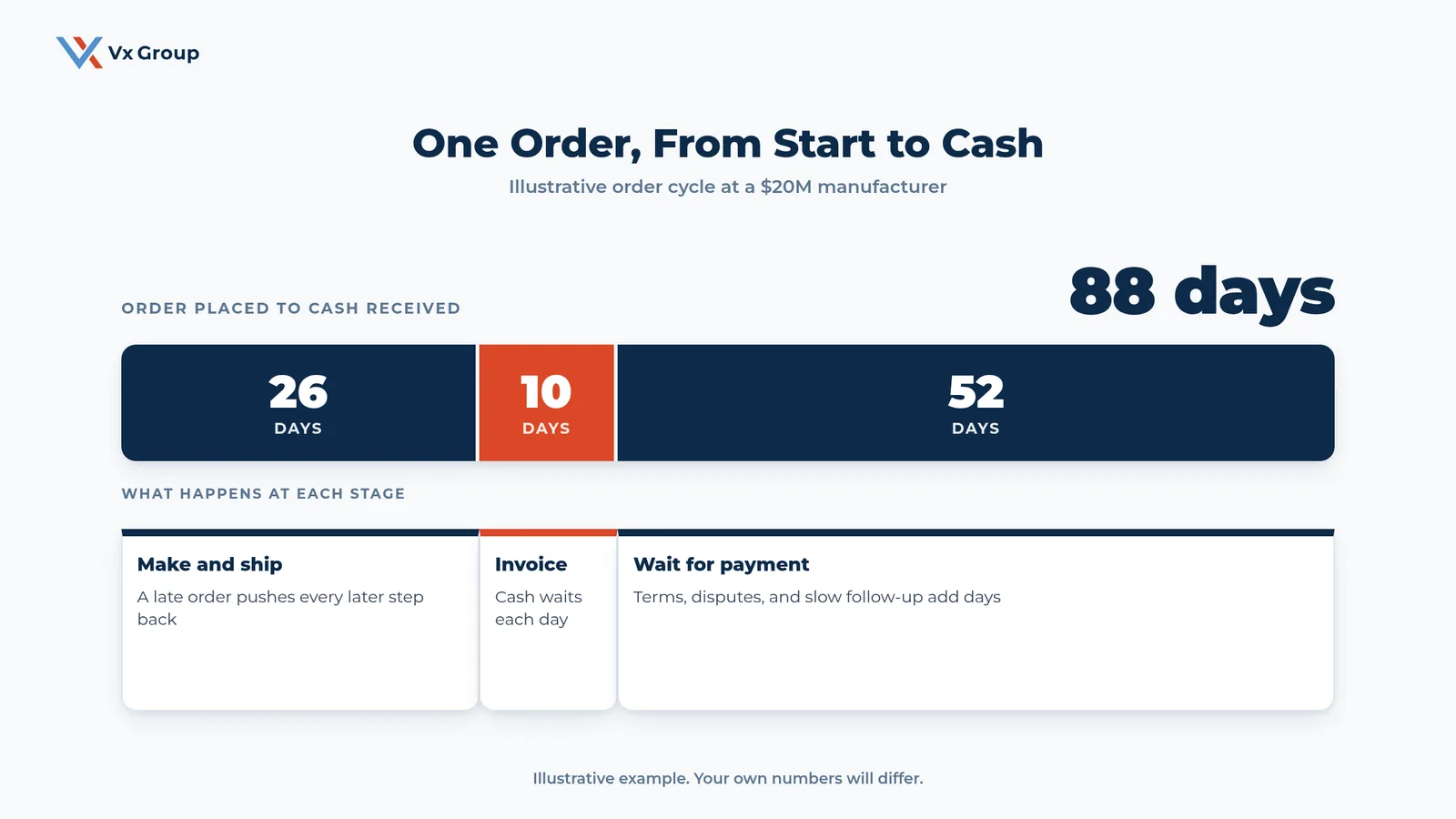
Cash gets stuck at every step between placing an order and receiving payment. The graphic shows one illustrative order at a $20M manufacturer: 26 days to make and ship, 10 days to send the invoice, and 52 days waiting for payment. That is 88 days from order to cash.
Each step has its own causes.
Make and ship. Orders slip because of missing material, a machine down, a rush job that bumped the schedule, or a quote that promised a date the plant could not meet. A slipped order delays every step after it.
Invoice. Many plants ship on one day and bill several days later. The invoice waits for a packing slip, a freight charge, a signature, or a person who bills on Fridays. Every day of waiting is a day your cash sits in a customer’s hands.
Wait for payment. Customer terms set the baseline, often net 30 or net 45. Disputes, missing purchase order numbers, and slow follow-up add days on top. A customer’s payables team pays the invoices that are clean and chased first.
The middle step is the easiest one to fix, and most owners have never measured it. Ask your controller how many days pass between shipment and invoice. The answer often surprises people.
How do you calculate your cash conversion cycle?
Your cash conversion cycle is the number of days between paying for materials and collecting from the customer. Add the days your inventory sits and the days your customers take to pay, then subtract the days you take to pay suppliers.
The worked example below uses the same $20M manufacturer. Cost of goods sold is $14M. All figures are illustrative.
| Measure | Formula | Example | Result |
|---|---|---|---|
| Days inventory outstanding (DIO) | Inventory ÷ cost of goods sold × 365 | $2.88M ÷ $14M × 365 | 75 days |
| Days sales outstanding (DSO) | Receivables ÷ revenue × 365 | $2.85M ÷ $20M × 365 | 52 days |
| Days payables outstanding (DPO) | Payables ÷ cost of goods sold × 365 | $1.34M ÷ $14M × 365 | 35 days |
| Cash conversion cycle | DIO + DSO − DPO | 75 + 52 − 35 | 92 days |
Operating working capital in this example is $2.88M plus $2.85M minus $1.34M, which is $4.39M. That is about 22% of revenue sitting in the operation.
Use this simple test. Take your annual revenue and divide by 365. That is your sales per day. In the example it is about $54,800. Each day you pull forward in the cycle puts about that much cash back in your hands.
Pull the three inputs from your balance sheet at month end. Run the math each month and keep the results in one small sheet. The trend matters more than any one month.
Why do late shipments hold up cash?
A late shipment delays cash three times. The shipment goes late, the invoice goes late, and the payment goes late. It also strains the relationship with the customer who is waiting on the order.
Past-due orders are the earliest warning a manufacturer has on cash. They show up before the aging report does, and weeks before the balance sheet does.
Build the past-due order list every morning
List every open order that has passed its promised ship date, or will pass it within the week. Include the customer, the dollar value, the promised date, and the reason for the delay.
Print it or put it on a shared screen. Review it for 10 minutes each morning with the plant manager, the scheduler, and whoever owns customer service. The list works when someone owns each line and a date to clear it.
Sort the list by dollars and by customer
A $4,000 order and a $140,000 order do not get the same attention. Sort by value and mark the customers you cannot afford to disappoint. Your top accounts deserve a call from you or a senior person before the order goes late.
Record why orders slip
Add one column for the cause: material, machine, labor, engineering change, or customer change. After a month, count the causes. You will usually find that two of them explain most of the slips. Those two get the first fix.
Reset the promise date when it is wrong
A promised date that nobody believes causes more harm than a long one. If the plant cannot ship on the date you gave, tell the customer a new date as soon as you know it. A customer who hears early can plan around it. A customer who hears after the date has passed often starts paying slowly.
Vx Group is building systems that help clients stay on top of past-due orders, because this list is where cash problems show up first.
Ready to grow?
See where cash is stuck in your own order-to-cash cycle with a team that works with owner-led manufacturers.
How do you get invoices out faster?
Send the invoice the day the order ships. This is the lowest-effort move in working capital management, and it needs no conversation with a customer.
On the example order, the invoice step takes 10 days. Cutting it to 2 days pulls cash forward 8 days on every order the company ships.
Find out how many days pass between shipment and invoice
Pull 30 shipments from last month. Write down the ship date and the invoice date for each. Average the gap. If you do not like the number, you have found the first project.
List what holds each invoice back
Common holds are a missing packing slip, an unentered freight charge, a purchase order number the customer requires, and a signature on proof of delivery. Write each hold on a card. Then ask which ones can happen at the dock, before the truck leaves.
Trigger the invoice from the shipping confirmation
The cleanest fix is to make shipping the trigger. When the shipment closes in your system, the invoice drafts itself and goes to a person for a quick check. Many ERP systems can do this already. If yours cannot, a daily check of that day’s shipments by one named person works as a start.
Fix the customer's own invoice rules once
Some customers need specific fields, formats, or portals. Keep a one-page sheet for each of your top 20 customers that says what their payables team requires. A wrong invoice goes to the bottom of their pile.
How do you collect faster without hurting relationships?
Collect faster by making payment easy and by talking to the people who pay you. A clean invoice, a quick answer to a question, and a call from someone the customer knows will move cash faster than a harsh reminder.
Relationships matter here because your largest customers set the pace. They can pay in 30 days or 60 days, and the difference often comes down to how much they trust you and how easy you are to pay.
Call the top slow payers yourself
List the ten customers with the most dollars past terms. Have the person who knows each customer call their contact. Ask whether anything is holding up the invoice. Most of the time, a small question is the cause.
Clear disputes within 48 hours
A short dispute over a price, a quantity, or a missing document can hold up a whole invoice. Name one person to own disputes. Give that person the authority to fix small ones the same day. Track how many open disputes you have each week.
Match your terms to your risk
Check what terms each top customer actually has, and what they actually pay. If a customer takes 60 days on 30-day terms every time, the real terms are 60 days. Decide whether to enforce the terms, change them at the next renewal, or price the delay into the account.
The same work supports your key account plans. The article on key account management covers how to build the relationships behind your largest customers. Customers who see you as a partner tend to answer your calls and pay faster.
Watch how much of your receivables sit with one or two customers. The article on customer concentration risk explains why a late payment from a single large account can strain the whole business.
How do you reduce inventory without missing shipments?
Reduce inventory by cutting the stock that has not moved, and keep safety stock on the items your customers order again and again. The goal is fewer idle dollars on the shelf with no new stockouts.
Many plants carry extra inventory because shipments run late. The buffer protects against the problem. Fix the late shipments first, and the buffer can shrink.
List the items that have not moved in 6 months
Pull a report of every item with no sales or usage in the last 6 months. Add the dollar value. This list is usually shorter than owners expect, and it often holds more cash than any single customer owes you.
Sort the rest by how often they ship
Split active inventory into three groups: items that ship every week, items that ship every month, and items that ship a few times a year. Weekly items earn a safety stock. Occasional items can often be made to order or bought in smaller lots.
Set a reorder point for your top 20 items
Write down the lead time, the average weekly use, and the safety stock for each of your 20 largest items. Review them every quarter. A written reorder point replaces the habit of ordering extra because someone got burned once.
Ask suppliers for shorter lead times and smaller lots
Your suppliers want to keep your business. Ask your five biggest suppliers what lot size and lead time they can offer. Even a small improvement lowers what you hold.
Paying suppliers late saves cash for a few weeks and costs you goodwill, and sometimes price. If you want longer payment terms, ask for them when the supply agreement renews.
How much cash can these moves free up?
The moves in this article can free about $1.3 million on a $20M manufacturer, which is roughly 29% of the $4.39M tied up in operations. Each day pulled forward on the sales side is worth about $54,800. Each day pulled forward on inventory is worth about $38,400, which is one day of cost of goods sold.
| Move | Change | Days gained | Cash freed |
|---|---|---|---|
| Ship orders sooner | 5 days earlier on average | 5 | about $274,000 |
| Invoice faster | 10 days down to 2 days | 8 | about $438,000 |
| Collect faster | 52 days down to 45 days | 7 | about $384,000 |
| Lower inventory | 75 days down to 70 days | 5 | about $192,000 |
| Total | about $1.29 million |
This table is an illustration. Your own numbers will differ, and some moves overlap. Collecting faster also depends on invoicing faster, so run each one on your own data before you plan around the total.
The cash is one time. You free it once, and from then on the business needs less working capital to run. That is why the work matters before you borrow, before you invest in equipment, and before you sell.
Buyers and lenders look at the same numbers. A buyer expects the business to come with enough working capital to run, and a quality of earnings review checks whether the level looks normal. If you plan to sell, the article on preparing a business for sale shows where working capital fits in the two years before you go to market.
Which numbers should you watch to keep cash moving?
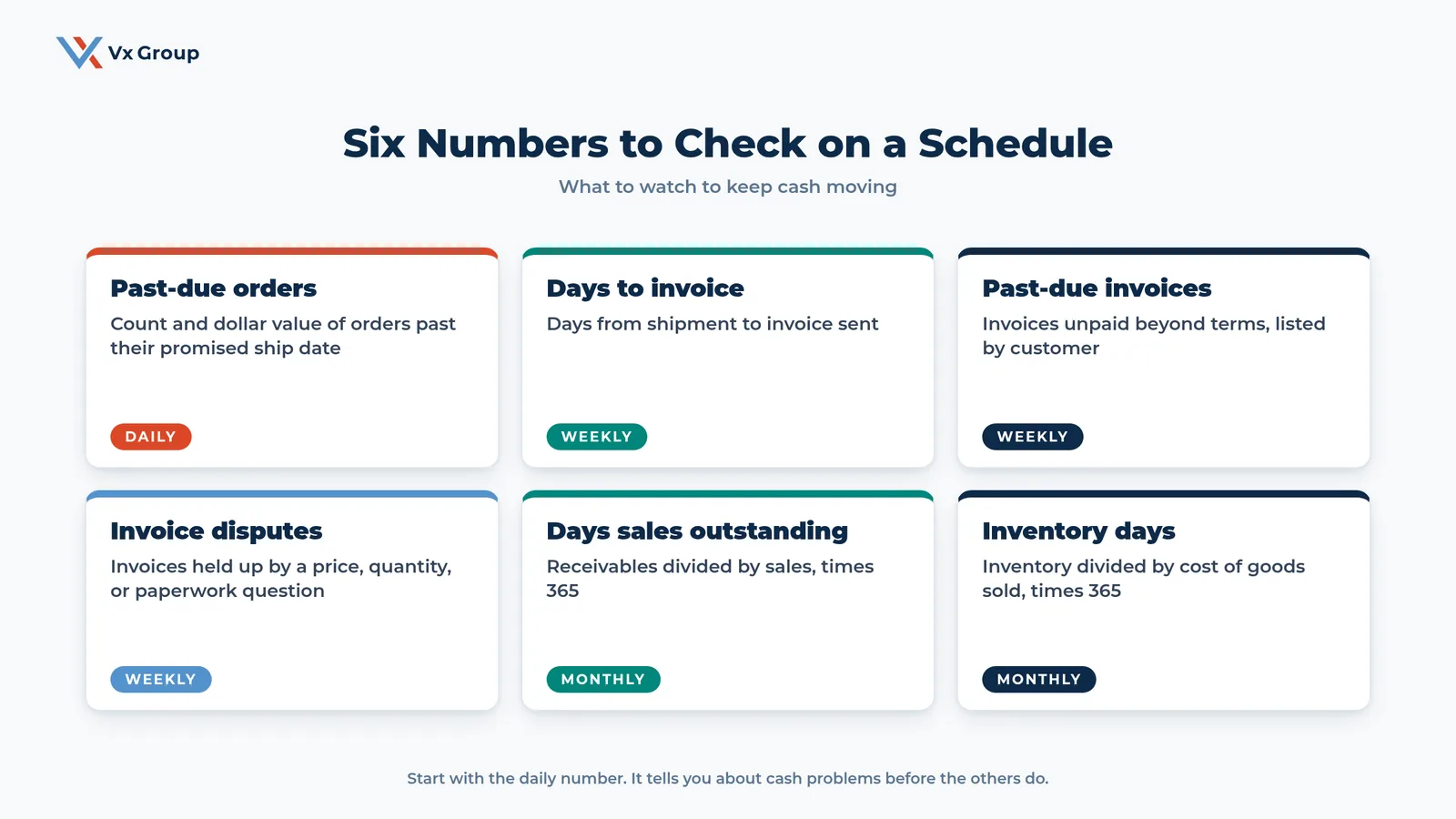
Watch six numbers, each on its own schedule. The graphic lists them: past-due orders daily, days to invoice, past-due invoices, and invoice disputes weekly, then days sales outstanding and inventory days monthly.
The daily number comes first because it moves first. Past-due orders rise weeks before past-due invoices do. A manufacturer that checks only the monthly numbers learns about a cash problem after it has already happened.
Put the six numbers on one page. Review that page in the same meeting every week, with the same people. Over time, the trend tells you which step needs attention.
Leading indicators like these also work across the rest of the business. The article on business leading indicators shows how to pick the few numbers that give you early warning.
Where does AI help with working capital?
AI helps most with the daily work around orders, invoices, and follow-up. It reads your data faster than a person and drafts the paperwork. It does not make a plant ship faster on its own.
Four uses are practical for a manufacturer today.
A daily past-due order report. AI can read your order data each morning, flag orders at risk of missing their ship date, and write a short summary for the plant manager. The list described earlier then builds itself.
Invoice drafts from shipping records. AI can read a packing slip and a freight bill, check them against the order, and draft the invoice for a person to approve. The gap between shipment and invoice shrinks.
Collection notes and dispute summaries. AI can draft a polite reminder for each overdue invoice and summarize the history of a dispute so the right person can resolve it quickly.
Written procedures for billing and purchasing. Record someone walking through the billing steps and ask AI to write the procedure from it. It takes minutes. A written procedure makes the work repeatable when someone is out. The article on how to build an infinite team covers how to capture what your best people know.
Clean data comes first. If your orders, shipping records, and customer terms live in several places, fix that before you ask AI to read them. The 6-step AI readiness assessment walks through what to check.
Check each AI use against a number on your own financials. Our article on AI for manufacturing covers where it pays off in a plant. For the full math on measuring AI against the lines you already read, the replay of our AI ROI session is available.
What mistakes slow down working capital work?
Four mistakes come up most often with owner-led manufacturers.
- Measuring only at month end. By the time the balance sheet shows a problem, you have lived with it for weeks. Check the daily and weekly numbers.
- Starting with customers. Pushing customers to pay faster before fixing your own invoices usually fails. A late or wrong invoice gives them a reason to wait.
- Cutting inventory too fast. A stockout on a top item costs more than the cash saved. Work down the stock that has not moved before touching the items customers reorder.
- Leaving the work with finance alone. Your controller cannot ship orders on time or send invoices from the dock. Plant, sales, customer service, and finance each own part of the cycle, so the owner has to put them in the same room.
Where should you start?
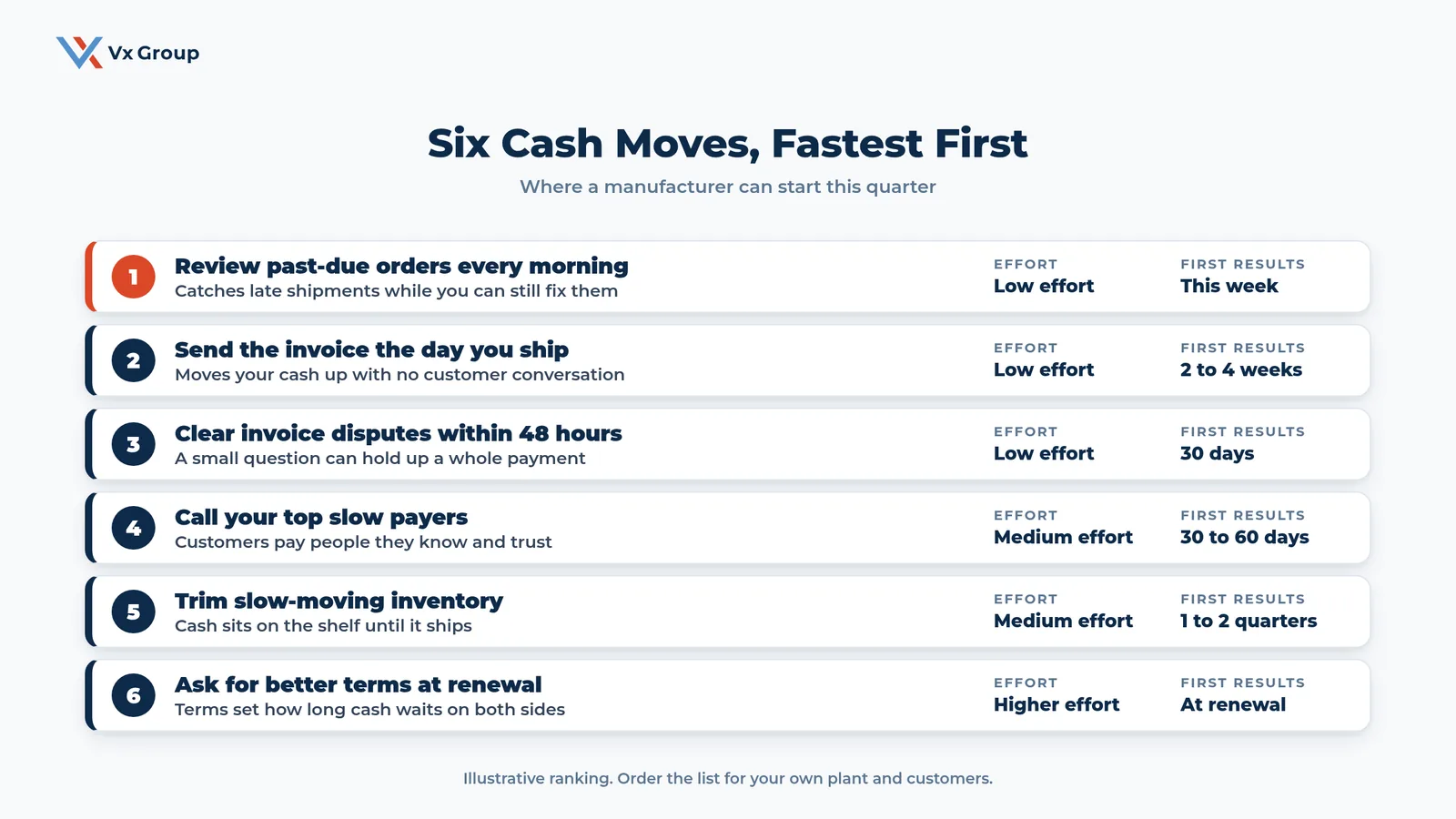
Start with the past-due order list, then the invoice step. The graphic ranks six moves from fastest to slowest. The first three take little effort and show results within a month.
Use this plan for the next 30 days.
- This week: Build the past-due order list and review it every morning for 10 minutes.
- Week 2: Pull 30 shipments and measure the days from shipment to invoice.
- Week 3: Name one person to own invoice disputes. Give them authority to settle small ones.
- Week 4: Calculate your cash conversion cycle with the formulas above, and write down the number.
Then pick one number to improve over the next quarter. Share it with the team that owns it.
Conclusion
Working capital management gives a manufacturer cash it already earned. The cash is sitting in late orders, slow invoices, and idle inventory. Each step has an owner and a number you can measure.
If you do one thing this week, build the past-due order list. It will tell you where the next dollar is stuck.
Which of your top ten customers has the most cash tied up in orders that shipped late? And do you know that number today?
Ready to grow?
Talk through where cash is stuck in your business with a team that works with owner-led manufacturers.
FAQs
About the Author: David Tisdale
