

Preparing a Business for Sale in 24 Months

Preparing a business for sale means making the changes a buyer will pay for, long enough before the sale that a buyer can see them working. For a manufacturer, that is a 24-month job. It starts with a review of your own company. It ends with a data room and a management team ready for buyer meetings. The work that moves the price most is handing customer relationships off from you.
TL;DR
- Start 24 months before you plan to go to market. Every change a buyer values needs a track record before the buyer believes it.
- Months 24 to 18: run a review of your own company and pick the three fixes worth making.
- Months 18 to 12: hand your top customer relationships to a second person on your team, and write the handoff down.
- Months 12 to 9: clean up the books so adjusted EBITDA needs fewer arguments.
- Months 9 to 6: build the growth story from evidence a buyer can check.
- Months 6 to 0: build the data room and practice the management meetings.
- Relationship work has the longest lead time and the biggest effect on price. It cannot be rushed.
Here is a pattern I see often. An owner decides the company will be sold in a couple of years. Nothing changes until a banker is hired. By then the plant looks good, the equipment list is long, and the owner still holds the relationships with the ten biggest customers.
A buyer asks who owns those customers. The honest answer is the owner. That answer moves the price, and there is almost no time left to change it.
This article is for owners and presidents of privately held manufacturers, roughly $5M to $50M in revenue, who expect to sell in the next few years. It gives you five stages in order, with a named output for each one. The sale itself, meaning buyers, offers, and deal terms, is covered in selling a manufacturing business. This piece covers the runway before it.
What does preparing a business for sale involve?
Preparing a business for sale is the work of making your company easier to believe in. Buyers pay for profit that keeps showing up and for customers who stay after you leave. Preparation produces the evidence for both.
Defined Term: Exit readiness.
How well a company can show a buyer that it runs, earns, and keeps customers without its owner in every decision. It is measured by evidence, such as handoffs that held, books that tie out, and revenue that repeated.
Three things carry most of the price in a manufacturing sale. The first is how much the business depends on you. The second is whether your customer relationships are documented and shared. The third is whether your revenue repeats in numbers a buyer can check.
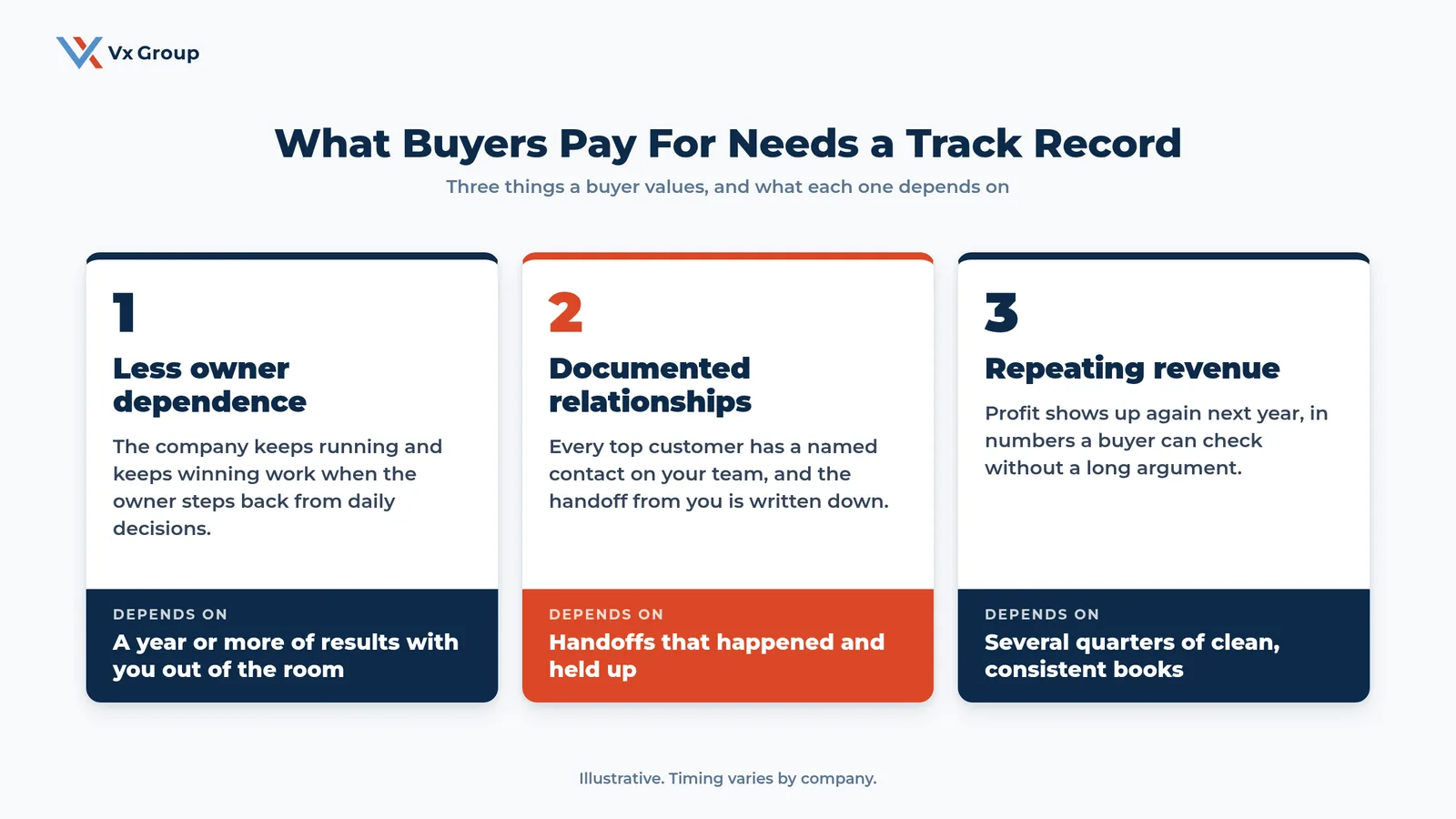
Each of the three depends on time. Owner dependence drops only after the company has run well with you out of the room. A relationship handoff counts only after the new contact has held the account through a real order cycle. Clean books count only after several quarters of closing on schedule.
That is why the three items in the graphic have a “depends on” line. You can start any of them today. You cannot finish any of them in the last two months.
Why do you need 24 months to prepare a business for sale?
Twenty-four months gives each change a stretch of results a buyer can look at. A buyer can verify two years of customer orders, monthly closes, and a team that ran the plant while you took a vacation. A plan gives a buyer nothing to check.
Compare two owners with the same company. The first starts when the banker is hired. The second starts two years earlier.
The first owner can polish the brochure, fix the roof, and clean up a few reports. A buyer reads those as presentation. The second owner can show a second contact who has run the top accounts for a year, books that closed on time for eight quarters, and a production lead who made the daily decisions.
Both owners may have the same plant and the same profit. The second one has evidence, and evidence is what a buyer pays for.
Twenty-four months also gives you room for surprises. A top customer may shift an order. A key person may leave. A bad quarter may arrive. With two years, you can absorb one of these and still show a clean picture at the end.
If you have less time, the plan still works in a shorter form. A later section covers what to do first with 12 months or less.
What does the full 24-month sequence look like?
The sequence has five stages. Each stage has one job, one owner, and one proof point a buyer can check.
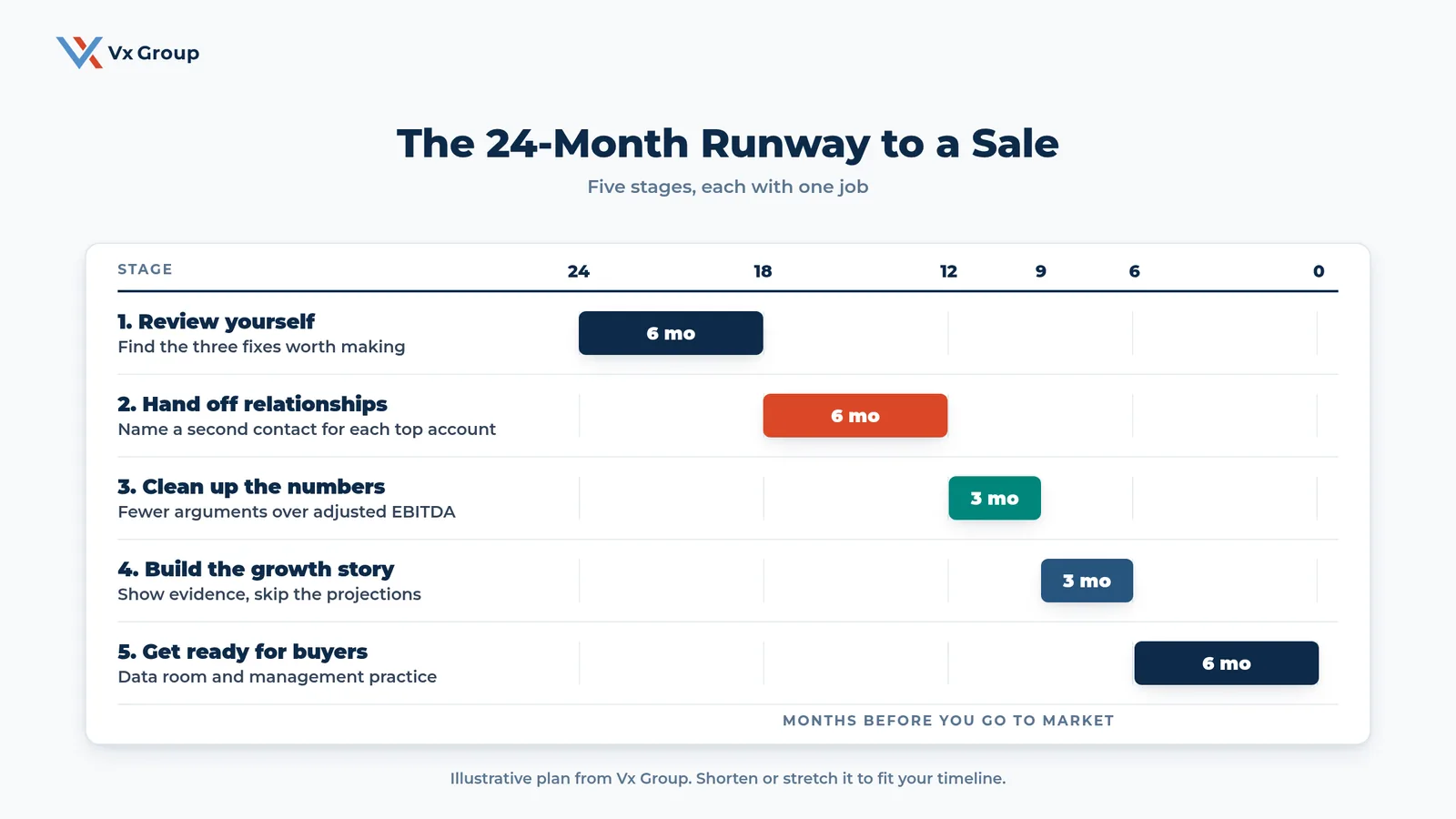
The stages run in this order because each one builds on the last. You cannot hand off relationships well until you know which ones matter. You cannot clean up the numbers until the relationship picture is clear. You cannot tell a growth story until the numbers hold up.
The table below shows who owns each stage and what a buyer can verify at the end of it. Use it as a checklist for your own calendar.
| Stage | Months before going to market | Who owns it | Proof a buyer can check |
|---|---|---|---|
| 1. Review yourself | 24 to 18 | Owner and CPA | A written list of findings and three chosen fixes |
| 2. Hand off relationships | 18 to 12 | Owner and sales lead | Named second contact on each top account, with a written handoff |
| 3. Clean up the numbers | 12 to 9 | Finance lead and CPA | Monthly closes on schedule and a short list of explained add-backs |
| 4. Build the growth story | 9 to 6 | Owner and sales lead | Orders, quotes, and customer results that show where growth comes from |
| 5. Get ready for buyers | 6 to 0 | Owner and management team | A complete data room and a practiced management presentation |
Relationship handoff gets the longest bar in the plan on purpose. It has the longest lead time and the biggest effect on price, and it cannot be compressed.
Step 1: How do you review your own business before a buyer does? (Months 24 to 18)
Run a review of your own company the way a buyer’s team would, then pick the three problems worth fixing. This is the first stage because it tells you where the next 18 months of work should go.
The same review is a core part of sell-side due diligence, where you look at your own business before a buyer does. At this stage, you run a lighter version of it.
Run the review with your CPA and one trusted advisor
Ask your CPA and one advisor you trust to join you for a half-day session. Bring the last three years of financial statements, a revenue list by customer, an org chart, and a list of your written procedures.
Ask three questions. Who owns each top customer relationship? Which profit numbers would a buyer argue with? What breaks if I am gone for 60 days?
Write down every finding, then rank it
Write each finding on one line. Mark each one by how much it could change the price and how long it would take to fix. Owner dependence and relationship ownership usually rank high on both.
Pick three fixes and name an owner for each
Choose the three findings with the biggest effect on price. Name one person who owns each fix and a date for the first result. Three fixes is enough. A list of fifteen will not get done.
The output of Stage 1 is a one-page list: three fixes, three owners, three dates.
Ready to grow?
See where your own top accounts stand and where a handoff should start.
Step 2: How do you reduce owner dependence by handing off customer relationships? (Months 18 to 12)
Reduce owner dependence by moving each top customer relationship from you to a named second person on your team, with a handoff written down. This stage has the biggest effect on price. A buyer pays more when a customer stays after you leave.
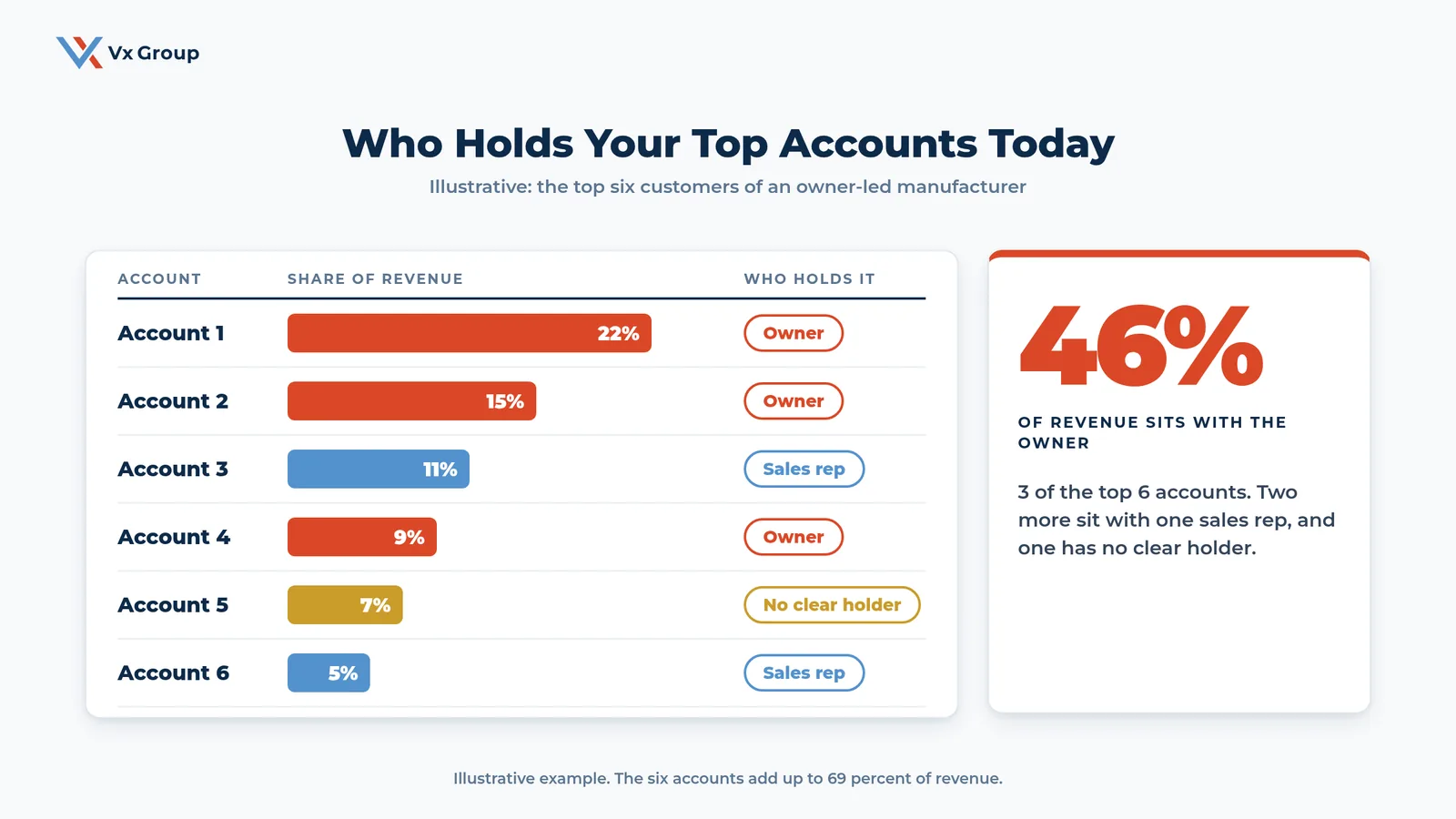
The chart shows a common starting point. In this illustrative example, the owner personally holds three of the top six accounts, and those three make up 46 percent of revenue. Two more sit with one sales rep. One has no clear holder. A buyer reads that page and sees a company that depends on a few people.
List your top ten accounts and who holds each one
Pull revenue by customer. For each of the top ten, write the name of the person at your company who holds the relationship. If the answer is “me” or “nobody,” mark it. This list is your starting point.
The risk behind the list is covered in customer concentration risk. Founder-held relationships are a related problem, covered in founder-dependent sales.
Name a second contact for every account you hold
For each account you hold, pick one person on your team to become the second contact. Choose someone the customer already knows, or someone the customer would trust after a few meetings.
Introduce them in person where you can. Say plainly to the customer why you are doing it: the company is growing, and you want more than one person who knows their business.
Write the handoff down
Write a one-page record for each account. Include what the customer buys, who makes decisions, what they care about, past problems, and any promises you made. This page protects the customer and the company.
Key account management covers how to run this record after the handoff.
Step back from the call and watch what happens
After the introduction, join fewer calls. Let your second contact handle a quote, a delivery problem, and a renewal. Keep notes on what went well and what needed you.
The output of Stage 2 is ten accounts, each with a named second contact and a written record, plus at least six months of orders that came through the new contact.
Step 3: How do you clean up the numbers so adjusted EBITDA needs fewer arguments? (Months 12 to 9)
Clean up the numbers by closing the books on a fixed schedule and writing down every adjustment you plan to claim. A buyer starts from your profit figure and then argues with it. Your goal is to give them less to argue about.
Defined Term: Adjusted EBITDA.
Operating profit with one-time costs and owner-specific costs added back, so a buyer can see what the business earns under a new owner. Buyers pay a multiple of this number, which is why each adjustment gets questioned.
The buyer’s review of your earnings is covered in quality of earnings. In this stage, you do the groundwork before that review starts.
Close the books every month on the same day
Pick a close date, such as the tenth of each month, and meet it for nine to twelve straight months. A buyer reads a steady close as a sign that the numbers are reliable.
List every add-back and attach proof
Write down each expense you plan to add back, such as a one-time legal bill, a family member’s pay above market, or a vehicle that is personal use. Next to each, attach the invoice or record. An add-back with proof rarely gets argued.
Explain the odd months before anyone asks
Look at your monthly profit for the last two years. For any month that looks unusual, write two sentences on why. A short note now saves a long conversation later.
The output of Stage 3 is a set of monthly closes that arrived on time and a one-page add-back list with proof.
Step 4: How do you build the growth story with evidence? (Months 9 to 6)
Build the growth story from facts a buyer can check, such as orders, quotes, and customer results. A buyer discounts projections. A buyer reads the last four quarters of real activity and decides where growth will come from.
Show where the last year of new revenue came from
Break the last 12 months of new revenue into new customers, existing customers buying more, and price changes. A buyer wants to know whether growth repeats or came from one event.
Document your pipeline and quote history
Gather open quotes, win rates, and the average time from first meeting to order. Add the names of the people who ran each deal. A pipeline that several people can run is worth more than one that only you can run.
Name two or three growth moves a new owner could make
Write down where a larger company could add value, such as a new market, a second plant shift, or a product line you never had time to push. Back each with one fact. Buyers pay for upside they can see a path to.
The output of Stage 4 is a short growth summary built from numbers a buyer can trace back to your records.
Step 5: How do you get ready for buyer meetings? (Months 6 to 0)
Get ready for buyers by building a complete data room and practicing the meetings your management team will have. This is the last stage, and it is the one most owners start with. It works best when the first four stages are done.
Defined Term: Data room.
A secure online folder holding the documents a buyer reviews, such as financial statements, customer contracts, employee records, and permits. A tidy data room signals a company that is run well.
Build the data room once and keep it current
Gather financial statements, tax returns, customer agreements, supplier agreements, equipment lists, insurance policies, permits, and key employee agreements. Put them in labeled folders. Update it monthly so it never goes stale.
Practice the management presentation out loud
Your leaders will present to buyers. Have each one practice with your advisor for 30 minutes. Cover what they own, how they run it, and what they would do next. People who sound sure reassure a buyer.
Prepare yourself for the hard questions
Write down the five questions you would least like to hear, such as why a customer left or why margins dipped. Practice a plain, short answer to each. Owners who answer directly build trust in the first meeting.
The output of Stage 5 is a data room, a rehearsed team, and an owner ready for direct questions.
What mistakes slow down preparing a business for sale?
Most delays in a sale trace back to a handful of avoidable mistakes. These are the ones I see most:
- Starting when the banker is hired. At that point, the changes buyers value have no track record behind them.
- Spending on the plant and ignoring relationships. A new machine adds a line to the equipment list. A customer handoff adds evidence a buyer will pay for.
- Making the handoff announcement too late. A customer who hears about a new contact the month before a sale may wonder what is wrong.
- Hiding a weak spot. A buyer finds it anyway, so explain it up front and show what you are doing about it.
- Changing too many things at once. Three fixes finished give a buyer more to see than ten started.
- Telling too many people. Keep the plan inside a small group until you are ready to tell customers and staff.
What should you do if you have less than 24 months?
If you have 12 months or less, do the stages in this order: relationship handoff first, then the add-back list, then the data room. These three cost the least and move the price the most.
With 12 months, you can run Stage 1 in a few weeks and start the handoffs right away. A six-month track record is shorter than ideal, and it still beats none.
With six months or less, you have time to list your top accounts, name second contacts, and begin the introductions. Be honest with buyers about how recent the handoffs are. Buyers respect a plain account of what is done and what is underway.
Whatever your timeline, start with the account list. It takes an afternoon and shows you the size of the work ahead.
Some owners are also weighing succession to family or to managers. That decision changes the plan, and it is covered in a separate piece on family business succession planning. For questions about why growth stalls at your size, see why owner-led companies stall.
Where should you start this week?
Start with one page: your top ten customers, their share of revenue, and the name of the person who holds each relationship. It takes about an hour with a revenue report.
Then ask yourself three questions. How many of these accounts depend on me alone? Who on my team could be a second contact for each? What would a buyer say about this page?
Next, book the half-day review from Stage 1 with your CPA and one trusted advisor. Put it on the calendar this month.
Finally, build a shared team around the plan. The article on how to build an infinite team covers how to create a team that runs the company with you in a smaller role.
Conclusion
Preparing a business for sale is mostly a matter of time. Buyers pay for customer relationships that transfer, profit that repeats, and a company that runs when you step back. Each one needs a track record, and a track record needs months.
If you plan to sell in two years, you can start the first stage this month. If you plan to sell in six months, you can still start with the account list and the handoffs.
Who holds your ten most important customer relationships today? And if the honest answer is “mostly me,” what would a buyer be paying for?
Ready to grow?
Talk through your own 24-month runway with a team that works with owner-led manufacturers.
FAQs
About the Author: Eric Zoromski
