

Consultative Selling vs Solution Selling for Manufacturers

Consultative selling starts with questions about the buyer’s operation and builds the offer from what the rep learns. Solution selling starts with a problem your product already fixes and shows the buyer what the fix is worth. For a manufacturer with a 6 to 12 month sale, consultative questions come first and solution selling closes the deal.
TL;DR
- Consultative selling fits deals where the buyer is still sorting out the problem. Solution selling fits deals where the buyer can already name it.
- Neither method wins on its own. In a long manufacturing sale, the rep diagnoses first, then puts a cost on the problem, then offers the fix.
- The real problem is the scripted pitch that skips the diagnosis. Both methods fail when the rep does not know the account’s history.
- A buying committee needs one cost-of-the-problem number that each member can use.
- Pick the method deal by deal. Tag your open deals this week by what the buyer knows and who has to agree.
- Reps need the account record before the first call. Without it, neither method works.
A rep at a $20M manufacturer walks into a first meeting with a deck. The deck has the company history, the product line, and a price sheet. The buyer is polite for 40 minutes. Nobody learns what the buyer’s plant is struggling with. Three weeks later the buyer says they went with someone else.
That is the scripted pitch. Consultative selling and solution selling are two ways to replace it. Both ask the rep to understand the buyer before talking about product. They differ in where the rep starts and how much the buyer already knows.
This article is for owners and presidents of privately held manufacturers, roughly $5M to $50M in revenue, with sales cycles of six months or more. It explains how each method works, where each one stalls, how to match the method to the deal, and how to use both on one team.
What is the difference between consultative selling and solution selling?
Consultative selling starts with the buyer’s situation and builds the offer from the answers. Solution selling starts with a known problem and shows how a specific product or package fixes it. The first suits a buyer who is still defining the need. The second suits a buyer who can already describe it.
The table below compares the two methods on the points that matter in a long manufacturing sale.
| Point of comparison | Consultative selling | Solution selling |
|---|---|---|
| Starting point | The buyer’s plant, process, and goals | A problem your product is known to fix |
| First thing the rep does | Asks open questions and listens | Confirms the problem and what it costs |
| What the rep brings | Questions, industry knowledge, and a point of view | A tested package, a business case, and proof |
| Best when | The buyer has a need but no clear definition of it | The buyer has named the problem and wants options |
| Stalls when | The rep keeps asking and never recommends | The rep assumes the problem before checking it |
| Who leads the conversation | The buyer, with the rep guiding | The rep, with the buyer confirming |
| Typical length of first phase | Two to four meetings | One or two meetings |
Both methods sit between pure order-taking and a hard pitch. If your team mostly quotes what customers ask for, read our guide on transactional selling first. If you want the full method behind the consultative side, our guide to consultative selling covers it in depth. This article focuses on how the two compare and when to use each.
What is consultative selling?
Consultative selling is a method where the rep acts as an advisor. The rep studies the buyer’s operation, asks questions about cost, quality, and risk, and recommends a fix only after the buyer has described the problem in their own words. The idea goes back to the 1970s and fits complex B2B sales well.
Defined Term: Consultative selling.
A sales method where the rep diagnoses the buyer’s situation through questions before offering anything, and builds the recommendation from what the buyer says.
Ask about the buyer's plant before your product
A good first meeting covers what the buyer makes, where it goes wrong, and what that costs. Ask about scrap, rework, late shipments, and the last time a supplier let them down. Take notes in the buyer’s words. Those words become your proposal language later.
Listen for the cost the buyer has stopped noticing
Buyers live with problems for years. A purchasing manager may accept 3% scrap because it has always been 3%. Ask what the line would do with those hours back. When the buyer hears their own number out loud, the problem becomes real to them.
Give a point of view by the third meeting
Consultative selling can drift into endless questions. Set a rule that the rep shares a view by the third meeting: what you see, what you would try, and what you would want to confirm. Buyers respect a rep who commits to a view.
Write the account record before the next call
Consultative selling depends on memory. Record the buyer’s problems, contacts, past orders, and open questions in one place. A rep who forgets what the buyer said last month loses the trust the questions were meant to earn.
What is solution selling?
Solution selling is a method where the rep starts from a problem the company already solves well. The rep confirms that the buyer has that problem, puts a cost on it, and shows how a specific product or package fixes it. It works best when the product fits a repeatable need.
Defined Term: Solution selling.
A sales method that links a known buyer problem to a defined package of product and service, and proves the value with the buyer’s own numbers.
Name the problem you fix best
List the three problems you solve better than competitors. For a machined-parts maker, that might be late deliveries, tolerance drift, and thin quality records. Each one becomes an opening line. A rep who opens with “Where do you see late shipments hurting you?” starts from strength.
Confirm the problem before you present
Solution selling fails when the rep assumes the problem. Ask two or three questions that check whether the buyer has it. If the buyer says yes, ask what it costs. If the buyer says it is fine, stop and switch to consultative questions.
Put a number on the problem
Solution selling closes on value. Work with the buyer to build a simple cost: hours of rework, scrap dollars, or lost orders. Keep the math short enough to repeat in a meeting. A number the buyer helped build gets used inside their company.
Package the fix with proof
Show the product, the service around it, and one example from a similar customer. Keep the package specific. “A stocking program, a tighter tolerance, and a monthly quality report” is a package. “A full-service partnership” is a slogan.
What does each method sound like on a real sales call?
On a consultative call the rep mostly asks and listens, and the buyer does most of the talking. On a solution call the rep confirms a known problem quickly and moves to cost and fix. The same supplier of machined housings would sound different on each call.
Hear the consultative version
The rep says: “Walk me through what happens when a housing arrives out of tolerance.” The buyer explains the rework, the line stoppage, and the call to the supplier. The rep asks what that cost last quarter. The buyer does not know, so the rep offers to help pull the numbers. No product has come up yet, and the buyer has started to trust the rep.
Hear the solution version
The rep says: “Most plants that buy housings from us have the same issue with tolerance drift. Is that happening for you?” The buyer says yes. The rep asks how many hours of rework that creates and then lays out the package: tighter tolerance, a stocking plan, and a monthly quality report. The call ends with a draft cost sheet.
Notice what both calls share
Each rep asked about a real problem before talking about product. Each ended with a next step. The difference is how much the buyer already knew. If you coach your team on one habit, make it this: no product talk until the buyer has said the problem out loud.
Ready to grow?
See how your sales team handles the first three meetings and where deals stall.
Why does the scripted pitch fail in long-cycle B2B?
The scripted pitch fails because a long-cycle buyer is deciding whether to trust a supplier for years. A deck full of company history gives the buyer no reason to believe the rep understands their plant. The buyer reads that as a vendor who treats every account the same.
Count what the buyer risks
A purchasing lead who picks a new supplier carries the risk if parts arrive late. The buyer wants proof that the rep understands the stakes. A rep who has asked about the last bad delivery shows that. A rep who recites a catalog does not.
Recognize the pattern in your own pipeline
Look at your last five lost deals. In how many did the rep present before diagnosing? In how many did the buyer say “we went another way” with no clear reason? The pattern often points to the same gap: nobody asked what the problem cost. Both methods in this article close that gap.
Where does each method stall in a long manufacturing sale?
Consultative selling stalls when questions replace recommendations. Solution selling stalls when the rep pitches a fix before checking the problem. In a sale that runs 6 to 12 months, both stalls cost months, because the buyer’s attention moves to other projects.
Spot the consultative stall
The signs are a fourth meeting with no proposal, a buyer who says “this was helpful, let us think about it,” and notes that list problems with no next step. Fix it by ending every meeting with a dated next step and by giving a recommendation by the third meeting.
Spot the solution stall
The signs are a buyer who nods at the presentation and then asks for a quote on the old part. The rep skipped the diagnosis, so the package solved a problem the buyer does not feel. Fix it by returning to two or three questions and asking what the buyer would change first.
Watch the committee
In a long manufacturing sale, several people weigh in. An engineer cares about spec and fit. A purchasing lead cares about price and delivery. A plant manager cares about uptime. A method that works with one buyer can stall with the rest. Our guide to the B2B buying process explains who tends to sit in the room.
Which method fits which deal?
Match the method to two facts about each deal: how well the buyer understands the problem, and how many people have to agree. A buyer who knows the problem and decides alone suits solution selling. A buyer who is still defining the need suits consultative selling. A committee needs both, in order.
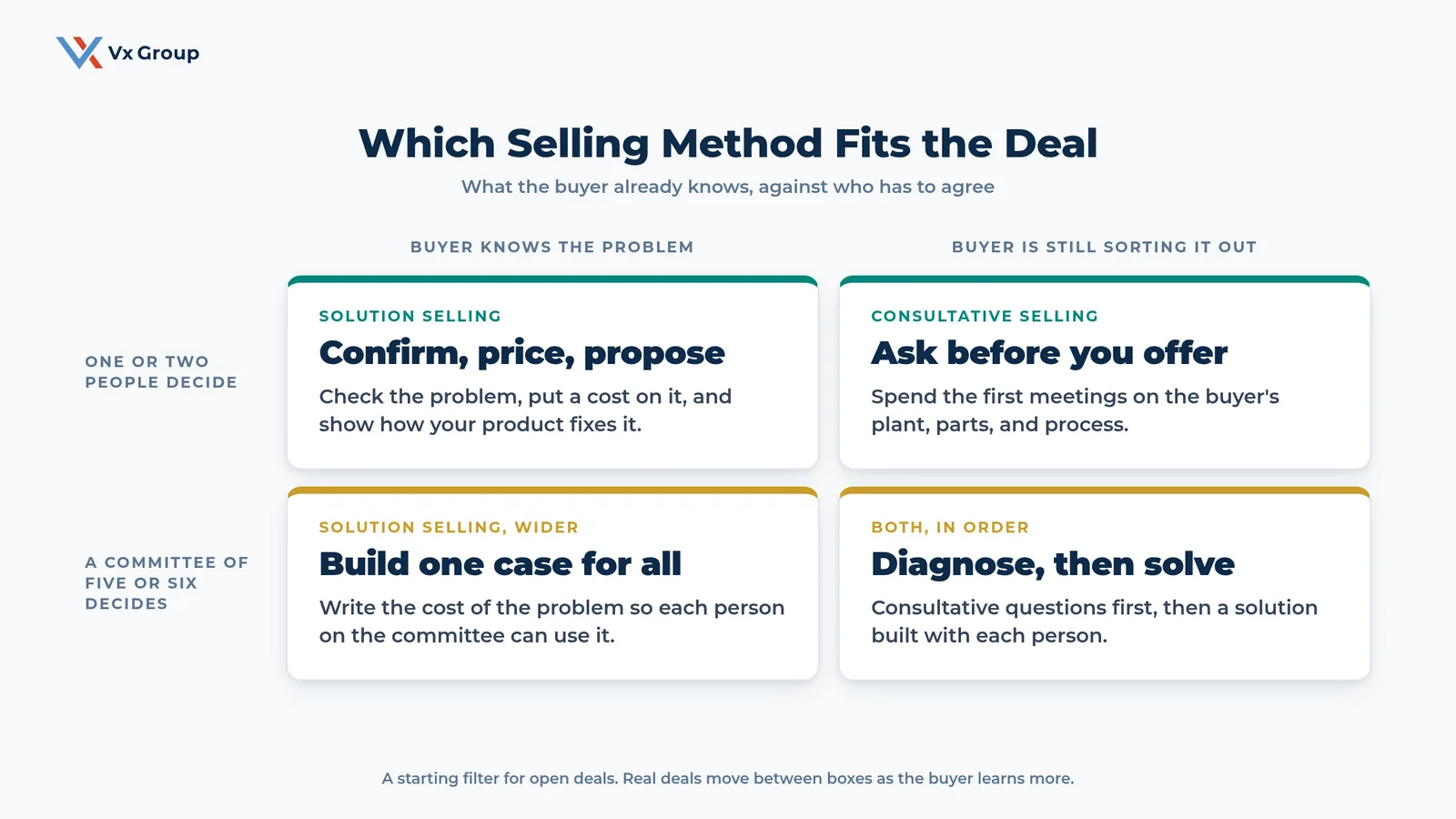
The grid sorts open deals into four boxes. Use it as a starting filter. Real deals move between boxes as the buyer learns more.
Use solution selling when the buyer can name the problem
A buyer who calls and says “our supplier keeps shipping late” has named the problem. Confirm it, put a cost on it, and show your package. Skip three meetings of open questions. The buyer will see that as wasted time.
Use consultative selling when the buyer feels a gap without a name for it
A buyer who says “we want to look at new suppliers” has a feeling and no definition. Spend the first meetings on the plant, the parts, and the history. The definition you help them reach becomes your proposal.
Use both in order when a committee decides
When five or six people decide, start consultative with each of them. Then build one cost-of-the-problem sheet that works for all of them. A mutual action plan helps hold the dates and owners together across the committee.
Check the length of the cycle
Short cycles tolerate a fast, solution-led pitch. Long cycles reward patience. If your average sale runs nine months, you have time for diagnosis, and the buyer expects it. Our guide to the stages of a B2B sales cycle shows where each method fits along the way.
How do you use both methods on one sales team?
Use consultative selling to find and define the problem, then solution selling to size it and propose the fix. Give every rep the same four-step path, the same account record, and one rule for when to move from asking to recommending. A shared path keeps the team consistent across reps.
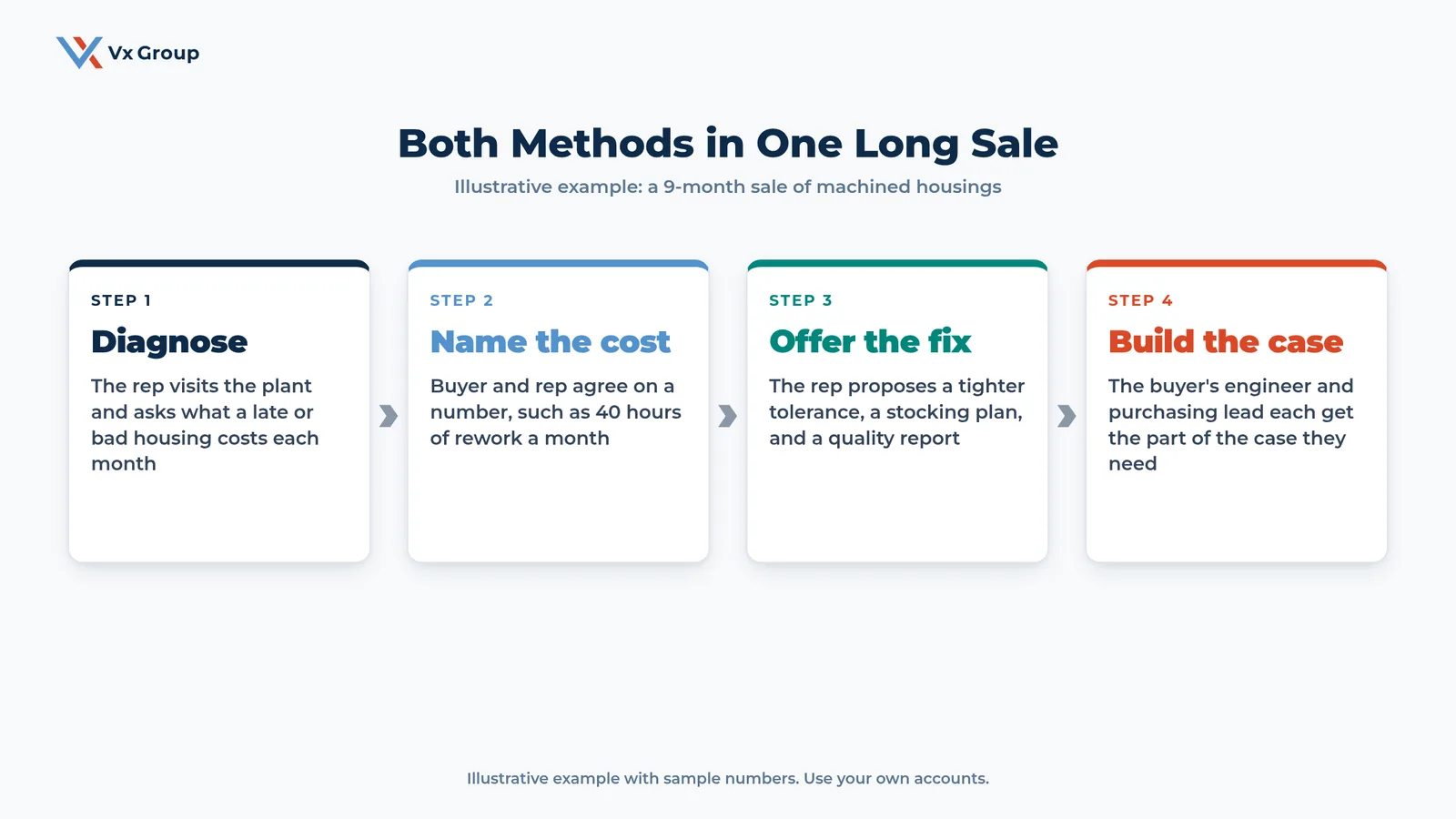
The example above shows one sale of machined housings. The rep diagnoses, agrees on a cost with the buyer, offers a package, and builds the case for each person on the committee. The numbers are sample figures, so use your own accounts.
Write the four-step path on one page
Name the steps: diagnose, name the cost, offer the fix, build the case. Under each, list what the rep should know and have before moving on. A one-page path is easier to coach than a thick manual. It also becomes the base of your sales playbook.
Teach five questions for the diagnosis
Give reps five questions they can ask in any first meeting. For example: What does a late shipment cost you? Who else is involved in this decision? What did you try before? What would make you change suppliers? What does a good year look like for this line? Reps will adapt the wording, and the questions keep the diagnosis on track.
Set a rule for when to recommend
Pick a clear trigger. For example: after the third meeting, or once the buyer has named a cost, whichever comes first. The rule stops consultative selling from drifting and stops solution selling from jumping ahead.
Keep one account record for every buyer
Every rep should log problems, costs, contacts, and the buyer’s own words. The record lets a new rep or a manager pick up the account. If most of your accounts live in one person’s head, you have a founder-dependent sales problem that no sales method will fix.
Train new reps with real deals
Use two or three closed deals as teaching cases. Show where the diagnosis happened, where the cost was set, and where the proposal came from. Our guide to sales onboarding covers how to build that into a new rep’s first 90 days.
What mistakes do teams make with each method?
The most common mistakes are pitching before diagnosing, asking questions with no point of view, using a script, and treating every account the same. Each one comes from skipping what the team knows about the account. All four are fixable with a shared record and a clear path.
Pitching before the diagnosis
The rep arrives with a deck and starts talking. Fix it by making the first meeting a listening meeting and by moving the deck to meeting three or later.
Asking questions with no point of view
Buyers get tired of a rep who only asks. Fix it with the third-meeting rule above. Share what you see and invite the buyer to correct you.
Running the same script on every account
A script cannot tell a loyal ten-year customer from a first-time buyer. Fix it by reading the account record before every call. Our guide to key account management shows how to treat your top accounts differently.
Treating consultative selling as a long free consulting project
Some reps give away weeks of advice with no path to an order. Fix it by agreeing on the next step and the decision date at the end of each meeting.
How do you pick a method for your open deals this month?
Pick five open deals and tag each one by two facts: what the buyer knows about the problem and how many people decide. Then choose the method that fits each box and the next step for each rep. The exercise takes about an hour and shows where deals are stuck.
- List five open deals above a size that matters to you.
- For each, write what the buyer has said about the problem in their own words. If nothing is written, mark it “unknown.”
- Count the people on the buyer’s side who have a say.
- Place each deal in a box on the grid above.
- Write the next step: a diagnosis meeting, a cost conversation, or a proposal.
- Review the five deals again in two weeks and move them between boxes.
Deals marked “unknown” tell you something. Your team does not yet know enough about the buyer to sell to them. Start with consultative questions on those accounts.
If your team spends most of its time on first contact, our guide to sales prospecting covers how to find and open conversations with the right accounts.
Next step for owners
Both methods ask your team to learn before they pitch. The method matters less than the habit: a diagnosis, a cost the buyer agrees to, and a clear fix. Owners who put those three in writing see deals move faster and fewer deals go quiet. Our guide to B2B sales strategy shows how this fits into the rest of your sales plan.
Ready to grow?
Bring one stuck deal and we will map which method fits it.
FAQs
About the Author: David Tisdale
