

Trade Show Planning Checklist for Manufacturers
A trade show planning checklist for manufacturers has six time windows. They are 8 weeks out, 4 weeks out, 1 week out, the show days, 48 hours after, and 10 days after. Each window carries a logistics list and a relationship list, and every item has an owner. The relationship list decides whether the show pays off.
TL;DR
- Most trade show checklists cover freight, carpet, and badge scanners. They list nothing about who you plan to see.
- Use six windows: 8 weeks out, 4 weeks out, 1 week out, show days, 48 hours after, and 10 days after.
- Give every window two lists. One covers logistics. The other covers relationship work and gets equal weight.
- Build a target account list 8 weeks out and book meetings by name 4 weeks out.
- Brief the booth team on who is coming, and agree on what counts as a qualified conversation.
- Write a card for every real conversation, with a next step, one owner, and a date.
- Send personal notes within 48 hours and hold the follow-up review within 10 days.
Here is a pattern we see with owner-led manufacturers. The show is booked a year ahead. The booth gets built, the freight gets scheduled, and the hotel rooms get reserved. A checklist covers every item on the truck.
Then the team arrives and nobody can say which twelve companies they most wanted to meet. Two of your best customers walked the floor and left without a word from you. The badge scanner shows 300 names, and nobody knows what to do with them.
We call that the badge scan trap. The checklist was a logistics list, so the team spent the show doing logistics.
This article is for owners and presidents of privately held manufacturers, roughly $5M to $50M in revenue, who exhibit at a few shows each year. It gives you a checklist you can copy into your own plan. Every window has a logistics list and a relationship list, and every item names the person who owns it.
What belongs on a trade show planning checklist?
A trade show planning checklist belongs on one page with six time windows. Each window has a logistics list and a relationship list, and every item has an owner. Logistics makes sure the booth works. Relationship work makes sure the right people walk into it.
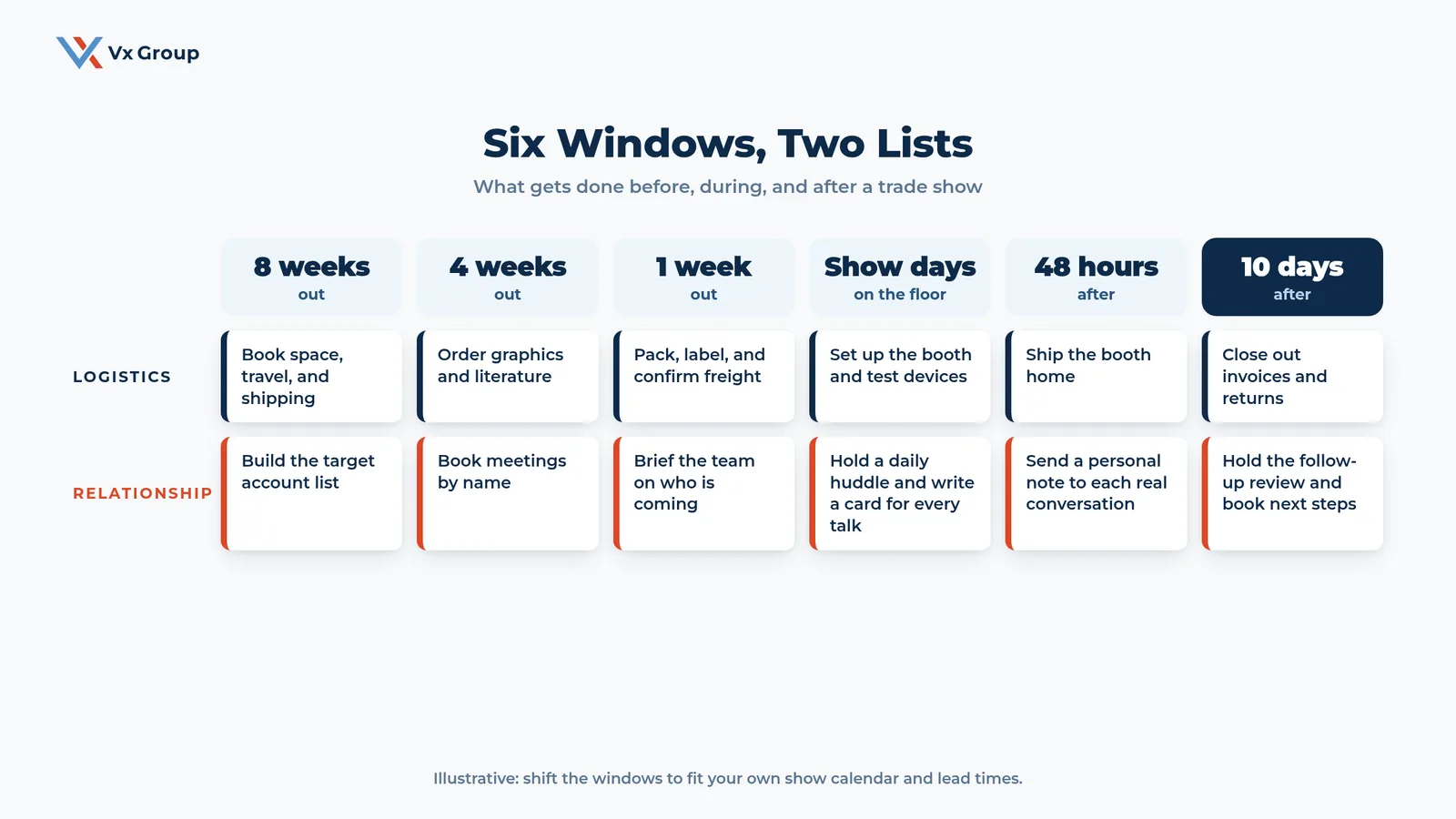
The grid above shows the shape. Each window has one logistics task and one relationship task as a headline. The sections below add the rest of the items under each window.
Most checklists you will find online stop at the logistics row. Freight deadlines, electrical orders, shipping labels, and a packing list matter, and your team should handle them. Even so, they cover only half of the work.
Defined Term: Relationship work.
The tasks that decide who you meet at a show and what happens after you meet them. It includes the target account list, meetings booked by name, the team brief, notes from every conversation, and the follow-up plan.
Most of the relationship work happens before the show, which is why the first windows matter most. If you are still deciding which shows deserve this effort, our guide on whether B2B trade shows are worth it can help you choose.
1. What should you do 8 weeks before a trade show?
Eight weeks before a trade show, lock the logistics that have deadlines and build the target account list. The list names the customers, distributors, and prospects you want to meet at this show, and it drives every later window.
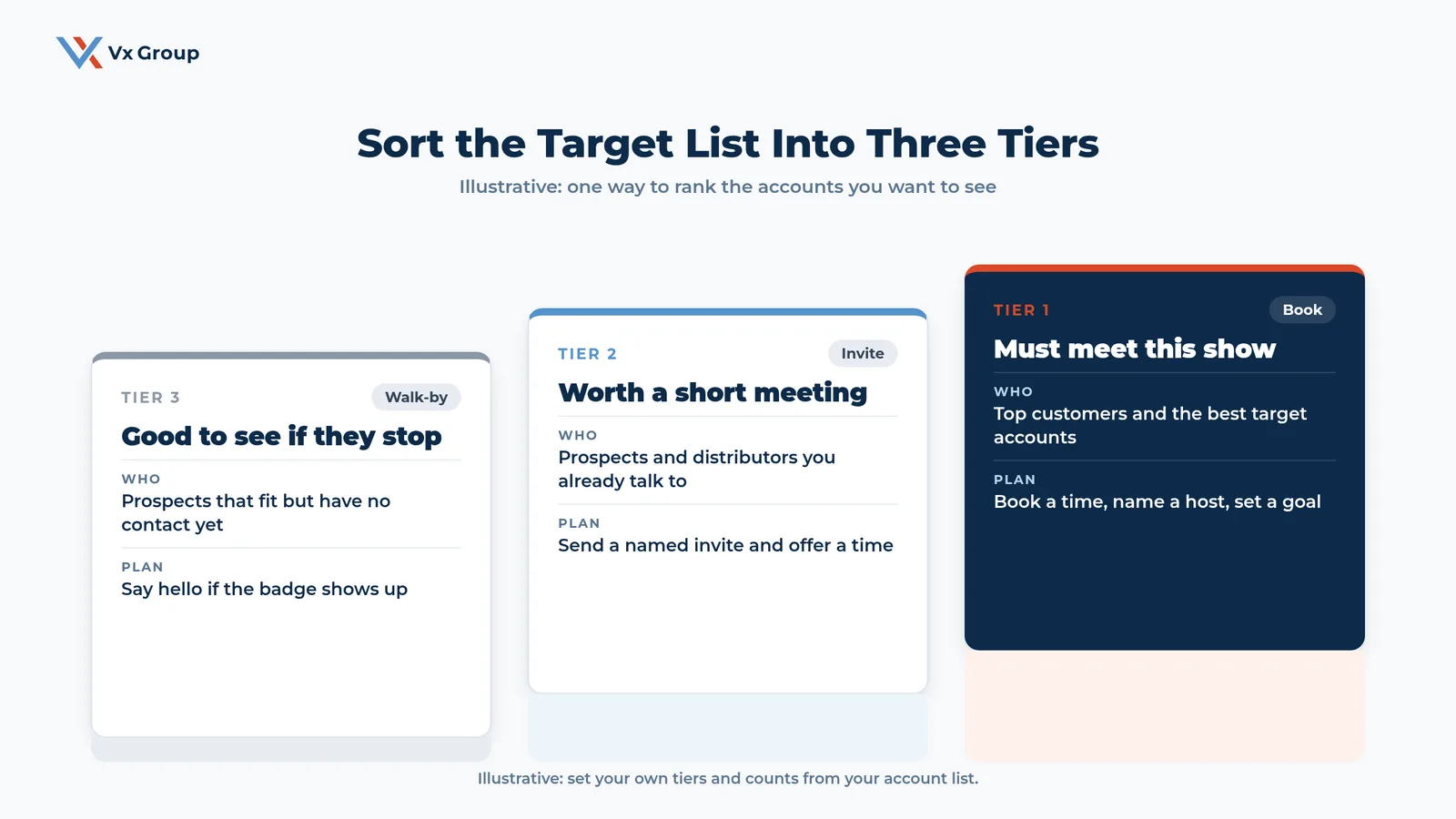
The graphic above sorts the target list into three tiers. Tier 1 accounts get a booked time, a named host, and a goal. Tier 2 accounts get an invitation. Tier 3 accounts get a hello if they stop by.
Finish the logistics that have deadlines
Complete these items first, because late fees and sold-out services come from missing them.
- Confirm the booth space and the show contract. Owner: operations lead.
- Book travel and hotel rooms for the team. Owner: operations lead.
- Order the booth graphics, product samples, and printed literature. Owner: marketing lead.
- Order electrical, internet, and any material handling the show requires. Owner: operations lead.
- Set the budget and track it in one sheet. Owner: owner or president. Our guide to trade show budgets shows what to include.
Build the target account list
Start with the exhibitor list and the attendee list the show provides. Pull the companies you already know, then add the ones you want to know. Aim for 25 to 40 names. Fewer than that leaves empty hours, and more than that is a list nobody will use.
Sort each name into one of three tiers, as in the graphic. Tier 1 holds your top customers and best target accounts. If you have not ranked your accounts before, our ideal customer profile template gives you a scoring method.
Put the name of the person on your team who owns each account next to it. Owner: sales lead.
Set one goal for each Tier 1 account
Write one sentence per Tier 1 account that says what you want from the meeting. Examples include a plant visit booked, a quote request on a new product, or an introduction to a second buyer at the company.
A goal turns a friendly chat into a meeting with a purpose. Owner: account owner for each name.
Write down the qualification bar
Agree now on who counts as a qualified conversation. A short definition works well: someone who buys or specifies what we make, or someone who influences a person who does.
| Visitor type | Counts as qualified? | Next step you can offer |
|---|---|---|
| Current customer | Yes | Plant visit or account review |
| Target account buyer | Yes | Quote review or a 30-minute call |
| Distributor or rep | Yes | Territory conversation |
| Student or job seeker | No | Literature and a thank you |
Print the table on the back of the booth brief. Owner: sales lead.
2. What should you do 4 weeks before a trade show?
Four weeks before a trade show, send named invitations and book meetings with your Tier 1 and Tier 2 accounts. A booked meeting with a named person tells you more than a pile of badge scans, and this window is when most meetings get booked.
Finish the logistics for the booth
- Approve the final booth graphics and send them to print. Owner: marketing lead.
- Confirm the shipping schedule and the freight carrier. Owner: operations lead.
- Arrange the product samples and demo units. Owner: operations lead.
- Pick two products to feature and one customer story to tell. Owner: sales lead. A crowded booth gives visitors too many places to look.
Send a named invitation to each target account
Write each invitation to one person at one company. Name the show, the booth number, and a specific time slot or two. Keep it to four or five sentences.
A good invitation gives a reason that fits the person. For a long-time customer, mention a project you worked on together. For a prospect, mention a problem you have solved for a similar company. For a distributor, mention what is new in the line. Owner: account owner.
Follow up by phone with your Tier 1 names one week after the email. A call from someone they know gets more yeses than a second email. Owner: account owner.
Plan the non-selling touches with your current customers
Pick three or four ways to spend time with current customers that have nothing to do with a sale. A dinner, a coffee at the hotel, a walk through the show together, or a visit to a supplier booth they care about all work.
These touches matter because your best customers are at the show too. Many of them are being courted by your competitors. A relaxed hour with the owner or the sales lead tells them you value the relationship. Our article on share of wallet explains why those accounts deserve that attention.
Owner: owner or president for the top five accounts, and sales lead for the rest.
Track replies in one place
Keep a single sheet with every Tier 1 and Tier 2 name, the invitation date, the reply, and the time booked. Check it each Friday. Owner: sales lead.
3. What should you do 1 week before a trade show?
One week before a trade show, pack and ship what is left, and brief the booth team on who is coming. The brief gives every person on the booth a job, so the team has a plan before they stand in the aisle.
Finish the packing and shipping items
- Confirm the freight has arrived or is on its way, with tracking numbers. Owner: operations lead.
- Pack a carry-on kit with extra badges, power strips, tape, cleaning supplies, and chargers. Owner: booth host.
- Print the one-page booth brief and enough copies for every person on the team. Owner: sales lead.
- Test any demo equipment or screens before they leave the building. Owner: operations lead.
Brief the team on who is coming
Hold a 45-minute team meeting. Read the target account list out loud. Say who owns each Tier 1 name and which meetings are already booked. Tell the team which customers will stop by and what each one cares about.
People walk the floor differently when they know twelve names. They watch the aisle for badges, and they say hello first. Owner: sales lead.
Practice the first thirty seconds
Pair people up and have them practice the opening line, one follow-up question, and a polite way to end a conversation that is not a fit. Practice takes 15 minutes and finds awkward phrasing before the show does.
Our article on trade show booth staff training covers the opening lines, the exit line, and the role-play in more detail. Owner: sales lead.
Set up the capture cards
Decide how the team will record each conversation. Paper cards and a CRM form both work. Each card has five fields: who they are, what they need, the next step, the one owner, and the date. Print the cards or build the form this week. Owner: sales lead, with help from whoever manages the CRM.
Ready to grow?
Bring your next show date and your top 25 accounts, and we will help you build the relationship half of your checklist.
4. What should you do on the show days?
On the show days, run the booth from the target account list. Hold a short huddle each morning, host the booked meetings first, write a card for every real conversation, and spend time with your current customers.
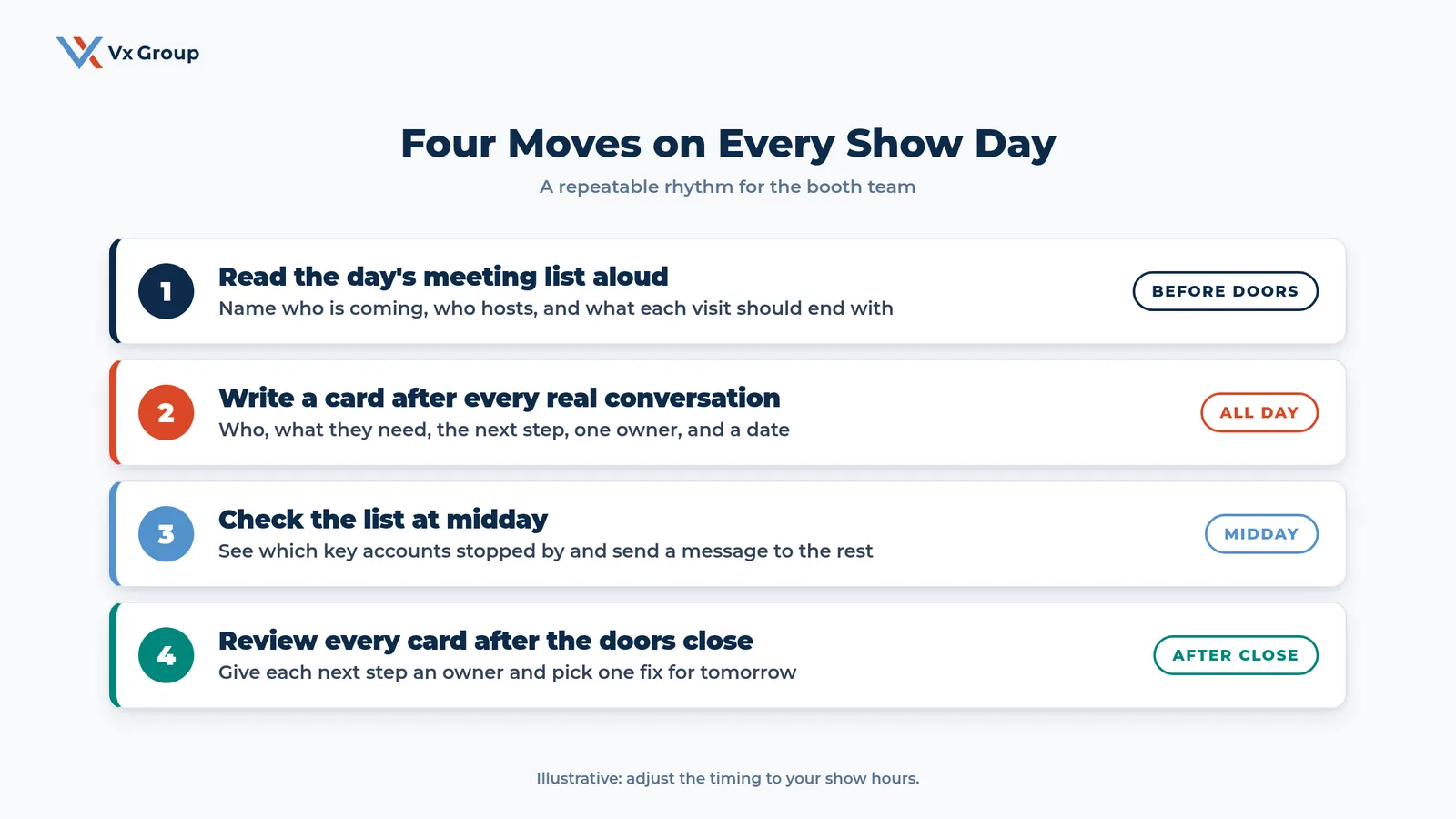
The graphic above shows four moves for each day. Each move takes about ten minutes or less, and together they keep the plan alive when the floor gets busy.
Run a ten-minute huddle before the doors open
Read the day’s meeting list out loud. Name who hosts each meeting. Say which Tier 1 accounts have not confirmed and who will watch for them. Assign one person to the capture desk and rotate the job each day.
Owner: sales lead.
Host the booked meetings first
A booked meeting gets the best person available and an unhurried conversation. Give the host the goal for that account, written on the brief.
If a meeting runs long, that is a good sign. Another person on the team covers the aisle. Owner: booth host.
Write a card after every real conversation
Capture next steps on the floor, before the next visitor arrives. Write who they are, what they need, the next step, the one owner, and a date. Memory fades fast on a busy show floor, and a conversation with no record is a conversation you cannot follow up.
A good rule is one person on the capture desk to help colleagues fill in the cards. Owner: every team member, with the capture desk person checking.
Check the target list at midday
At midday, look at who has stopped by. If a Tier 1 account has not shown up, send a short message or call the account owner. Many buyers will come by when they know someone is expecting them. Owner: sales lead.
Review every card after the doors close
Spend 15 minutes reviewing the day’s cards. Give each next step an owner if it has none. Pick one thing to fix for tomorrow, such as moving the capture desk or changing an opening line. Owner: sales lead.
5. What should you do 48 hours after a trade show?
Within 48 hours after a trade show, ship the booth home and enter every card in your CRM. Then send a personal note to every person you had a real conversation with. A note sent within two days gets read, because the visitor still remembers you.
Handle the logistics items
- Pack and ship the booth and any leftover literature. Owner: operations lead.
- Collect receipts and log expenses against the budget. Owner: operations lead.
- Send thank-you messages to the show organizer and any helpful vendors. Owner: marketing lead.
Enter every card into your CRM
Put every card into your CRM by the end of the second day. Tag each one with the show name and the tier of the account. Fix any card that is missing a next step or an owner.
A card that stays in a bag is a lost conversation. Owner: every team member for their own cards, with the sales lead checking.
Send a personal note to every real conversation
Write one or two sentences to each person. Name something you talked about, confirm the next step, and give a date. Skip the template with the show logo and the three product links.
Our guide to sales follow-up emails covers wording that gets a reply. Owner: the person who had the conversation.
Thank your current customers who stopped by
Send a short thank-you to every current customer you saw, even if the visit was five minutes. Mention one detail from the talk. It costs a few minutes and tells them they mattered. Owner: account owner.
6. What should you do within 10 days after a trade show?
Within 10 days after a trade show, hold the follow-up review and book the next step for every qualified conversation. This window turns a show into pipeline. After about two weeks, most buyers have moved on to the next thing on their desk.
Hold the follow-up review
Gather the team for 60 minutes in the second week. Go through every card with a next step. Confirm each owner and each date. Remove any card that has no real next step and note the reason.
Cards that go through this review get done, because someone has said the date out loud. Owner: sales lead.
Book the next step for each Tier 1 account
Look at your Tier 1 list. For every account you met, make sure a plant visit, a call, a quote review, or another next step is on the calendar. For every account you missed, call and offer a time.
Missed meetings happen at every show, and a call within ten days is still welcome. Owner: account owner.
Close out the logistics
- Pay the final invoices and confirm the booth has been returned. Owner: operations lead.
- Update the booth inventory and the packing list for the next show. Owner: operations lead.
Record what happened and what you would change
Write a one-page summary. Include the number of Tier 1 meetings held, the number of qualified conversations, the cards with a next step, and the next steps that happened. Add three changes for the next show. Our article on trade show metrics explains which numbers to track, and our guide to measuring trade show effectiveness shows how to read them.
Revisit the numbers at 90 days to see which conversations became orders. Our piece on trade show ROI covers how to connect them to revenue. Owner: owner or president.
Who owns each item on a trade show checklist?
Every item on a trade show checklist needs one named owner, so tasks get done and nobody guesses. In most owner-led manufacturers, six roles cover the whole list.
| Role | What they own | Typical items |
|---|---|---|
| Owner or president | Goals, budget, and top accounts | Final budget, calls to the top five customers, the final review |
| Sales lead | The relationship plan | Target list, qualification bar, team brief, huddles, follow-up review |
| Account owner | Each named account | Invitations, goals for Tier 1 names, personal notes, next steps |
| Operations lead | Freight and booth setup | Shipping, travel, electrical, packing, returns |
| Marketing lead | Graphics and print | Booth graphics, literature, vendor thank-yous |
| Booth host | The booth during the show | Meeting hosting, carry-on kit, aisle coverage |
If one person holds two roles, that is fine. A small company often has the sales lead also serve as booth host. What matters is that each item has one name next to it.
What mistakes make a trade show checklist useless?
A trade show checklist stops helping when it lists only logistics, names no owners, and ends on the last day of the show. These mistakes are common and easy to fix.
- A logistics-only list. The team arrives with a booth and no list of people to see.
- No target account list. The booth talks to whoever walks up.
- Meetings left to chance. Invitations go out as a blast with no names or times.
- No team brief. Engineers and operations people answer product questions with no idea who is asking.
- Cards with no owner. Two people say they will follow up, and neither does.
- Follow-up on week three. The buyer has already forgotten the conversation.
- No review. The same mistakes repeat at the next show.
Each one costs a few hours of planning and no extra budget. If you want a wider view of how shows fit into your growth plan, see our articles on what trade show marketing includes and B2B event marketing. For ideas on the booth itself, see our guide to trade show booth ideas.
Where should you start?
Start with the target account list. Eight weeks before your next show, block two hours, pull the attendee list, and write down the 25 to 40 names you most want to see. Sort them into three tiers and put an owner next to each one.
Everything else in the checklist follows from that list. The invitations, the team brief, the huddles, and the follow-up all point back to named people.
Vx Group works with owner-led manufacturers on how their people show up at shows and what happens after. We can help you build the relationship half of your checklist and train your team to use it.
Ready to grow?
Bring your show calendar and your account list, and we will help you build a plan.
FAQs
About the Author: Jacob Camhi
