

B2B Event Marketing for Manufacturers

B2B event marketing is a plan for using trade shows, hosted events, industry conferences and field visits to meet the accounts you want to win and keep. It works when you pick events by who will be in the room, brief your team, follow up within 10 days and measure all events together.
TL;DR
- B2B event marketing covers four event types: trade shows, hosted events, industry conferences and field events. Treat them as one portfolio with one target list and one set of numbers.
- Most manufacturers book events out of habit. The same shows get renewed every year and nobody can say what they produced.
- Score every event on target-account attendance, audience overlap and cost per qualified conversation. Keep, test or drop each one.
- Build the target list first. Name the accounts you want to meet, one owner for each, and book meetings before anyone travels.
- Staff with a clear role for every person, a 30-minute briefing and a same-day note for every conversation.
- Follow up on a fixed schedule over the 10 days after the event. Day one is a thank-you. Day ten is a decision about each account.
- Measure the portfolio each quarter. Cost per qualified conversation, meetings with target accounts and pipeline that moved tell you which events to repeat.
Ask a manufacturer what they spent on events last year and most owners can give you a number. Ask what came back and the answer gets vague. Someone says the show was “good.” A few business cards are in a drawer. Three people got a follow-up email, and that was three weeks late.
We call this the badge scan trap. A team pays for a booth, scans a few hundred badges and reports the scan count as results. The next year, the same booth gets renewed because it was there last year.
This guide is for owners and presidents of privately held manufacturers, roughly $5M to $50M in revenue, who sell to a limited number of high-value accounts. Your buyers take months to decide. One new account can be worth hundreds of thousands of dollars over its life. For companies like yours, an event pays off when it produces conversations with the right people. A lead count tells you very little.
The sections below cover how to choose events, build a target list, staff the team, follow up and measure the results. The example numbers are illustrations. They come from no survey and no client.
What is B2B event marketing?
B2B event marketing is the planned use of events to start, deepen and protect business relationships. It covers any setting where your team meets customers and prospects in person or live. A manufacturer’s event plan usually has four kinds of events, and each one does a different job.
Defined Term: B2B event marketing.
A portfolio of trade shows, hosted events, industry conferences and field events, chosen against a shared list of target accounts and measured together by the conversations and pipeline they produce.
Search results for this topic come mostly from event agencies and software companies. They write about registration tools, attendee apps and virtual platforms. A manufacturer with 20 to 200 employees has a smaller question. Of the 15 events we could attend, which ones are worth the trip?
The table below compares the four event types. Cost levels are relative. Your own numbers will depend on your industry and your region.
| Event type | Cost to you | Cycle stage it serves | Metric that proves it |
|---|---|---|---|
| Trade show | High | Early. New names and re-meeting lapsed accounts | Qualified conversations with target accounts |
| Industry conference | Medium to high | Early to middle. Credibility with a narrow group | Meetings with named buyers |
| Hosted event (dinner, roundtable, plant day) | Low to medium | Middle to late. Deepening and expanding accounts | Attendance by invited accounts and next steps booked |
| Field event (customer site visit, distributor day) | Low | Late and ongoing. Protecting and growing accounts | Follow-on orders and wallet share |
Trade shows get most of the budget in most companies we meet. Hosted and field events often have the lowest cost per useful conversation, because you choose the guest list. For a closer look at one event type, see our guides to what trade show marketing is and whether B2B trade shows are worth it.
Why do most manufacturers' events fail to produce pipeline?
Most manufacturers’ events fail to produce pipeline because each event is bought alone. Nobody compares the show to the dinner or the conference. There is no shared target list, no staffing standard and no measure that survives the trip home. The same shows get renewed because they were on last year’s calendar.
Four patterns show up again and again:
- Booking by habit. The show was on the calendar last year, so it is on the calendar this year. Nobody checks whether the buyers you want still attend.
- No target list. The team goes to “meet people.” Without names, the best conversation of the day is whoever walks by.
- No staffing standard. Engineers, sales reps and the owner all do different things at the booth. Some of them spend their time on their phones.
- No follow-up that survives the flight home. Cards get entered in a spreadsheet three weeks later. By then the buyer has forgotten the conversation.
These four patterns have one cause. Events sit outside the sales plan. They are a budget line owned by marketing, an office manager or the owner’s habit. When they connect to named accounts and a follow-up plan, the same spend does more work.
Events also tie closely to how you grow existing accounts. A show where your top customers send people is a chance to meet their other buyers. Our guide to account expansion shows how to find those people and what to do after the introduction.
How do you choose which B2B events to attend?
Choose events by scoring each one on three questions. How many target accounts will attend? How well does the audience match your ideal customer? What will each qualified conversation cost? A weighted score gives you a keep, test or drop call before you sign a contract.
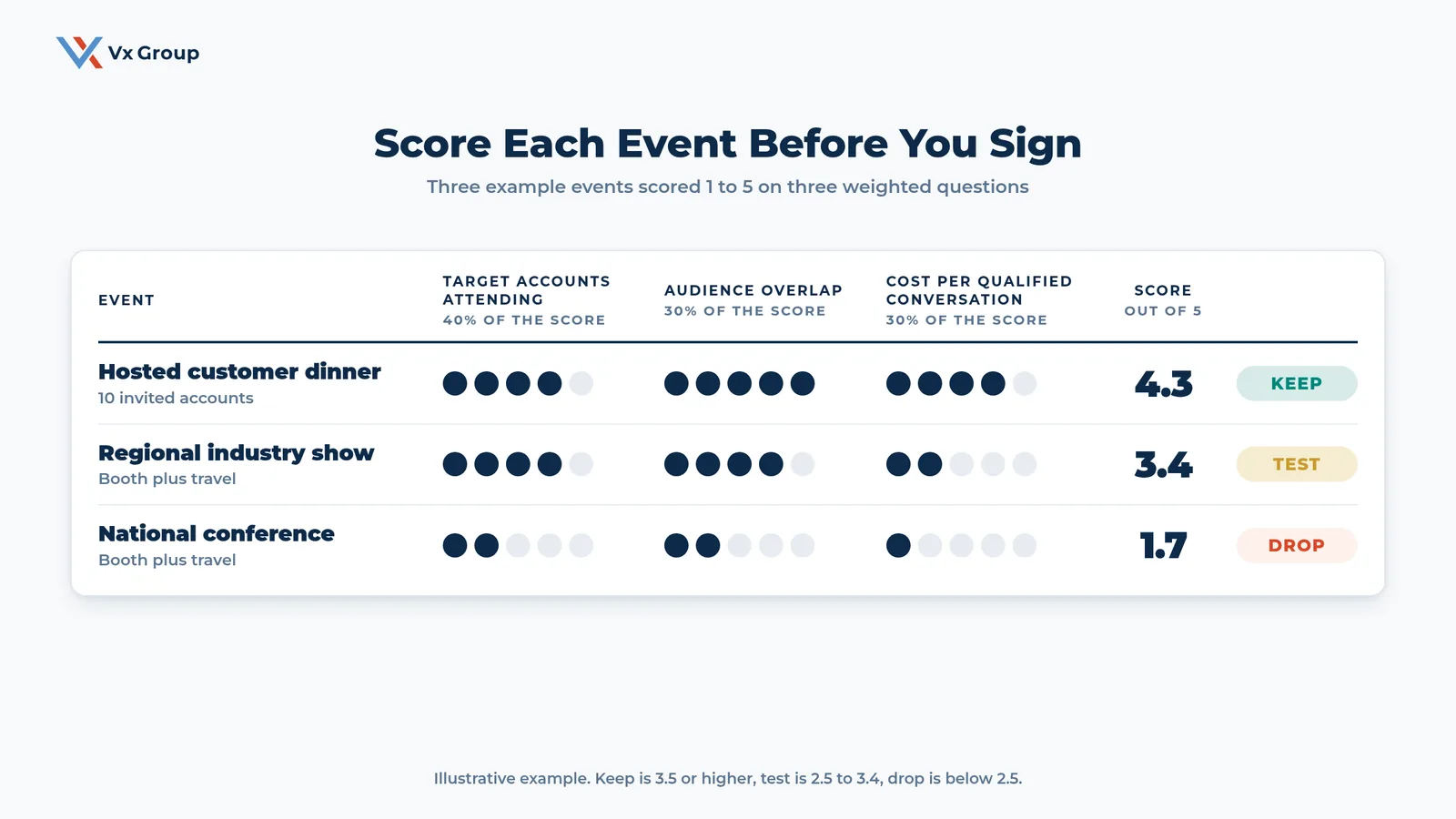
The graphic scores three example events on a 1 to 5 scale. The scores are weighted 40% for target accounts, 30% for audience overlap and 30% for cost per qualified conversation. The hosted customer dinner scores 4.3 and is a keep. The regional industry show scores 3.4 and is a test. The national conference scores 1.7 and is a drop. These events and scores are examples to show the method.
Score each event on three questions
Use the same three questions for every event, and score each from 1 to 5.
- Target-account attendance (40%). How many of the accounts on your target list will have someone there? Ask the organizer for last year’s attendee or exhibitor list. A show where 8 of your top 40 accounts send people scores higher than one where 1 does.
- Audience overlap (30%). How closely does the audience match your ideal customer profile? Look at job titles, company size and industry. A purchasing manager at a $20M machine shop is the person you want. A student visitor adds nothing to your pipeline.
- Cost per qualified conversation (30%). What will you spend per useful conversation? Use last year’s number if you have it. If you do not, estimate it from the full cost and a realistic count of conversations.
Change the weights if your business calls for it. A company with a very short list of target accounts may weight attendance at 50%.
Pull the target-account count from the attendee list
Ask the organizer for the exhibitor list and last year’s attendee list by company. Match the company names against your top accounts and your ideal prospects. Write the count of matches next to the show name. Many organizers share an exhibitor list, and some share company-level attendee lists with exhibitors. For a small event, call the organizer and ask who attended.
Work out cost per qualified conversation
Defined Term: Cost per qualified conversation.
The full cost of attending an event divided by the number of conversations with people who fit your ideal customer profile and agreed to a next step.
Count the full cost: booth or ticket, travel, shipping, staff time and follow-up. Count only the conversations that meet your standard. A conversation qualifies when the person fits your ideal customer profile and agreed to a next step, such as a call, a plant visit or a quote.
In our example, the regional industry show cost $24,000 and produced 12 qualified conversations. That is $2,000 each. The hosted dinner cost $6,000 and produced 9, or about $670 each. The national conference cost $30,000 and produced 10, or $3,000 each.
Set the keep, test or drop rule
Write a rule and apply it to every event. A simple version uses the weighted score:
- Keep: 3.5 or higher. Attend again and put more preparation into it.
- Test: 2.5 to 3.4. Attend with a narrower goal, and change one thing, such as sending a different team or booking more meetings ahead.
- Drop: below 2.5. Remove it from the calendar and move the money to an event that scored higher.
Review the scores every year. An event that scored well three years ago can change owners, venues and audiences.
How do you build a target list before the event?
Build the target list before you pick the booth size, the giveaway or the flight. The list names the people you want to meet at each event, who on your team owns each one, and what you want from the conversation. Without it, the day goes to whoever walks up.
Start with your top accounts
Write down your 10 to 20 best current accounts, and the accounts that used to buy and stopped. Our guide to top 10 customers as strategy explains why these accounts deserve their own plan. Check each against the attendee list. A customer who will be at the show is an easy meeting. They also bring other buyers from their plant.
Add the prospects that match your ideal customer
Add 10 to 20 prospects from the attendee list that match your ideal customer profile. Pick companies where you have a reason to believe you can win: the right size, the right industry and a product that fits. Our guide to account-based selling versus volume selling covers how to choose them.
Name one owner and one goal for each account
Give every account on the list one owner from your team and one goal. The goal should be specific. “Re-open the relationship with the new purchasing manager” is a goal. “Say hello” gives your team nothing to act on. Use three tiers:
| Tier | Who goes on it | Goal | Team member |
|---|---|---|---|
| Must meet | Top accounts and the best-fit prospects | A scheduled meeting before the event | Owner or sales lead |
| Should meet | Good prospects and second-tier customers | A conversation and a next step | Sales rep or engineer |
| Nice to meet | Everyone else on the attendee list | A short hello if the chance comes | Anyone on the booth |
Book meetings before anyone travels
Send a short note to each “must meet” and “should meet” contact two to three weeks before the event. Say who is coming, offer two times and suggest 20 to 30 minutes. Include one reason to meet that is specific to them, such as a project you worked on or a product update. Customers usually respond best, because the relationship already exists. Aim to have most of your “must meet” list booked before you leave.
Ready to grow?
If your event budget has grown without a plan behind it, we can help you score what you attend now and build a target list for the next 12 months.
Which event types should a manufacturer use, and how do you run each one?
Most manufacturers should use a mix of all four event types. Weight the mix toward the ones that reach target accounts at the lowest cost per qualified conversation. Each type has its own way of working. The steps below cover the three that owners most often skip.
Run the trade show around the meetings you booked
Plan the trade show around the meetings on your target list. Use the booth as a place to meet. Put chairs and a small table inside the booth, and leave the front open. Keep the display simple enough that one person can explain the products in two minutes. Our guide to trade show booth ideas has more on layout and staffing the booth.
Host a dinner or roundtable for 8 to 12 accounts
A hosted dinner is the simplest event to run and often the best value. Invite 8 to 12 people from your target list. Pick a restaurant near a show or an industry meeting, so guests can come with little travel. Seat your team among the guests, with one host at each end. Set a loose topic, such as a problem several of them share, and let them talk. You do not need slides.
Send invitations from the owner or president, by email or phone, three to four weeks ahead. Follow up with a personal call. Keep the guest list short, so every guest knows why they were invited.
Hold a plant day for customers and top prospects
A plant day brings customers or prospects to your facility. Show them how you make the product, introduce the engineers and operators who handle their orders, and let them ask questions. Buyers who have been inside your plant know who is behind the quote. Pick a week when production is running and the floor has room for visitors. Keep the group to 6 to 10 people and send each guest a note the next day.
How do you staff and brief the team for an event?
Staff an event by giving every person a clear role, holding a 30-minute briefing before you go and logging every useful conversation the same day. A team that knows the target list and the goal for each account runs a tighter event.
Assign a role to each person
Decide in advance who does what. A workable set of roles:
- Host. The owner or sales lead. Meets the “must meet” accounts and greets guests.
- Technical lead. An engineer or product specialist. Answers detailed product questions and joins customer meetings.
- Greeter. Opens conversations with people walking past and routes them to the host or technical lead.
- Note-taker. Logs each conversation in the CRM or a shared sheet. Rotate this role through the day.
At a small event, one person may hold two roles. Write them down anyway.
Hold a 30-minute briefing before the event
Meet with the whole team before you travel. Walk through the target list, the three tiers and the meetings already booked. Review the two or three products or topics you want to talk about. Agree on how you will handle a conversation with a competitor or a person outside your ideal customer profile. Give everyone the one-page list.
Use a short conversation guide
Give each person three or four open questions. Good ones sound like a person talking. Try “What are you working on this year?” and “What would you change about how your supplier handles orders?” The goal is to learn something about the buyer. A pitch can wait for the follow-up.
Log every conversation the same day
At the end of each day, spend 20 minutes entering notes. Record the person, the company, what they care about, what you agreed to do and when. A conversation logged on day one is worth ten that get entered three weeks later. If your team resists CRM entries, our guide on CRM adoption covers how to make it stick.
What should you do in the 10 days after an event?
Follow up on a fixed schedule over the 10 days after an event. Send a thank-you on day one and something useful on day three. Ask for a call or meeting by day seven. Decide on every account by day ten. Each account gets a clear next step before the conversation fades.
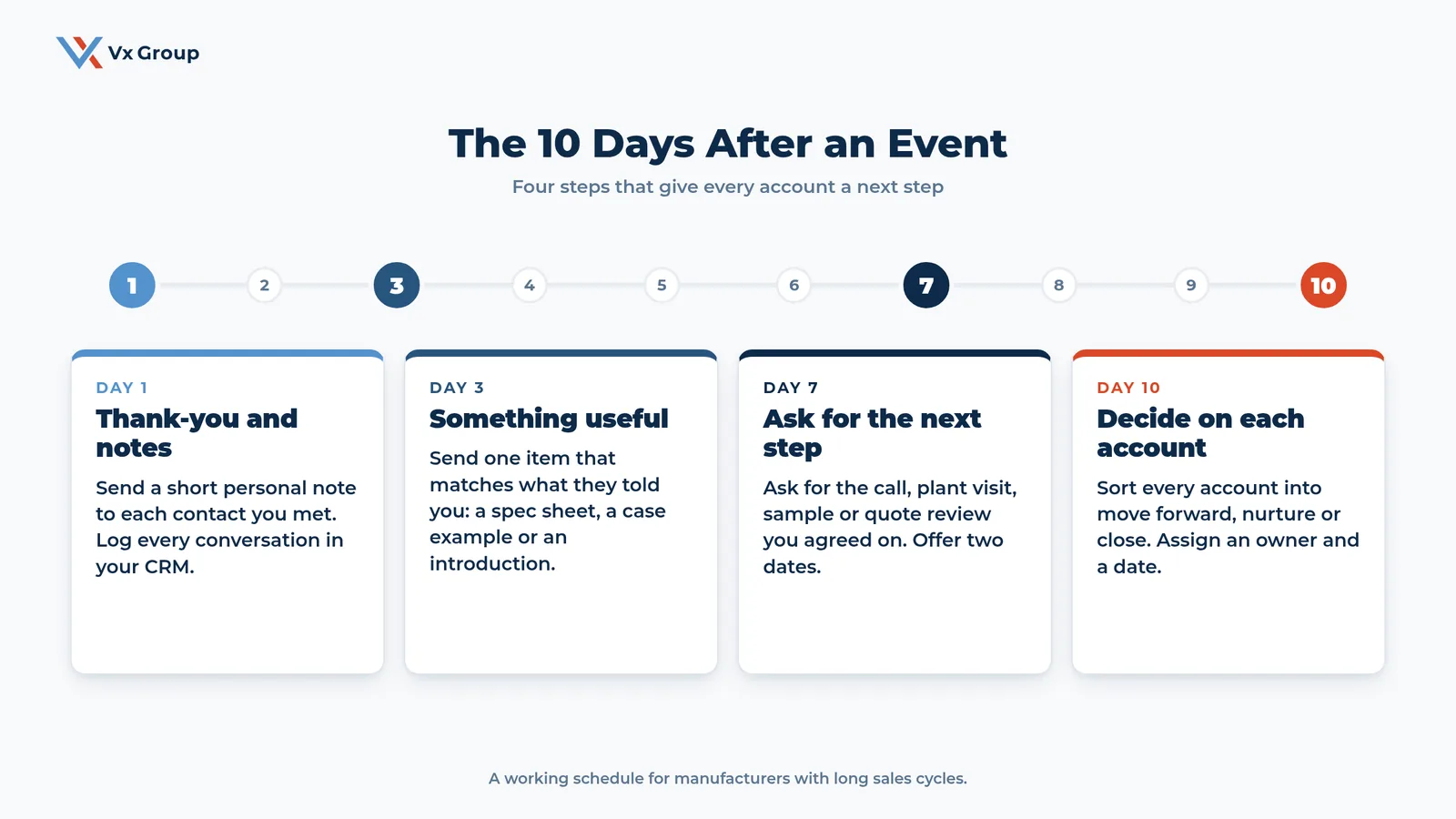
The graphic shows the four steps on a 10-day line. Day 1 covers the thank-you and the logged notes. Day 3 is a follow-up that gives the contact something useful. Day 7 asks for a call, a plant visit or a quote review. Day 10 is when you sort every account into move forward, nurture or close.
Send a personal thank-you by day one
Send a short note the day after the event to each “must meet” and “should meet” contact. Mention one thing you talked about. Keep it to three or four sentences. Our guide to sales follow-up emails has examples you can adapt.
Send something useful by day three
Send each contact one item that matches what they told you: a spec sheet, a case example, a link to an article, or an introduction to someone on your team. One item is enough. A long email with every brochure you own gets ignored.
Ask for the next step by day seven
By day seven, ask for the next step you agreed on: a call, a plant visit, a sample or a quote review. Offer two dates. If the contact has not replied to the first two notes, pick up the phone. A short voicemail from a person who met them last week lands better than a third email.
Sort every account by day ten
On day ten, meet with the team for 30 minutes and sort every account on the list:
| Result | What it means | Next step |
|---|---|---|
| Move forward | A meeting or quote is booked | Assign an owner and a date |
| Nurture | Interested, but timing is later | Add to your regular check-in schedule |
| Close | No fit or no response after three attempts | Remove from the active list |
Record the sort in your CRM. The sort is how you measure the event. It also keeps the list honest, because every account ends up with a clear status.
How do you measure a whole B2B event portfolio?
Measure the whole portfolio by comparing every event on the same numbers each quarter. Use cost per qualified conversation, meetings with target accounts, pipeline that moved and the share of your target list reached. The comparison shows which events to repeat and which to drop.
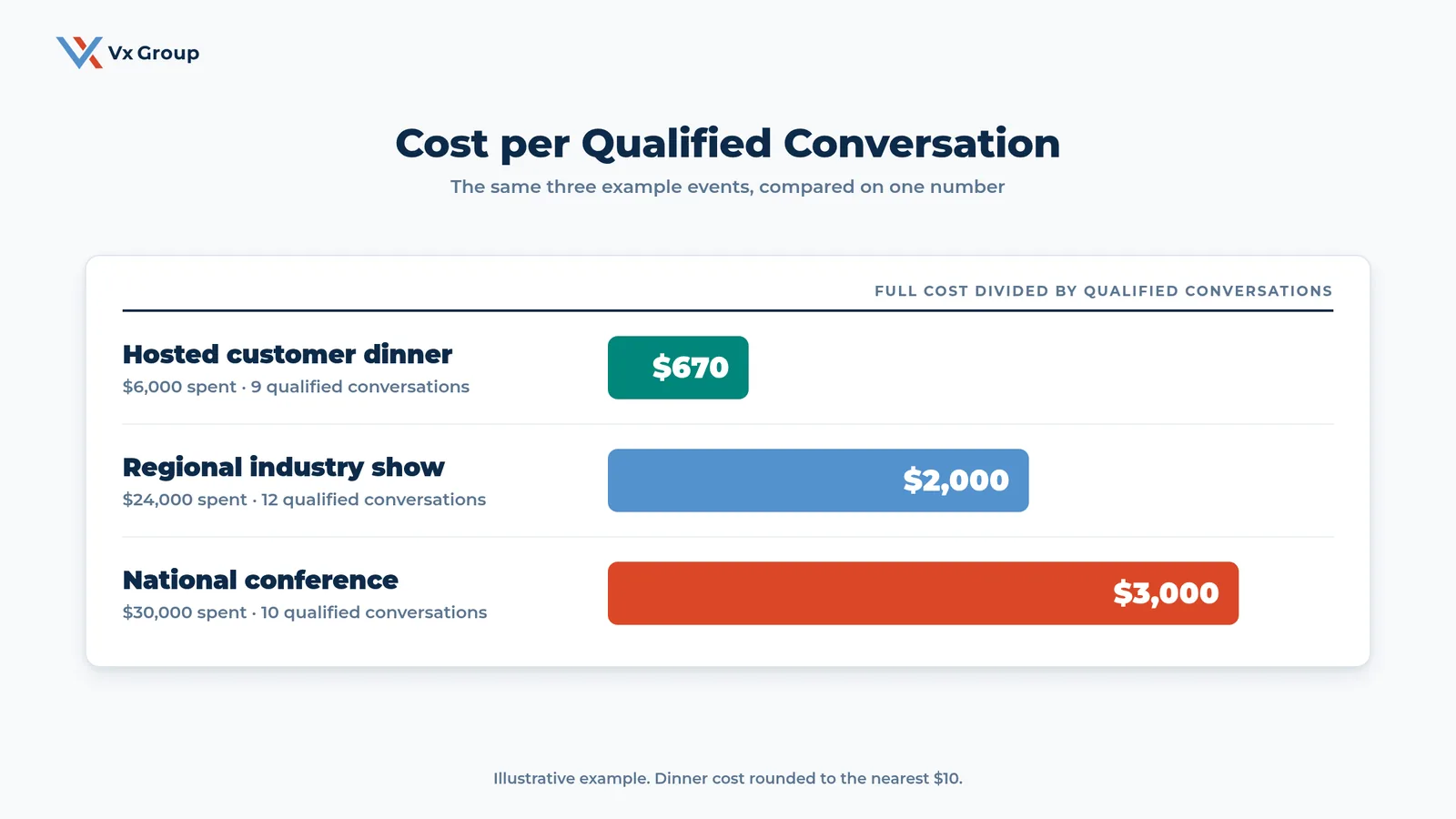
The graphic uses the same three example events as the scoring board. The hosted dinner cost $6,000 for 9 qualified conversations, about $670 each. The regional industry show cost $24,000 for 12, or $2,000 each. The national conference cost $30,000 for 10, or $3,000 each. The numbers show why the cheapest event is often the hosted one: you control who comes.
Track cost per qualified conversation for every event
Divide the full cost of each event by its count of qualified conversations. Put the results in one table with every event from the past year. Sort from lowest to highest. The spread between events is often large. A manufacturer who sees a 4 to 1 gap between its best and worst events has a clear place to move money.
Count meetings with target accounts
Count how many “must meet” and “should meet” accounts you actually met at each event, and how many meetings were booked in advance. This number shows how well the preparation worked. If you booked 12 meetings and held 5, find out why the other 7 fell through.
Follow pipeline that moved within 90 days
Track what happened to the accounts after the follow-up. Count the meetings, quotes and orders that came from each event over the next 90 days. Sales cycles in your business may run longer, so keep tracking at 6 and 12 months. For help setting up the right numbers, see our guides to trade show metrics, how to measure trade show effectiveness and trade show ROI.
Review the portfolio each quarter
Once a quarter, put the measures for every event into one table and review them with your sales lead.
| Measure | How to calculate it | What a healthy portfolio shows |
|---|---|---|
| Cost per qualified conversation | Full event cost divided by qualified conversations | The lowest-cost events get the most budget |
| Target accounts met | Target accounts you spoke with divided by target accounts on the list | Rising each quarter |
| Meetings held versus booked | Meetings held divided by meetings booked ahead | Most booked meetings happen |
| Pipeline within 90 days | Quotes and orders traced to the event | Concentrated in the “keep” events |
| Share of target list reached | Unique target accounts met across all events | Covers most of your top accounts each year |
The review ends with three decisions: which events to keep, which to test and which to drop. Move the dropped money to the events with the lowest cost per qualified conversation.
How much should a manufacturer spend on B2B events?
Set the event budget from the value of the accounts you want, and check it against what last year’s events produced. A fixed share of revenue is a starting point. Then work out what one new account is worth over its life and how many qualified conversations it takes to win one.
Start from what one account is worth
Work out the lifetime value of a typical new account. If an account is worth $300,000 over five years and you win one account for every 15 qualified conversations, each conversation is worth about $20,000 in expected value. That figure sets a ceiling on what a conversation can cost. These numbers are examples. Use your own.
Compare your last year's spend with what it produced
Add up everything you spent on events last year. Then divide by the qualified conversations and the accounts won. If the cost per account won exceeds the lifetime value of the account, the program needs changes before it needs more money.
Hold part of the budget for events you did not plan
Keep 10% to 15% of the budget open. A customer invites you to speak. A distributor opens a plant day. A show that did not exist last year grows in your region. A flexible budget lets you say yes to the events that fit the target list.
What does a working event plan look like for a manufacturer?
Field Notes:
This is a composite example built from patterns we see in manufacturers with $5 million to $50 million in revenue. It is illustrative and describes no single client.
A family-owned maker of industrial components attended seven events a year. The calendar had grown over 15 years. Two national shows took most of the budget, and the owner went to both. Nobody had counted what they produced.
The team pulled attendee lists and matched them to the top 40 accounts. One of the two national shows had 3 of the 40. A regional show had 9. The team also added up what each event cost against the useful conversations it produced.
They dropped the larger national show, kept the regional show with a narrower goal, and added two hosted dinners for 10 customers each, in cities where several accounts were close together. The owner and the sales lead hosted both. They booked meetings with the “must meet” accounts three weeks before each event and followed up on a 10-day schedule.
Within a year, the number of events fell from seven to five. Meetings with target accounts went up. The company picked up two quote requests from accounts that had been silent for over a year.
The lesson from the composite is practical. The company held its budget flat and moved the money to the events where its target accounts were. It also followed up on a schedule.
What mistakes sink a B2B event program?
B2B event programs fail in familiar ways. Most come from skipping the work before and after the event. Check your own program against this list.
- Renewing by habit. Score every event every year, and let the score decide.
- Going without a target list. Name the accounts, the owners and the goals before you book travel.
- Judging an event on badge scans. Count qualified conversations with people who fit your ideal customer profile.
- Sending the wrong team. Engineers answer technical questions. Sales leads and owners meet the “must meet” list. A booth full of people who do not know the plan wastes the trip.
- Waiting weeks to follow up. Memory fades in days. Use the 10-day schedule.
- Measuring each event alone. An event that looks mediocre alone may be the best way to reach a few key accounts. Compare it with the others.
- Skipping the hosted event. Dinners and plant days cost less per useful conversation and give you control over the guest list.
- Leaving sales and marketing apart. Both teams should own the target list and the follow-up. See our guide to marketing and sales alignment.
Where should an owner start this week?
Start with the events already on your calendar. List every event you attended or paid for last year, and write the full cost next to each. Then write the number of qualified conversations you can remember. It will be rough. The gaps will show you what you do not know.
Next, pull the attendee list for your largest upcoming event and count how many of your top 20 accounts will be there. If the count is low, ask whether the event is worth keeping. If it is high, book the meetings now.
Then pick one hosted event for the next quarter. A dinner for 8 to 10 customers needs a list, a restaurant and an invitation from the owner. It is the fastest way to see how much more a chosen audience is worth than a floor of strangers.
B2B event marketing works best when it supports a clear sales plan. If your accounts and your buyers are still unclear, start with our guides to the ideal customer profile and share of wallet.
Ready to grow?
Bring us last year’s event list and costs, and we will help you score each one and decide what to keep.
FAQs
About the Author: Jacob Camhi
