

How to Build a Trade Show Budget for Manufacturers
A trade show budget should list every dollar the show costs you. That means booth space, shipping, travel, the loaded cost of your staff’s time, and one show’s share of the booth build. It also means the outreach and follow-up on either side of the event. Set the total from a target cost per qualified conversation, then compare plan to actual after the show.
TL;DR
- Most trade show budgets list space, services, shipping, and travel. In our worked example that is $35,100 of a real $60,600 cost, about 58 percent.
- Step 1: list every line item, including the loaded hourly cost of each person on the floor and in transit.
- Step 2: spread the booth build across the shows it will attend. Do not charge it all to one show.
- Step 3: set the budget from a target cost per qualified conversation. Last year’s number plus inflation tells you nothing about whether the show earns its place.
- Step 4: add the pre-show outreach, post-show follow-up, and collateral lines that most budgets skip.
- Step 5: after the show, put plan beside actual on one page and recalculate cost per qualified conversation.
Ask an owner what a trade show cost and you usually hear three numbers: booth space, freight, and the hotel. Those are the bills that arrive with a logo on them. The cost of four people leaving their desks for five days is never on an invoice, so it never makes the budget.
The result is a show that looks “cheap.” A $35,000 show with 900 badge scans reads as $39 a lead, and nobody asks whether it earned its place. Rebook it, and the same math repeats next year.
This guide is for owners and presidents of privately held manufacturers, roughly $5M to $50M in revenue, who sell to a limited number of high-value accounts. It walks through five steps. Each step ends with something you can write down: a line-item list, a per-show build cost, a cost target, a pre- and post-show plan, and a one-page reconciliation.
All dollar figures in this guide come from one illustrative show. Replace them with your own.
What does a complete trade show budget include?
A complete trade show budget has nine cost lines. They are space and fees, show services, shipping, travel and lodging, one show’s share of the booth build, staff time, pre-show outreach, post-show follow-up, and collateral. Add a reserve of about 5 percent for the surprises every show produces.
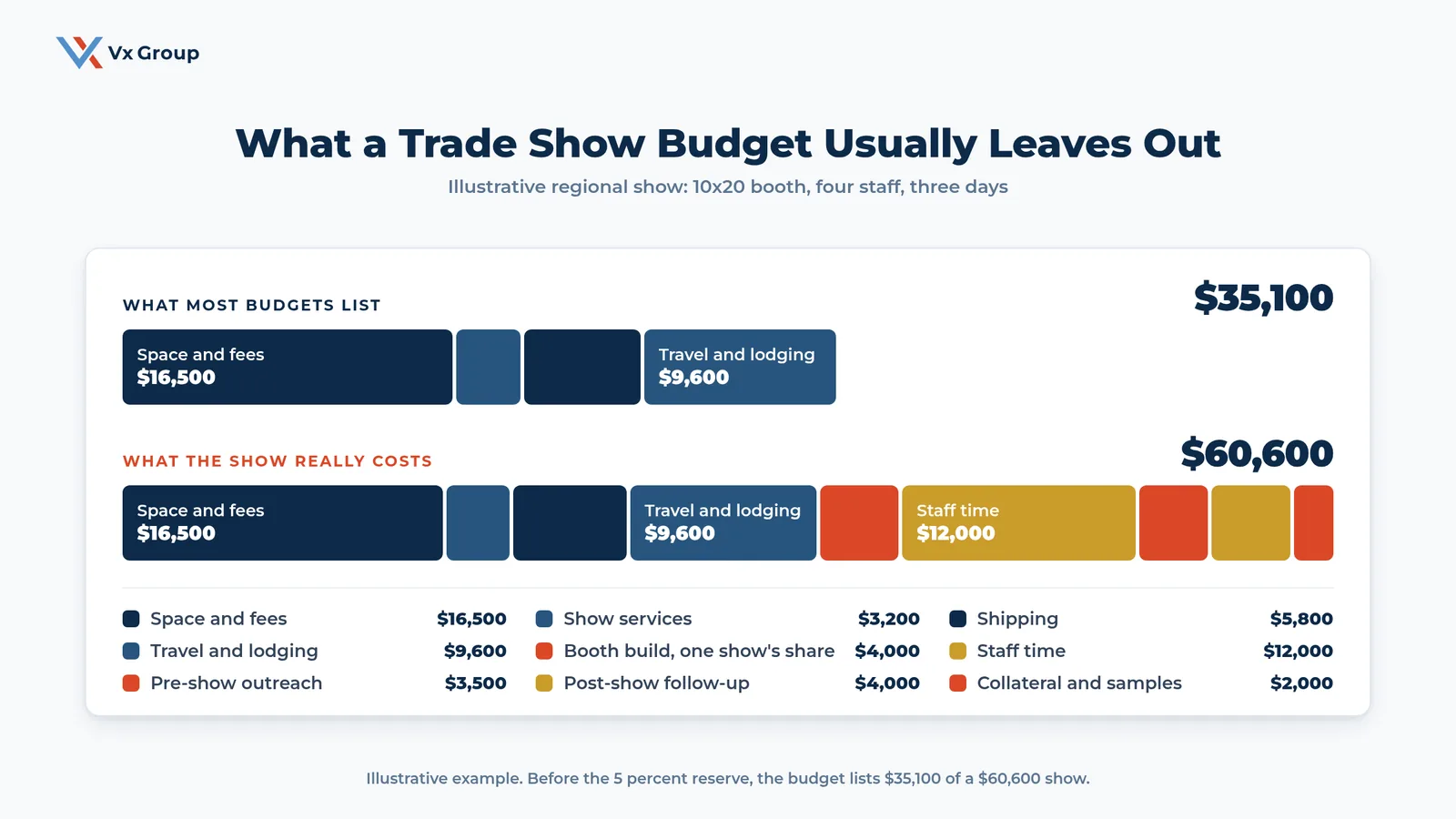
The graphic shows one regional show: a 10×20 booth, four people on the floor, three show days. A typical budget lists space and fees ($16,500), show services ($3,200), shipping ($5,800), and travel and lodging ($9,600). That adds up to $35,100.
The fully loaded cost is $60,600. The $25,500 gap is the booth build share ($4,000), staff time ($12,000), pre-show outreach ($3,500), post-show follow-up ($4,000), and collateral ($2,000). About 42 percent of what the show costs never appears in the budget.
Defined Term: Fully loaded trade show cost.
Every dollar a company spends to exhibit at one show, including staff time at a loaded hourly rate, one show’s share of any booth build, and the outreach and follow-up work before and after the event. It is the figure to divide by qualified conversations.
Leadership teams often defend the smaller number because it is the one finance sees. The larger number is the one that tells you whether to rebook.
Step 1. How do you list every cost of a trade show?
List every trade show cost by walking through the show in time order: before you leave, on the floor, in transit, and after you return. Put a dollar figure on each line, including the hours your own people spend. Anything that takes a person’s time or a company’s money belongs on the list.
Add the loaded hourly cost of every person
Loaded cost means salary plus benefits and payroll taxes, divided by working hours. A manager whose total package is $156,000 a year costs the company $75 an hour, or $600 a day.
Multiply that daily cost by every day the person is away from regular work. Four people at $600 a day for five days is $12,000.
You do not need payroll detail to do this. Ask finance for a loaded daily rate by role, or use a flat figure for the whole team and say so in the budget notes.
Count travel days as working days
The days spent in a car or an airport are days the person did not sell, quote, or solve problems. In our example the show runs three days. Add a travel day on each end and the staff time covers five days.
If someone works from the hotel on the travel day, count half a day. Write down the rule you chose so next year’s budget uses the same one.
Price the show services before you sign
Power, internet, carpet, cleaning, furniture rental, and lead retrieval usually come in an exhibitor kit with deadlines. Early-bird pricing on those orders often differs from the on-site price. Put the early price in the budget and set a reminder for the order deadline.
Write the line items into one table
Here is the full budget for the example show. Every line has an owner who can explain it.
| Line item | What it covers | Budget |
|---|---|---|
| Space and show fees | 10×20 space, registration, badges | $16,500 |
| Booth build, one show’s share | $60,000 build spread over 15 shows | $4,000 |
| Show services | Power, internet, carpet, lead retrieval | $3,200 |
| Shipping and drayage | Freight both ways, material handling | $5,800 |
| Travel and lodging | Four people at $2,400 each | $9,600 |
| Staff time | 4 people, 5 days, $600 a day | $12,000 |
| Pre-show outreach | Invitations, calls, one mailer | $3,500 |
| Post-show follow-up | 40 hours of inside sales, samples | $4,000 |
| Collateral and samples | Print, sample parts | $2,000 |
| Subtotal | $60,600 | |
| Reserve at 5 percent | Overruns and late orders | $3,030 |
| Total budget | $63,630 |
Step 2. How do you spread the booth build across several shows?
Spread the booth build by dividing its cost by the number of shows it will actually attend. A $60,000 booth that will go to 15 shows over five years adds $4,000 to each show. Charging all $60,000 to the first show makes it look like a failure, and charging nothing makes every later show look cheap.
Divide the build cost by the number of shows
A booth that goes to one show a year and a booth that goes to four wear out at different rates, so years make a poor denominator. Count the shows you will really exhibit at, based on the calendar you have today.
Be conservative. If you attended two shows last year and talk about five, use three.
Add a refurbishing line for every show
Graphics get scuffed, flooring tears, and a monitor dies. Set aside a few percent of the build cost each year for repair. Add it to the per-show share so the booth is still in shape for show 15.
Keep one-time purchases off the per-show lines
A new display wall, a demo unit, or a sample kit you will use for years is a capital purchase. Record it once, spread it, and keep the per-show budget clean. That way a quiet year does not look like a cost cut when it is really a year without a purchase.
For booth design ideas that make the build earn its share, see our guide to trade show booth ideas.
Ready to grow?
Bring your last two show budgets and we will help you build the fully loaded version and set a cost target.
Step 3. How do you set a trade show budget from a cost target?
Set the budget from a target cost per qualified conversation, then multiply by the number of conversations you can realistically hold. The target comes from what a conversation is worth to you. Last year’s number plus 3 percent only repeats last year’s guess.
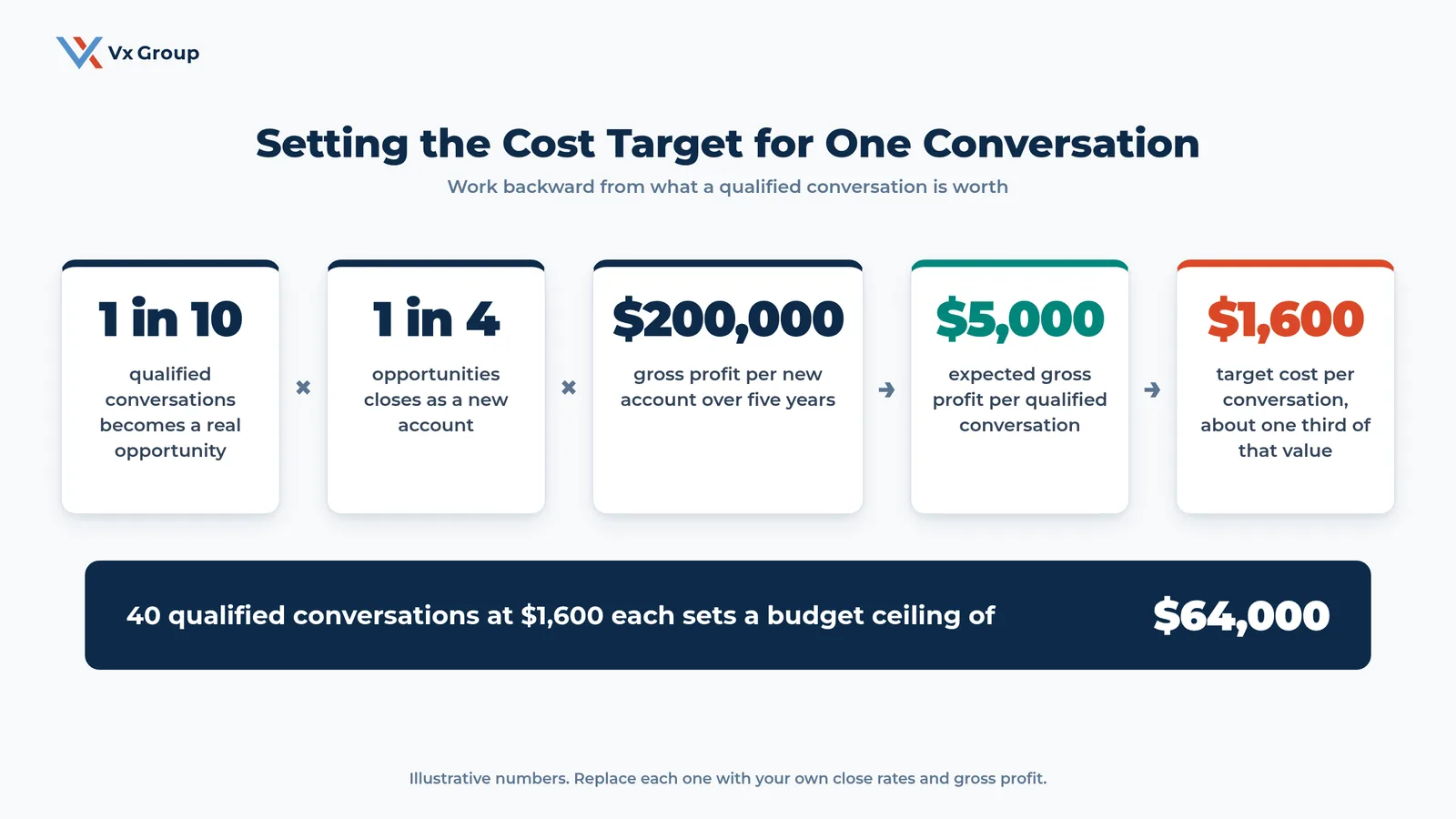
The graphic walks through the example. One in 10 qualified conversations becomes a real opportunity. One in 4 opportunities closes. A new account is worth $200,000 in gross profit over five years. Multiply it out and a qualified conversation is worth about $5,000. The target cost is about one third of that, or $1,600.
Forty conversations at $1,600 sets a ceiling of $64,000. The line-item budget from Step 1 comes to $63,630, which is $1,591 per conversation. It passes.
Work out what a qualified conversation is worth
Use your own close rates. Your sales team knows how many conversations at past shows became quotes, and how many quotes became orders. If nobody tracked it, use a rough guess and mark it as a guess.
Then use gross profit over the life of a typical new account. Revenue overstates the value, because it ignores what the work cost you to deliver.
Set the target at about one third of that value
One third leaves room for the rest of the cost of the sale. That includes the salary of the person who closes the deal, the quote work, and the delivery. A show that costs more than a third of the value it produces has little left over.
The one-third figure is a starting rule we use. If your margins are thin or your cycles run long, use a lower share.
Count the conversations you can hold
A 10×20 booth with four people over three days can hold only so many real conversations. Count pre-booked meetings first, then add a modest number of floor conversations. Ask what a good show produced for you before.
Use a number you would bet on. If 40 is optimistic, use 30 and the ceiling falls to $48,000.
Compare the ceiling with the line-item budget
If Step 1 comes in above the ceiling, you have three choices: cut a line, send fewer people, or skip the show. Cutting follow-up to save money is the worst option, because the conversations are already paid for by then. Our guide to trade show metrics explains how to define and count a qualified conversation.
Step 4. Which pre-show and post-show costs do most budgets leave out?
Most budgets leave out three groups of costs: pre-show outreach, post-show follow-up capacity, and collateral. They sit outside the show dates, so no one thinks of them as show costs. In the example they total $9,500, or 16 percent of the $60,600 base.
Budget the outreach that fills the calendar
Pre-booked meetings are the cheapest qualified conversations a show produces. Plan 4 to 6 weeks of outreach to your target accounts and existing customers. Budget the time of the person making calls, the invitation, and one mailer.
In the example that comes to $3,500. If it books 15 meetings, those conversations cost about $233 each in outreach.
Budget the people who follow up
A show produces its value in the 10 days after it ends. If the inside sales team is already full, no one has time to call. In the example, 40 hours of inside sales time plus sample shipping costs $4,000.
Put the hours on the budget now. If you wait until you return, the follow-up competes with everything else on the desk.
Budget the collateral for the accounts you chose
Print only what the target-account meetings need: a one-page capability sheet, a few sample parts, a line card. Skip the giveaway tables. In the example the total is $2,000.
If you are not sure how much to bring, see the planning ideas in our guide on what trade show marketing is.
Step 5. How do you reconcile the trade show budget after the show?
Reconcile the budget within 30 days of the show by putting plan and actual side by side on one page and recalculating cost per qualified conversation. The page tells you which lines ran over, whether the reserve covered them, and whether to rebook.
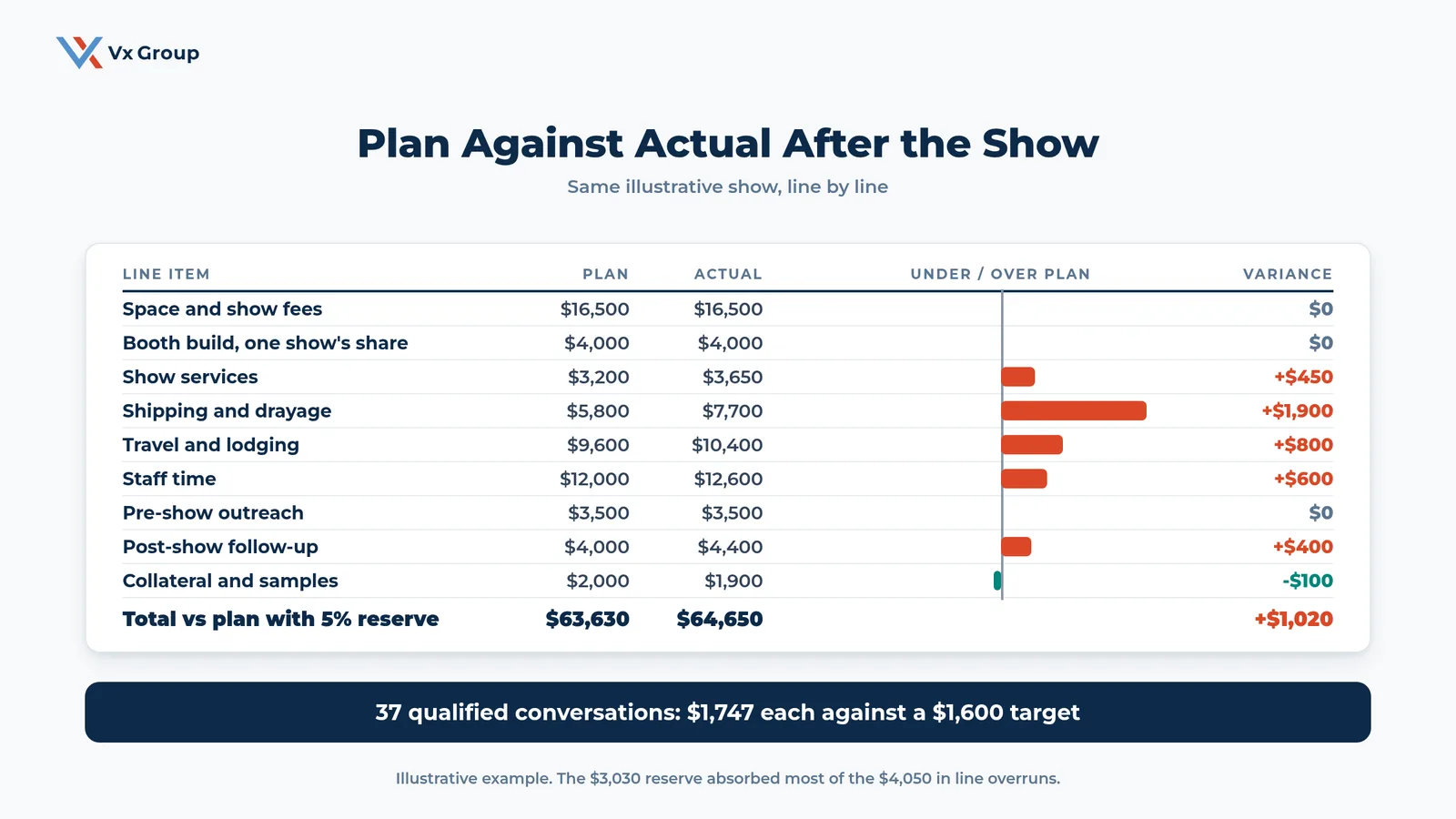
In the example, the actual cost was $64,650 against a plan of $63,630, a gap of $1,020. Shipping ran $1,900 over because of a return freight charge. Travel ran $800 over, staff time $600, show services $450, and follow-up $400. Collateral came in $100 under. The 5 percent reserve of $3,030 absorbed most of the $4,050 in overruns.
The team held 37 qualified conversations, so the show cost $1,747 per conversation against the $1,600 target. That is 9 percent over.
Fill in actual costs within 30 days
Ask finance for invoices and expense reports by a set date. Staff time is the hardest line, so use the same loaded daily rate you used in the plan and count the days people actually spent.
Explain every variance above 10 percent
Write one sentence for each line that ran more than 10 percent over or under. In the example, the shipping line ran 33 percent over. The sentence reads: “Return freight was billed at the on-site rate. Order the return pickup before the show next time.”
Recalculate cost per qualified conversation
Divide the actual total by the number of qualified conversations. Compare the result with the target from Step 3. Include the number in the report you send to leadership, next to the budget total.
Decide whether to rebook, change, or drop
Use three questions. Did the cost per conversation land within 15 percent of target? Did the conversations turn into meetings and quotes? Would you pay the same price for the same show next year? Two yes answers mean rebook. One means change the plan. None means drop it.
For the revenue side of this decision, our guide on how to measure trade show ROI shows how to credit a show for deals that close months later.
How much should a manufacturer spend on trade shows in a year?
A manufacturer should add up the ceilings from every show it plans to attend and test the total against the gross profit those shows are expected to produce. No single percentage of revenue fits every company, because a $20M manufacturer that sells to 60 accounts needs a different plan than one that sells to 600.
Start by ranking your shows by cost per qualified conversation from past years. Fund the best ones in full and cut the weakest. Our guide on B2B event marketing for manufacturers shows how to compare a trade show with a hosted dinner or a regional event on the same cost per conversation.
If you are still deciding whether a show belongs in the plan at all, read are B2B trade shows worth it for manufacturers.
How does a trade show budget change for a small booth or a national show?
A smaller booth cuts the space, build, and shipping lines. A national show raises nearly every line, with the biggest changes in space and fees, travel, and staff time. The structure of the budget stays the same, with the same nine lines.
- 10×10 booth at a regional show: Space, build share, and freight fall. Staff time barely changes if two people still attend. Cost per conversation can improve or worsen, so measure it.
- 10×20 booth at a regional show: The example in this guide.
- National show with a larger booth: Space and fees rise sharply. Add more staff days, more travel, and a larger reserve. Pre-booked meetings matter more, because the floor is crowded.
Whatever the size, keep the cost per qualified conversation target. It lets you compare a $20,000 regional show with a $90,000 national one on equal terms.
What mistakes make a trade show budget unreliable?
A trade show budget becomes unreliable when it leaves out staff time, charges the booth build to one show, or gets built backward from last year’s total. Six mistakes show up often.
- Leaving out staff time. This is the most common one, and the biggest line after space.
- Charging the whole booth build to one show. The first show looks bad and later shows look free.
- Setting the budget before the target. A number with no cost target behind it cannot be defended.
- Skipping the follow-up line. The money is spent on the show and the conversations then sit.
- No reserve. Late orders and return freight arrive at every show.
- Never reconciling. A budget that nobody checks after the show teaches the team nothing.
Where should an owner start with a trade show budget this week?
Start with the show on your calendar that costs the most. Pull last year’s invoices, add the people and the days, and see how far the real number sits from the one in the budget. Four steps get you through it in an afternoon.
- Write down every cost line from last year’s biggest show, including staff days at a loaded rate.
- Divide the total by the qualified conversations you held. If nobody counted, use your best estimate and mark it.
- Set a cost target at about a third of what a qualified conversation is worth.
- Build next year’s budget from that target and add the pre-show and follow-up lines.
Ready to grow?
Talk through your show calendar with us and leave with a budget and a cost target for the next one.
FAQs
About the Author: Jacob Camhi
