

B2B Sales Strategy for Long-Cycle Companies

A B2B sales strategy is a written plan. It names the customers you sell to, who owns each relationship, what your team says in the first meeting, and how you measure progress. For companies with 6 to 18 month sales cycles, it starts with the accounts you already have.
TL;DR
- A B2B sales strategy answers six questions: which accounts, which owners, what to say first, what happens between meetings, what to measure, and when to review.
- Most sales strategy advice comes from short-cycle software companies. It assumes thousands of small buyers. A manufacturer with 40 important accounts needs a different plan.
- Start with your current customers. Sort them into grow, protect, and find more like them.
- Give every important relationship a named owner on your side and at least three contacts on theirs.
- Run the first meeting around the buyer’s problem, and send a written summary within a day.
- Measure relationship depth, share of wallet, and next steps booked. Activity counts like calls and emails tell you little.
- You can write the first version in 90 days, and most of the work is decisions only the owner or president can make.
What this guide covers
- What a B2B sales strategy is
- Why a short-cycle playbook fails in a long-cycle company
- Where a sales strategy starts
- How to pick the accounts to grow
- How to protect the accounts that carry the business
- How to find new accounts that look like your best ones
- Who should own each relationship
- What your team should say in a first meeting
- How to run the weeks between meetings
- How to measure the strategy
- How to write the first version in 90 days
- A field example
- Mistakes that break a long-cycle sales strategy
- Where to start this week
Ask ten owners of manufacturing and distribution companies for their sales strategy. Most will say some version of “we work our relationships.” That is true, and it is a good place to start. It is also a plan that lives in one head.
The owner knows which customers matter. The owner knows who to call. The owner remembers what the plant manager at the biggest account said at the trade show in March. None of that is written down, and none of it transfers to the next salesperson you hire.
This guide is for owners, presidents, and sales leaders at privately held B2B companies. A handful of customers carry the business, and deals take months. It covers what to decide, in what order, and what to write down. Each section gives you something to build.
What is a B2B sales strategy?
A B2B sales strategy is a short written plan. It says who you sell to, who sells to them, what the team says at each step, and how you will know it is working. It guides the sales team for the year and fits on one to three pages.
The plan answers six questions. Each one needs a decision from the owner or president.
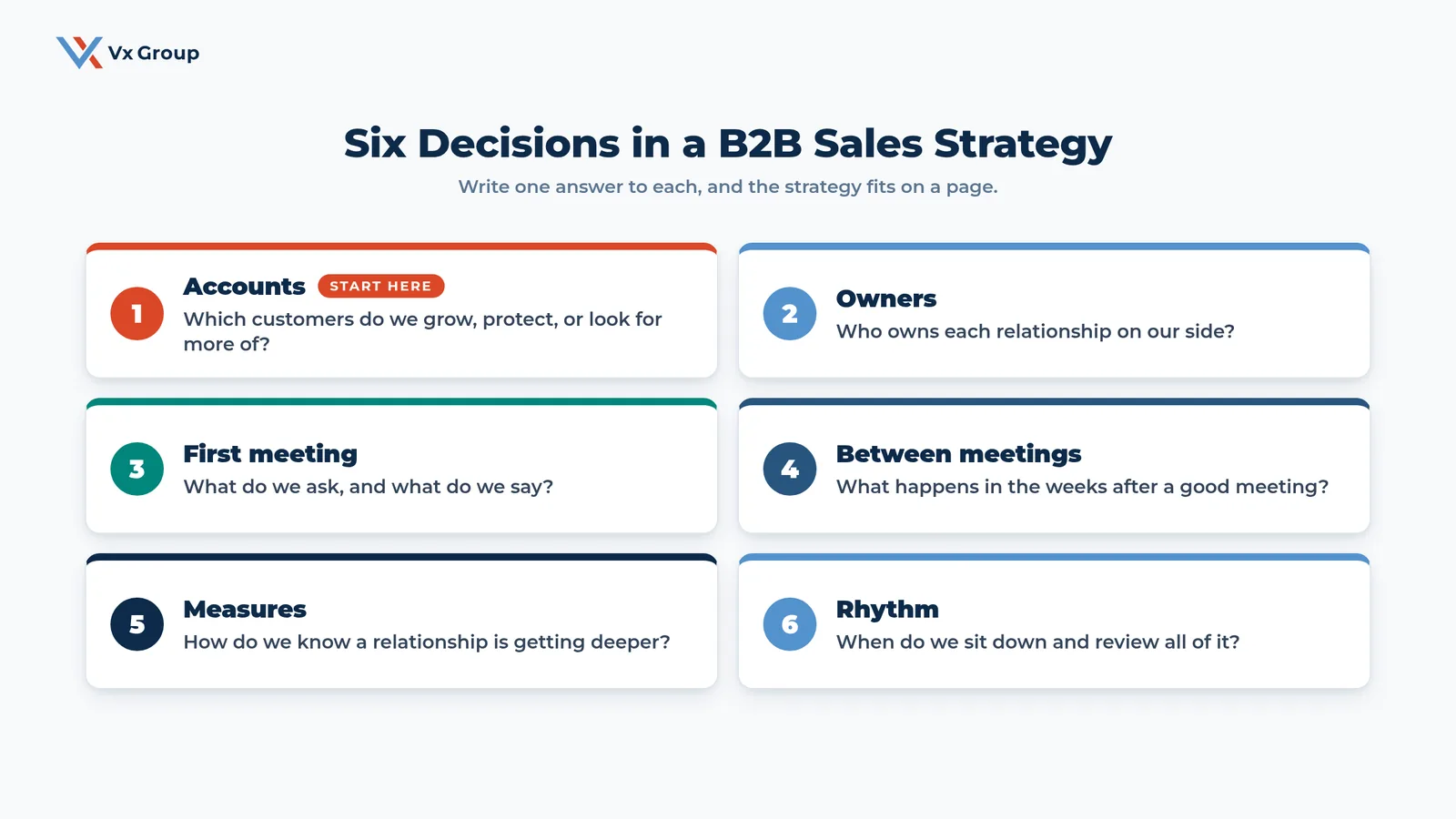
The graphic above lists the six decisions. Accounts come first because every other answer depends on which customers you are planning for. The owner of a relationship, the questions asked in a first meeting, and the measures you track all change from one account to the next.
Defined Term: B2B sales strategy.
A written plan that names the accounts a company will grow, protect, and look for more of, assigns an owner to each relationship, sets what the team asks and says at each step, and defines the measures that show whether relationships are getting deeper.
Sales strategy is different from a sales process. A sales process lists the stages a deal moves through. A sales strategy decides where to spend the team’s time before any deal starts. If you want the stages, read our guide to sales cycle stages in complex B2B deals. This guide stays at the level of strategy.
Why does a short-cycle sales playbook fail in a long-cycle company?
Most published B2B sales strategy advice is written for software companies with short cycles and many small buyers. It focuses on outreach volume, sequences, and lead scoring. A manufacturer with 12-month cycles and a few dozen important customers has a different problem. The same advice produces a lot of activity and few results.
Look at how the two situations differ.
| Situation | Short-cycle software playbook | Long-cycle manufacturer or distributor |
|---|---|---|
| Typical deal length | Days to a few weeks | 6 to 18 months |
| Number of buyers that matter | Thousands | A few dozen to a few hundred |
| Who decides | One or two people | A group from purchasing, operations, engineering, and finance |
| Where revenue comes from | Many small accounts | A handful of accounts carry most of it |
| Main growth lever | More leads | More share of what current customers already buy |
| Main risk | Low conversion | Losing one key relationship |
The right column changes the strategy. When a few accounts carry the business, losing one costs more than any lead program can replace. When the buying group has five or six people, one contact at the account is a weak position.
Companies often borrow the left column anyway. They buy a list, run a sequence, and count meetings booked. We covered why this fails in why more leads are almost never the answer. A long-cycle company has to start somewhere else.
Where should a B2B sales strategy start?
A B2B sales strategy starts with the customers you already have. They show you who buys from you, why they stay, and what a good account looks like. They also hold most of your near-term revenue. Start there, and the rest of the strategy has real data under it.
Pull the last three years of revenue by customer
Ask finance for a list of every customer with revenue and gross margin for each of the last three years. Put it in one spreadsheet, sorted by the most recent year.
Add three columns of your own. The first holds the name of the person at your company who owns the relationship. The second holds the number of contacts you have at the customer. The third lists the product lines they buy. Leave the cells blank when you do not know. The blanks are the first useful finding.
Sort every account into grow, protect, or find more like it
Go down the list and mark each customer as one of three buckets. Grow accounts have room to buy more from you. Protect accounts carry the business today and would hurt to lose. The third bucket is a target list: companies that look like your best accounts and do not buy from you yet.
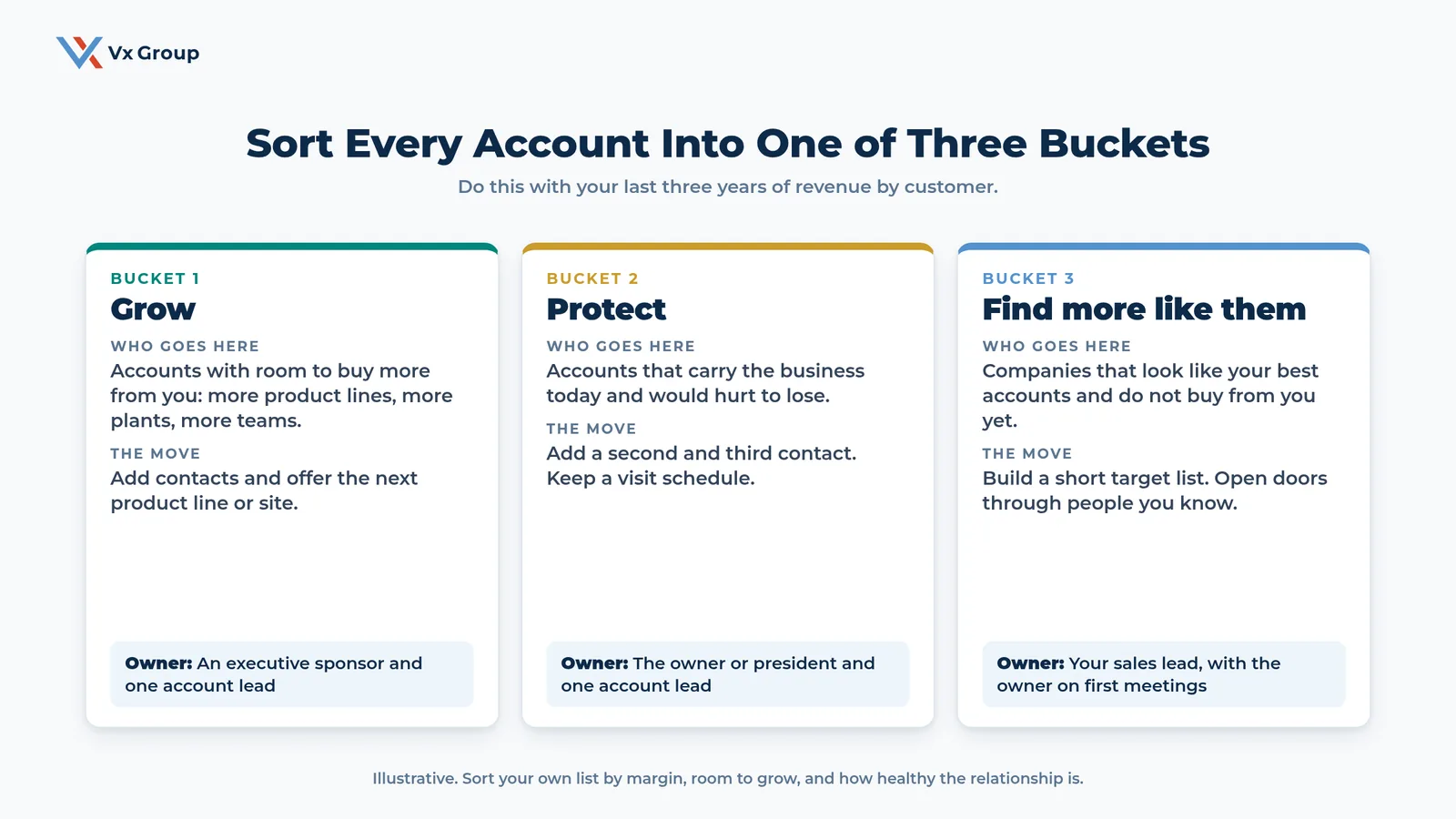
Many accounts belong in both grow and protect. Pick the bucket that matches the first job. If losing the account would hurt more than growing it would help, mark it protect.
Write the one-page account list
Cut the list to the accounts that matter most. For most owner-led companies that is 10 to 25 accounts. Put each on one page with its bucket, owner, and one next step. This page is the center of the strategy. The rest of this guide explains how to fill it in.
How do you pick the accounts to grow?
Pick accounts to grow by looking at room to buy more, and put size second. A large customer that already buys everything you make has little room left. A medium customer that buys one product line from you and the rest from three competitors has a lot. Score each account on room to grow, margin, and the strength of the relationship.
Start with share of wallet, which is the portion of a customer’s spending in your category that comes to you. In our work with manufacturers and distributors, a company often holds a small share of what its biggest accounts spend, sometimes under five percent. We cover the idea in share of wallet.
Estimate what each account spends in your category
Ask your account owner for a rough number. What does this customer spend each year on products like yours, and how much of that comes to us? A good guess is enough. Mark the gap between the two. A big gap with a healthy relationship is your best growth account.
Score the accounts on three criteria
Give each account a 1 to 5 score on room to grow, margin, and relationship health. Add the scores. The accounts with the highest totals get your best people and your first calls.
Relationship health means how many people at the customer know you, how well they know you, and how they would describe the last year. An account with room to grow and one tired contact needs relationship work before it needs a sales push.
Choose a next step for each grow account
Write one concrete move per account: a plant tour, an introduction to the engineering team, a quote on the product line they buy elsewhere. Our guide to account expansion has more examples of next steps that work.
How do you protect the accounts that carry the business?
Protect an important account by building more than one relationship inside it and by visiting on a schedule. Most accounts are lost when the one person who liked you retires, changes jobs, or gets a new boss. A second and third contact at the account is cheap insurance against that.
Count the contacts you have at each protect account
Go back to your spreadsheet. For each protect account, count the people at the customer who know you by name and would take your call. If the answer is one, that account is at risk today, no matter how good the numbers look.
Pair each contact with a person on your team
Match each customer contact with a peer at your company. Pair the customer’s plant manager with your operations lead, their engineer with yours, and their buyer with your account lead. Peers talk more easily than a salesperson and a gatekeeper. We use this pairing method in key account management, and it works for any protect account.
Put visits on the calendar
Set the visit schedule at the start of the year: a call each month, a review each quarter, and one visit by an executive. Put the dates in calendars before the busy season. A visit that depends on free time will not happen.
For the owner who carries every relationship, this section matters most. We wrote about the risk in founder-dependent sales. Moving a few of those relationships to a second person is the first step. It lets the company grow without the owner on every call.
How do you find new accounts that look like your best ones?
Find new accounts by describing what your best customers have in common, then building a short list of companies that match. Start with your top 15 or 20 customers. Look at what they share: industry, size, how they buy, what they value, and how they found you. That profile is your target.
Write the profile from your best accounts
Pull your top accounts and write down the traits they share. Include firm facts like revenue and plant count. Add relationship traits too: they stay for years, they pay on time, they send referrals, they value a partner who picks up the phone. We call this an ideal customer profile and cover how to build one in what is an ideal customer profile.
Build a list of 25 to 50 target companies
A short list lets your team learn about each company and approach it with something useful to say. Pick 25 to 50 targets from the profile. For each one, write down who the likely buyers are and who in your network might know them.
Open doors through people first
Ask your best customers, your suppliers, your distributors, and your advisors who they know at each target. Warm introductions and trade show meetings carry far more weight with a long-cycle buyer than a cold email. For more on this, see our guide to B2B prospecting strategies for relationship-driven companies and our look at account-based selling versus volume selling.
Ready to grow?
Bring your top 20 accounts. We will help you sort them, assign owners, and write a sales strategy your team can run.
Who should own each relationship?
Every important account needs one named owner on your side, plus an executive sponsor for the largest. The owner is the person who answers for the account’s health. Without a name on the page, each account belongs to whoever happens to have the phone number.
Three roles cover most companies.
| Role | What the person does | Typical fit |
|---|---|---|
| Executive sponsor | Holds the relationship with a senior person at the customer and visits once a year | Owner, president, or head of sales |
| Account lead | Runs the plan, schedules the calls, tracks the next steps | Salesperson or account manager |
| Technical or service peer | Talks with the customer’s engineering, operations, or purchasing teams | Engineer, plant manager, or customer service lead |
Name the account lead for every account on the page
Open the one-page account list and write a name next to every account. If two accounts share a lead, check the load. If an account has no obvious lead, that is a decision for the owner or president.
Assign an executive sponsor to the accounts that matter most
An executive sponsor gives a customer someone senior to call. The account lead runs the account. The sponsor shows up at the annual review and answers the phone when the customer has a problem. An executive can sponsor two or three accounts with real attention, so size the list to the number of sponsors you have.
Check whether the owner should still hold each large account
Owners often keep the largest accounts out of habit. Check whether that is still the best use of your time. Often the owner should stay on the executive sponsor seat and hand the day-to-day work to an account lead. Our guide to sales leadership for long-cycle B2B companies covers how to set up that handoff.
What should your team say in a first meeting?
In a first meeting with a long-cycle buyer, your team should ask about the buyer’s situation and listen for the problem. Then it should agree on a next step. Save the presentation for later. A buyer who spends the hour talking about their own plant, customers, and constraints leaves with a good impression of you.
Prepare three things before the meeting
Write down what you know about the company, who will be in the room, and the one problem you think they may have. Check the website, recent news, and any contacts you share. Walk in with a short list of questions and leave the deck behind.
Use five questions that open the conversation
A simple set works in most industries:
- What is changing in your business this year?
- What does a good supplier do for you that others do not?
- Where have past suppliers let you down?
- Who else is involved when you make a decision like this?
- What would make this worth your time to explore further?
These questions put the buyer’s situation first. The fourth one matters most in a long cycle because it tells you who else to meet.
Close the meeting with a dated next step
Before anyone leaves, agree on one next step with a date: a plant visit, a sample, an introduction to engineering. A meeting that ends with “let’s stay in touch” usually produces no second meeting. Our guide to consultative selling goes deeper on how to ask good questions.
How do you run the weeks between meetings in a long sales cycle?
In a long cycle, most of the work happens between meetings. Send a written summary within one business day, keep adding contacts, and hold a short call every few weeks. Deals stall when nobody owns the quiet stretch after a good meeting.
Send a summary within one business day
Write three short paragraphs: what you heard, what you plan to do next, and the date of the next step. Send it to everyone who was in the room. The summary shows the buyer you listened. It also gives your contact something to forward to a boss who was not there.
Add one new contact per quarter at each open deal
Every open deal should show a new name at the customer each quarter. Ask your contact who else should see the proposal. A deal with one contact is a deal that stalls when that person changes jobs.
Keep a standing check-in call
Set a call every three to four weeks with each active opportunity, even when nothing is due. Use it to share a useful article, a design idea, or news about the market. The purpose of the call is to stay present and useful. To manage the pipeline across many open deals, see sales pipeline management for long-cycle companies. For the full path, see our B2B sales funnel guide.
How do you measure a B2B sales strategy?
Measure a B2B sales strategy by relationship depth, share of wallet, and dated next steps booked. These measures move before revenue does. Call counts and email volume say how busy the team is and say little about whether accounts are growing.
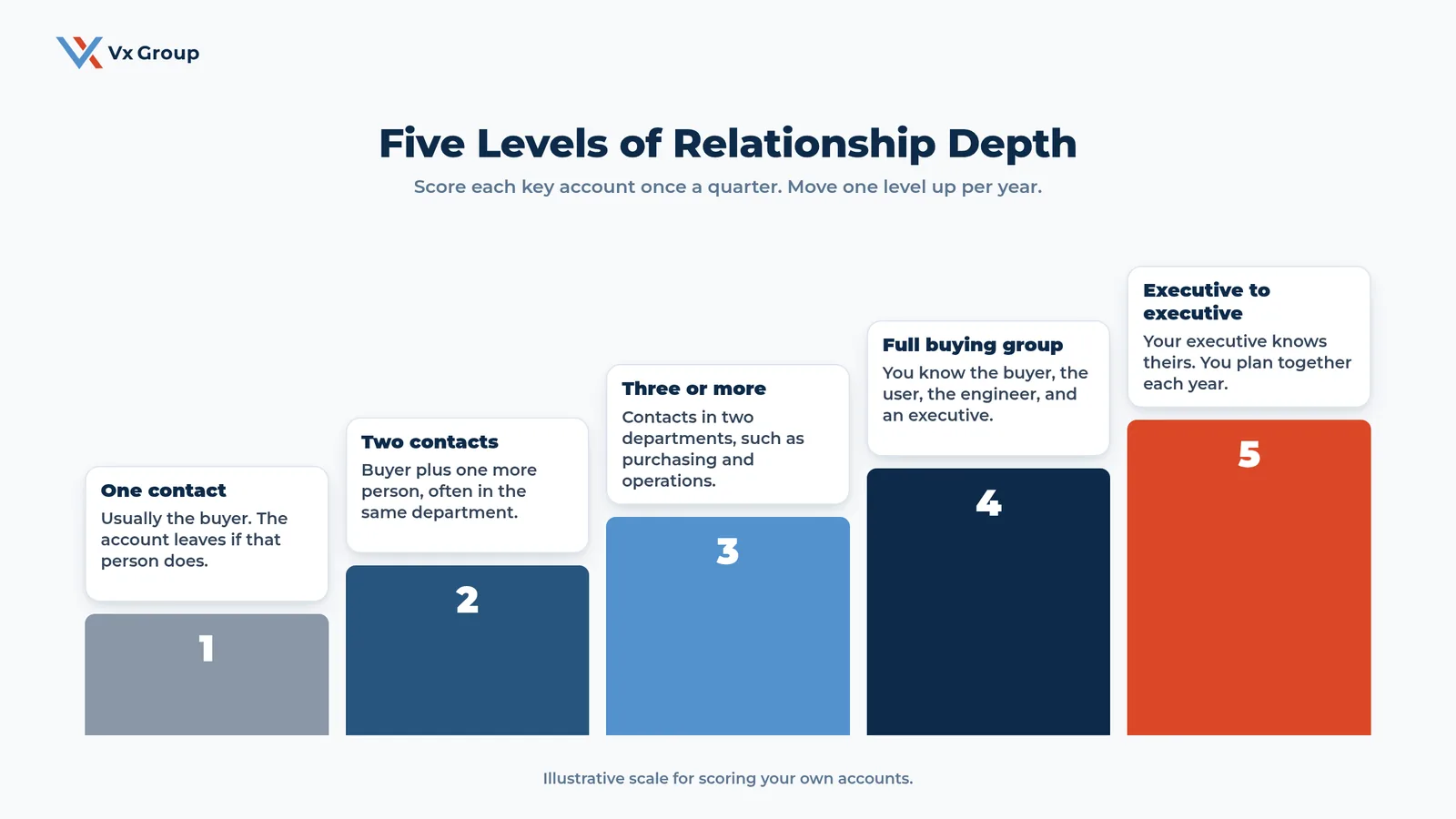
The graphic shows five levels of relationship depth. Level 1 is one contact at the customer, usually the buyer. Level 5 is an executive on your side who knows an executive on theirs and plans together each year. Score every key account on this scale each quarter.
Defined Term: Relationship depth.
The number and seniority of people at a customer who know your company well enough to take your call, vouch for you, and share what they plan to buy. A deeper relationship survives a retirement, a promotion, or a new boss.
Track five measures for every key account
| Measure | How to calculate it | What it tells you |
|---|---|---|
| Relationship depth | Score from 1 to 5 using the scale above | Whether the account can survive a change of contact |
| Share of wallet | Your sales divided by the customer’s total spend in your category | How much room is left to grow |
| Contacts per account | Count of people at the customer who know you | Whether you rely on a single person |
| Next steps booked | Dated actions on the calendar for the next 90 days | Whether the account has momentum |
| Reorder timing | Days between orders compared with the usual pattern | An early sign that a customer is changing how it buys |
Review the numbers once a quarter
Put the five measures for each key account on one page and review them with the account leads every quarter. Look for accounts where depth is stuck at 1 or 2, accounts with no dated next step, and accounts where a reorder came late. Those are the accounts that need attention first.
Set one target per account per year
Pick one thing to improve for each key account this year. Move up one level on depth, add two contacts, or raise share of wallet by a set amount. One target is easy to remember and check.
How do you write a B2B sales strategy in 90 days?
You can write the first version of a B2B sales strategy in about 90 days, working one decision at a time. Most of the work is gathering data and making choices that only the owner or president can make. Plan for a draft in month one, a test in month two, and a review in month three.
Spend days 1 to 30 on the account list
Pull the revenue data, add the owner and contact count for each account, and sort every account into grow, protect, or find more like it. Cut the list to the accounts that matter most. End the month with the one-page account list.
Spend days 31 to 60 on owners and the first meeting
Name an account lead for every account and a sponsor for the top accounts. Write the five first-meeting questions and the summary template. Try them in the next three real meetings and adjust.
Spend days 61 to 90 on measures and the review
Set up the five measures on one page. Score every key account once. Hold the first quarterly review with the account leads and write down one target per account. After that, the strategy runs on a calendar: monthly check-ins, quarterly reviews, and an annual refresh.
What does a B2B sales strategy look like in practice?
Field Notes:
An illustrative composite of several companies. An industrial components maker with about $22 million in revenue had 38 active customers. The owner personally handled the eight largest. When the owner sorted the list, three of those eight had only one contact on the customer side, and two of the three bought just one product line. The owner picked those two as grow accounts, paired the plant manager with the customer’s operations lead, and gave an engineer the technical seat. Within two quarters, each account had three contacts, and the quotes for the second product line started.
The example is a composite built to show the steps. Your numbers will differ. The pattern holds in many companies. A handful of accounts hold most of the revenue, they rely on one contact, and nobody wrote down a plan to protect them.
What mistakes break a long-cycle sales strategy?
The most common mistakes are copying a software playbook, spreading effort evenly across all accounts, and keeping the plan in the owner’s head. Each one is easy to spot and fix. Check your own strategy against this list.
- Copying a short-cycle playbook. Volume tactics create meetings with the wrong people and little trust. Build the plan around the accounts you have.
- Treating every account the same. Ten accounts that carry the business deserve more attention than a hundred that buy occasionally.
- Keeping the owner as the only relationship. Revenue that depends on one person is a risk to the whole company.
- Measuring activity. Calls and emails show effort. Relationship depth and next steps show progress.
- Writing the strategy once and filing it. A strategy needs a quarterly review and an annual refresh, or it goes stale in six months.
- Hiring a salesperson before the plan exists. A new hire needs accounts, a first-meeting script, and a way to be measured. Build those first, and read our guide on onboarding a salesperson into a long cycle.
- Paying for the wrong behavior. If the pay plan rewards new logos only, nobody will protect your best accounts. Our guide to sales compensation plans for long cycles covers this.
Where should you start this week?
Start this week by pulling three years of revenue by customer and sorting the top 20 into grow, protect, and find more like it. That one task takes a few hours and shows you where the plan is thin. Then take the following steps in order.
- Ask finance for revenue and margin by customer for the last three years.
- Add the account owner and the number of contacts for each of the top 20.
- Mark every account grow, protect, or find more like it.
- Name an account lead for every account, and a sponsor for the top five.
- Write the five first-meeting questions and share them with the team.
- Put the quarterly review on the calendar for the next 90 days.
If marketing and sales both work from different lists, bring them together first. Our guide to aligning B2B marketing and sales shows how to do that around one plan.
Write the plan around the accounts you have
A B2B sales strategy for a long-cycle company has four parts. It has a short list of accounts and a name next to each one. It has a plan for the first meeting and a few measures of relationship depth. Write it in 90 days and review it every quarter. Most owners find that the first sorting of accounts shows them what they have been missing.
Ready to grow?
Bring your top accounts. We will help you build a sales strategy around them, with owners, a first-meeting plan, and measures your team can track.
FAQs
About the Author: Jacob Camhi
