

EOS Alternatives: 7 Operating Systems for Growing a B2B Company

The main EOS alternatives are Scaling Up, Pinnacle, 4DX, OKRs, the Great Game of Business, and Measured in Millions®. Each installs a different rhythm of meetings, metrics, and accountability. The right one depends on how your company actually earns revenue: through volume and velocity, or through a small number of deep, long-lived relationships.
TL;DR
- EOS is a well-built system with a specific design assumption behind it: that growth comes from tighter internal execution.
- Companies that grow through a handful of long relationships often run EOS faithfully for two years and still watch revenue sit flat, because the system never touches the relationships that produce the revenue.
- Scaling Up adds strategy and cash discipline. Pinnacle is lighter and cheaper to run. 4DX and OKRs are execution and goal layers that sit on top of something else.
- The Great Game of Business teaches the whole company to read the numbers, which works when the constraint is financial literacy.
- Measured in Millions® is built for relationship-driven B2B: the operating rhythm runs on named accounts, relationship owners, and long-cycle revenue.
- Pick based on where your growth actually breaks, then run one 90-day pilot before you roll anything company-wide.
What is a business operating system, and why do companies look for EOS alternatives?
A business operating system is a documented set of meetings, metrics, roles, and planning cycles that makes a company run the same way whether or not the founder is in the room. EOS is the best-known one in the lower middle market, and for good reason. It is clear, it is teachable, and the EOS Worldwide directory listed 923 implementers you can hire to install it as of August 2026.
Defined Term: Business operating system.
The documented combination of planning cadence, meeting rhythm, scorecards, and role definitions a company uses to run itself. It is the difference between a company that works because of who is in the building and a company that works because of how it is built.
Companies start hunting for EOS alternatives for a small number of recurring reasons. Recognizing which one applies to you matters more than the shopping list, because the reason points to the replacement.
- The meeting load feels heavy for the size of the team. A 25-person company running the full EOS meeting rhythm can spend a meaningful share of its leadership hours sitting in meetings about the business.
- The scorecard measures activity that has no relationship to revenue. Weekly numbers get filled in, the trend line is green, and the pipeline still does not move.
- Quarterly Rocks keep landing on internal projects. Two years in, the company has cleaner processes, a tidier org chart, and roughly the same revenue.
- The strategy layer feels thin. EOS is deliberately light on market strategy and cash. For a company whose real problem is a shrinking addressable market or a channel that is drying up, that is a gap.
- The system has nothing to say about relationships. This is the one that matters most for the companies Vx Group works with, and it is the one almost nobody names out loud.
That last point deserves the villain treatment, because it is where most of the wasted years come from. A relationship-driven B2B company forces a generalist operating system onto a business that grows through trust, watches it fail to produce growth, and concludes the team lacks discipline. The team has plenty of discipline. The system was designed for a different kind of company.
Field Notes:
A specialty manufacturer we worked with had run EOS for a little over two years. Level 10 meetings every Monday, Rocks set every quarter, scorecard green most weeks. Revenue had moved less than four percent across the whole period. When we pulled their revenue apart, seventy-one percent of it came from eleven customer relationships, and not one of those eleven appeared anywhere in the operating system. No owner, no contact rhythm, no measure of relationship health. The company was executing beautifully on everything except the thing that paid for the building.
How do the seven EOS alternatives compare?
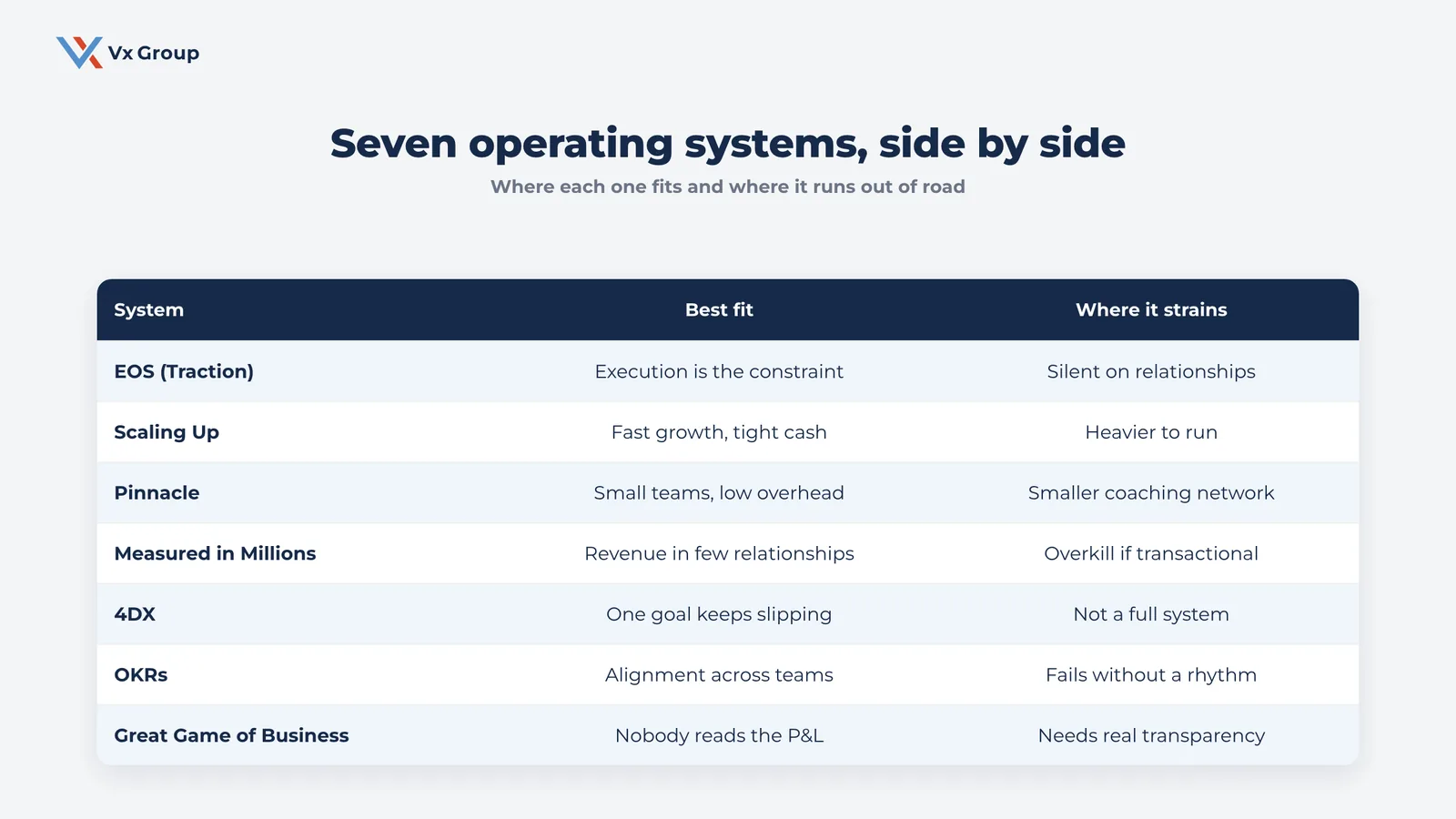
The short version: EOS, Scaling Up, Pinnacle, and the Great Game of Business are full operating systems. 4DX and OKRs are layers you bolt onto one. Measured in Millions® is a full operating system built for a narrower kind of company.
| System | Best fit | Core mechanism | Where it strains |
|---|---|---|---|
| EOS (Traction) | 10 to 250 employees, execution is the constraint | Six components, Level 10 meetings, quarterly Rocks | Silent on market strategy, cash, and relationships |
| Scaling Up | 50+ employees, growing fast, cash is tight | Four Decisions, One-Page Strategic Plan | Heavier to run, needs a leader who likes planning |
| Pinnacle | Small teams that want structure without overhead | Five principles, lighter meeting load | Thinner coaching network, less prescriptive |
| Measured in Millions® | Long-cycle B2B where revenue sits in few relationships | Named accounts, relationship owners, long-term value | Overkill for high-volume transactional businesses |
| 4DX | Any size, one goal that keeps getting crowded out | Wildly Important Goal, lead measures, scoreboard | Not a full system, needs a host |
| OKRs | Companies with existing operating discipline | Objectives with measurable key results | Fails badly without a meeting rhythm underneath |
| Great Game of Business | Companies where nobody outside finance reads the P&L | Open-book management, the Critical Number, MiniGames | Requires real financial transparency from ownership |
1. EOS (Traction): the baseline everything else gets measured against
EOS is the right starting point for most lower-middle-market companies that have never run a formal system, and it is the honest baseline for this list.
Gino Wickman built it and published it as *Traction* in 2007. It organizes a company around six components: Vision, People, Data, Issues, Process, and Traction. The mechanics are the Vision/Traction Organizer for planning, the Accountability Chart for roles, a weekly scorecard of five to fifteen numbers, quarterly Rocks, and the Level 10 Meeting to run all of it.
Who it fits. Companies between roughly 10 and 250 employees where the real constraint is execution. Priorities keep shifting, meetings wander, nobody is clear on who owns what, and good ideas die between quarters. EOS fixes all four, quickly.
Where it strains. EOS is deliberately silent on three things: market strategy, cash management, and relationships. That silence is a design choice, and for many companies it is the right one. For a company whose growth problem lives in one of those three places, running EOS harder will not touch it. The scorecard will stay green while the revenue line stays flat.
The tell is simple. If your leadership team can complete a full quarter of Rocks without a single one touching a customer relationship by name, EOS is organizing your internal work while leaving your revenue engine untouched.
2. Scaling Up: EOS with a real strategy and cash layer
Scaling Up is the better choice when the constraint is growth planning and cash.
Verne Harnish built it from the Rockefeller Habits work he published in 2002 and expanded it into *Scaling Up* in 2014. It runs on Four Decisions: People, Strategy, Execution, and Cash. The centerpiece is the One-Page Strategic Plan, which forces a company to write down its core values, its ten-year target, its three-year picture, its annual plan, and its quarterly priorities on a single sheet.
Who it fits. Companies past roughly 50 employees that are growing fast enough to feel it in the bank account. Scaling Up is the only system on this list that treats cash as a first-class discipline, with a working-capital cycle you actively manage.
Where it strains. It asks more of the leadership team than EOS does. The One-Page Strategic Plan is genuinely hard to fill out well, and a team that has never done structured strategy work will produce a page of adjectives on the first attempt. It also carries more overhead. For a 20-person company, Scaling Up is a lot of machinery.
3. Pinnacle: a lighter framework for teams that want structure without the overhead
Pinnacle is the reasonable pick when a team wants the benefits of an operating system and has already decided the EOS meeting load is more than it will sustain.
Steve Preda and Gregory Cleary published *Pinnacle* in 2020, built around five principles and supported by a network of Pinnacle Business Guides. The design intent is a lighter touch: fewer mandated meetings, less prescriptive machinery, more room for a leadership team to adapt the system to how it already works.
Who it fits. Smaller teams, often under 30 people, and leadership groups that have tried a heavier system and abandoned it. If your last operating system died because nobody could sustain the cadence, a lighter framework has a better chance of surviving the second attempt.
Where it strains. The coaching network is smaller than the EOS one, so finding a guide near you in a Midwest metro can take longer. The flexibility that makes it easier to adopt also makes it easier to let slide. A team with weak self-discipline usually does better with a system that tells it exactly what to do on Monday.
Ready to grow?
We will walk your last five closed deals with you and tell you honestly whether an operating system is the thing standing between you and growth.
4. 4DX: an execution layer for one goal that keeps getting crowded out
4DX belongs on this list with a caveat: it is an execution discipline, and it needs a host system to live inside.
Chris McChesney, Sean Covey, and Jim Huling published *The 4 Disciplines of Execution* through FranklinCovey in 2012. The four disciplines are focusing on a Wildly Important Goal, acting on lead measures, keeping a compelling scoreboard, and holding a cadence of accountability.
The insight that makes 4DX useful is the lead-measure distinction. Most companies track lag measures: revenue, margin, retention. Those tell you what already happened. Lead measures are the small, controllable behaviors that move the lag measure, and they are the only thing a team can actually act on this week.
Defined Term: Lead measure.
A predictive, controllable activity that a team can influence directly this week, which moves a lagging result later. “Revenue from the top ten accounts” is a lag measure. “Number of top-ten accounts that had a real conversation with an executive this month” is a lead measure.
Who it fits. Any company, any size, with one goal that keeps getting run over by the day job. 4DX is the sharpest tool on this list for protecting a single priority.
Where it strains. 4DX will not tell you who owns what, how to run a leadership meeting, how to plan a year, or how to manage cash. Companies that adopt it as a complete operating system discover the gaps within about two quarters.
5. OKRs: goal alignment for companies that already have operating discipline
OKRs work well as an alignment layer for a company that already has a functioning meeting rhythm underneath them.
Andy Grove developed the approach at Intel and John Doerr carried it to Google, then published it for a wider audience in *Measure What Matters* in 2018. The structure is simple: an Objective states what you are trying to accomplish, and three to five Key Results state the measurable outcomes that prove you accomplished it.
Who it fits. Companies with real operating discipline already in place, a leadership team comfortable with measurement, and enough scale that alignment across departments has become a genuine problem.
Where it strains. OKRs are the most commonly abandoned system on this list, and the reason is structural. OKRs describe goals. They say nothing about how a company runs. Drop them into an organization with no meeting rhythm and no clear ownership, and by the second quarter they become a spreadsheet nobody opens. A relationship-driven company also has a specific problem with OKRs: the most important things a long-cycle B2B company does in a quarter frequently produce no measurable key result inside that quarter, because the deal closes eleven months later.
6. The Great Game of Business: open-book management that teaches the numbers
The Great Game of Business is the right call when your constraint is that almost nobody outside the finance office understands how the company makes money.
Jack Stack built it at SRC Holdings and published *The Great Game of Business* in 1992. The method is open-book management: teach every employee to read the financials, identify the one number that most determines whether the company wins this year, and run short MiniGames aimed at moving it.
Who it fits. Companies with a large operational workforce, where day-to-day decisions on the floor have real financial consequences and the people making them cannot see those consequences. Manufacturers and distributors are the natural home for it.
Where it strains. It asks ownership for genuine financial transparency, and a lot of privately held Midwest companies are not prepared for that. A partial version, where the numbers are shared but the real ones stay hidden, produces cynicism faster than no version at all.
7. Measured in Millions®: an operating system built around the relationships that produce the revenue
Measured in Millions® is built for a specific kind of company: long-cycle B2B where most of the revenue sits inside a small number of relationships that took years to build.
Vx Group developed it inside relationship-driven manufacturers, distributors, and industrial companies over two decades. The operating system, MiMOS, keeps the parts that every good system has, including a planning cadence, defined roles, and a scorecard. What it adds is a layer the others leave out: the named relationships that produce the revenue, who owns each one, how healthy each one is, and what each is worth over the full life of the relationship.
Defined Term: MiM™ Lens.
The habit of evaluating any interaction by what the relationship is worth over its full life. One part order from a new plant can be the opening of a twenty-year account, and a system that measures only this quarter’s revenue will treat it as noise.
Who it fits. Companies between roughly $25M and $100M in revenue, with sales cycles measured in months, customers measured in decades, and a revenue base concentrated in a small number of accounts. If your top ten customers are more than half your revenue, this is the design assumption you need your operating system to share.
Where it strains. It is the wrong system for a high-volume transactional business. A company doing thousands of small orders a month with no meaningful account concentration should run EOS or Scaling Up. The relationship layer that makes MiM™ valuable adds work that a transactional business will not get a return on.
Keeping this entry honest matters. Measured in Millions® is one option among seven, and six of them are better answers for companies that grow differently.
How do you choose the right operating system for your company?
Choose based on where your growth actually breaks, which means diagnosing before shopping. Four steps, in order.
Write down how your last five deals actually closed
Take your five most recent wins over $50,000 and write one paragraph on each: who brought it in, how long it took from first contact to signature, how many people at the customer touched the decision, and what the relationship history was before the deal started.
Read the five paragraphs together. If most of them started with someone who already knew you, your growth runs on relationships and your operating system needs a relationship layer. If most of them started cold and closed inside a quarter, you have a velocity business and EOS or Scaling Up will serve you well.
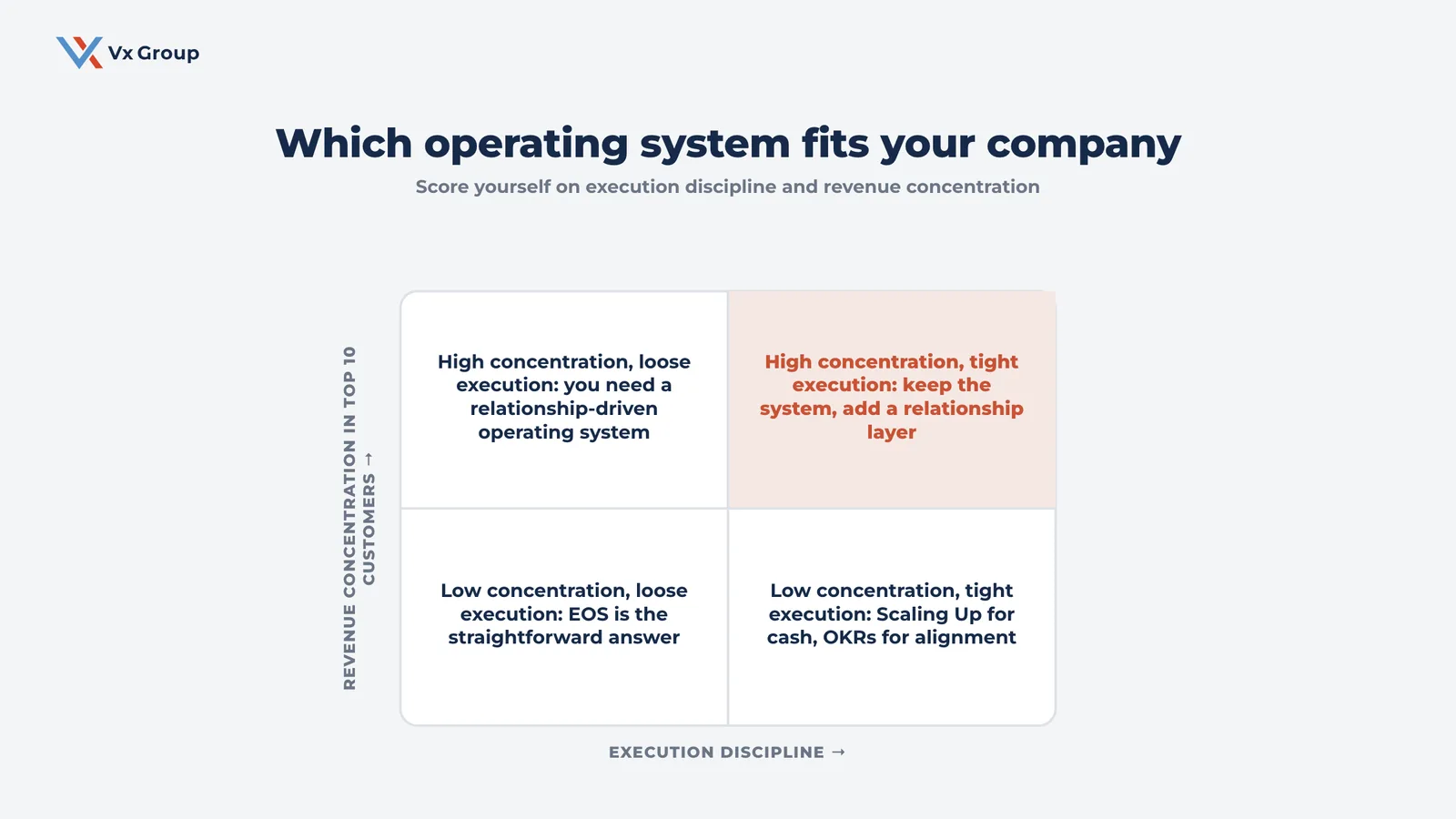
Score your company on the two axes that decide the fit
Rate each from 1 to 5, honestly:
- Execution discipline. Do priorities survive the quarter? Does the leadership meeting produce decisions? Does everyone know who owns what?
- Revenue concentration. What percentage of revenue comes from your top ten customers?
Low execution discipline and low concentration points to EOS. Low execution discipline and high concentration points to a relationship-driven system. High execution discipline with a strategy or cash problem points to Scaling Up. High execution discipline with an alignment problem points to OKRs.
Run a 90-day pilot on one team before you roll anything company-wide
Pick one business unit or one sales team. Run the full cadence of your chosen system for one quarter. Track three things: whether the meetings actually happened, whether the scorecard numbers moved, and whether anyone outside the pilot asked to join.
The third one is the real signal. A system that works spreads by demand. A system people tolerate has to be pushed, and pushing it across the whole company multiplies the cost of a bad fit by the size of your payroll.
Name a human owner for the system itself
Somebody has to own the operating system the way somebody owns the ERP. That person runs the cadence, keeps the scorecard honest, and protects the meeting from being cancelled when the quarter gets busy. Write the name down. An operating system with no owner reverts to whatever the company was doing before, usually within two quarters.
What goes wrong when a company switches operating systems?
Most failed switches come from four predictable mistakes.
- Switching for the wrong reason. A company abandons EOS because the meetings feel heavy, adopts something lighter, and discovers eighteen months later that the meeting weight was never the problem. The problem was that no system was pointed at the actual growth constraint.
- Running two systems at once. Half the company still sets Rocks, half sets OKRs, and the scorecard has columns from both. Pick one, retire the other completely, and give people a clean date.
- Skipping the diagnosis. Buying an operating system before understanding where growth breaks is how companies end up two years and six figures in with a tidier org chart and flat revenue.
- Treating the switch as a leadership decision only. The system lives or dies at the level of the people running the weekly meetings. If the sales manager and the plant manager were not part of choosing it, they will run it as compliance, and compliance systems die quietly.
Two of our published pieces go deeper on the diagnosis: What Is a Business Growth Operating System? covers what these systems are built to do, and How to Pick the Right Operating System for Your Business walks the single matchup between a general-purpose system and a relationship-driven one in more detail.
Where to start
Start with the five-deal exercise from the choosing section. It takes an afternoon, it costs nothing, and it answers the question that every one of these systems assumes you have already answered: how does this company actually make money?
If the answer is volume and velocity, EOS and Scaling Up are excellent, and the certified implementer networks behind them make adoption straightforward. If the answer is a small number of relationships built over years, you need an operating system that treats those relationships as the asset they are, with named owners, real measures of health, and a cadence that does not wait for a problem to trigger contact.
The companies that get this right are usually the ones that stopped blaming the team for a system that was never designed for their business.
Ready to grow?
Bring us your last five deals and your top ten accounts, and we will tell you which of these seven systems fits how your company actually grows.
Subscribe to Insights → for practical growth systems built for relationship-driven B2B companies.
FAQs
About the Author: David Tisdale
