

How to Build a Distribution Strategy to Grow Channel Revenue

A distribution strategy is your plan for how a product reaches the people who buy and use it, and who owns the customer relationship along the way. For relationship-driven manufacturers, that decision runs deeper than logistics. It sets how much of the end-customer relationship you keep and how much you hand to a distributor to carry on your behalf.
TL;DR
- A distribution strategy decides two things at once: how your product physically reaches the market, and whose trust the sale depends on.
- There are three core models. Direct keeps the margin and the relationship. Distributor (indirect) trades margin for reach and speed. Hybrid splits the market by segment so you keep the accounts that matter and delegate the rest.
- The right model is a function of how much the relationship drives the sale and how much reach you can build on your own. Map it per segment, then choose per segment.
- Margin and control move together. Every point of margin a distributor takes usually buys you reach, coverage, or lower cost to serve. The question is whether that trade is worth it for that customer.
- Watch for the warning signs that your model has outlived its usefulness: customers who only know your distributor, revenue concentrated in one partner, and margins that erode while the partner’s hold steady.
- Whatever model you run, build in shared visibility into the end customer so a partner change never erases years of relationship value.
Most manufacturers inherited their distribution strategy. The founder landed a distributor in 1998 because that distributor already called on the right accounts, and thirty years later the company still runs the same channel, through the same partners, with the same margins, serving markets that have since split into pieces.
The model made sense once. Nobody has revisited whether it still does. That is the villain this guide is built to beat: distribution by default, the channel you drifted into and never decided on purpose.
The stakes are higher than margin. When a distributor owns the relationship, the distributor owns the trust. Your product may be in ten thousand facilities, and you may not be able to name a single person who uses it.
That is a fragile place to grow from. This guide walks through the models, the real tradeoffs, and the decision framework to choose the right structure for each part of your market, so channel revenue grows on purpose.
What is a distribution strategy?
A distribution strategy is the documented decision about how your product gets from your dock to the end user, which channels carry it, and who is responsible for the customer relationship in each one. It answers three questions: who sells, who fulfills, and who the customer trusts when something goes right or wrong.
Defined Term: Distribution strategy
The deliberate plan for how a product reaches its end users, which combination of direct and indirect channels carries it, and who owns the customer relationship in each channel. It governs coverage, margin, control, and the durability of your customer relationships.
Distribution strategy sits inside your larger go-to-market plan, and the two get confused often. A B2B go-to-market strategy defines who you sell to and why they buy. Distribution strategy defines how what you sell physically and commercially reaches them once that demand exists.
You can have a sharp go-to-market plan and still leak revenue through a distribution model that hands your best relationships to a partner who has no reason to grow them.
Three terms travel with this topic and get used loosely, so define them before going further:
- Distribution channel: the path a product travels from manufacturer to end user. A channel can be direct (you to the buyer) or indirect (through one or more intermediaries such as distributors, dealers, or resellers).
- Direct distribution: you sell and fulfill to the end customer yourself, with no intermediary owning the relationship.
- Indirect distribution: an intermediary buys from you or represents you, then sells to the end customer and typically owns that relationship.
Get these definitions written down and shared internally. Most channel arguments inside a company are really disagreements about which of these words means what.
Why is distribution strategy really a decision about trust?
Because in relationship-driven B2B, whoever holds the customer relationship holds the pricing power, the renewal, and the next order. When you route a sale through a distributor, you share margin and you hand that distributor the trust the customer feels. Trust is the asset that actually compounds over the life of an account.
This is the reframe most textbooks miss. They teach distribution as a coverage-and-cost problem: pick the channel that reaches the most buyers at the lowest cost to serve. That math matters, and this guide covers it. Coverage is only half the picture. The other half is relationship ownership, and it is worth more over time than any single quarter’s margin.
Defined Term: Relationship ownership
Who the end customer calls first, trusts by default, and would follow if they switched suppliers. In an indirect channel, the intermediary usually owns it. Whoever owns the relationship owns most of its long-term value.
Consider what happens when a distributor owns the relationship and then decides to promote a competing line. Your product has been designed in, specified, and trusted for years, and the customer’s loyalty routes through the distributor who is now steering them elsewhere.
You lost that account for one reason: you never owned the relationship the sale depended on. The product was specified and trusted the whole time, and the trust simply ran through someone else. The lifetime value of a company’s strongest relationships often exceeds the entire pipeline of new prospects, and a distribution model can quietly place that value in someone else’s hands.
None of this means direct is always right. It means the relationship question deserves equal weight to the margin question when you design the model. A distributor who genuinely earns and holds trust in a market you could never cover yourself is one of the most valuable assets you can have.
The failure is treating the handoff as a logistics decision when it is a trust decision.
What are the three distribution channel models?
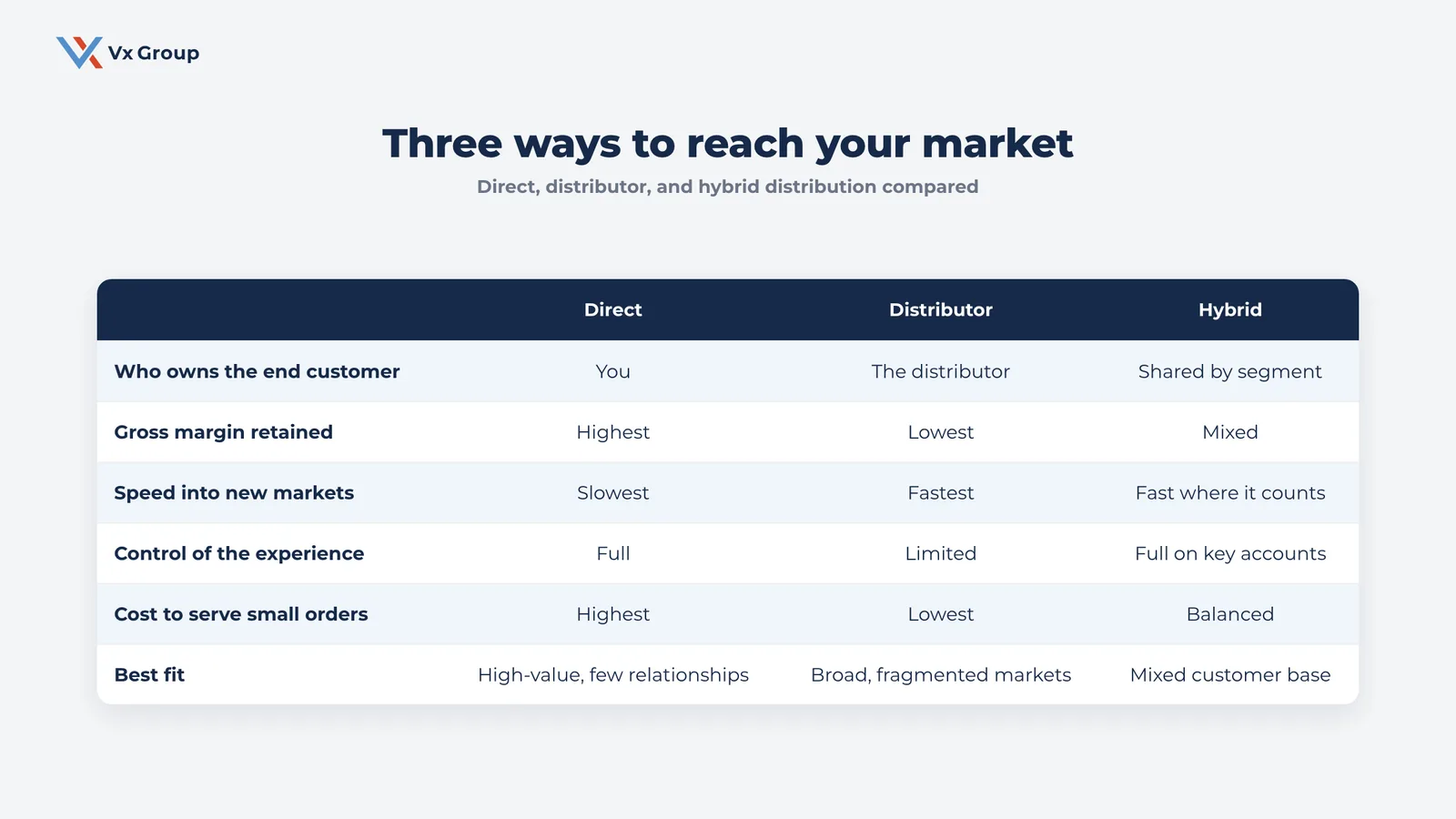
There are three core models: direct, distributor (indirect), and hybrid. Direct means you own the sale and the relationship end to end. Distributor means an intermediary carries both. Hybrid means you split the market so different segments get different owners. Each buys you something and costs you something, and the right answer usually varies by segment inside the same company.
Sell direct when the relationship is the product
Choose direct distribution when the value of the relationship justifies the cost of carrying it yourself. You keep full margin, full control of the experience, and first-party knowledge of every end user. You also carry the full cost: a sales team, fulfillment, credit, support, and the slow work of building coverage market by market.
Direct fits high-value products, complex sales that need your expertise in the room, and customer bases small enough in count and large enough in value that owning each relationship pays for itself. A manufacturer with 150 accounts that each buy six figures a year almost always belongs direct. Build a named account plan for each of those relationships and hold someone accountable for growing it.
Use a distributor when reach and local trust outrun your own
Choose an indirect, distributor-led model when a partner can reach and serve the market faster, cheaper, or with more local trust than you can build alone. The distributor buys coverage you would spend years and millions to replicate: existing relationships, local inventory, credit terms, and the ability to serve thousands of small orders profitably. You give up margin and direct relationship ownership in exchange.
This model fits fragmented markets, geographically dispersed buyers, high transaction volume with low per-order value, and any situation where the customer values one-stop local availability more than a direct line to the manufacturer.
When you sell through dealers, a deliberate dealer network strategy decides how much of that coverage you can actually rely on, and a broader B2B channel strategy keeps every indirect route pulling in the same direction. Our guide to channel marketing for manufacturers and distributors goes deep on making this partnership productive once you choose it.
Run a hybrid model when different segments need different owners
Choose a hybrid (also called dual distribution) when no single model fits your whole market, which for most established manufacturers is the honest answer. You sell direct to the segments where the relationship drives the sale, usually your largest and most strategic accounts, and you run everything else through distributors who serve the long tail profitably.
Done well, hybrid gives you the margin and control where it matters most and the reach and efficiency where it does not. It also introduces the hardest management problem in distribution, channel conflict, which the next sections address directly.
Draw the line explicitly: write down which accounts, segments, or order sizes are direct and which are channel, and publish that rule to both your sales team and your partners.
Defined Term: Channel conflict
The friction that arises when two channels compete for the same customer, most often when a manufacturer sells direct to an account a distributor also wants. Left unmanaged, it erodes partner trust and confuses customers. Managed with clear rules of engagement, it is the manageable cost of a hybrid model.
Ready to grow?
See how your current model maps to where your best relationships actually live before you change anything.
What are the margin and control tradeoffs of each model?
Margin and control move together, and every point of margin a distributor takes should buy you something specific in return: reach, coverage, lower cost to serve, or faster market entry. The discipline is refusing to give up margin without naming what it buys. A distributor discount of 25 points is expensive if the distributor adds nothing but order-taking, and cheap if it delivers a sales force, local inventory, and relationships you could never build.
Walk the math with a real example. Say you sell a product at a 45 percent gross margin when you sell it direct. Route the same product through a distributor at a 25 point channel discount and your realized margin drops to roughly 20 points on those units.
That looks like a steep loss until you count what direct selling actually costs on small, dispersed orders: the sales time, the freight, the credit risk, the support calls. For a large strategic account, direct wins on both margin and relationship. For a customer placing forty small orders a year across three states, the distributor may deliver more profit per dollar of effort even at the lower margin, and it does it without you hiring a single new rep.
These figures are illustrative; run your own numbers by segment. Control follows the same logic.
- Direct gives you full control of pricing, positioning, service quality, and data.
- Indirect trades much of that away: the distributor sets the local price, controls the shelf, and decides how hard to push your line against the others it carries.
- Hybrid lets you keep tight control where the stakes are highest and accept looser control where the economics favor delegation. The tradeoff is never free in either direction. The goal is to make it deliberately, segment by segment, with the numbers in front of you.
How do you choose the right distribution model?
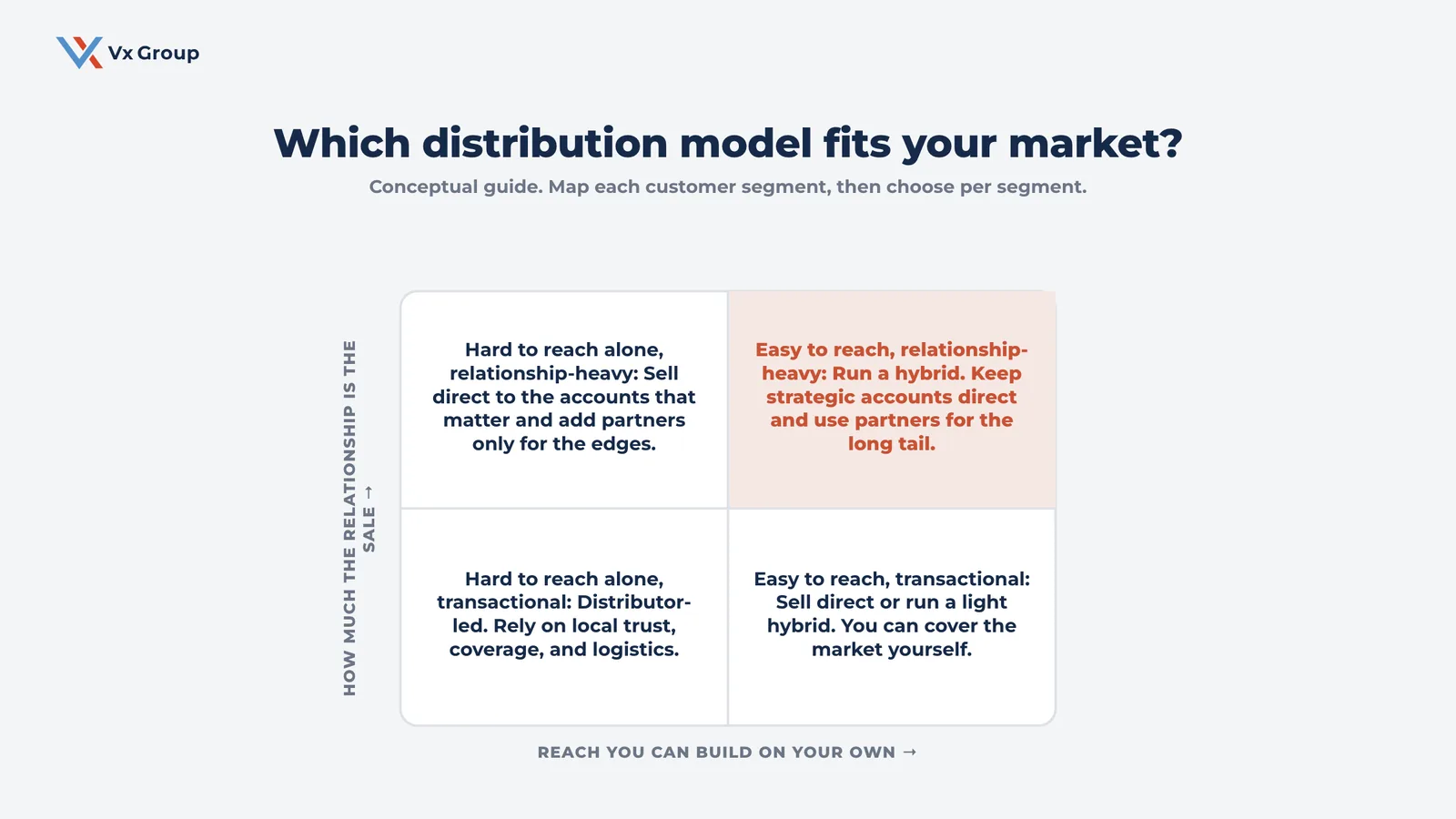
Choose your model by mapping each customer segment on two axes, how much the relationship drives the sale and how much reach you can build on your own, then selecting the model that fits each quadrant. Most manufacturers land on a hybrid because their market is not uniform. The point of the exercise is to choose deliberately per segment instead of applying one inherited model to a market that has since fragmented.
Map where your best relationships actually live
List your top 20 to 50 accounts and mark, honestly, who the customer trusts and calls first: you or an intermediary. This is uncomfortable and clarifying. Many manufacturers discover their largest accounts route entirely through a distributor, which means their revenue rests on a relationship they do not own. Build a simple one-page map: account, revenue, who owns the relationship today, and who should own it. That map drives every decision that follows.
Rank each segment by cycle economics and relationship value
Group your market into segments and score each one on two things: the lifetime value of a typical relationship in that segment, and the cost to serve it directly. High value and low cost to serve points toward direct. Low value and high cost to serve points toward a distributor. This is the same discipline behind sound customer segmentation, applied to the channel decision. Rank the segments in a table so the pattern is visible.
Decide which relationships you will never hand off
Some relationships are too valuable to the long-term health of the business to place in a partner’s hands, and you should name them before economics tempt you to delegate. These are typically your largest accounts, your reference customers, and the buyers whose specifications pull the rest of the market. Write a short list of accounts that stay direct regardless of order economics, and treat it as a standing rule.
Model the margin math for each channel
For each segment, build the simple margin comparison from the tradeoffs section: direct margin minus the fully loaded cost to serve directly, versus channel margin minus your cost to support the partner. Do this with real numbers from your own books. The answer is often counterintuitive, and it protects you from both over-delegating your best accounts and clinging to direct service on business that quietly loses money.
Pick the model per segment, then write it down
Assign a model to each segment, then document the whole thing as a one-page distribution plan: which segments are direct, which are channel, which are hybrid, and the rule that decides any ambiguous account. Undocumented distribution strategy is how channel conflict starts and how inherited models survive long past their usefulness. The document is the strategy itself, and everything before it is the analysis that produced it.
Ready to grow?
We help relationship-driven manufacturers map segments to channels and put the plan in writing.
What are the signals it is time to change your distribution model?
The clearest signal is that your best customers only know your distributor, never you. When the relationship that carries your revenue lives entirely inside a partner, you have a growth model with a single point of failure. Below are the review triggers worth watching. If three or more are true, put the model on the agenda this quarter.
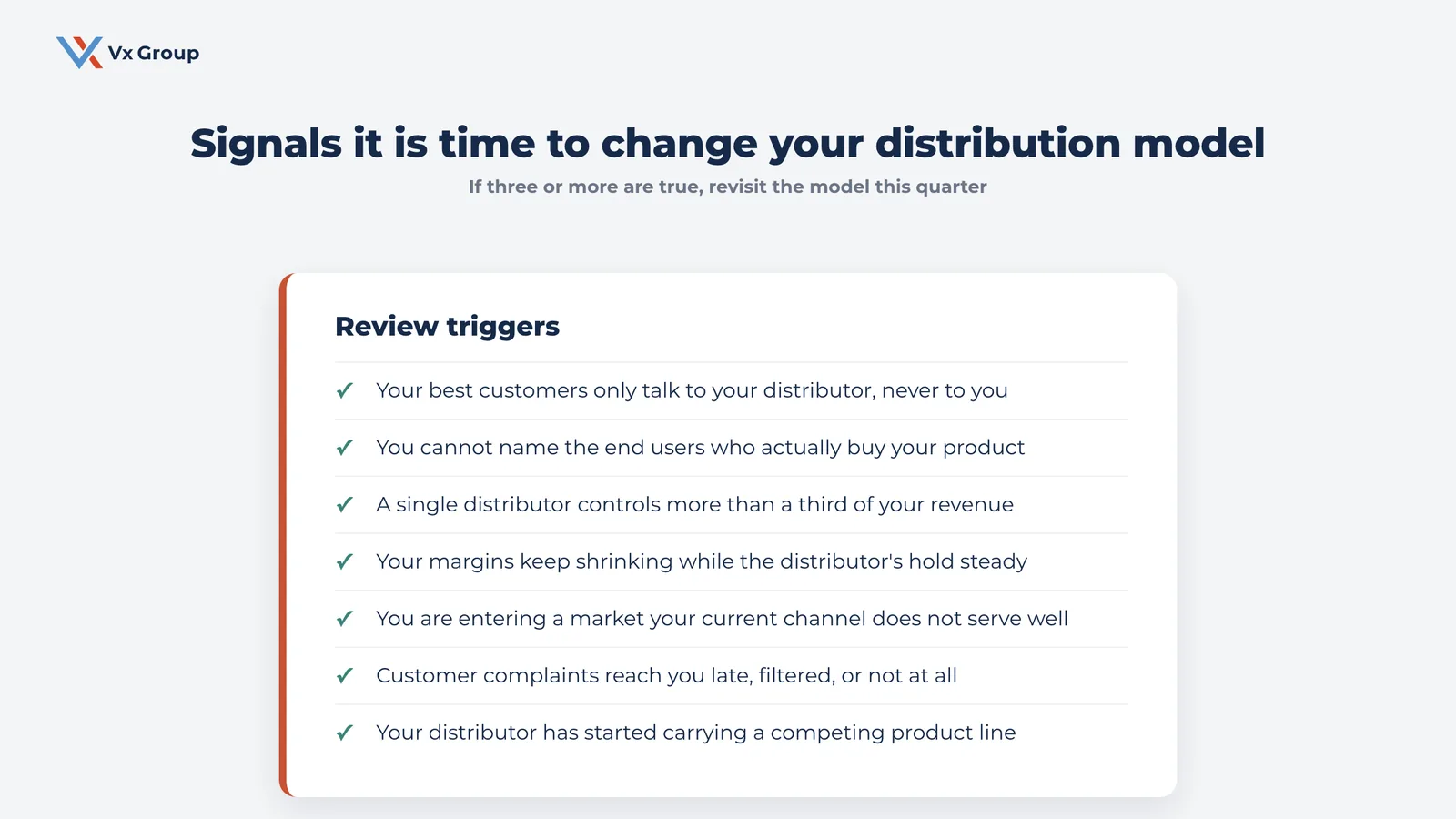
- Your best customers only talk to your distributor and would not recognize your name.
- You cannot name the end users who actually buy and use your product.
- A single distributor controls more than a third of your revenue.
- Your margins keep shrinking while the distributor’s hold steady.
- You are entering a market your current channel does not serve well.
- Customer complaints and product feedback reach you late, filtered, or not at all.
- Your distributor has started carrying a competing product line.
Any one of these is a yellow flag. The concentration signal deserves special weight. When one partner controls a large share of revenue, that partner effectively sets your terms, and the day the relationship changes hands or sours, a large piece of the business goes with it.
Revenue concentrated in a single relationship you do not control is the channel version of a risk every operator already understands: too much depending on one thing you cannot steer.
Field Notes
A regional components manufacturer we studied grew for two decades through a single master distributor that covered the entire Midwest. Revenue was steady, margins were quietly thinning, and the leadership team could not name ten end users of their own product. When the distributor was acquired and the new owner pushed its house brand, the manufacturer lost nearly a third of its volume in eighteen months. The recovery took three years and started with the same first move this guide recommends: building direct visibility into the top 40 end-user relationships while keeping the distributor for the long tail. The lesson is simple. A relationship you cannot see is a relationship you cannot protect, and even a good distributor does not change that.
How do you keep control of the customer relationship when a distributor owns the account?
You keep control by building shared visibility into the end customer, co-owning the top relationships with named people on both sides, and setting the rules of engagement before conflict forces the issue. You do not have to choose between the reach of a distributor and knowledge of your own customers. You do have to design for both on purpose, because neither happens by default.
Build shared visibility into end-customer data
Negotiate for end-user data as part of the partner agreement: who is buying, in what volume, in which segments, and where trends are moving. Many distributors resist this, and the willingness to share is itself a signal of partnership health. At minimum, track sell-through (what the distributor sells to end users) alongside sell-in (what the distributor buys from you), so you can see whether a channel is growing real end-user demand or just loading up on inventory. Put the reporting cadence in writing.
Co-own the top relationships with named people
For your most important end users, insist on a shared account model where a named person from your team and a named person from the distributor both know the customer. Joint business reviews, shared account plans, and manufacturer participation in key sales calls keep you present in the relationship without cutting the distributor out, the same discipline that drives strong dealer engagement. The principle behind account expansion applies through the channel too: the growth hiding in your best accounts is only reachable if you can see and touch those accounts.
Name the top 20 and assign co-owners this quarter.
Set the rules of engagement before conflict starts
Write down, in the partner agreement, exactly which accounts or segments the manufacturer serves direct and which belong to the channel, and how any disputed account gets resolved. Rules of engagement written before a conflict are a partnership tool. Rules invented during a conflict are a fight. Define the direct-account list, the deal-registration process, and the escalation path in advance, and both sides can trust the model. A formal channel partner program is usually where these rules live and stay current.
How do you measure distribution strategy performance?
Measure distribution strategy on four things: the margin each channel actually delivers after cost to serve, how much of your revenue sits with any single partner, how much of your end-customer base you can see, and whether real end-user demand is growing. Most manufacturers track only the first crudely and ignore the rest, which is how a channel problem stays invisible until it becomes a revenue problem. These numbers also feed your broader channel sales strategy, since you cannot set targets for a channel you cannot measure.
Here are the metrics worth putting on a quarterly dashboard, with a plain definition for each:
- Channel gross margin after cost to serve: the true profitability of each channel once you subtract the fully loaded cost of supporting it. Tells you whether a channel is actually earning its discount.
- Revenue concentration: the share of total revenue running through your single largest partner. A number above roughly a third is a standing risk worth a mitigation plan.
- End-customer visibility: the share of your end users you can actually name and reach. Low visibility means low control and high fragility.
- Sell-through growth: the growth in what distributors sell to end users, separate from what they buy from you. The truest read on whether real demand is rising.
- Relationship ownership ratio: the share of your top accounts where your own team owns the primary relationship. The number that predicts how much of your value survives a partner change.
Review these as a set. A channel with strong sell-in and flat sell-through is building a cliff. A channel with high margin and near-zero end-customer visibility is profitable and fragile at the same time. The dashboard exists to surface those contradictions early enough to act on them.
What are the most common distribution strategy mistakes?
The most common mistake is treating distribution as a fixed inheritance, something you set once and never reopen. The others follow from that same passivity. Watch for these:
- Running an inherited model unexamined. The channel that fit the company at 20 million in revenue rarely fits it at 80 million or across new geographies. Put the model on a set review schedule, every year or two, so a crisis is never what forces the conversation.
- Trading margin for reach without measuring the reach. Distributor discounts are only worth it if the partner delivers coverage, service, or demand you could not. Hold the channel accountable for what its margin is supposed to buy.
- Letting one partner concentrate the revenue. Comfort with a single strong distributor is how a company ends up with its fate in someone else’s hands. Build a second path before you need one.
- Going direct on price and undercutting your own channel. The fastest way to destroy a hybrid model is to compete with your partners on the accounts you handed them. Set and hold the rules of engagement.
- Skipping the paperwork. An undocumented distribution strategy is just a set of habits waiting to be disputed. Write the plan down and keep it current.
Avoiding these comes back to one habit: choosing the model on purpose, writing it down, and reviewing it as the market moves. Growth through the channel comes from clarity about who you serve directly, who you serve through partners, and why.
The manufacturers that grow channel revenue on purpose share one trait. They know exactly which relationships they own, which they have delegated, and what it would cost them if a partner walked away tomorrow. That knowledge is what turns distribution from a thing that happened to you into a lever you control.
Ready to grow?
We help relationship-driven manufacturers and distributors design a distribution strategy that grows channel revenue and protects the relationships underneath it.
Subscribe to Insights → Get the next manufacturing growth guide the week it publishes.
FAQs
About the Author: David Tisdale
