

Customer Segmentation Models for Relationship-Driven B2B Companies

A customer segmentation model is the method a company uses to group its accounts so it can treat different groups differently. Most models sort accounts by attributes like industry, size, or behavior. Relationship-driven B2B companies get more from a relationship-value model that groups accounts by how much trust exists and how much room there is to grow.
TL;DR
- A customer segmentation model groups your accounts so you can invest your time where it pays back the most.
- The common models (demographic, firmographic, behavioral, needs-based, value-based) all sort accounts by what a company *is* or what it *did*, which misses what a relationship is *worth* over its life.
- In long-cycle B2B, two accounts with the same profile can be worth ten times different amounts, because the value lives in trust and expansion room.
- Relationship-value segmentation plots every account on two axes: relationship depth and expansion room.
- That gives you four working segments: Core Growth, Protect, Develop, and Monitor, each with its own play.
- You build it in five steps: score depth, estimate room, plot every account, assign a tier and owner, and review on a set cadence.
- The payoff shows up in net revenue retention, expansion inside your best accounts, and fewer surprises when a big relationship changes hands.
Most B2B companies segment their customers the way they inherited it: a spreadsheet of accounts sorted by industry code and revenue band, built once, and rarely opened again. It feels organized. It rarely changes what anyone does on Monday morning. The sales team still calls whoever called them last, the biggest logo gets the most attention whether or not there is room to grow it, and the quiet account that could double next year sits in the same bucket as the one that will never buy again.
That inherited spreadsheet is the villain here. Sorting accounts by what a company looks like on paper is fine for building a prospect list. It is a poor way to decide where your best people spend their hours, because the number that actually matters in relationship-driven B2B is not on the spreadsheet. It is how much a customer will be worth over the life of the relationship, and how much of that value you have earned the right to capture. This guide walks through the standard models honestly, shows where each one breaks for long-cycle companies, and lays out a relationship-value model you can build from your existing account list this quarter.
What is a customer segmentation model?
A customer segmentation model is a repeatable method for grouping your customers into segments that behave similarly or deserve similar treatment, so you can prioritize time, money, and attention instead of treating every account the same. The point of any model is to make a hard question easy to answer: where should the next hour go?
Defined Term: Customer segmentation model
The set of rules a company uses to sort its accounts into groups so it can serve, price, and grow each group on purpose. A good model changes behavior. If it does not change who gets called, what gets pitched, or where the budget goes, it is a filing system rather than a segmentation model.
Segmentation is close cousins with your ideal customer profile, and the two get confused often. Your ideal customer profile describes the kind of company you want to acquire. Segmentation sorts the customers you already have and the prospects already in front of you. You use the ICP to decide who to chase. You use a segmentation model to decide how to spend on the accounts you have already won.
What are the main types of customer segmentation models?
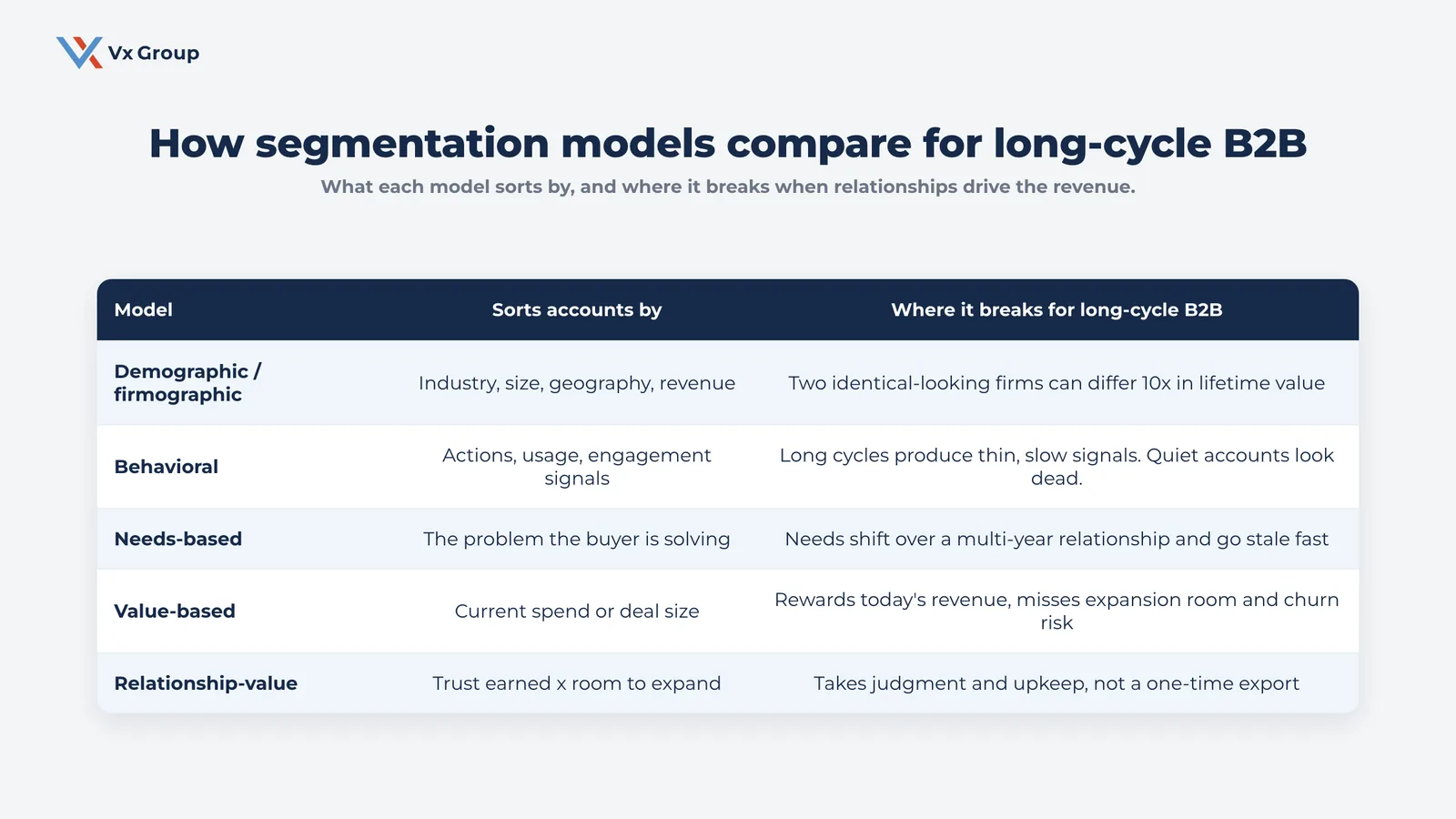
There are five segmentation models most B2B companies use, and each one groups accounts by a different signal. Understanding what each measures makes it obvious why relationship-driven companies need something more.
- Demographic and firmographic segmentation groups accounts by fixed attributes: industry, company size, geography, revenue band, employee count. It is the fastest to build because the data usually already lives in your CRM.
- Behavioral segmentation groups accounts by what they do: recent orders, product usage, site visits, email engagement, support tickets. It is the backbone of product-led and high-volume businesses.
- Needs-based segmentation groups accounts by the problem they are trying to solve. Two customers in different industries land in the same segment because they are buying for the same reason.
- Value-based segmentation groups accounts by current spend or deal size, usually into tiers like A, B, and C. It is the most common way B2B companies decide who gets a dedicated rep.
- Technographic segmentation groups accounts by the tools and systems they run, which matters most when compatibility or integration drives the sale.
Here is how the four standard models most B2B companies reach for stack up, and where each one runs into trouble once relationships and long cycles drive the revenue.
| Model | Sorts accounts by | Best for | Where it breaks for long-cycle B2B |
|---|---|---|---|
| Demographic / firmographic | Industry, size, geography, revenue band | Fast list-building and territory planning | Two firms with the same profile can be worth ten times different amounts over the life of the relationship |
| Behavioral | Recent actions, usage, engagement | Product-led and high-volume businesses | Long cycles create thin, slow signals, so a patient account looks dead |
| Needs-based | The problem the buyer is solving | Messaging and solution selling | Needs move across a multi-year relationship and the tags go stale |
| Value-based | Current spend or deal size | Prioritizing this quarter’s revenue | Rewards what an account is worth today and misses room to grow and risk of loss |
None of these models is wrong. Each was built to answer a real question. The problem is that they were mostly designed for businesses with short cycles, many customers, and quick feedback, and they were then borrowed by companies whose economics work nothing like that.
Why do standard segmentation models fail relationship-driven B2B companies?
Standard models fail relationship-driven B2B companies because they measure attributes and past activity, while the value in these businesses lives in trust and future room to grow, neither of which shows up in a firmographic field. When your average customer stays for a decade and your sales cycle runs twelve to eighteen months, sorting by industry code answers a question you were not really asking.
Four things go wrong when a long-cycle company runs a short-cycle playbook:
- Same profile, wildly different value. Two manufacturers of the same size in the same region can differ by an order of magnitude in what they are worth to you over ten years, based entirely on how much they trust you and how much of their spend you can earn. Firmographics cannot see that gap.
- Quiet gets mistaken for dead. Behavioral models reward recent activity. A relationship-driven account can go quiet for two quarters and then place the largest order of the year. Score it on last-90-days engagement and you will deprioritize your best future customer.
- Big gets mistaken for valuable. Value-based tiering sorts by current spend, so the largest account always sits at the top. Sometimes that account is already at its ceiling and quietly shopping you, while a mid-size account has three departments you have never sold into. Current spend hides both the risk and the upside.
- The model never changes what anyone does. Because these models are built once and treated as reference data, they rarely reassign a rep, trigger an expansion plan, or flag a relationship going cold. They describe the customer base instead of directing effort.
There is a deeper cost. When a company has no real segmentation, growth defaults to whoever shouts loudest and whichever fire is closest. That is the scattered, react-to-the-inbox approach that keeps relationship-driven companies stuck below their ceiling. The fix is a model built around the thing that actually drives value in these businesses: the relationship itself.
What is relationship-value segmentation?
Relationship-value segmentation groups your accounts by two things a firmographic model cannot capture: how deep the relationship already is, and how much room there is to grow it. Plot every account on those two axes and you get four segments that tell you exactly where to put your time.
Defined Term: Relationship-value segmentation
A model that sorts accounts by relationship depth (how much trust and access you have earned) and expansion room (how much more the account could be worth if you served it well). It prioritizes lifetime relationship value over current spend, which fits how long-cycle B2B companies actually grow.
The two axes are worth defining precisely, because the whole model depends on scoring them honestly.
Defined Term: Relationship depth
How much trust, access, and standing you have with an account. A deep relationship means multiple contacts across levels, an internal champion who defends you, and a seat at the table before a decision is made. A shallow one means a single price-driven contact who compares you to three others on every order.
Defined Term: Expansion room
The gap between what an account spends with you today and what it could reasonably spend if you served it fully, capped by the account’s own budget and how well you fit its needs. High expansion room means departments, product lines, or locations you have never sold into.
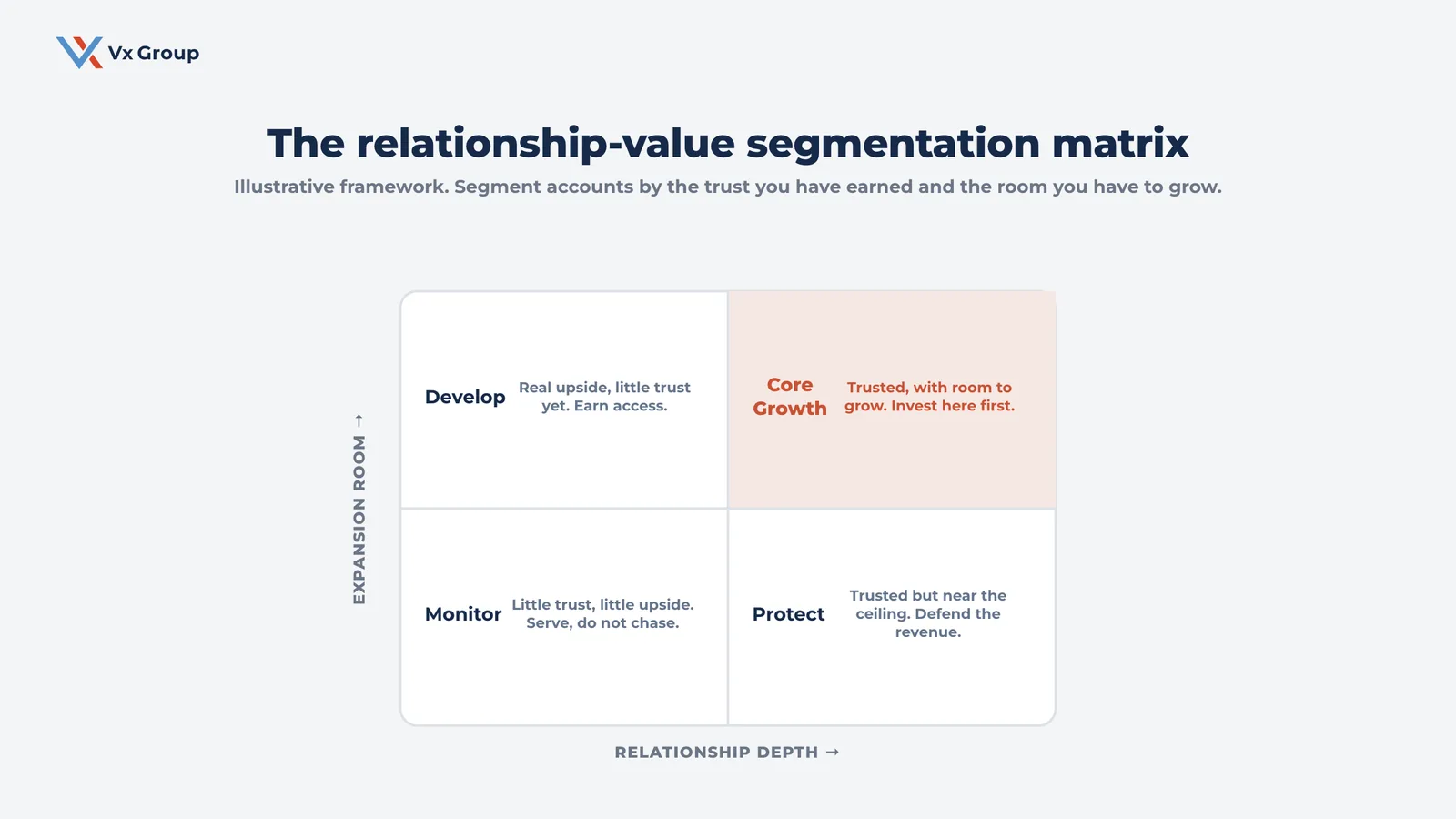
The four segments the matrix produces:
- Core Growth (deep relationship, lots of room): your highest-return accounts. You have the trust and there is real upside. These get your best people and a written plan.
- Protect (deep relationship, little room): loyal accounts near their ceiling. The job is to defend the revenue and the renewal, because losing one of these hurts more than winning a new small logo.
- Develop (shallow relationship, lots of room): real upside, not enough trust yet. These earn patient, deliberate investment to build the relationship before you push for the expansion.
- Monitor (shallow relationship, little room): serve them well and keep the door open, but do not spend your scarce senior time chasing them. Watch for a change that moves them up.
This is the model that fits the Vx Group view of B2B growth: the lifetime value concentrated in your top handful of relationships usually dwarfs the pipeline of new prospects, so protecting and expanding what you have is almost always the faster path to revenue. Segmentation should point your effort there on purpose.
Ready to grow?
See how this maps onto your own account list and where your Core Growth accounts really are.
How do you build a relationship-value segmentation model?
You build a relationship-value segmentation model in five steps: score each account’s relationship depth, estimate its expansion room, plot every account on the matrix, assign each one a tier and an owner and a play, and review on a set cadence. You can do the whole thing in a spreadsheet with your existing account list. The discipline is in scoring honestly and then acting on what you find.
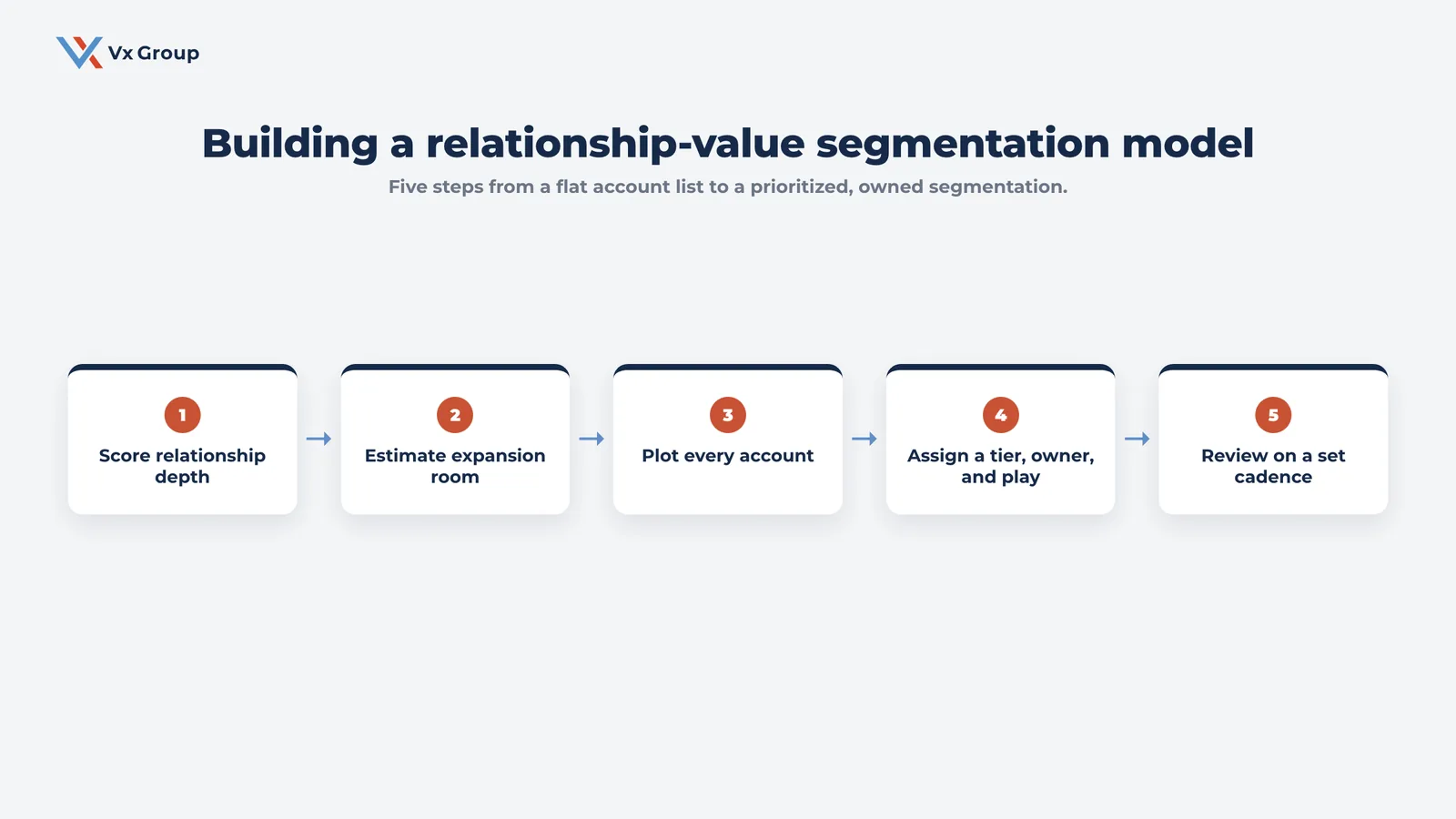
Score each account’s relationship depth on a 1 to 5 scale
Rate every active account from 1 to 5 using a fixed rubric so the score means the same thing across your whole team. Write the rubric down and have two people score a sample of the same accounts to check that they land within a point of each other.
- 1, Transactional: one contact, price is the whole conversation, no advocate inside the account.
- 2, Known: a working relationship with one department, you get a fair look but no executive access.
- 3, Trusted: several contacts, they call you before an RFP goes out, you have some access above your buyer.
- 4, Partner: relationships across multiple levels, you help shape their thinking, they bring you problems early.
- 5, Embedded: you are part of how they operate, an internal champion defends you, and losing you would genuinely disrupt them.
By the end you have a single depth number for every account and, more useful, a clear picture of where your relationships are thin even inside big logos.
Estimate each account’s expansion room in real dollars
For each account, write down what they buy today, list what they could reasonably buy from you, and estimate the annual gap in dollars, then cap that number by their actual budget and how well you fit. Turn the dollar gap into three buckets so it plots cleanly:
- Low: at or near their ceiling with you, little realistic room.
- Medium: one clear expansion path (a new product line, one more location or department).
- High: several untapped paths, or a large share of their category spend still going to someone else.
Keep this honest. Expansion room is what they could spend with you, capped by their budget and your fit, and it is not wishful thinking about their total market. If you cannot name the specific path to more revenue, the room is Low.
Plot every account on the matrix
Place each account on the two axes using a simple decision rule so the segment is not a matter of opinion. Treat a depth score of 3 or higher as the “high” side of the depth axis, and treat Medium or High expansion room as the “high” side of the room axis. That rule assigns every account to one of the four quadrants:
- Depth 3+ and room Medium/High becomes Core Growth
- Depth 3+ and room Low becomes Protect
- Depth 1 to 2 and room Medium/High becomes Develop
- Depth 1 to 2 and room Low becomes Monitor
Now you can see the shape of your base. Most companies are surprised by two things: how few accounts truly sit in Core Growth, and how much senior time is being spent in Monitor out of habit.
Assign each account a tier, a named owner, and a next play
Give every account one segment, one person who owns the relationship, one next action, and one review date, written on a single line so nothing hides. Use a simple account card so the model turns into work:
Account card template
Account · Segment · Depth score · Expansion room · Owner · Next play · Review date
The owner matters as much as the segment. A segment with no name attached is a label that changes nothing. When you assign owners, you are also protecting the business: relationships that live only in one person’s head can walk out the door with a single resignation. Writing down who owns what, and what the plan is, makes the relationship a company asset instead of a personal one.
Set a review cadence and the triggers to re-segment early
Re-score the whole base once a quarter, and re-segment any single account immediately when something material changes, because a static model rots fast in a business where relationships shift. Put the quarterly review on the calendar as a working session, not a report. Then define the events that force an off-cycle move:
- A new executive or buyer enters the account.
- The account is acquired, merges, or reorganizes.
- Your champion leaves.
- A large order lands, or a renewal is lost.
- A competitor displaces you on part of the account.
Each of those changes depth or room, sometimes both, and the account should move segments the week it happens rather than at the next quarterly review.
How should you act on each segment?
Each segment gets a different play, a different amount of senior time, and a different definition of success. The whole point of the model is that Core Growth and Monitor accounts should not be treated the same, and this table is where that becomes concrete.
| Segment | What defines it | Where your time goes | The play |
|---|---|---|---|
| Core Growth | Deep relationship, real room to grow | Your most senior time and best thinking | A written expansion plan with a named owner and a target |
| Protect | Deep relationship, near the ceiling | Steady, high-touch service | Defend the renewal and the relationship before chasing anything new |
| Develop | Shallow relationship, real room | Patient, earn-the-right investment | A trust-building sequence aimed at one clear first win |
| Monitor | Shallow relationship, little room | The least time, mostly self-serve | Serve well, stay easy to buy from, watch for a change |
Put your best people and a written plan on Core Growth accounts
Treat Core Growth as the portfolio you cannot afford to coast on. Each one gets a documented account expansion plan: the next department or product line to win, who inside the account can champion it, the specific next conversation, and a dollar target for the year. These are the accounts where an extra hour returns the most, so they get the senior relationships and the proactive ideas rather than reactive service.
Defend Protect accounts before you chase new logos
Treat Protect accounts as revenue you have already earned and could lose without noticing. The play is retention and relationship maintenance, not expansion: regular executive contact, early warning on any service slip, and a renewal managed months ahead rather than weeks. Because so much lifetime value sits here, strong customer retention strategies protecting these accounts usually beat the return on a new small account. This is also where customer concentration risk hides, so watch how much of your revenue sits in a few Protect accounts.
Run a patient trust-building sequence on Develop accounts
Treat Develop accounts as future Core Growth that have not earned your full investment yet. The play is to build depth deliberately: get a second and third contact, deliver one clear win that proves you, and earn access above your current buyer before you push a big expansion. Rushing the expansion before the trust is there is how these accounts stall. The target profile criteria you use to qualify new business can help you rank which Develop accounts deserve the patient investment first.
Keep Monitor accounts easy to buy from and watch for movement
Treat Monitor accounts as accounts you serve efficiently and do not over-invest in. The play is to make them easy to buy from, keep service clean, and avoid pouring senior time into relationships with little trust and little room. The one thing you owe them is attention to change: a Monitor account can jump to Develop the moment a new decision-maker arrives or a new need opens up.
How is relationship-value segmentation different from your ICP and ABM?
Relationship-value segmentation, your ICP, and account-based marketing answer three different questions, and they work best together rather than in place of one another. Confusing them is why companies run all three and still feel scattered.
- Ideal customer profile answers *who should we go after?* It defines the traits of a great-fit prospect and points your acquisition effort. It looks outward at the market.
- Account-based marketing answers *how do we win a specific named account?* It coordinates marketing and sales around a target list, usually early in the relationship. It is a go-to-market motion.
- Relationship-value segmentation answers *where do we invest across the customers we already have?* It looks at your installed base and sorts it by depth and room so you protect and grow the right accounts.
Used together, your ICP fills the top of the funnel with good-fit accounts, ABM helps you win the priority ones, and relationship-value segmentation makes sure the accounts you win get grown instead of neglected. The segmentation model is what keeps a hard-won customer from quietly sliding into Monitor because nobody owned the relationship.
Ready to grow?
We help relationship-driven companies turn a flat account list into a prioritized, owned segmentation.
What metrics tell you your segmentation is working?
Your segmentation is working when accounts move up in depth, when expansion shows up inside Core Growth, and when your revenue holds even as individual accounts change. Track these five, and track them by segment rather than as company-wide averages that hide the story.
- Net revenue retention by segment: the revenue you keep and grow from existing accounts, measured separately for each segment. Healthy Core Growth and Protect segments should hold above 100%.
- Expansion rate in Core Growth: the share of Core Growth accounts that added a product line, department, or location in the last year. This is the direct payoff of the model.
- Coverage: the share of Core Growth accounts that have a written expansion plan and a named owner. If it is not near 100%, the model is a label rather than a practice.
- Depth movement: the number of accounts that moved up at least one depth point over the last two quarters. This tells you whether Develop accounts are actually becoming Core Growth.
- Top-relationship concentration: the share of total revenue sitting in your top ten relationships. Rising concentration in Protect accounts is a risk flag worth managing deliberately.
A quick word on data integrity: these numbers are only as good as the honesty of your depth scores. If reps inflate depth to look good, the whole model tilts. Score depth in a shared session, spot-check it, and reward accurate scoring over flattering scoring.
What mistakes should you avoid?
The model is simple to describe and easy to undermine. These are the failure patterns that show up most often when relationship-driven companies try to segment.
- Segmenting once and never revisiting. A model built in January and ignored by March describes a company that no longer exists. Put the quarterly review on the calendar before you finish the first build.
- Confusing big with valuable. The largest logo is not automatically Core Growth. If it is near its ceiling and shopping you, it is a Protect account that needs defending, and your growth is somewhere less obvious.
- Letting the model live in one person’s head. When segment logic and relationship history sit only with the rep, you have built a personal asset that leaves when they do. Write it down so the company owns it.
- Over-serving Monitor accounts out of habit. Long-standing low-value accounts often absorb senior time because the relationship is comfortable. Comfortable is not the same as valuable.
- Assigning a segment but no owner or play. A segment with no name and no next action changes nothing. Every account needs a person and a play, or the exercise stays theoretical.
Field Notes
Field Notes: the mid-size account nobody was watching
A distribution client ran the standard A/B/C value tiering built on current spend. Their top “A” account was a large buyer they had served for fifteen years, and it got the most attention by far. When we re-scored the base on depth and room, that account came back deep but near its ceiling, a textbook Protect. The surprise was a “B” account two-thirds its size, buying from a single division, with a strong champion and three other divisions buying nothing from them. On the old model it was a mid-tier account getting mid-tier attention. On the relationship-value model it was Core Growth with the largest expansion room in the portfolio. They assigned a senior owner and a written plan, led with the one division that already trusted them, and grew that account meaningfully over the following year while holding the “A” account steady. Nothing about the accounts changed. What changed was which question they used to sort them.
Conclusion
The model you use to segment customers quietly decides where your company spends its most valuable hours. Sort by industry code and revenue band and you will keep serving whoever called last and over-investing in whoever is already biggest. Sort by relationship depth and expansion room and you point your best people at the accounts with the most trust and the most room, protect the loyal revenue you have already earned, and build the trust that turns a promising account into a core one. It is the difference between a segmentation model that sits in a drawer and one that changes what happens Monday morning.
You can build the first version this quarter with the account list you already have. The hard part is not the spreadsheet. It is scoring honestly, assigning owners, and reviewing it often enough that it keeps up with relationships that are always shifting.
Ready to grow?
We help relationship-driven B2B companies segment and prioritize their accounts so growth stops being a matter of who shouts loudest.
Subscribe to Insights → Get the next guide in this series delivered as it publishes.
About Vx Group
Vx Group helps relationship-driven B2B companies in manufacturing, distribution, and the industries that support them build growth systems that do not depend on any one person’s memory. Measured in Millions® is the Vx Group methodology for turning scattered growth activity into a repeatable system that protects and expands the relationships that matter most.
Related reading
- What Is an Ideal Customer Profile, and Why Most B2B Companies Get It Wrong
- Account Expansion
- Customer Retention Strategies
- Customer Concentration Risk: What It Is and How to Reduce It
- Your Top 10 Customers as Strategy
FAQs
About the Author: Jacob Camhi
