

The Private Equity 100-Day Plan: A Growth-First Playbook

A private equity 100-day plan works when it sequences four things in order. Map revenue, relationship risk, and wallet share potential in the first 15 days. Document the best-fit customer profile and the buying committee behind it by day 45. Assign named owners and start transitioning founder-held relationships by day 75. Install the operating cadence leadership runs alone by day 100.
TL;DR
- Start with a revenue and relationship map in the first 15 days. A cost review can wait.
- Score wallet share on every top account. A fully retained customer can still be worth two or three times its current revenue.
- Map the buying committee by role before deciding a relationship is actually diversified. Contact count alone does not tell you that.
- Document the best-fit customer profile from the accounts already producing the strongest, most durable revenue.
- Name an owner for new-account development and a separate owner for existing-account growth before day 75.
- Begin transitioning founder-held relationships early. Waiting until an exit event is too late.
- Install a weekly pipeline review and a monthly relationship review so the cadence survives without the operating partner in the room.
Most 100-day plans in private equity read the same. Cut overhead. Tighten reporting. Get a dashboard in front of the investment committee before the first board meeting. None of that is wrong on its own. It is also not a growth plan.
The plans that actually produce growth do something different in the first hundred days. They find out where the revenue really lives, who holds the relationships that produce it, and whether that revenue would survive a departure, a retirement, or a change of ownership. A cost-out plan protects the number you already have. A growth plan protects the relationships behind that number and starts building the ones that come next, which is ultimately how private equity creates value in a relationship-driven business.
The more common failure is a plan that never gets past the deck. Ninety days of analysis followed by a slide with logos and boxes gives a leadership team nothing to actually run on a Monday morning. What follows is a sequence built to be run, phase by phase, with a named owner and one question each phase has to answer.
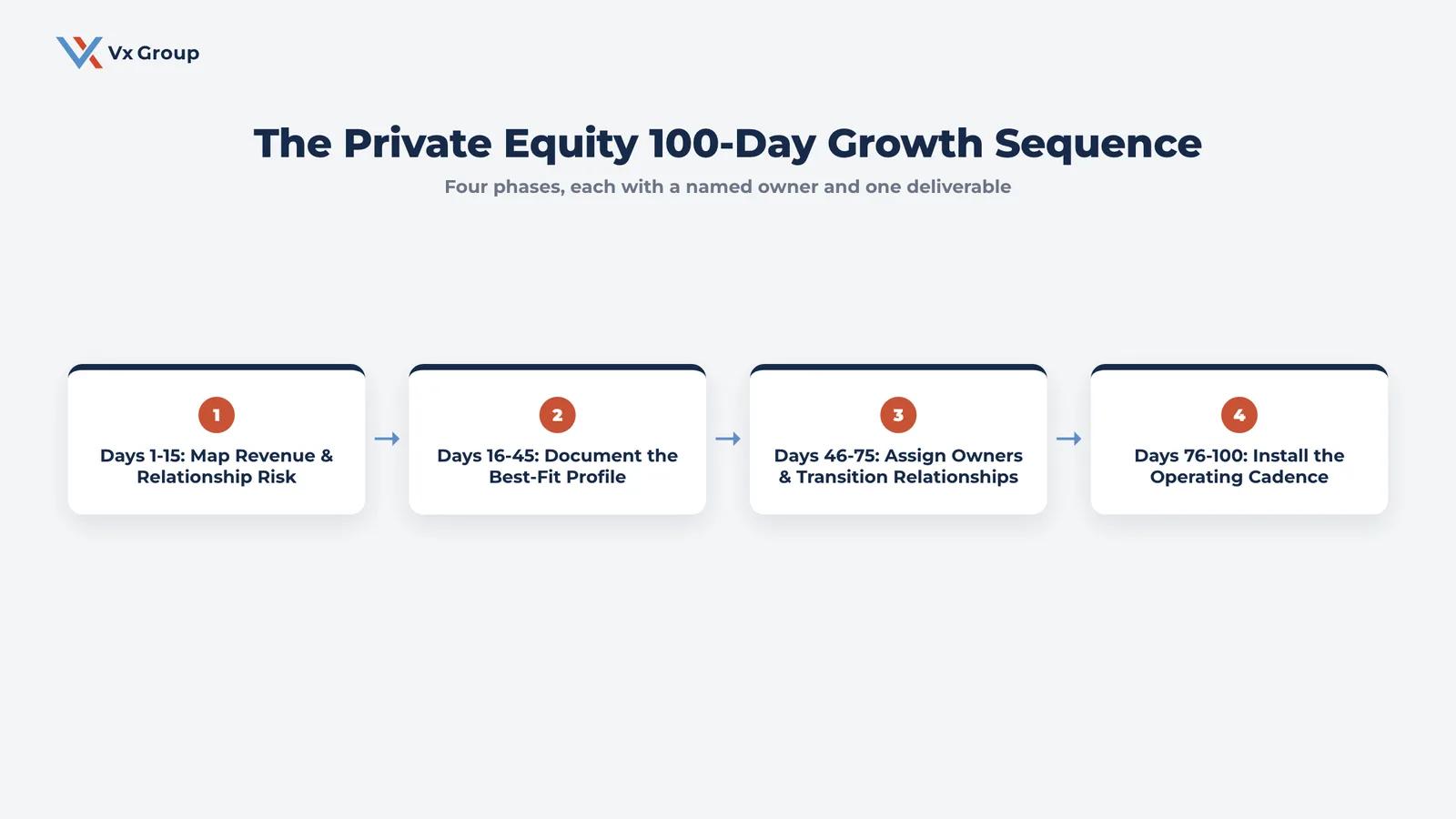
Here is the sequence as a single reference table before the detail on each phase.
| Phase | Days | Deliverable | Owner | Key question it answers |
|---|---|---|---|---|
| 1. Map | 1 to 15 | Ranked account list by relationship quality, revenue concentration, and wallet share potential | Operating partner and CEO | Where does the revenue actually live, and how much of it is still available to win? |
| 2. Define | 16 to 45 | Documented best-fit customer profile, a buying-committee map, and a founder-relationship transferability assessment | CEO and sales leader | Which relationships are portable, and which live in one person’s head? |
| 3. Assign | 46 to 75 | Named owners for new-account development and existing-account growth | CEO | Who owns growth once the operating partner steps back? |
| 4. Install | 76 to 100 | Weekly pipeline review and monthly relationship review cadence | Leadership team | Does the plan run without the operating partner in the room? |
Map revenue and relationship risk in the first 15 days
The first 15 days of a hold should produce two things: a ranked list of every account scored for relationship risk, and a wallet share score showing how much room each account still has to grow. Not a P&L review. Not a cost audit. A map of where the money actually comes from, who would take it with them if they left, and how much of it is still sitting on the table.
Days 1 to 4: Pull the revenue and account data
- Pull the last 24 to 36 months of revenue by account from the accounting system or CRM, not just the current fiscal year. A single year hides accounts that are declining slowly.
- Build one working sheet with one row per customer, not per invoice and not per ship-to location, so a multi-site account does not get counted five times as five separate relationships.
- Add a column for the account’s primary owner of record, even if you suspect that record is stale. You correct it in the next step.
- Reconcile the total against the most recent board reporting before moving on. A revenue map that does not tie out to numbers the board has already seen creates a credibility problem in week one that is entirely avoidable.
Days 5 to 8: Score every account for relationship exposure
- Rank the top 20 accounts by dollar contribution.
- For each one, log three things: who owns the relationship today, how many other people at the company have had a direct conversation with that customer in the last 90 days, and when the last real conversation happened. A support ticket or an invoice does not count as a conversation.
- Flag any account where the honest answer to “how many other people” is one. A single-threaded relationship is the specific risk this phase exists to catch, regardless of how strong that one relationship looks.
- Score each account low, medium, or high risk using two inputs together: revenue share and thread count. An account with high revenue share and a single thread is always high risk, even if the account looks completely healthy on paper.
Defined term: Revenue concentration
The share of a company’s total revenue that depends on a single account, relationship, or salesperson. A business with several accounts each holding more than 10 to 15% of revenue, especially where that revenue routes through one person, is carrying concentration risk that a standard financial review will not surface.
Days 9 to 12: Score wallet share and account penetration
This step complements customer retention strategies already at play. It measures not whether an account will stay, but how much bigger it could get.
- For each of the top 20 accounts, estimate two numbers: what the customer currently spends with you, and a realistic estimate of what they spend in total on what you sell, including whatever share currently goes to a competitor or an unaddressed need. The account owner usually has a rough sense of this even without a clean data source. Ask directly rather than skipping the account for lack of a perfect number.
- Divide the first number by the second to get a wallet share percentage. An account paying you $200,000 a year that runs closer to $1.2 million a year across its full operation in that category is sitting under 20% wallet share, no matter how mature or settled the relationship feels.
- Sort the list into two groups: accounts above roughly 60% wallet share, which are retention priorities because there is limited room left to grow, and accounts below that line, which are expansion priorities because real revenue is still sitting outside your reach.
- Growth usually shows up faster from raising wallet share on an account that already trusts you than from winning a new logo from scratch. This ranking becomes the first assignment for whoever is named the existing-account growth owner in Phase 3, so build it now instead of leaving it for later.
Defined term: Wallet share
The share of a customer’s total spend in a category that your company currently captures, measured against what a competitor, a substitute, or an unaddressed need is capturing instead. An account can be fully retained and still be worth two or three times its current revenue if its wallet share is low.
Days 13 to 15: Build the risk-and-potential-ranked account list
- Combine the relationship-risk scores from Days 5 to 8 with the wallet share scores from Days 9 to 12 into one list. An account can be low-risk and high-potential, high-risk and low-potential, or any mix in between, and the plan needs to treat each combination differently.
- Review the top five highest-risk accounts and the top five highest-potential accounts with the CEO, and get written agreement on both lists before day 15. These lists are the direct input to the best-fit profile and transferability work in Phase 2.
- Hand over the ranked spreadsheet itself as the day 15 artifact. A file the leadership team can open and re-sort themselves earns more trust than a slide deck describing it.
Most commercial due diligence processes test market size, revenue quality, and pipeline. Very few test whether the revenue behind the number would survive the relationship holding it changing hands, or how much of that customer’s spend is still available to win. That gap is exactly what the first 15 days should close, before it becomes a surprise in month eight.
Document the best-fit customer profile in days 16 to 45
Days 16 to 45 turn the account map from Phase 1 into three things: a best-fit customer profile built from the accounts that are actually working, a buying-committee map for every high-value relationship, and a transferability assessment for every relationship that depends on one person.
Days 16 to 23: Pull the pattern from your best accounts
- Take the top 15 to 20 accounts from the Phase 1 list, filtered down to the ones with strong revenue, healthy margin, and more than one relationship thread.
- Document five fields for each account: industry, company size, how the relationship originally started, how long the customer has stayed, and the reason they chose you over an alternative, if that reason is known.
- Look for the pattern that holds across most of the list. A pattern that fits 12 of 15 accounts is more useful to a salesperson than a blended average that fits none of them exactly.
Days 24 to 30: Write the one-page best-fit profile
- Turn the pattern into a document a salesperson can use to qualify a new prospect in under five minutes: the industry range, the size range, the buying trigger, and two or three disqualifying signs that predict a poor-fit account.
- Test the draft profile against three accounts the company lost or churned in the last two years. If it would have flagged them as poor fits in advance, it is doing its job.
- Hand the finished profile to whoever is named the new-account development owner in Phase 3, so it is in use from day one of that role.
Days 31 to 38: Map the buying committee on every high-value account
This step shifts the focus from which accounts to which people, borrowing the same logic as account-based selling: a deal is never really won or protected by one contact.
- For every account in the Phase 1 top 20, and every account flagged high-potential in the wallet share work, list who your team actually deals with by role, not just by name: who signs off on renewal or expansion, who champions you internally when nobody from your company is in the room, who uses what you sell day to day, and who controls access or scheduling to reach the rest.
- Score each account on how many of those four roles you can name a real, direct contact for. An account where all four are named is multi-threaded and durable. An account where only the day-to-day user is named is single-threaded no matter how many contacts are sitting in the CRM, because the people who actually decide whether spend goes up, down, or away are invisible to you.
- Treat a long CRM contact list as a false signal until it is checked against these four roles. Ten logged contacts who are all day-to-day users say nothing about whether the relationship would survive a renewal conversation.
- Feed this map into the next two steps at once. It tells the transferability assessment which relationships are genuinely fragile, since the founder or departing owner is often the only person who has ever met the actual economic buyer, and it hands the future existing-account growth owner a name to call first when trying to raise wallet share on that account.
Defined term: Buying committee
The actual set of people, by role, who make or influence a purchasing decision at a customer account. In most B2B relationships this includes an economic buyer who approves spend, a champion who advocates internally, a day-to-day user, and someone who controls access to the rest. A relationship is only as strong as the roles you can actually name.
Days 39 to 45: Run the transferability assessment
- For every account flagged high-risk in Phase 1, sit down with the current relationship owner and ask one direct question: if you left the company tomorrow, who could take this customer’s next call with zero disruption?
- Cross-check the answer against the buying-committee map from the previous step. An owner who names a successor but cannot say who the actual economic buyer is has not solved the risk. They have only relocated it.
- Score the honest answer low, medium, or high risk. “Nobody” is a high-risk answer. A named backup who has met the customer at least once is medium. A backup who already has an independent relationship with the customer is low.
- Build a simple register with four columns: account name, current owner, risk score, proposed successor. This conversation is uncomfortable in founder-led and family-run businesses, where the honest answer is often “nobody,” but it is far cheaper to have in week six than to have it during an exit process.
Defined term: Founder-held relationship
An account or customer relationship where the trust, history, and day-to-day contact sit primarily with one individual, often the founder or a long-tenured salesperson, rather than with the company. A founder-held relationship can be worth millions and still never appear as a risk on a balance sheet.
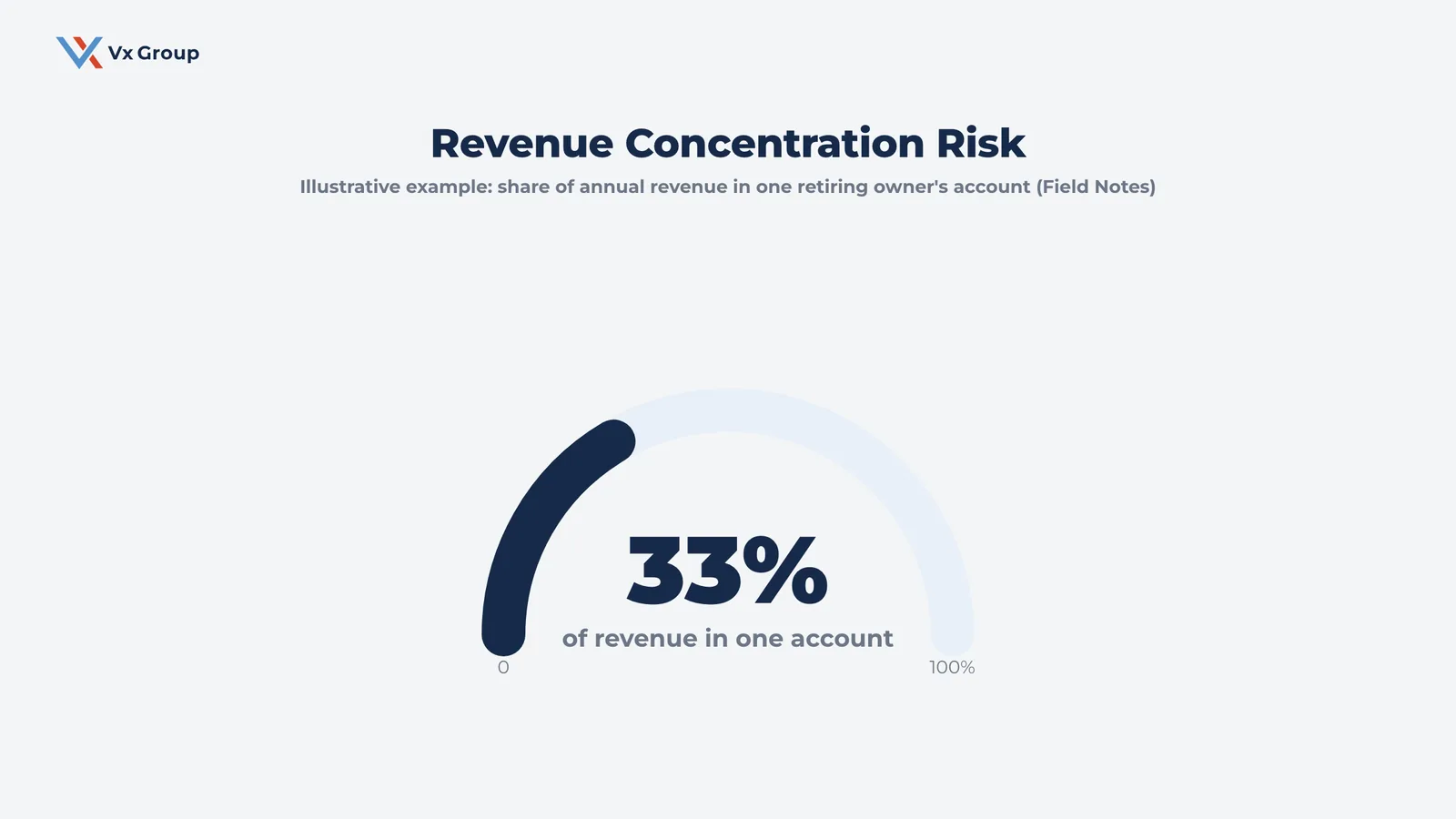
Field Notes: one distributor we worked with had close to a third of its annual revenue sitting in a single account, a relationship the retiring owner had personally managed for over 15 years. Nobody else at the company had ever run a meeting with that customer alone. The transferability register built in this phase flagged it as the single highest-risk relationship in the portfolio, ahead of anything a standard financial review had surfaced.
Assign ownership and start transitioning founder-held relationships in days 46 to 75
Days 46 to 75 exist to answer one question the first two phases only diagnosed: who owns growth now?
Days 46 to 50: Name the two growth owners
- Name one person to own new-account development and a separate person to own growing the accounts you already have. These have to be two different people. Whoever ends up holding both mandates will let one of them slide the first time things get busy.
- Neither owner should be the busiest person in the building. Urgent work beats important work whenever the same person is responsible for both, and relationship development is always the first thing pushed aside when something else catches fire.
- Put both names and both mandates in writing and share them with the full leadership team, not only the board, so everyone knows who to route a new opportunity to and who owns keeping an existing account healthy.
Days 51 to 65: Start the relationship handoffs
- Start with the accounts scored high-risk in the Phase 2 transferability register. Begin the handoff now, not at the eighteen-month mark and not during an exit process.
- Assign a named successor to each high-risk account and put them on a joint call with the current owner in the first week of this phase.
- Build a one-page account history for each: how the relationship started, key contacts beyond the primary buyer, past issues and how they were resolved, and anything the current owner knows that has never been written down.
- Introduce the successor directly to the customer’s other day-to-day contacts, not only the primary buyer, so the relationship never depends on a single new point of failure either.
The distributor from the Field Notes example above got a named successor on that retiring owner’s account in week seven of this phase: a joint call, a documented account history, and a direct introduction to the customer’s other contacts. By day 90, the successor was running half the meetings solo. The revenue never moved. The risk did.
Days 66 to 75: Confirm the transition is holding
- Check each handoff against a simple status: is the successor running meetings solo, running them jointly, or still shadowing only?
- Any account still in shadow-only status by day 70 needs a direct conversation about what is actually blocking it. More often than not, that is the original owner, consciously or not, still holding on.
- Confirm revenue and relationship health have not moved on any transitioned account. A handoff has worked when the customer never notices it happened.
This is also where the How Operating Partners Can Drive Growth in Private Equity role earns its keep. The operating partner’s job in this phase is making sure the CEO actually names the owners and holds the transition timeline, instead of letting it slide because the retiring owner is still in the building and everything still feels fine.
Install an operating cadence that leadership runs without the operating partner in days 76 to 100
The last 25 days exist to prove the plan survives without you in the room, the same test that matters when installing a growth system anywhere else in the portfolio. If the operating partner has to personally run the weekly pipeline review in month six, the plan failed, no matter how good the first 75 days looked on paper.
Days 76 to 85: Build the two recurring reviews
- Build a weekly pipeline review with four fixed agenda items: new opportunities added since last week, stage changes, anything stalled more than 14 days, and next actions with a named owner attached to each. Assign the new-account development owner to run it.
- Build a monthly relationship review covering the top 20 accounts from Phase 1: is spend growing or flat, when was the last real conversation, and has ownership of any account quietly drifted back to a single person. Assign the CEO to run it.
- Put both meetings on the calendar for the next 12 months before day 85, not just for the next quarter. A cadence that only exists until the current set of calendar invites runs out was never actually installed.
Defined term: Operating cadence
A documented, recurring rhythm of meetings, reviews, and reporting that keeps growth activity visible and owned, independent of any single person remembering to do it. A cadence that only runs because the operating partner keeps asking about it disappears the moment they stop.
Days 86 to 95: Run the cadence with the operating partner watching only
- Attend both meetings during this window, but let the named owner run each one from start to finish.
- Note anywhere the meeting stalls without your input: a missing agenda item, an unclear owner, a report nobody else knows how to pull. That gap is exactly what needs fixing before day 100.
- Fix the gap by adjusting the agenda or the owner. Do not fix it by quietly stepping back in to run the meeting yourself.
Days 96 to 100: Hand the cadence to leadership
- Confirm both meetings have run at least once with zero input from the operating partner.
- Update the transferability register from Phase 2 with the current status of every handoff, and flag any account still in shadow-only status.
- Deliver the one-page ownership map to the CEO: who owns what, what gets reviewed, when it gets reviewed, and where every transition stands.
By day 100, that one-page ownership map is the actual deliverable of the first 100 days. A closing memo for the investment committee was never the point.
Most 100-day plans fail quietly. Nobody points at the deck and says it did not work. The company just keeps growing the way it always has, on the same handful of relationships, run by the same one or two people, until one of them leaves and the board finds out what the real risk was the hard way.
A hundred days is enough time to know where the revenue lives, who actually owns it, and whether the company can grow it without the same person doing everything. The job of actually growing the company continues well past day 100, usually inside a value creation plan that carries the work forward. What the plan has to prove by then is that someone other than the operating partner can run it.
So here is the question worth sitting with before you write the first page of the plan: do you know, right now, how much of this company’s revenue depends on one person picking up the phone? And if the honest answer is more than you are comfortable with, does the first 100 days actually fix that, or does it only measure it and call that progress?
FAQs
About the Author: Eric Zoromski
