

Channel Partner Marketing: How to Drive Revenue Through Partners

Channel partner marketing is how a B2B company generates demand and revenue through the partners who sell or influence its products: independent reps, dealers, distributors, and referral partners. For relationship-driven companies, it works by treating those partners as relationships first, then giving them the tools, incentives, and attention to sell well on your behalf.
TL;DR
- Channel partner marketing is demand generation and revenue growth created through reps, dealers, distributors, and referral partners rather than only through your direct sales team.
- Most published advice is written for enterprise software vendors running 500-partner programs. Owner-led manufacturers and distributors need a simpler, relationship-first version.
- The villain is treating partners as a distribution mechanism: signing them, shipping product, then going quiet until the numbers slip.
- A working program has six parts: right-fit selection, enablement, co-marketing, incentive structure, relationship cadence, and shared review.
- Mindshare is the real currency. Your partners carry many lines, and they sell the one whose company shows up, makes selling easy, and treats them well.
- Measure leading indicators like partner-sourced pipeline, active-partner ratio, and time to first deal, rather than only closed revenue at year-end.
Why most channel programs stall
Most companies that sell through partners quietly neglect them. They recruit a dealer or sign a rep firm, send over a product catalog and a price sheet, and then wait for orders. When the orders come in smaller than expected, the conclusion is usually that the partner is weak, the territory is soft, or the market is down.
The real issue is upstream. A partner who never hears from you, never gets help selling, and never feels like a priority will quietly deprioritize your line. They carry a dozen relationships that all want shelf space in their head, and they rationally invest where they get the most support and the most respect.
Channel partner marketing is the discipline of earning that investment on purpose. Done well, it turns a roster of partners who technically carry your product into a network of people who actively choose to sell it. This guide is written for the companies that grow through reps, dealers, and distributors, not for software vendors managing a sprawling partner portal. The principles are simpler and the relationships matter more.
What is channel partner marketing?
Channel partner marketing is the set of activities a company uses to generate awareness, demand, and sales through third parties who sell, resell, or refer its products. Instead of marketing only to end customers, you also market to and through the partners who reach those customers on your behalf.
Defined Term: Channel partner marketing
Marketing and sales activity directed at and conducted through indirect partners (reps, dealers, distributors, resellers, and referral partners) to generate demand and revenue, rather than selling exclusively through a direct sales team.
There are two halves to it, and most companies only run one. The first half is marketing *to* your partners: recruiting the right ones, training them, and keeping your product top of mind so they choose to sell it. The second half is marketing *through* your partners: helping them generate demand in their own markets with co-branded campaigns, shared content, leads, and event support. A program that only recruits partners and then leaves them alone is doing a quarter of the job.
Why channel partner marketing looks different for relationship-driven B2B companies
For manufacturers, distributors, and other relationship-driven B2B companies, channel partner marketing is a trust exercise long before it is a campaign. Your partners are independent businesses with their own customers, their own reputations, and their own reasons for choosing what to promote. You cannot automate your way into their priority list.
This is where most of the advice on the internet leads owner-led companies astray. Search “channel partner marketing” and you will find playbooks built for high-velocity software companies: tiered partner portals, deal-registration automation, partner relationship management platforms, and certification tracks designed to manage hundreds or thousands of partners at scale. Those mechanics solve a volume problem that a manufacturer with forty dealers does not have.
Your channel partners are relationships first and a distribution mechanism second. The companies that treat them that way consistently outgrow the ones that don’t.
The relationship-driven version of channel partner marketing trades scale for depth. You may have twenty or fifty partners rather than five hundred, and the lifetime value concentrated in your best handful of partner relationships can exceed the total pipeline of every prospect you are chasing directly. That changes the math. It makes a phone call to a dealer principal worth more than another automated email blast, and it makes a single afternoon spent training a rep team a better use of marketing budget than most lead-generation campaigns. The same logic that makes your top 10 customers a growth strategy applies to your top partners.
The four types of channel partners and what each one needs
Different partners play different roles, and a program that treats them all the same underperforms. Before you build anything, get clear on which kinds of partners you actually have and what each one needs from you.
| Partner type | What they do | What they need most from you |
|---|---|---|
| Independent sales reps / agencies | Sell on your behalf for commission, often carrying complementary lines | Easy-to-sell materials, fast quoting support, responsiveness, and a reason to lead with you |
| Dealers / VARs | Buy, stock, and resell your product to their own customers | Margin protection, demand in their territory, training, and co-op marketing support |
| Distributors | Hold inventory and supply a downstream network of dealers or contractors | Forecasting clarity, pricing consistency, and help activating the partners beneath them |
| Referral / alliance partners | Send you qualified introductions without selling directly | A clear handoff process, follow-through on the leads they send, and recognition |
Each relationship has a different center of gravity. A rep cares about how easy you make their job and whether you respond when they need a quote. A distributor cares about predictability and whether you help keep the dealers below them active. Mapping these needs is the difference between a program partners tolerate and one they champion. For a deeper look at keeping the downstream network engaged, see dealer engagement, and for the broader structure, our B2B channel strategy guide.
Defined Term: Channel conflict
Tension that arises when a company’s direct sales efforts or its different partners compete for the same customer, eroding trust and discouraging partners from investing in the line. Clear rules of engagement and territory or account boundaries prevent it.
What a channel partner marketing program actually includes
A complete channel partner marketing program has six working parts. You do not need elaborate software to run them. You need to run all six with intention rather than running one or two by default.
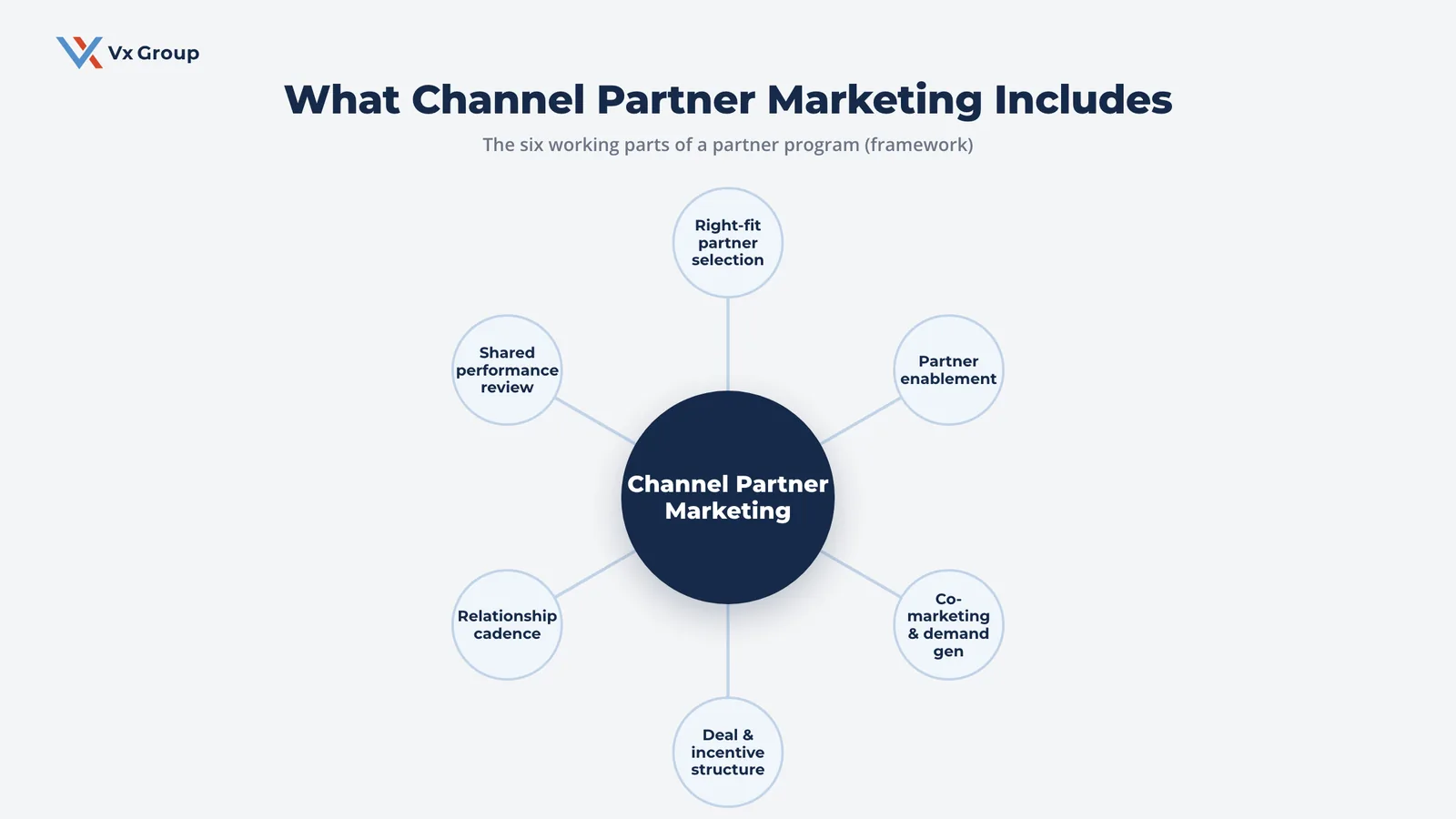
- Right-fit partner selection. The fastest way to weaken a channel is to fill it with partners who do not fit. Define the profile of a partner who serves your ideal end customer, has the reach you need, and has room in their portfolio to make you a priority.
- Partner enablement. Give partners everything required to sell your product without friction: training, sell sheets, quoting tools, demo support, and clear answers to the objections their customers raise.
- Co-marketing and demand generation. Help partners create demand in their own markets through co-branded campaigns, shared content, qualified leads, and event support, so selling your line gets easier over time.
- Deal and incentive structure. Build margins, rebates, and rewards that make selling your product worth a partner’s attention, and protect those economics from internal channel conflict.
- Relationship cadence. Stay in contact on a predictable rhythm, not only when you need something. Regular check-ins, business reviews, and real conversations keep your line top of mind.
- Shared performance review. Look at the numbers together. Joint reviews build accountability and surface the support a partner needs before a slow quarter becomes a lost relationship.
Defined Term: Partner enablement
The training, content, tools, and support a company provides so its partners can sell its products confidently and without friction. Strong enablement removes the everyday reasons a partner would choose to sell something else instead.
Only two of the six parts are what most people picture when they hear “marketing.” The other four are relationship and operations work, and that balance is what makes a channel program hold.
Why mindshare is the real currency
The single most useful concept in channel partner marketing is mindshare. Your partners almost never sell your product alone. They carry complementary and competing lines, and on any given customer call they have a choice about which one to lead with. Mindshare is the share of that attention you have earned. It is the real thing you are buying with every piece of enablement, every co-marketing dollar, and every phone call.
Defined Term: Mindshare
The share of a partner’s attention, preference, and selling effort your product earns relative to the other lines they carry. Mindshare determines how often a partner actually leads with you, whatever the signed agreement says.
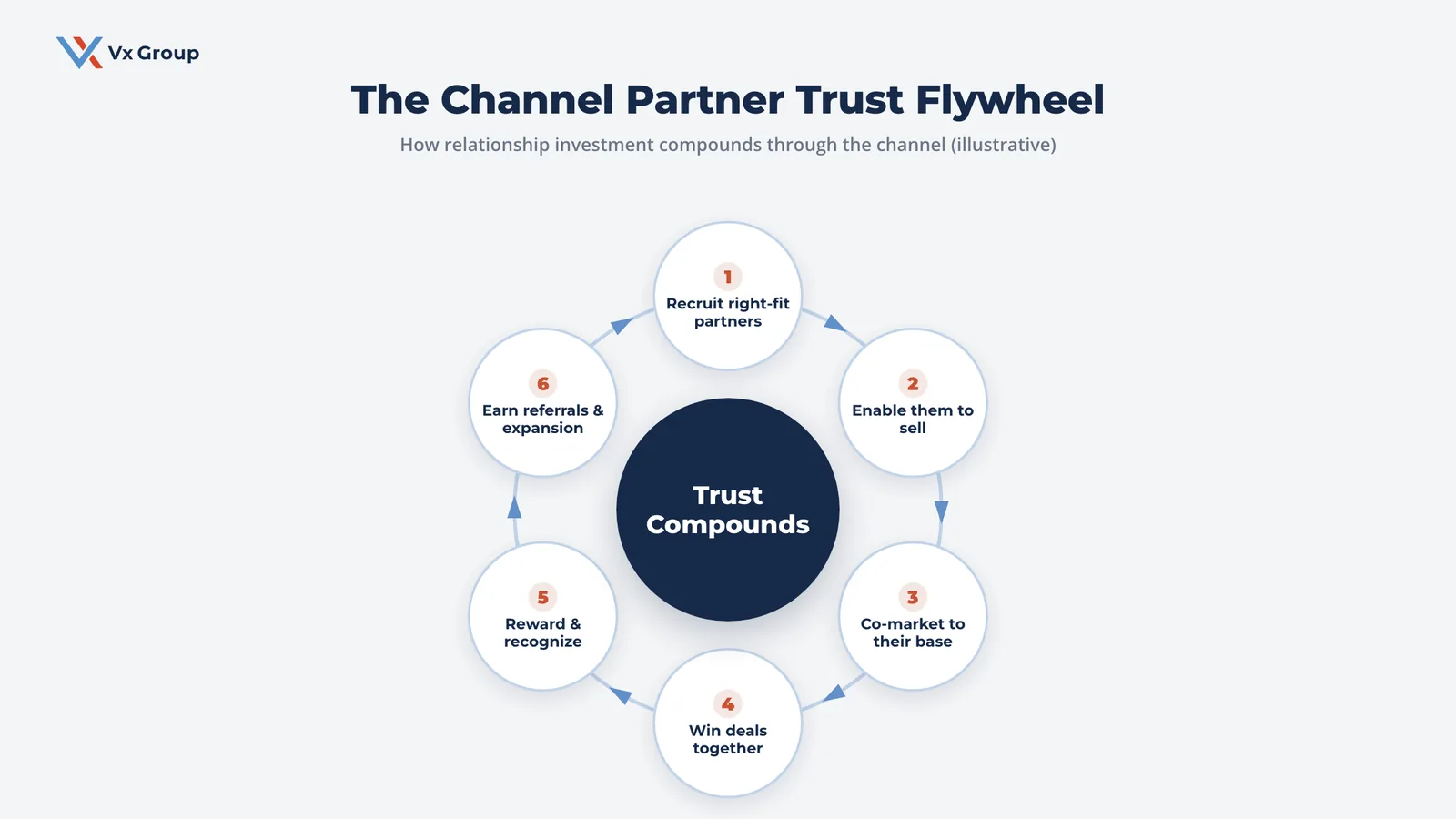
Mindshare compounds. A partner you train well closes a deal faster. A faster close builds their confidence in your line. Confidence makes them lead with you on the next opportunity, which produces more wins, which earns them rewards and recognition, which deepens the relationship and earns you referrals into accounts you could never have reached directly. Each turn of that cycle makes the next one easier.
The companies that lose this cycle are usually the ones treating partners as a transaction. They negotiate the agreement hard, ship the product, and then disappear until renewal or a slow quarter. By then the partner has already shifted their attention to the vendor who stayed close. Winning mindshare is not expensive, but it does require consistency, and consistency is exactly what a scattered, campaign-of-the-month approach to growth cannot provide.
Ready to grow?
Talk through where your channel is losing mindshare today and how to win it back.
How to build a channel partner marketing program
You can stand up a relationship-first channel partner program in a deliberate sequence. Each step builds on the one before it, and skipping ahead is the most common reason programs stall.
1. Define the partner you actually want
Start by describing your ideal partner with the same rigor you would use to describe an ideal customer. Which end customers do they serve? What reach do they have? How much room is in their portfolio for another line? A smaller roster of well-fit partners almost always outperforms a large roster of mismatched ones.
2. Make your product easy to sell
Before you recruit anyone new, audit how hard it is to sell what you make. If a rep cannot get a quote in a day, find a current spec sheet, or answer a customer’s top three questions without calling you, your enablement is the bottleneck. Fix that first.
3. Recruit with a clear value exchange
When you approach partners, lead with what they gain: the margin, the demand support, the responsiveness, the recognition. Partners have heard every “exciting opportunity” pitch. They respond to specifics about how you will make their job easier and their business stronger.
4. Onboard and train deliberately
A signed agreement is the start of the work. Give new partners a real onboarding: product training, the materials they need, a named contact, and a first win to build momentum. The time from signing to first deal is one of the clearest signals of program health.
5. Co-market in their market
Help partners generate demand where they sell. Co-branded campaigns, shared content, leads from your own marketing, and support at their trade shows all lower the cost of selling your line. This is where channel partner marketing connects to your wider demand generation work and your overall channel sales motion. For the sales side of that motion, see our channel sales strategy guide.
6. Build a relationship cadence and review rhythm
Set a predictable schedule of check-ins and business reviews. Use those conversations to look at results together, surface obstacles early, and recommit to shared goals. The cadence is what keeps mindshare from quietly draining away between transactions.
Field Notes
A regional equipment manufacturer worked through a network of roughly thirty independent dealers and could not understand why revenue had flattened. The product was strong and the dealers were established. When they looked closely, the pattern was clear: the company contacted dealers almost exclusively to push orders at quarter-end and almost never to help them sell. Dealers had drifted toward competing lines that offered training, co-op advertising, and a responsive contact.
They turned it around with a relationship cadence rather than a new portal or a bigger rebate. The company assigned each dealer a named point of contact, built a simple quarterly business review, shipped a quoting tool that cut response time from days to hours, and put modest co-marketing support behind the dealers who showed momentum. Within two quarters, the dealers who engaged were leading with the line again. The product was the same as it had always been. What changed was the attention they paid to the relationship.
How to measure channel partner marketing
Measure channel partner marketing with leading indicators, not only with the closed revenue you see at the end of the year. Closed revenue tells you what already happened. The metrics below tell you whether the relationship is healthy enough to produce revenue next quarter.
| Metric | What it tells you | Why it matters |
|---|---|---|
| Partner-sourced pipeline | Demand created by or through partners | Shows whether the channel is generating opportunity rather than only fulfilling it |
| Active-partner ratio | Share of partners producing in a given period | Reveals whether growth depends on a few partners or a healthy base |
| Time to first deal | How long from onboarding to a partner’s first sale | A direct read on how well your enablement works |
| Mindshare signals | Lead-with rate, attendance at training, response to outreach | Early warning that attention is rising or slipping |
| Partner retention | Share of partners who stay active year over year | Protects the relationship value already built into the channel |
Pick a small number of these and review them in your partner business reviews. Review them so you catch a fading relationship while you can still act on it. A dashboard nobody uses is wasted effort.
Common mistakes that quietly cap growth
Most channel programs are limited by a handful of avoidable patterns. None of them announce themselves; they just slowly cost you mindshare.
- Recruiting for coverage instead of fit. Signing every partner who will carry the line dilutes your attention and fills the channel with partners who will never prioritize you.
- Treating enablement as a one-time event. Training at signup and never again leaves partners stranded the moment a customer asks something new.
- Going quiet between transactions. Contacting partners only to push orders teaches them that you see the relationship as a transaction, and they respond in kind.
- Ignoring channel conflict. When your direct team competes with partners for the same accounts, or partners undercut each other, trust erodes and investment stops.
- Measuring only closed revenue. By the time revenue drops, the relationship has usually been slipping for months. Leading indicators give you time to act.
Where channel partner marketing fits in your growth strategy
For companies that sell indirectly, channel partner marketing is the growth engine itself. The trust you build with partners compounds the same way trust with customers does, and the companies that invest in it deliberately stop growing by accident and start growing on purpose.
None of this is complicated. The hard part is consistency, and consistency is hard to sustain without a system and a clear picture of where your channel stands today. If your partners are carrying your line without leading with it, the gap is almost always in one of the six parts above.
Conclusion
Channel partner marketing rewards the companies willing to treat their partners as relationships worth investing in. The mechanics are not exotic: choose the right partners, make your product easy to sell, help partners create demand, structure incentives that respect their economics, stay in contact on a real rhythm, and review results together. What separates the companies that grow through partners from the ones stuck waiting for orders is the consistency to do all six, quarter after quarter.
Ready to grow?
If your channel is producing less than it should, closer and more consistent attention to your existing partners is what moves it.
FAQs
About the Author: Jacob Camhi
