

Webinar Recap: Why Most AI Investment Fails Before It Starts
David Tisdale and Jacob Camhi hosted the AI Advantage Workshop, a live session for leaders at companies owned by private equity firms and family offices, and for any B2B leader wrestling with the same problem.
We hosted this session to give everyone who attended the opportunity to leave knowing whether their company is set up to build a real AI advantage or is already falling behind, with a specific first AI tool identified to build against their own business.
TL;DR
- Most companies get an AI mandate from their board or ownership group, and most respond by signing up for a tool rather than answering the real question underneath it.
- The root cause of failed AI investment is what Vx Group calls transactional architecture: growth activities that aren’t tied to a strategy, and institutional knowledge that lives in one person’s head.
- The fix is what Vx Group calls compounding architecture: knowledge documented and owned by the company as a whole, so the business doesn’t depend on whoever happens to still be there.
- Companies get AI implementation wrong in one of two ways: underdoing it (a chatbot subscription with no real use case) or overdoing it (a six-figure evaluation process that produces nothing after eight months).
- The fastest way to find a company’s actual first AI tool is a simple three-part scorecard: list the most broken and person-dependent workflows, score each on business impact and readiness, then build against the ones that are both high-impact and ready.
The AI Mandate Is Coming From the Board, and Most Companies Don’t Have an Answer
Every company Vx Group works with is fielding some version of the same question right now: what is your AI plan? It comes from boards, ownership groups, and the people they answer to, and shows up in deal reviews and quarterly updates.
Jacob Camhi, VP of Growth and Revenue at Vx Group, named the pattern directly: “The problem and the pattern that keeps showing up is either we don’t really have an answer, or we’re going in and just winging it, signing up for an AI tool so we can check the box.”
What happens next follows a predictable path. A budget gets approved. A tool gets purchased. Six months later, nothing about the business has actually changed.
The Real Problem Is Transactional Architecture
There is a root cause behind most AI failures at the company level, and it has nothing to do with which tool got purchased.
Defined Term: Transactional architecture.
A company structure where growth activities are handled ad hoc with no shared strategy connecting them, and institutional knowledge and customer relationships live inside one or two people, never documented anywhere the rest of the company can reach.
A transactional company’s growth tactics run one at a time, reactively, with no strategy connecting them. Institutional knowledge lives in one person’s head, often a top salesperson or operator who has built years of relationships nobody else can access.
If that person leaves, a large share of what the company knows about its own customers and processes leaves with them.
New hires feel it too: without documentation, they have to shadow that person for months just to learn the job.
David Tisdale, President of Vx Group, sees the same pattern from the ownership side: “The AI mandate often stops at ‘we should be using Claude more,’ or figuring out what security implications AI has for the business. Rarely does it progress into how the organization actually deploys this at scale.”
What Compounding Architecture Looks Like Instead
Defined Term: Compounding architecture.
A company structure where growth activities are documented and owned by the organization as a whole, relationship data lives in a shared system, and the business can run without depending on a single individual.
A compounding company shows four traits at once:
- Growth activities are documented and owned by the organization as a system, independent of any one person’s habits.
- Customer relationships are recorded and protected in a shared system, so if someone leaves, another relationship owner can take over without missing a beat.
- Process knowledge is captured in one place that anyone on the team can search and query.
- The business runs without depending on any single person staying in their seat.
Building AI on a Broken Foundation Just Makes the Problem More Expensive
Bringing AI into a transactional company doesn’t fix the underlying problem. It gives that problem more reach. A new salesperson still can’t find a process that only lives in someone else’s head, AI or not, and now the company is also burning real money on tokens while everyone tries to build their own version of something nobody wrote down.
The session laid out six concrete signals split across two columns: whether a company is AI vulnerable or AI ready.
Companies are AI vulnerable when irreplaceable people run the key workflows, growth knowledge is undocumented or scattered across dozens of places, and growth stalls whenever one or two people leave. Companies are AI ready when new hires can follow documented processes on their own, relationship data lives in one shared system everyone can access, and leadership can describe the growth model without naming a specific person.
Eric Zoromski, Founder and CEO of Vx Group, made the point that stuck with the room: “Getting one great result by yourself, working alone at 11 o’clock on a Wednesday night, is easy. The hard part is getting the whole team to repeat that process every single week until it shows up as dollars on the P&L.”
The Two Ways Companies Get AI Implementation Wrong
Underdoing it looks like this: a board or ownership contact asks what the AI plan is, the team signs up for a paid AI plan within the week, and it gets used as a glorified chatbot. There’s no real team buy-in, no agreed use case, and within a few months the effort gets shelved because nobody can point to a business result.
Overdoing it looks like the opposite mistake: panic mode, finance pulled in on budget, half a dozen AI vendors evaluated through a formal proposal process, and six figures committed to an implementation. Eight months in, onboarding is still underway, nothing has shipped, and the annual license is about to renew with nothing built to show for it.
The Chassis: Why You Should Own Your AI Tools Instead of Renting Them
David Tisdale offered the clearest picture of the concept: “Think of the chassis as the garage for the things you’re parking within it. It’s got a window, a garage door, some fundamental electricity, and it serves as the location for the AI tools you build and deploy into the business.”
Off-the-shelf tools like Claude or ChatGPT handle a lot on their own, like a repeatable quoting template someone builds and reuses. What they can’t do is run a complex process spanning a dozen estimators and multiple business lines at once. The chassis is built for that gap: an environment a company owns and controls, where the underlying AI models can be swapped out over time without rebuilding the whole system. Every tool added makes the next one faster and cheaper, because the foundation already exists.
How to Find Your Company’s First AI Tool
The workshop walked attendees through a three-part scorecard exercise, live, using their own businesses.
First, list the two or three workflows that are the most broken, the most expensive, or the most dependent on a single person. These often show up in customer relationship handoffs, reporting that can’t be trusted, or product knowledge that lives entirely with one or two people.
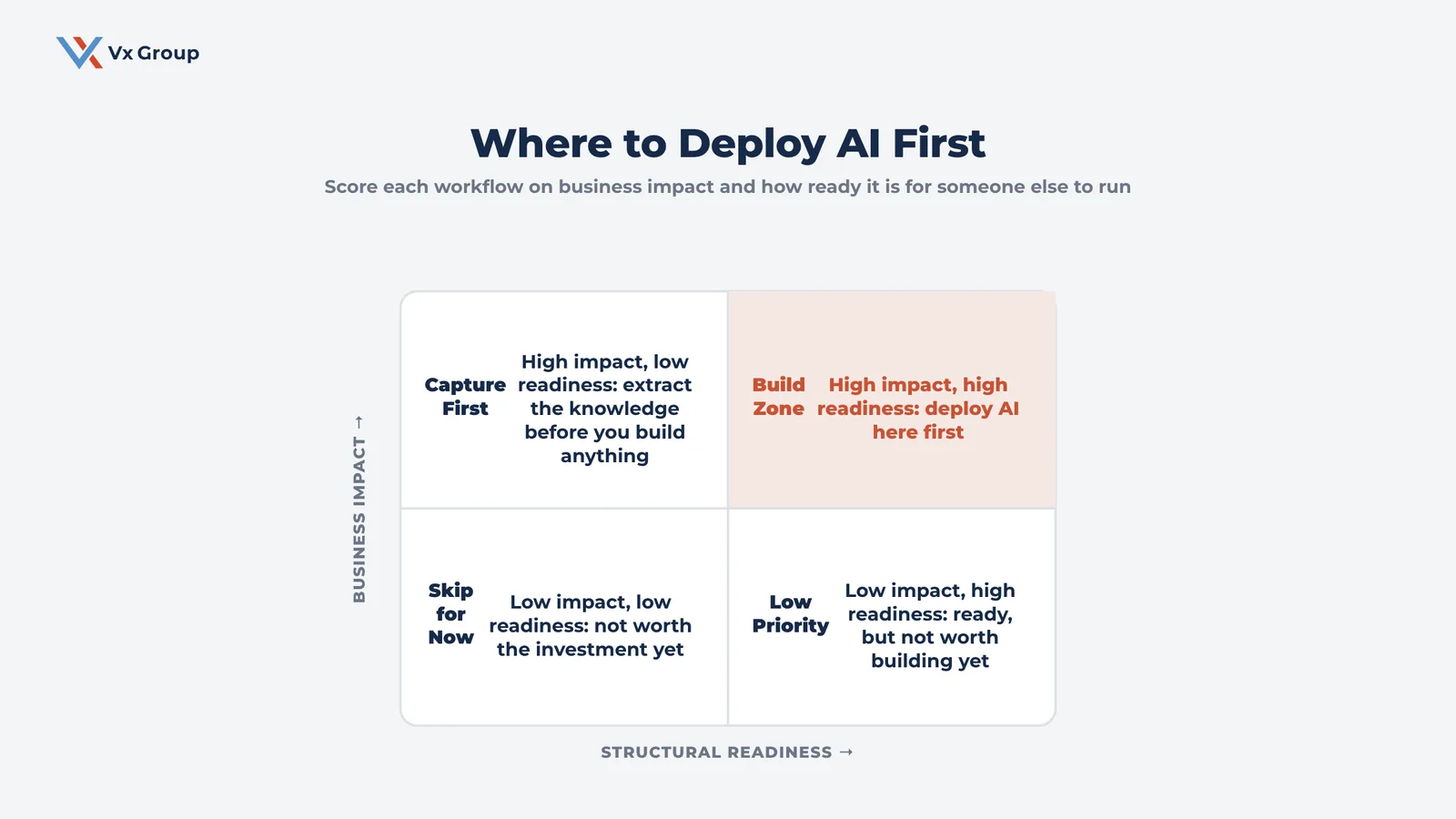
Second, score each workflow on two lines: business impact from one to five, and structural readiness from one to five, meaning how ready it actually is for someone else to step in and run it.
Third, plot the results. High impact and high readiness is the build zone: deploy AI there first. High impact and low readiness means capture the knowledge before building anything, since a tool built on an undocumented process just automates the gap. Low impact, regardless of readiness, means don’t spend the budget there yet.
The clearest way to state a first AI tool candidate is one sentence: we will build [tool] so that [workflow] no longer depends on [person]. Vx Group’s own examples from the session: an internal knowledge base so understanding the company no longer depends on one founder; a content engine so showing up in search and AI answers no longer depends on one person; a quoting tool so getting quotes out no longer depends on one person; a webinar follow-up tool so post-production no longer depends on one person.
Almost every first-tool exercise traces back to the same root problem: institutional knowledge that isn’t documented, systematized, or accessible to the rest of the company. That gap rarely shows up as a line item. It shows up as slower onboarding, inconsistent work across the team, and revenue that quietly slips away.
What Happens Next: The AI Accelerator
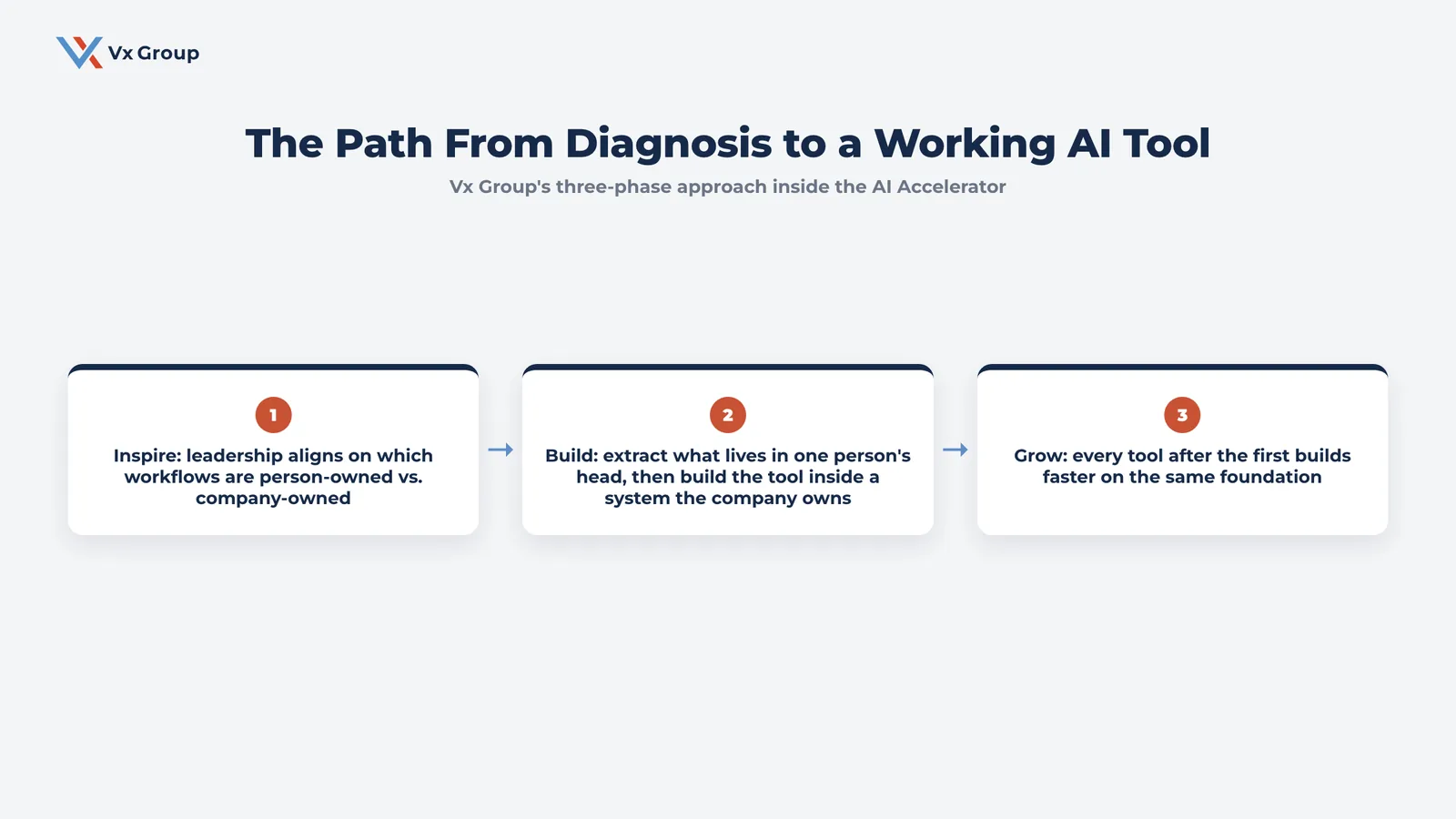
The scorecard exercise is step one of a longer engagement Vx Group runs called the AI Accelerator: a 90-day program built around the same diagnostic, structured as three phases. Inspire is leadership alignment on which workflows are person-owned versus company-owned, plus identifying use cases worth building against.
Build is where the tool actually gets built, starting with knowledge extraction wherever a workflow is still person-owned. Grow is what happens after: every tool built after the first moves faster because the foundation already exists.
The program runs $7,500 a month on a three-month commitment. What gets built belongs to the company outright at the end of the engagement, running in an environment they control going forward.
For a fund running more than one company, the same chassis built for the first one becomes a reusable playbook for the next company acquired, and the cost drops each time the process repeats across the group.
Ready to grow?
Bring your completed scorecard and we’ll help you turn your highest-priority workflow into a working plan.
FAQs
About the Author: Beth Barbaglia
