

What a Growth Advisory Relationship Should Actually Look Like

A growth advisory relationship should pair clear-eyed advice with a system that makes the advice stick. Two roles do that work together: a Coach who leads the leadership team to clarity about where growth actually comes from, and an Architect who turns that clarity into the tools, data, and playbooks the team runs on its own.
TL;DR
- Growth advisory is an ongoing relationship that combines outside judgment with the build work required to install what gets decided.
- Two roles operate as a pair. The Coach works with the leadership team on clarity. The Architect builds the customer profile, the growth roles, the relationship process, and the measurement.
- The failure mode to watch for is the advisor who delivers a strategy deck, holds a readout meeting, and leaves nothing behind that the team can run.
- Advice with no system fades within about a quarter. A system with no clarity behind it produces well-organized activity aimed at the wrong customers.
- Before signing anything, ask what artifacts you own at the end, who on your team operates them, and what happens to the work when the engagement ends.
Most companies that hire outside growth help have done it before. They can usually produce the deck from the last time, and they can tell you which slide was right. What they cannot tell you is why nothing changed.
That is the work of a specific villain: the advisor who leaves a deck and no system behind it. The diagnosis was often correct. The recommendations were reasonable. What never arrived was the machinery that would have made any of it happen: the documented customer profile, the named owner for each decision, the process the sales team follows on a Tuesday, the numbers reviewed on a set schedule. The engagement ended, the deck went into a shared drive, and the company went back to running growth out of the founder’s head.
A growth advisory relationship is worth paying for when it closes that gap. This is what that should look like from the buyer’s side of the table.
What is a growth advisory relationship?
A growth advisory relationship is an ongoing engagement where an outside advisor works with a leadership team on where growth comes from and then installs the system that makes those decisions repeatable. The advice and the build work belong to the same engagement.
Defined Term: Growth advisory.
An ongoing engagement pairing outside judgment about a company’s growth strategy with the build work needed to install that strategy as a working system, so the leadership team can operate it after the advisor’s involvement ends.
The word “ongoing” carries weight. A project has a deliverable and an end date. An advisory relationship has a cadence, a set of artifacts that accumulate, and a handoff point where the client’s team takes over operation. The measure of whether it worked is whether the company still runs the system a year later without anyone from the outside firm in the room.
Vx Group delivers this through Measured in Millions®, a growth operating system built for companies whose revenue depends on long-tenured customer relationships. The delivery model puts two roles on every engagement.
What does a growth advisor actually do?
A growth advisor does two jobs at once: leads the leadership team to a clear, shared answer about where growth comes from, and builds the working system that carries that answer into daily operation. Those jobs map to two roles that work the same engagement together.
The Coach leads the leaders. That means running the conversations a leadership team rarely has on its own: which customers generate the most long-term value, which segments the company keeps chasing without winning, who actually owns growth activity, and what the team has been avoiding deciding. A Coach pushes each of those conversations to a written decision before the meeting ends.
The Architect builds what the decisions require. Once the leadership team knows which customers matter, someone has to write the profile down in a form a salesperson can use, define the roles that do the work, build the relationship process, connect the CRM so the data is trustworthy, and set the metrics that get reviewed. That is construction work, and it is what most strategy engagements skip.
Neither role produces a durable result on its own. Clarity with no build work fades. Build work with no clarity produces a well-organized system pointed at the wrong customers, which is an expensive way to be efficient. The reason to hold both roles in one engagement is that the build work keeps surfacing questions only the leadership team can answer, and the leadership conversations keep producing decisions that need building.
Diagnose where growth actually comes from
The first work is a truthful account of the current business: which customers produce long-term value, what the company wins and loses, and which growth activity has been producing results. Most companies have opinions here and very little documentation.
The output is a written diagnosis the leadership team agrees with, including the parts that are uncomfortable. A diagnosis nobody argued about usually means the hard questions went unasked.
Name an owner for every growth decision
Growth activity fails quietly when nobody owns it. In a lot of mid-market companies, growth is owned by the founder in practice and by nobody on paper.
The output is a role map: each growth responsibility, the person accountable for it, and what they are measured on. This is where founder-dependent sales gets addressed structurally.
Build the tools the team will actually use
Every decision gets a matching artifact. A customer profile becomes a one-page document a salesperson can screen a prospect against in two minutes. A relationship process becomes a documented sequence with owners and timing. A pipeline definition becomes CRM stages the team understands.
The output is a set of artifacts the client owns outright and can hand to a new hire.
Set the measurement the leadership team reviews
Metrics that nobody reviews are decoration. The engagement defines a small set of numbers, who reports them, and the cadence for reviewing them.
The output is a standing review on the calendar with named attendees and a fixed set of figures. If the review survives six months without the advisor prompting it, the system has been installed.
Why do strategy engagements stop working after the deck?
They stop working because the recommendations required operational changes that no one built, staffed, or scheduled. The strategy was fine. It arrived as a document in an organization with no mechanism to carry it.
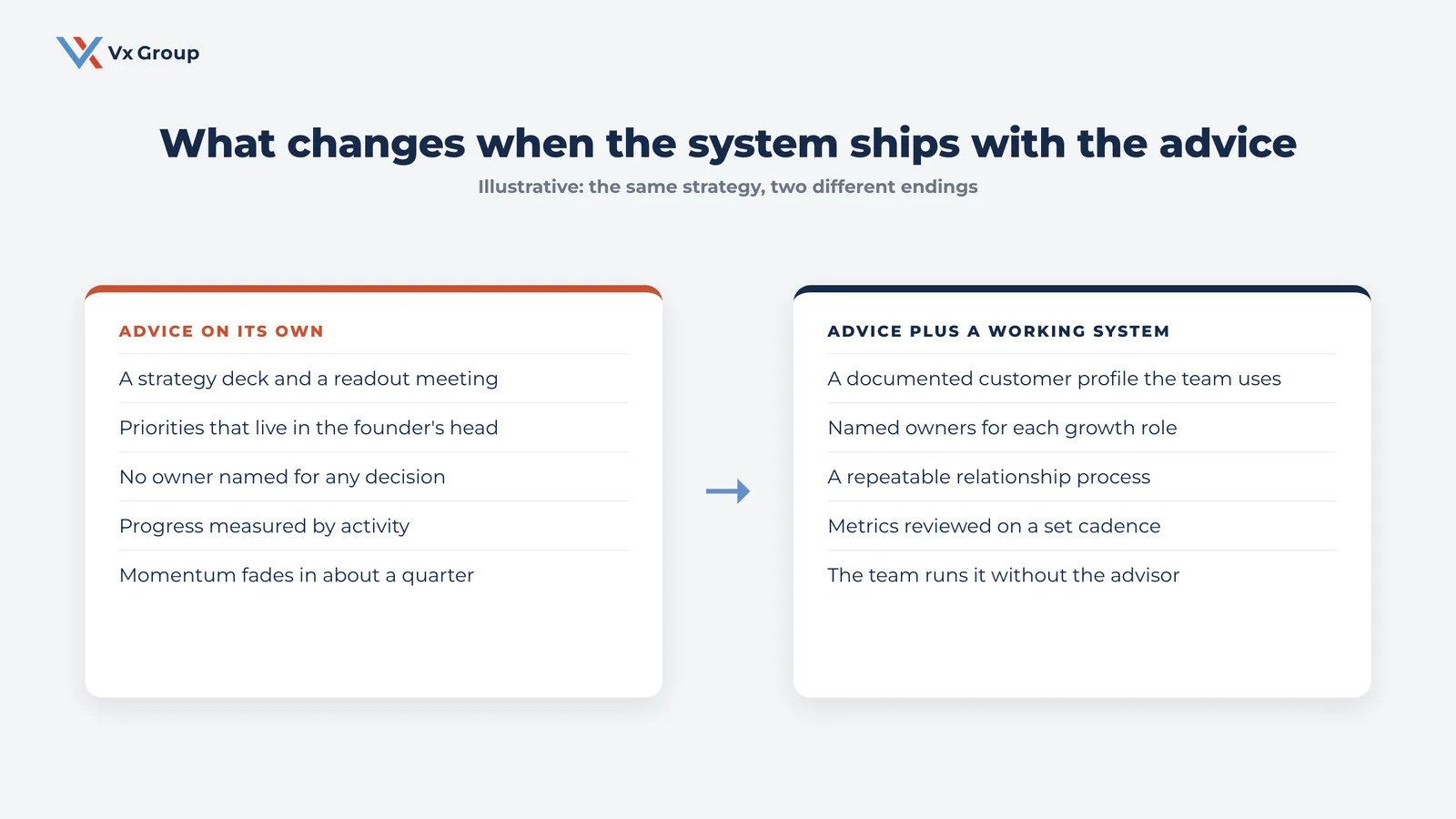
Three things happen in the weeks after a readout meeting. First, the leadership team returns to the operating problems that were waiting for them. Second, the recommendations get informally divided among people who already have full workloads. Third, nobody has authority to change how the sales team spends its week, so the sales team keeps spending it the way it always has. By the end of the quarter the deck is a reference document, and by the end of the year it is history.
Field Notes:
A recurring pattern in conversations with owner-led B2B companies: they have hired outside growth help two or three times, and each engagement produced a document they can still find. Asked what changed operationally, the answer is usually a variation of “we got clearer on our market.” Asked whether a new salesperson could be handed anything from that work, the answer is no. The clarity was real and it lived in the heads of the four people who sat in the sessions. When one of those people left, a portion of it left with them.
The structural problem is that advice and installation are usually sold as separate things by separate firms. The strategy firm hands over a recommendation and exits at the point where the work gets hard. The implementation vendor arrives with no context for why any of it was decided and builds what it is told to build. The company pays twice and absorbs the gap between them.
Ready to grow?
See what the Coach and Architect roles would look like against your own growth plan.
How is growth advisory different from consulting and fractional leadership?
The three models differ in what you own when the engagement ends. Consulting typically delivers a recommendation. Fractional leadership supplies an operator who runs the function. Growth advisory delivers a system your own team operates.
| Model | What you get | What you own at the end | Where it commonly breaks |
|---|---|---|---|
| Traditional consulting | Analysis, a recommendation, a strategy document | A document and whatever the team remembers | The recommendation needs operational changes nobody was staffed to build |
| Fractional or interim executive | An experienced operator filling a seat part-time | The results produced while they were there | Capability leaves when the person leaves |
| Implementation vendor | Configured tools, CRM builds, campaign execution | Working software and assets | The tools get built without a clear answer on which customers matter |
| Growth advisory | Outside judgment plus the installed system | A documented system, named owners, and a review cadence your team runs | Requires real leadership time, so it fails when the client treats it as outsourced |
That last row includes the honest limitation. A growth advisory relationship asks for the leadership team’s attention across months. A company hoping to hand growth to an outside firm and receive results should hire a fractional executive, because that model is built for it.
For a fuller treatment of what the installed system contains, see What Is a Business Growth Operating System? and How to Pick the Right Operating System for Your Business.
When does a company actually need growth advisory?
The clearest signal is a company that grows but cannot explain why, and whose leadership team cannot name what would make growth repeatable. Five conditions come up most often:
- Revenue has flattened and adding activity has stopped helping. More outreach, more marketing spend, and more trade shows produce the same result, which points at a targeting or process problem. Volume was never the constraint.
- Growth depends on one or two people’s relationships. The company is one resignation away from losing a meaningful share of its revenue. This is the situation described in The Real Reason Owner-Led B2B Companies Stall at $5M.
- Nobody agrees on the ideal customer. Ask four leaders to describe the best customer and get four answers. Every downstream growth decision inherits that disagreement.
- There is a strategy and no operating cadence. The plan exists. No standing review, no owners, and no measurement carry it into the work.
- A previous engagement produced a document and no change. This is the most common one, and the reason to ask a different set of questions the next time.
A company with none of these is probably shopping for execution capacity, which is a different purchase.
What should you ask before signing a growth advisory engagement?
Ask what you own at the end, because that answer separates the models faster than any credentials conversation. Six questions worth putting to any firm:
- What artifacts do we own when this ends? Ask for the actual list: documents, templates, role definitions, CRM configuration, dashboards. A vague answer here is the most reliable warning sign available.
- Who on our team operates each of those artifacts, and how do they learn to? Naming the client-side owner is the difference between installation and delivery.
- What does the cadence look like, and how much of our leadership team’s time does it require? A real number in hours per month. If the firm avoids this, the engagement is being sold as outsourcing.
- What gets built, and by whom? Find out whether the same firm does the build work, or whether you will be handed a recommendation and a referral.
- How will we know in 90 days whether this is working? A good answer names artifacts completed and behavior changed, with specifics.
- What happens when the engagement ends? Ask what the company should be able to do on its own, and what the firm expects to still be involved in.
The answers to questions one and two tell you almost everything. A firm that can name the artifacts you will own and the people on your team who will run them is describing a system. A firm that answers with methodology and experience is describing a project.
What should the first 90 days produce?
The first 90 days should produce a written diagnosis, a documented customer profile, a role map with named owners, and a standing review on the calendar. Anything less at that point is a project running behind.
A reasonable sequence:
| Weeks | Coach is working on | Architect is working on |
|---|---|---|
| 1 to 3 | Interviews, leadership sessions, the truthful diagnosis | Data pull, CRM audit, customer and revenue analysis |
| 4 to 6 | Deciding the priority customers and segments | The written customer profile and screening criteria |
| 7 to 9 | Growth roles, ownership, and accountability | The relationship process, CRM stages, templates |
| 10 to 13 | The review cadence and leadership habits | Dashboards, metric definitions, handoff documentation |
By week 13 the leadership team should be running its own review off numbers it trusts, and a new salesperson should be able to read the customer profile and screen a prospect without asking anyone. Both are testable. Ask for them.
For companies choosing an outside partner more broadly, Business Growth Consultant: What They Do and How to Choose One covers the selection question from a different angle, and What Is B2B Growth Consulting (And When Does Your Company Actually Need It) covers when the work is warranted at all.
Where to start
Find the last strategy document your company paid for. Read it, then write down what changed operationally as a result. For most companies that exercise takes about ten minutes and produces a short list.
That gap is the thing to buy against. When you talk to an advisory firm, hand them the list and ask how their engagement produces a different outcome. Then ask the six questions above and pay close attention to whether they can name the artifacts you will own and the people on your team who will run them.
The engagements that work look like a partnership with a handoff built into the design. Someone helps your leadership team see the business clearly, someone builds the system that carries those decisions, and at the end your team owns and operates it.
Ready to grow?
We can walk through what the Coach and Architect roles would build in your business, and what you would own at the end.
FAQs
About the Author: David Tisdale
