

How to Run a Customer Advisory Board

A customer advisory board is a group of 8 to 12 customers who meet with your leadership once or twice a year to give honest advice. It works when you pick members for range of view, hand customers most of the talking time, and show them what you did with their advice.
TL;DR
- A customer advisory board (CAB) is a standing group of 8 to 12 customers who advise your leadership.
- Write down what you want from the board before you invite anyone. “Customer input” is too loose to guide a single decision.
- Fill seats for range of view. Include a few critics and a few newer customers along with your largest accounts.
- Send a personal invitation that says what you ask of members and what they get back.
- Keep your own talking time under one third of the session. Customers should fill the rest.
- Ask questions that invite disagreement, and give the quiet member the first word.
- Send a thank-you in one day, a summary in three, an action list in ten, and a progress note in thirty.
What this guide covers
- What a customer advisory board is
- What a customer advisory board should do for your company
- Who should sit on the board
- How to invite customers
- How to plan the agenda
- How to run the meeting
- How to close the loop afterward
- How to measure the board
- Mistakes that sink a customer advisory board
- Where to start this month
Most owners of manufacturing and distribution companies have been to a meeting like this, on one side of the table or the other. The company presents a roadmap for two hours. The customers are polite. There is a nice lunch. Nobody says anything hard, and everyone goes home.
That meeting turns goodwill into a sales pitch. The company learns nothing it did not already believe, and the customers learn to expect a pitch next year.
This guide is for owners, presidents, and sales leaders at privately held B2B manufacturers and distributors. It covers six steps for running a board that customers want to attend. Each step ends with something you can build this month. You will end up with a purpose statement, a seat map, an invitation, an agenda, a question list, and a follow-up schedule.
What is a customer advisory board?
A customer advisory board is a group of customers you invite to meet with your leadership on a regular schedule. They tell you what they think of your direction. Members give advice. Your company decides what to do with it and tells them what it did.
Defined Term: Customer advisory board.
A standing group of 8 to 12 customers who meet with your leadership once or twice a year. They give candid advice on strategy, service, and new products. The company reports back on what it did with the advice.
You will also see the terms CAB, customer advisory council, and customer advisory panel. They describe the same thing, and this guide covers all of them.
Compare a customer advisory board with a user group and a focus group
Three formats get mixed up. Each answers a different question.
| Format | Who attends | Main question | How often |
|---|---|---|---|
| Customer advisory board | 8 to 12 selected customers | Where should the company go next? | Once or twice a year |
| User group | Any customer who wants to come | How do I get more from what I bought? | Yearly or more |
| Focus group | Paid participants, often strangers | How do people react to this idea? | One time |
A user group teaches customers about your products. A focus group tests a specific idea. A customer advisory board is a long relationship with a few people. They know your company well enough to say what is wrong with it.
What should a customer advisory board do for your company?
A customer advisory board should have one written purpose that helps you make decisions. “Get customer input” is too loose. You can collect input from a survey. A board earns its cost when it helps with a decision that a survey cannot settle.
Decide the purpose first. Who you invite, what you ask, and how long you meet all follow from that one sentence.
Write the purpose in one sentence
Use this format: “This board helps us decide ___ by ___.”
Examples for a $20 million manufacturer:
- “This board helps us decide which two product lines to expand by telling us where their plants are short on supply.”
- “This board helps us decide how to restructure service and lead times by telling us what delays cost them.”
- “This board helps us decide where to put our next sales hire by telling us how they buy and who influences the order.”
If you cannot finish the sentence, you are not ready to invite anyone.
List the three decisions the board will inform this year
Write down three real decisions you face in the next 12 months. Pricing, lead times, a new product line, a change in distribution, and a new service offer are common ones. These become your agenda topics.
Keep a fourth line for the relationship itself. A board that meets twice a year builds trust that no survey can. That trust shows up in how customers talk to your salespeople and how quickly they call when something goes wrong. Our article on B2B customer experience covers why those moments shape renewals.
Agree who owns the board inside your company
Name one executive host and one coordinator. The host is usually the owner or president, because customers give more weight to a meeting the top person attends. The coordinator handles invitations, logistics, notes, and follow-up.
Without a named owner, the board lasts about one meeting.
Who should sit on a customer advisory board?
A customer advisory board should hold 8 to 12 members chosen for range of view. A group that small can talk as one table. A group that large still gives you several perspectives.
The common mistake is to rank customers by spend and invite the top 12. That group looks impressive. It also thinks alike, because your largest customers buy from you for similar reasons.
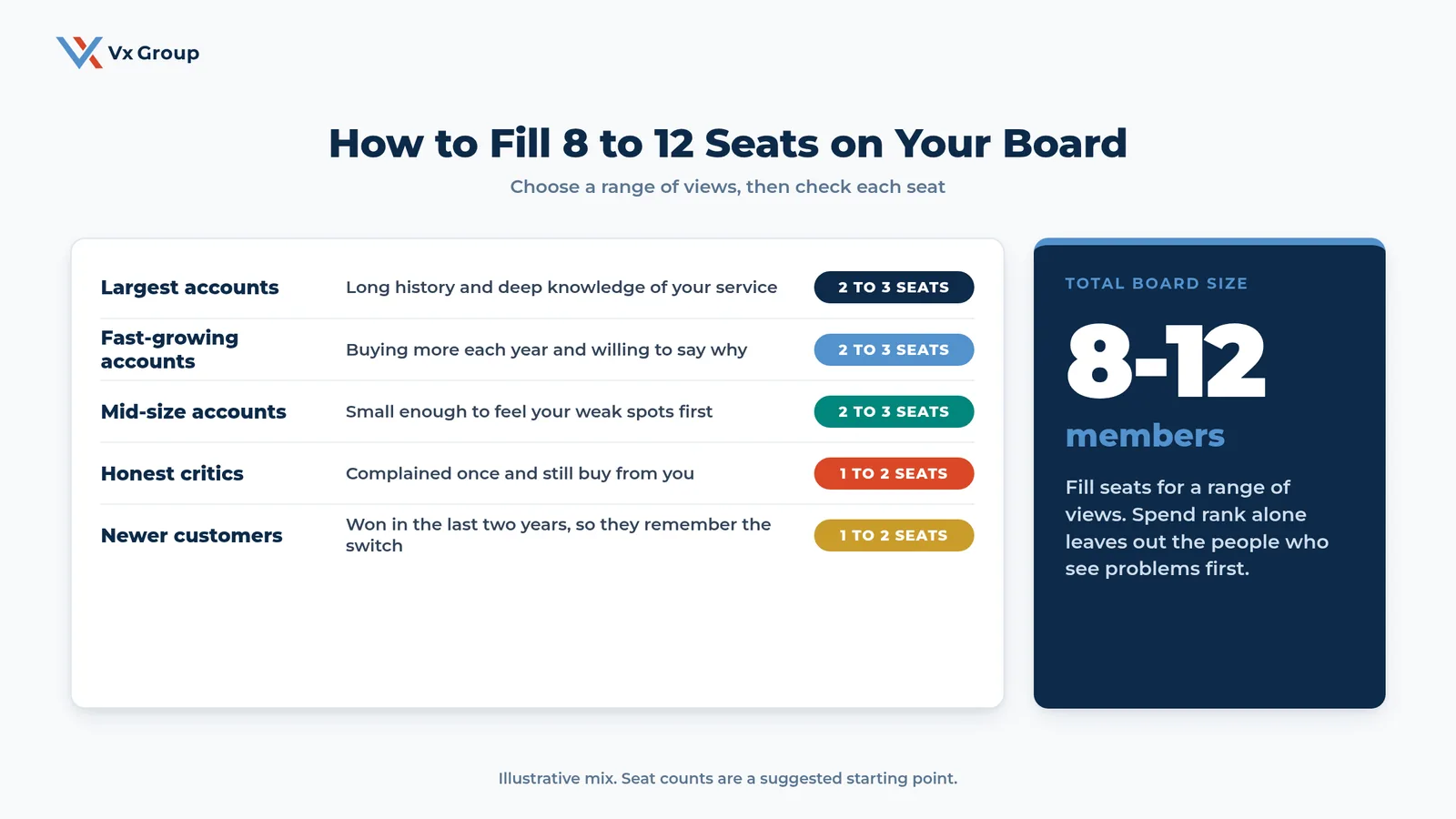
The graphic above shows a suggested mix of five seat types: largest accounts, fast-growing accounts, mid-size accounts, honest critics, and newer customers. Together they fill 8 to 12 seats.
Build a seat map before you pick names
Draw the five seat types on a page with a count for each. Then match names to seats.
- Largest accounts (2 to 3 seats): they know your service best and carry the most revenue.
- Fast-growing accounts (2 to 3 seats): they show where the market is going.
- Mid-size accounts (2 to 3 seats): they feel your weak spots first, because they get less attention.
- Honest critics (1 to 2 seats): customers who complained once and still buy from you.
- Newer customers (1 to 2 seats): they remember how they chose you over someone else.
Score each candidate before you invite
A short score keeps the choice honest. Rate each candidate from 1 to 5 on the four questions below, and invite people with the best total in each seat type.
| Question | What to look for |
|---|---|
| Will they speak plainly? | Has told you something hard before |
| Do they see beyond their own order? | Talks about their market and their customers |
| Can they commit to the meeting? | Has the authority and the calendar |
| Do they fit the mix? | Fills a seat type you have not covered |
Choose the person who decides, or the person the decider trusts. A buyer who has to ask permission for everything adds little.
Add a customer you may lose
Put one person on the board who is thinking about leaving, if you can. They will tell you what the others are too polite to say. It takes nerve to invite them. It also gives you information you cannot get anywhere else.
Your key account management work already tells you which customers matter most. The board seat map gives you a second list built around who sees your company clearly.
How do you invite customers to a customer advisory board?
You invite customers with a personal ask from the owner or president. The ask says what you want, how much time it takes, and what they get back. A form email gets a polite no. A phone call or a short note gets a yes.
Customers say yes to a board when it respects their time and gives them something they cannot get elsewhere.
Call each candidate before you send anything
Make the first contact a short call from the person who knows them best, followed by a written invitation from the owner. The call takes five minutes and covers three points:
- Why you picked them in particular.
- What you will ask of them.
- What they will get.
Many candidates will say yes on the call. Some will ask questions you should answer before the invitation arrives.
Write the invitation in plain words
A good invitation fits on one page. It states the purpose in your one-sentence form, the dates, the time commitment, the location, and the term (one or two years is typical). It also names who else is invited, so the candidate knows the table.
Sample opening: “We are starting a customer advisory board of ten people to help us decide where to put our next investment. We would like you on it because your plant tells us things we do not hear anywhere else.”
Tell members what they get back
Customers give you hours of their year. Say what they get in return:
- A direct line to your leadership team and a say in what you build.
- A look at your plans before the rest of the market sees them.
- A chance to meet peers who face the same supply and service problems.
- A written summary of what you heard and what you will do.
The peer benefit is often the one members value most. A plant manager at one company rarely gets to compare notes with a plant manager at another, and your board gives them a reason to.
Set the commitment so members can plan
State the term, such as two years. Give the number of meetings (two a year is common) and the length (half a day to a full day). Say whether you cover travel. Avoid open-ended asks. Customers who can see the end of the commitment say yes more often.
Ready to grow?
Share your top accounts and we will help you pick the seats, write the purpose, and plan your first meeting.
How do you plan a customer advisory board agenda?
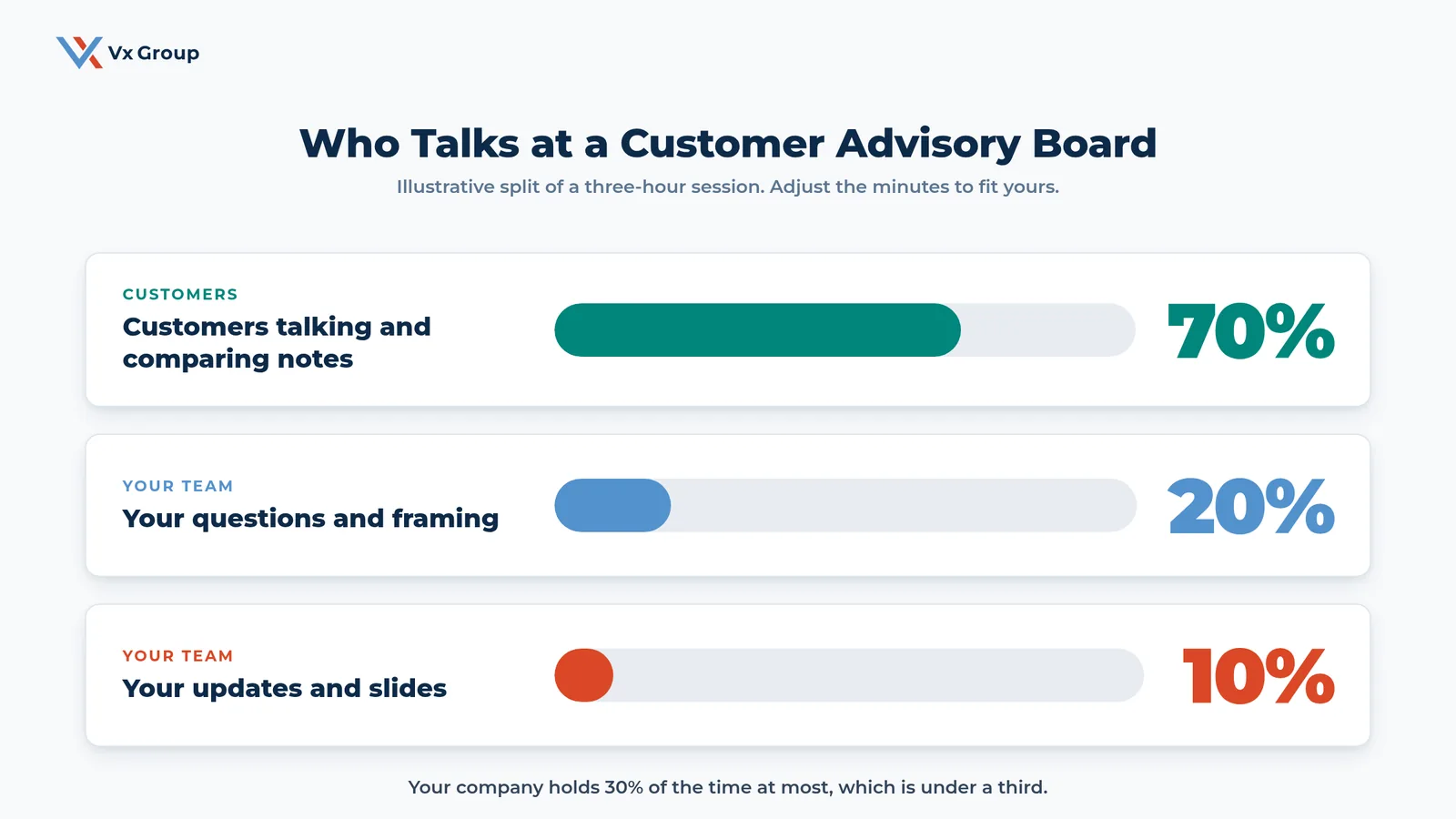
You plan a customer advisory board agenda by giving customers at least two thirds of the session and building each block around a question you want answered. Your company talks for under a third of the time. Slides stay short, and every presentation ends with a question.
The graphic below shows a suggested split for a three-hour session. Customers talk about 70% of the time. Your team uses 20% for questions and framing, and 10% for updates.
Cap company updates at 15 minutes
Open with a short update, no more than 15 minutes, and cover only what members need to give useful advice. Show one or two slides on where the company is and what choice you are weighing. Leave your best news for the newsletter.
Build each block around one decision
Take the three decisions you wrote down earlier and give each one a block of 35 to 45 minutes. Open each block with two minutes of context and spend the rest asking and listening.
Use this agenda template
Here is a sample agenda for a three-hour morning session.
| Time | Block | Who leads |
|---|---|---|
| 0:00 to 0:15 | Welcome and purpose of the board | Owner |
| 0:15 to 0:30 | Company update and the decisions we face | Owner |
| 0:30 to 1:10 | Decision 1: open discussion | Facilitator |
| 1:10 to 1:20 | Break | Everyone |
| 1:20 to 2:00 | Decision 2: open discussion | Facilitator |
| 2:00 to 2:40 | Decision 3: open discussion | Facilitator |
| 2:40 to 3:00 | What we heard, and what happens next | Owner |
Send the agenda and a one-page pre-read at least a week ahead. Ask each member to bring one thing they would change about working with you.
Plan the room before the day
Seat members at a U-shape or a round table so they can see each other. Seat your own team at the edges. Hold lunch after the session, because the conversation over lunch is often where the most candid comments come out.
How do you run a customer advisory board meeting?
You run a customer advisory board meeting by asking open questions, using a neutral facilitator when possible, and drawing out the quiet members before the loud ones set the tone. Your job in the room is to listen, take notes, and resist the urge to defend.
Candor comes from the setup. Customers say hard things when they believe you want to hear them and when you listen without arguing.
Open with a rule about candor
In the first five minutes, say what you want: “We asked you here because you will tell us the truth. Nothing you say here changes how we treat you. We will tell you what we do with it.” Then say it once more at the first hard comment, by thanking the member who made it.
Ask these questions to get candid answers
These questions produce more honest answers than “How are we doing?”:
- “What is one thing we do that you wish we would stop?”
- “When did we last let you down, and what did that cost you?”
- “If you could change one thing about how we work with your plant, what would it be?”
- “Who else do you buy from for something we could supply, and why?”
- “What will your company need in three years that you do not buy from us today?”
- “What would make you tell a peer to call us? What would make you tell them to wait?”
Pick four or five for your session. Ask the question, then stay quiet. Count to five before you say anything.
Give the quiet member the first word
Every board has a loud member and a quiet one. The loud member sets the direction of the room by speaking first. Ask the quietest person for their view before anyone else. Say, “Sam, you have seen this in your plant. What do you think?” Then go around the table.
If one member dominates, thank them and ask for a second view: “That helps. Who sees it another way?”
Take notes in the open and read them back
Assign a note-taker who is not the host. At the end of each block, read back the three main points and ask members if you got them right. This gives you an accurate record and shows members you listened.
Field Notes:
Picture a $25 million fabricator that invites its ten largest customers. Nine praise the company, and one says lead times slipped last year. The owner thanks them and moves on. Six months later that customer cuts its order by a third. This example is an illustrative composite. A seat map with two critics and two mid-size accounts would have put the lead-time problem on the table while it could still be fixed.
How do you close the loop after a customer advisory board meeting?
You close the loop by sending members a thank-you within a day, a summary within three days, an action list within ten, and a progress note within thirty. Then you open the next meeting by showing what changed. This step decides whether members come back next year.
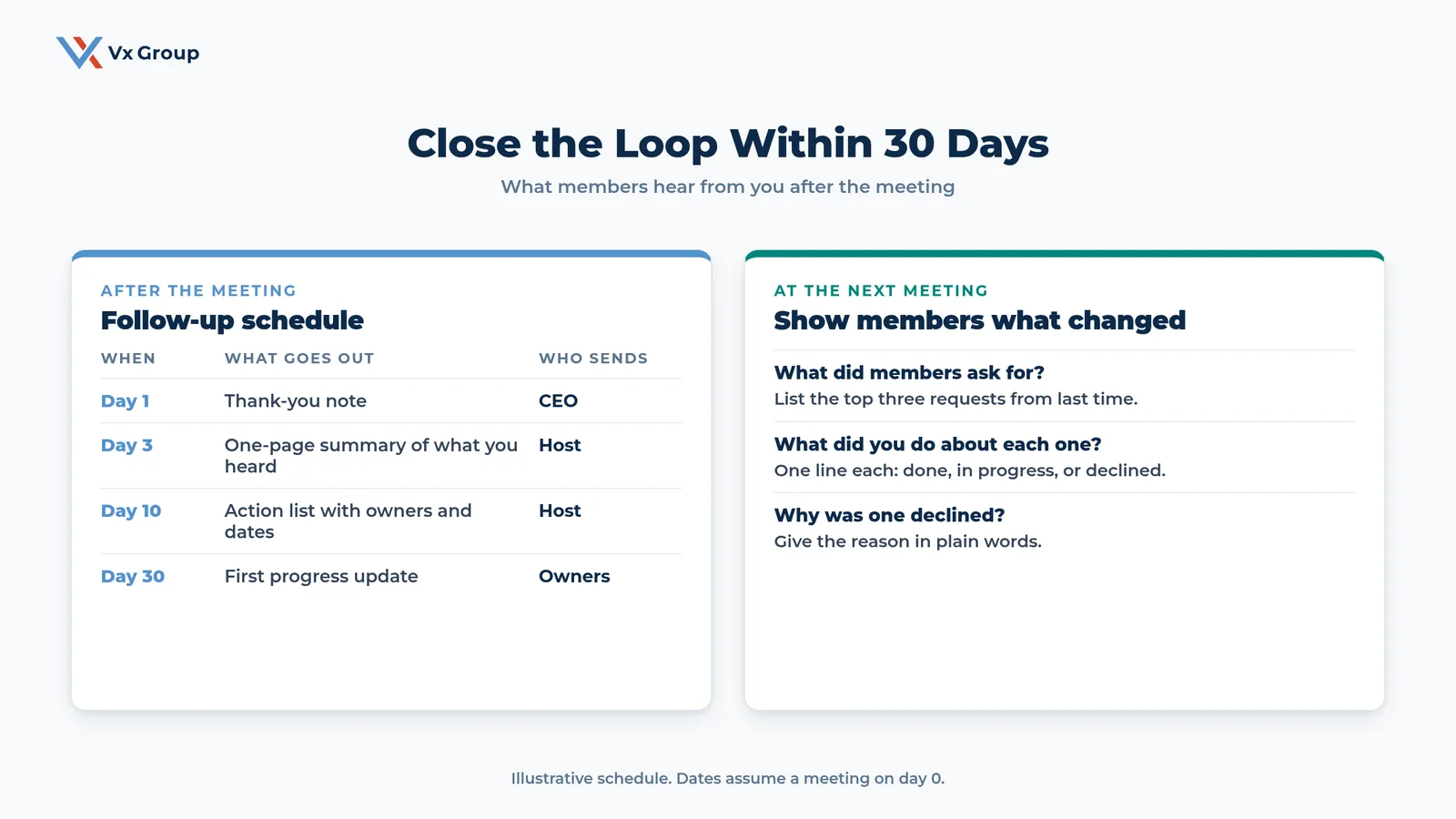
The graphic above lays out the 30-day schedule and the three things to show at the next meeting. Most boards fail here. The company holds a good meeting, gets busy, and says nothing for ten months.
Send the one-page summary within three days
List what you heard in the order members said it. Use their words where you can, and keep it to one page. Include the names of anyone who agreed to a follow-up conversation.
Turn the main points into an action list with owners and dates
For each main point, write one of three outcomes: “We will do this,” “We are looking at this,” or “We will pass on this, and here is why.” Give each action an owner and a date. Declining a request with a clear reason earns more trust than staying quiet.
Report progress to members in 30 days
Send a short note with the status of each action. Done, in progress, or declined. Members who see movement in a month will remember the board when you invite them again.
Open the next meeting with a "you said, we did" list
Spend the first 15 minutes of the next session on this list. For each member request from last time, show what you did. If something stalled, say so. This list is the best reason a customer has to attend a second time.
It also feeds the rest of your customer work. A board is an early warning on customer retention, and what members say often shows up later in net revenue retention.
How do you measure whether a customer advisory board works?
You measure a customer advisory board by what changes at the member accounts and inside your company. Track a few simple numbers once a year, and keep the list short so your team keeps it up.
Track five signals for the board
| Signal | How to measure it |
|---|---|
| Attendance | Share of members who attend each meeting |
| Re-sign rate | Share of members who agree to a second term |
| Action completion | Share of “we will do this” items finished by the next meeting |
| Account growth | Change in spend at member accounts against similar non-members |
| Decisions informed | Number of company decisions that cite board input |
Use the account growth number with care. Many things drive growth at an account, and members were chosen for a reason. Treat it as one view among five.
Look at share of wallet inside member accounts
Members who feel heard often give you more of their purchasing. Check share of wallet at each member account at the start of the term and again at the end. If it rises, the relationship is working. If it falls, ask the member why.
The same goes for account expansion. A board tells you what members would buy if you offered it.
What mistakes ruin a customer advisory board?
A customer advisory board fails when the company treats it as a sales event, invites only friendly customers, talks too much, or goes silent afterward. Each mistake has a plain fix.
Avoid turning the meeting into a sales pitch
If a salesperson is in the room to sell, members notice, and they stop being candid. Keep sales conversations out of the session. A member who is happy will bring up new needs on their own, and your account owner can follow up in the week after.
Avoid filling the table with fans
A board of people who like you tells you what you already know. Fill at least two seats with critics or mid-size accounts. The comments will sting a little, and they will be the most useful you get.
Avoid presenting for two hours
The most common mistake is a long presentation. Cut your slides in half, then cut them again. Every minute you talk is a minute a customer does not.
Avoid asking for advice you will ignore
If you have already decided, say so. Ask for help with the how, and leave out the whether. Members can tell when you ask for advice you do not want.
Avoid skipping the follow-up
Silence after the meeting tells members the board was a show. The 30-day schedule is the easiest fix, and it takes about two hours a month.
Avoid choosing seats by spend alone
Spend rank gives you a table of similar companies. The seat map earlier in this guide fixes that in one afternoon.
Avoid letting the board run forever without a term
Set a two-year term with a renewal option. Rotate in new members so the group stays fresh. A board with no end date gets stale, and good members drift away without saying why.
Where should an owner start this month?
Start with the purpose sentence and the seat map, then call five candidates. You can complete all three in two weeks, and the first meeting can happen within a quarter.
Here is a four-week start:
- Week 1: Write the purpose in one sentence and list three decisions the board will inform.
- Week 2: Build the seat map and score 15 candidates.
- Week 3: Call the top 12 and send the written invitation to those who said yes.
- Week 4: Fix the date, send the agenda and pre-read, and name the facilitator and note-taker.
If your team already runs a quarterly business review with top accounts, use what you learn there to shape the invitations. And if you have been collecting voice of customer notes from sales calls, bring the three most common comments to the first session as discussion starters.
A customer advisory board is a long-term relationship with a short list of customers who know your company well. Run it with a clear purpose, a mixed table, and a promise to report back, and the board gives you what no survey can: customers who tell you the truth and stay.
The same logic applies to owners who worry about customer concentration risk. A board puts you in regular, honest contact with the accounts you cannot afford to lose.
Ready to grow?
Bring your list of top accounts and we will help you design a board your customers want to join.
FAQs
About the Author: Jacob Camhi
