

Capacity Planning for Manufacturers: A Step-by-Step Guide
Capacity planning is the process of working out how much your plant can make in a given period and comparing that number to the orders you expect. A manufacturer calculates capacity station by station and finds the slowest one. Then it decides whether to add hours, equipment, or outside help before accepting a large order.
TL;DR
- Your plant ships only as fast as its slowest station. Find that station first, because it sets the real capacity of the whole plant.
- Calculate capacity as people or machines, times hours, times output per hour, times a realistic efficiency factor from your own history.
- Compare capacity to demand every month. A large order is safe to take only when the bottleneck, the suppliers, and the cash can all carry it.
- When demand is higher than capacity, you have six options: a later date, overtime, a second shift, equipment, outsourcing, or a polite no.
- Review five or six numbers monthly so the next big order is a planned decision and never a surprise.
A customer calls and wants 6,000 parts over the next eight weeks. It is the biggest order you have seen this year. Everyone in the building wants to say yes.
If you say yes without checking, the order can pull welders off your regular customers. Their deliveries slip. You are also left holding a stack of steel you have not been paid for. The big order wins and three good accounts get angry.
This guide shows owners of $5 million to $50 million manufacturers how to answer that call with numbers. It covers how to calculate production capacity and how to size up a large order. It also covers what to do when demand is higher than capacity and which numbers to watch each month. Everything here is plant-floor planning. It needs a notebook and a spreadsheet, and no new software.
What is capacity planning for a manufacturer?
Capacity planning for a manufacturer is the work of matching what the plant can produce to what customers are likely to order. It looks at machines, people, shifts, materials, and the time each step takes. The result is a number you can compare to demand, so you know when to add resources and when to hold off.
Defined Term: Production capacity.
The most a plant can make in a set period, such as a day or a week, with the people, machines, and hours it has now. Rated capacity is the theoretical maximum. Effective capacity is what the plant makes on an ordinary day after setups, breaks, repairs, and scrap.
Defined Term: Bottleneck.
The station in a process with the lowest effective capacity. The whole plant can ship only as many parts as the bottleneck can finish.
Project teams and IT departments use the same words for planning staff hours on software work. Those guides rarely help a plant manager. A manufacturer plans around machine time, setups, material lead times, and a floor full of parts that move from one station to the next.
Capacity planning also looks forward. Your sales team sees orders coming. Operations sees the hours available. The plan puts the two side by side early enough to act. For the sales side of that picture, see our guide to sales velocity.
How do you calculate production capacity?
You calculate production capacity one station at a time. For each station, multiply the number of machines or people by the hours they run and the parts they finish per hour, then apply an efficiency factor. The station with the lowest result is your bottleneck, and its number is the capacity of the plant.
The example below follows one plant that makes fabricated steel enclosures. The numbers are illustrative. Use your own.
List every station a part passes through
Write the steps in order, from raw material to the loading dock. A typical metal fabricator has cutting, forming, welding, painting, assembly, and packing. Keep the list to the steps where parts wait in line. In the example, three stations matter: cutting, welding, and painting.
Rate each station in parts per day
Use this formula for each station:
Rated capacity per day = machines or people x hours per shift x shifts x parts per hour
| Station | Machines or people | Hours | Parts per hour | Rated per day |
|---|---|---|---|---|
| Cutting | 2 lasers | 8 | 40 each | 640 |
| Welding | 4 welders | 8 | 15 each | 480 |
| Painting | 1 line | 8 | 70 | 560 |
Take parts per hour from timed runs or from the last three months of production records. A quoted machine speed usually runs higher than what the floor delivers.
Apply an efficiency factor from your own history
Rated capacity assumes nothing goes wrong. Setups, changeovers, repairs, breaks, and rework use up part of every shift. Compare actual output to rated output over the last three months and use that ratio. The example plant runs at 75 percent.
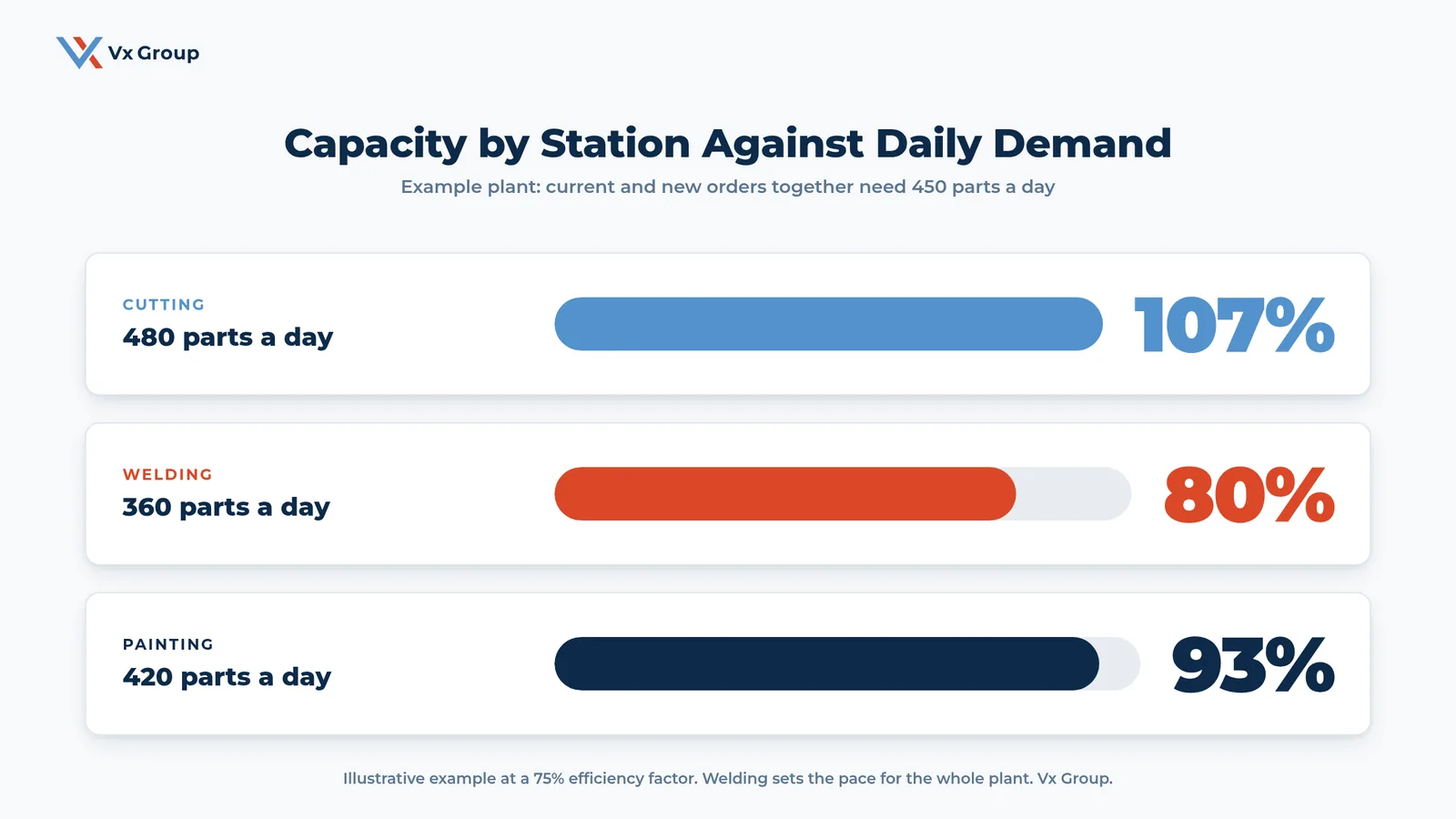
Effective capacity then reads 480 parts a day for cutting, 360 for welding, and 420 for painting.
Name the bottleneck and write down its number
Welding is the lowest at 360 parts a day. That is the capacity of the plant, even though the laser can cut 480. Post the number where your plant manager and your sales lead can both see it.
What are lead, lag, and match strategies?
Lead, lag, and match are three ways to time capacity against demand. A lead strategy adds capacity before demand arrives. A lag strategy adds capacity after demand has proven itself. A match strategy adds capacity in small steps as demand grows. Each one trades cost against the risk of missing an order.
| Strategy | What you do | Works best when | Main risk |
|---|---|---|---|
| Lead | Hire, train, or buy ahead of orders | Lead times for people or machines are long and demand is likely to grow | Idle people and equipment if the orders slip |
| Lag | Wait until the backlog proves the demand | Cash is tight, or demand is uncertain | Late deliveries and lost orders during the wait |
| Match | Add a small step each time utilization crosses a set line | Demand grows steadily and the next step is quick to add | Constant small decisions and no slack for a sudden jump |
Most owner-led plants use a mix. They lead on skilled labor, because a trained welder takes months to find. They lag on equipment, because a new machine costs real cash and the payback needs proof. They match on overtime and temporary help.
Pick the strategy for each bottleneck on purpose, and write it down. A plant that never chose one is usually running lag by default.
Ready to grow?
Bring your next big quote and we will help you test it against the growth your plant can deliver.
How do you decide whether to take a large new order?
Check four things in order: total demand with the new order added, the bottleneck, supplier lead times, and the cash the order will tie up. If all four hold, take the order. If one fails, fix it in the quote or change the terms.
Add the new order to current demand
Convert the order into the same unit as your capacity numbers. In the example, 6,000 parts over 40 working days adds 150 parts a day. Current orders already use 300 parts a day. Together the plant needs 450 parts a day.
Compare the total to the bottleneck
Welding can finish 360 parts a day. Demand is 450. The plant is 90 parts a day short, which is 20 percent of what customers expect. Painting is close behind at 420.
If the total is under the bottleneck number with a cushion of 10 to 15 percent, take the order. A plant that runs at 100 percent of capacity has no room for a rush job or a broken machine.
Check supplier lead times on the new volume
Ask your main suppliers how fast they can ship 40 working days of material. Steel mills, coating suppliers, and casting shops often need weeks of notice for volume that is double the normal release. Our guide to supplier evaluation lists what to ask before you rely on one source.
Work out the cash the order will tie up
Large orders pull cash out of the business before they put it back. You buy material first, pay for labor weekly, and collect from the customer 45 to 60 days after shipping. Add up material, labor, overtime, and freight for the full run, then subtract what the customer pays up front. Our article on working capital management covers how to measure and shorten that gap.
Decide and write the decision on one page
Record the demand, the bottleneck, the supplier dates, the cash needed, and the option you chose to close any gap. Keep it with the quote. In six months, you will want to know what you assumed.
What can you do when demand is higher than capacity?
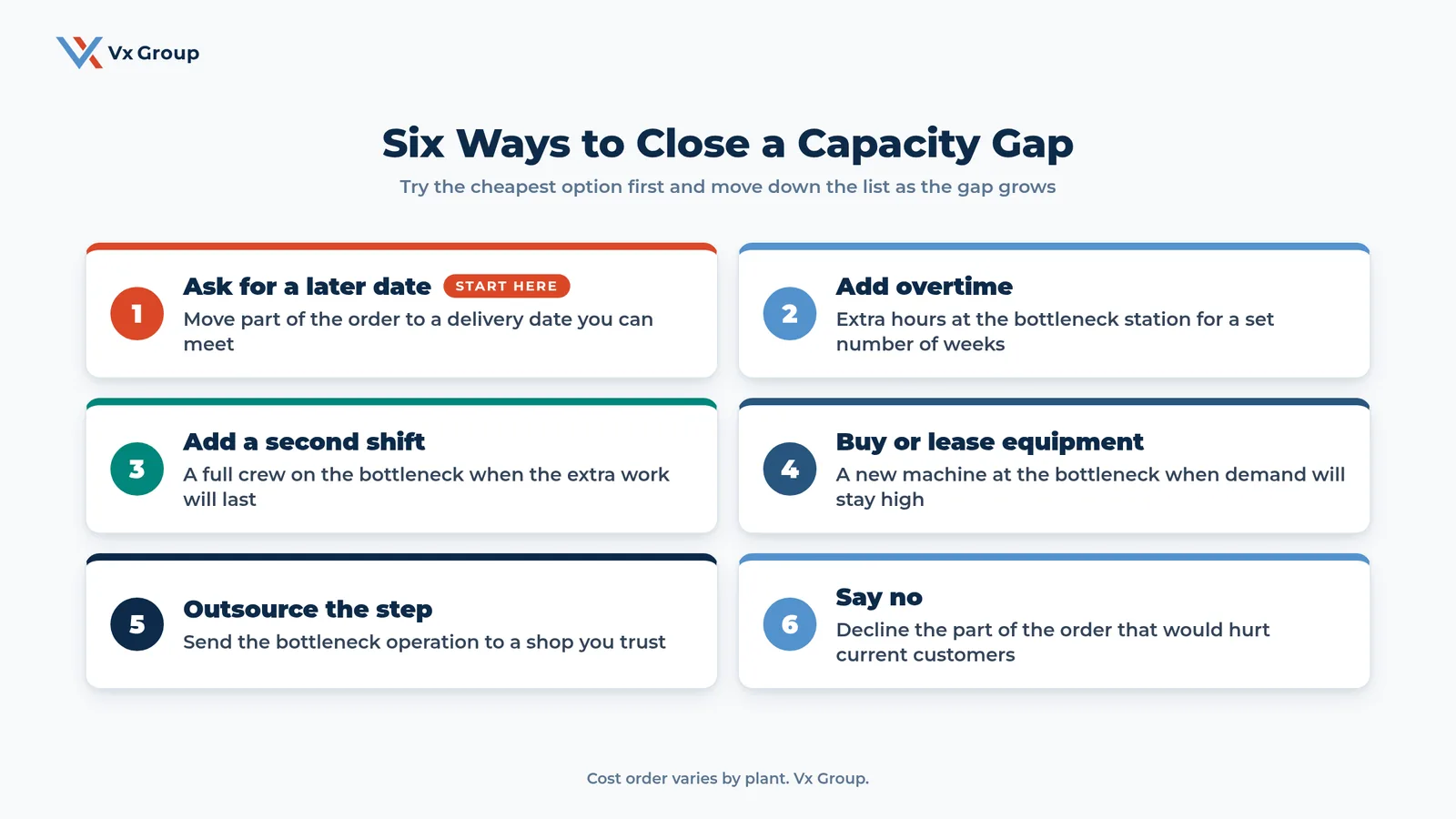
When demand is higher than capacity, you can ask for a later delivery date, add overtime, add a second shift, buy or lease equipment, outsource the bottleneck step, or decline part of the order. Start with the cheapest option and move down the list as the gap grows.
Ask for a later delivery date on part of the order
Many customers care about a date for the first lot and have more room on the rest. Offer to ship the first 2,000 parts on the requested date and the remaining 4,000 over a longer window. This costs nothing and often closes the gap on its own.
Add overtime at the bottleneck for a set number of weeks
In the example, welding is 90 parts a day short. Four welders working 10-hour days, up from 8, produce 360 x 10 / 8 = 450 parts a day. That closes the gap with two extra hours a day, for eight weeks. Overtime costs time and a half and wears people down after a few weeks, so give it an end date.
Add a second shift when the extra work will last
A second shift makes sense when the volume will stay for months. The cost is a supervisor, a crew, and a second set of utilities and quality checks. A fifth welder on the day shift also closes the example gap. Five welders x 8 hours x 15 parts x 75 percent equals 450.
Buy or lease equipment when demand will stay high
A new machine at the bottleneck lifts capacity for good. Buy only when the extra volume is likely to last for several years, and check how long delivery and installation will take. A machine that arrives after the order has shipped solves nothing.
Outsource the bottleneck step to a shop you trust
A qualified job shop can take the welding or machining step for a fee. The cost per part is higher, and you carry the quality risk. Audit the shop before sending parts, and keep your own name off the shipment until you have inspected the first lot.
Say no to the part of the order that would hurt current customers
A plant that takes every order can lose its best accounts. Your top ten customers pay for the business. Decide in advance how much of their schedule you will protect, and turn down work that breaks that promise. Our guide to key account management shows how to name those accounts and protect them.
After you fix the bottleneck, the next station becomes the new bottleneck. In the example, a fifth welder lifts welding to 450 parts a day, and painting at 420 becomes the limit. Plan the second fix before the order starts.
Which capacity numbers should an owner review every month?
Review six numbers every month: utilization at the bottleneck, backlog in weeks, on-time delivery, overtime hours, scrap and rework, and quoted lead time against actual. Together they tell you whether the plant has room for new work and whether a problem is building before customers feel it.
| Number | How to calculate it | What to watch for |
|---|---|---|
| Utilization at the bottleneck | Hours run divided by hours available | Above 85 percent for several months |
| Backlog in weeks | Open order hours divided by weekly capacity | Backlog growing for three months in a row |
| On-time delivery | Orders shipped by the promised date divided by all orders | Any drop of more than a few points |
| Overtime hours | Overtime hours divided by regular hours | Overtime that never ends |
| Scrap and rework | Parts reworked or scrapped divided by parts made | A rising rate at the bottleneck |
| Quoted vs actual lead time | Lead time you quote minus lead time you deliver | Actual running longer than quoted |
Put these on one page with the last twelve months beside them. Trends tell you more than any single month. For other signals that move ahead of revenue, read our guide to leading indicators for a business.
Utilization at the bottleneck also affects margin. A plant that runs its bottleneck steadily spreads fixed cost over more parts. Our guide to how to increase EBITDA shows how that flows to profit, and the article on cost of sales explains where overtime and outsourcing land in your numbers.
How should sales and operations share the capacity number?
Sales and operations should share one capacity number, updated monthly, that the quoting team checks before any delivery date goes to a customer. The number lives on a single page owned by the plant manager, and the sales lead reads it before every large quote.
Give the quoting team a simple lookup
Build a one-page table with the bottleneck station, its effective capacity per day, and the hours already booked for the next twelve weeks. A salesperson can subtract booked hours from available hours and see the open room in minutes. If the room is short, the quote goes to the plant manager before it goes to the customer.
Set a rule for rush orders
Decide in advance what a rush order costs. Many plants add a premium of their own choosing for work that bumps the schedule, and the premium pays for the overtime. Write the rule down so a salesperson can quote it without calling the owner each time.
Hold a short monthly review
Put the six numbers in front of sales, operations, and finance for 30 minutes. Ask what changed, what the next three quotes need, and which station will be the limit in 90 days. Keep notes so the next meeting starts from the last one.
How is capacity planning different from demand planning and S&OP?
Capacity planning measures what the plant can make. Demand planning estimates what customers will buy. Sales and operations planning, or S&OP, is the monthly meeting where sales, operations, and finance compare the two and agree on one plan.
| Process | Question it answers | Owner |
|---|---|---|
| Demand planning | How much will customers order, and when? | Sales |
| Capacity planning | How much can the plant make, and where does it stall? | Operations |
| S&OP | What is our one plan for the next quarter? | Owner or president, with all three |
A plant of $5 million to $50 million can run S&OP without heavy process. A 45-minute monthly meeting with sales, operations, and finance is enough. Bring the six numbers above and the next three large quotes. Leave with one agreed plan for hours, hiring, and material.
The weak link in many plants is the handoff between sales and operations. Sales promises a date that operations learns about on Friday. A shared capacity number fixes that, because the quoting team can see how much room the bottleneck has before they commit.
What mistakes do manufacturers make with capacity planning?
These six mistakes show up most often. Each one produces late shipments and surprised customers.
- Using rated capacity. Machine specs assume perfect days. Use your own output history.
- Averaging across stations. A plant with a fast laser and a slow weld shop has the capacity of the weld shop.
- Counting people as machines. A skilled welder who leaves takes capacity with them. Document the work so a second person can step in, as our guide to knowledge management in manufacturing describes.
- Quoting before checking. The salesperson should see the capacity number before a date goes to the customer.
- Running at 100 percent. A plant with no slack misses dates on the first breakdown.
- Forgetting price. When capacity is tight, the next order should earn more. Our guide to a price increase letter covers how to raise prices with customers.
Where should an owner start with capacity planning?
Start with the bottleneck. Pick the one station that limits your plant today, calculate its effective capacity, and compare it to the last three months of orders. That one number answers most of the questions you will face about the next large order.
This week, do three things:
- Time the bottleneck station for one full shift and record parts finished.
- Compare actual output to rated output over the last three months.
- Put the result on a page next to the orders you expect over the next quarter.
Then run the same check on the next order that comes in. After two or three quotes, the process takes an hour.
Ready to grow?
We help owners line up sales growth with what operations can deliver.
FAQs
About the Author: David Tisdale
