

How to Write a Sales Proposal Buyers and Their AI Can Read

To write a sales proposal that wins, build page one so a reader who stops there still knows your price, your lead time, your certifications and two customers they can call. Open with the buyer’s problem in their words. Explain your price in two sentences. Write the terms in numbered sections with defined terms. Many buyers now have an AI summarize your proposal before anyone reads it.
TL;DR
- A sales proposal is a document that tells one buyer what you will build, what it costs, when it ships and why you can be trusted. A quote is the price and terms alone.
- More buyers now paste a quote or proposal into an AI assistant and ask for a summary. The summary can become the only version some people read.
- If your proposal hides a fact in an image, gives a range, or says “in progress,” the summary repeats the gap or fills it with a guess.
- Build page one around five facts. They are the buyer’s problem, the price with what it includes, the lead time with a start point, the certifications with numbers and dates, and two named references.
- Write terms in numbered sections, define every key word once, and replace “reasonable efforts” with a number.
- Test your last lost proposal this week by pasting it into an AI assistant and reading the summary.
A purchasing manager at a customer of yours opens an email on Tuesday. Your proposal is attached. She has six other quotes to review before Friday. She pastes yours into an AI assistant and types, “Summarize this and list the risks.”
The summary takes ten seconds. It gets forwarded to the plant manager and the controller. Neither of them opens your PDF.
For many readers, that summary is the proposal. If page three held your best proof, nobody sees it. If your lead time was a range, the summary repeats the range and may add a worry about it.
This guide is for owners and presidents of privately held manufacturers, roughly $5M to $50M in revenue. These leaders sign off on big proposals or read them before they go out. It builds on the quote exercise from our October webinar, How to Make AI Buy From You. It shows how to write a proposal that wins whether a person reads all of it or an AI reads it first.
What is a sales proposal, and how is it different from a quote?
A sales proposal is a document written for one buyer. It explains what you will deliver, what it costs, when it arrives, and why the buyer can trust you to do it. A quote gives the price and terms for a defined item or job. Many manufacturers send a quote and call it a proposal, or the reverse.
Defined Term: Sales proposal.
A written offer to one buyer. It states the buyer’s problem, your solution, the price and what it includes, the lead time, your proof, and the terms of the sale.
Search results for this topic come mostly from sales software vendors. Their guides cover templates, e-signature tools and proposal software. A manufacturer that sells custom or engineered work needs something shorter and more careful: the facts a buyer checks before choosing a supplier.
The table below shows how the three documents differ.
| Document | Its job | Typical length | Who reads it |
|---|---|---|---|
| Quote | States price, quantity, lead time and terms for a defined job | 1 to 3 pages | Purchasing, often alone |
| Sales proposal | Makes the case for choosing you, with price, proof and terms | 4 to 12 pages | Purchasing, engineering, finance and the owner |
| Page-one summary | Gives the five facts a buyer checks first | 1 page | Everyone, including the buyer’s AI |
Use a quote for repeat orders where the buyer already knows you. Use a proposal for new accounts, large jobs and anything a committee will review. Put the page-one summary at the front of both. For how committees review a deal, see our guide on the B2B buying committee.
Why does your sales proposal need to survive an AI summary?
Your sales proposal needs to survive an AI summary because a buyer’s AI reads the text it can extract and fills gaps with the most likely guess. Facts placed in images, scanned pages, vague ranges or phrases like “available on request” reach the summary as gaps, and a gap looks like risk.
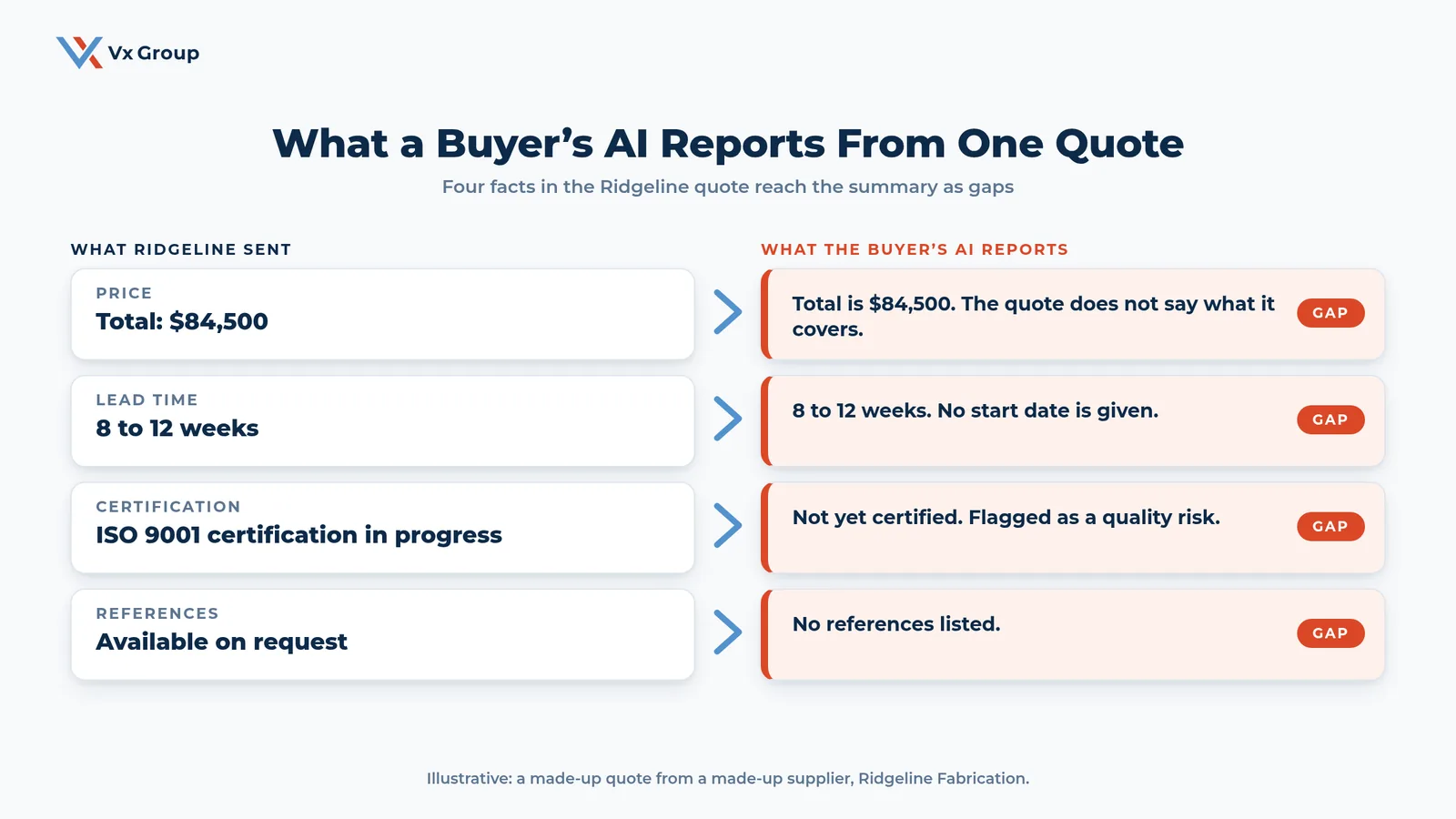
The graphic uses a made-up quote from a made-up supplier, Ridgeline Fabrication. The left side is what Ridgeline sent. The right side is what a buyer’s AI reports back. Four items show up as gaps: no price breakdown, a lead-time range, a certification still in progress, and references only on request.
Each gap costs you. A buyer comparing four suppliers moves on to the one whose summary has no gaps. The buyer rarely calls to ask what you meant.
We cover how buyer AI tools choose suppliers in our guide on AI in procurement. This guide goes deeper on the proposal itself.
How can you test your last sales proposal the way a buyer's AI reads it?
Test your proposal by pasting it into an AI assistant and reading the summary. The test takes 20 minutes and shows you what a buyer sees before they ever call. Use a proposal you lost, since you already know the outcome.
Pick one lost proposal and strip it to text
Choose a proposal from the last six months that went to a new account and lost. Open the file you sent, which is usually a PDF. Select all the text and copy it. If the text will not select, the buyer’s AI cannot read it either, and you have found your first problem.
Run four prompts in two assistants
Paste the text into two AI assistants. Ask each one these four questions, one at a time:
- Summarize this proposal in five sentences for a plant manager.
- What is the total price, and what does it include?
- When will this ship, and when does the clock start?
- What are the risks of choosing this supplier?
Using two assistants shows you which answers hold steady and which change.
Log every gap in one table
Make a simple table with four columns: the question, the answer the AI gave, the answer you would have wanted, and the fix. A wrong or missing answer is a fact your proposal left out or buried. Keep this log. It becomes your edit list for the next section.
For a related exercise on scoring your own company as a supplier, see our guide on supplier evaluation.
Ready to grow?
Bring us your last lost proposal and we will show you what a buyer’s AI saw on page one.
How do you build page one of a sales proposal?
Build page one around five facts, in this order: the buyer’s problem, the price, the lead time, your certifications, and two named references. A reader who stops after page one, human or AI, should be able to repeat all five.
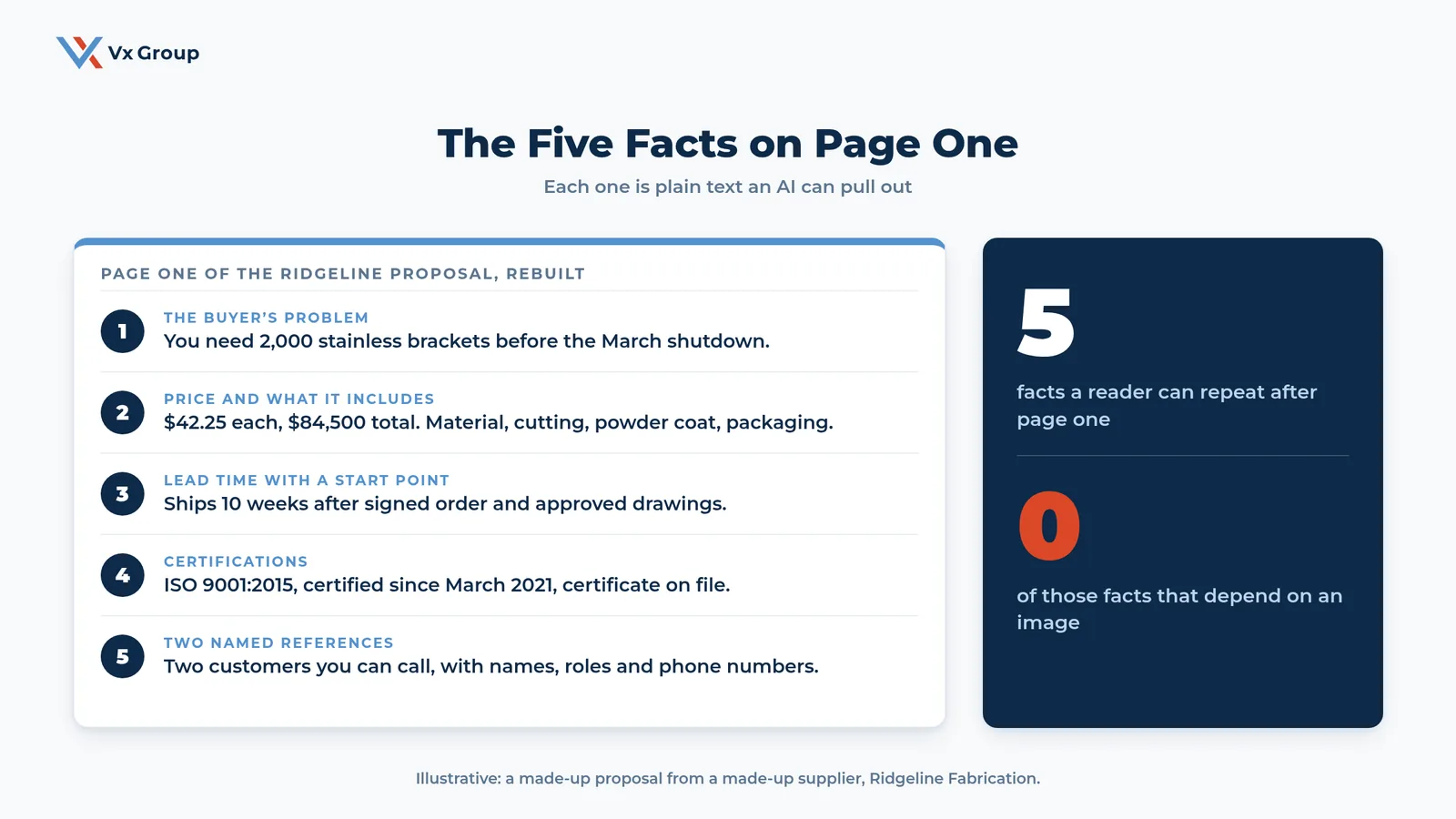
The mock-up shows the five blocks stacked on a single page. Each block holds plain text that an AI can extract. None of the five blocks depends on an image, a chart or a link to another document.
Open with the buyer's problem in their words
Start page one with two or three sentences that restate the buyer’s problem in the words they used in your meetings. Quote their email if you can. For example: “You need 2,000 stainless brackets for the new washdown line, delivered before the March shutdown, with a finish that survives daily caustic cleaning.”
This shows the buyer that someone listened. It also gives the AI the context it needs to judge whether your answer fits.
State the price in text and list what it includes
Put the total price and the unit price in the first third of the page, written as text. List what the price includes in one short line: material, processing, finishing, packaging, tooling. State what it excludes, such as freight, in the same line.
A price in an image or a table saved as a picture is invisible to an AI. A bare total with no list invites the AI to guess what is included.
Give lead time as a number with a start point
Write lead time as one number and name the day it starts. “Ships 10 weeks after we receive your signed order and approved drawings” is a complete statement. “8 to 12 weeks” leaves the summary to pick a number, and it often picks the longer one.
If your real lead time varies, say what it depends on. “10 weeks for standard finish, 12 weeks if you choose the custom color” gives two numbers and a reason.
Publish certifications with the standard, the number and the date
Write each certification as a standard, a status and a date: “ISO 9001:2015, certified since March 2021, certificate on file.” Add where the buyer can verify it. “In progress” gives the summary nothing to report except a risk. If a certification is pending, give the audit date.
Name two references the buyer can call
List two customers by company, role and phone or email, with their permission. Add one line on what you did for each. Two named references work better than ten logos. An AI can pass the names along, and a buyer can pick up the phone.
How do you explain your price before a buyer's AI guesses at it?
Explain your price in two sentences placed right under the number. The first sentence says what drives the price. The second says what the buyer gets for it. When you leave out the explanation, an AI compares your total to the other quotes and treats the difference as the story.
Here is an illustrative example for the Ridgeline brackets. Suppose a competitor bids $71,000 and Ridgeline bids $84,500.
“Our price of $42.25 per bracket covers 11-gauge 304 stainless, laser cutting, bending, powder coat and export packaging. The 11-gauge material holds its finish in daily washdown use. The price also includes a first-article inspection report before the full run ships.”
That explanation gives the AI three facts it can use when it compares the two bids: the material, the finish and the inspection report. Without it, the summary says “Ridgeline is 19% higher” and stops there.
Show the price in a short table when a job has several parts
If the job has several line items, add a small table with the item, the quantity, the unit price and the line total. Put one sentence above the table that names what the table shows. Keep it to ten rows or fewer. Longer price lists belong in an appendix with its own heading.
Say what changes the price
List the two or three things that would move the number: quantity breaks, material surcharges, rush dates. “Price holds for 30 days. Orders above 3,000 units drop the unit price to $39.80.” Specific triggers show the buyer that someone built the number and can defend it.
How do you write proposal terms an AI can read?
Write proposal terms as numbered sections, define each key word once, and attach a number or a date to every obligation. An AI summarizing your terms can then report them exactly. A vague term like “reasonable efforts” is reported as vague, and the buyer’s lawyer notices the same thing.
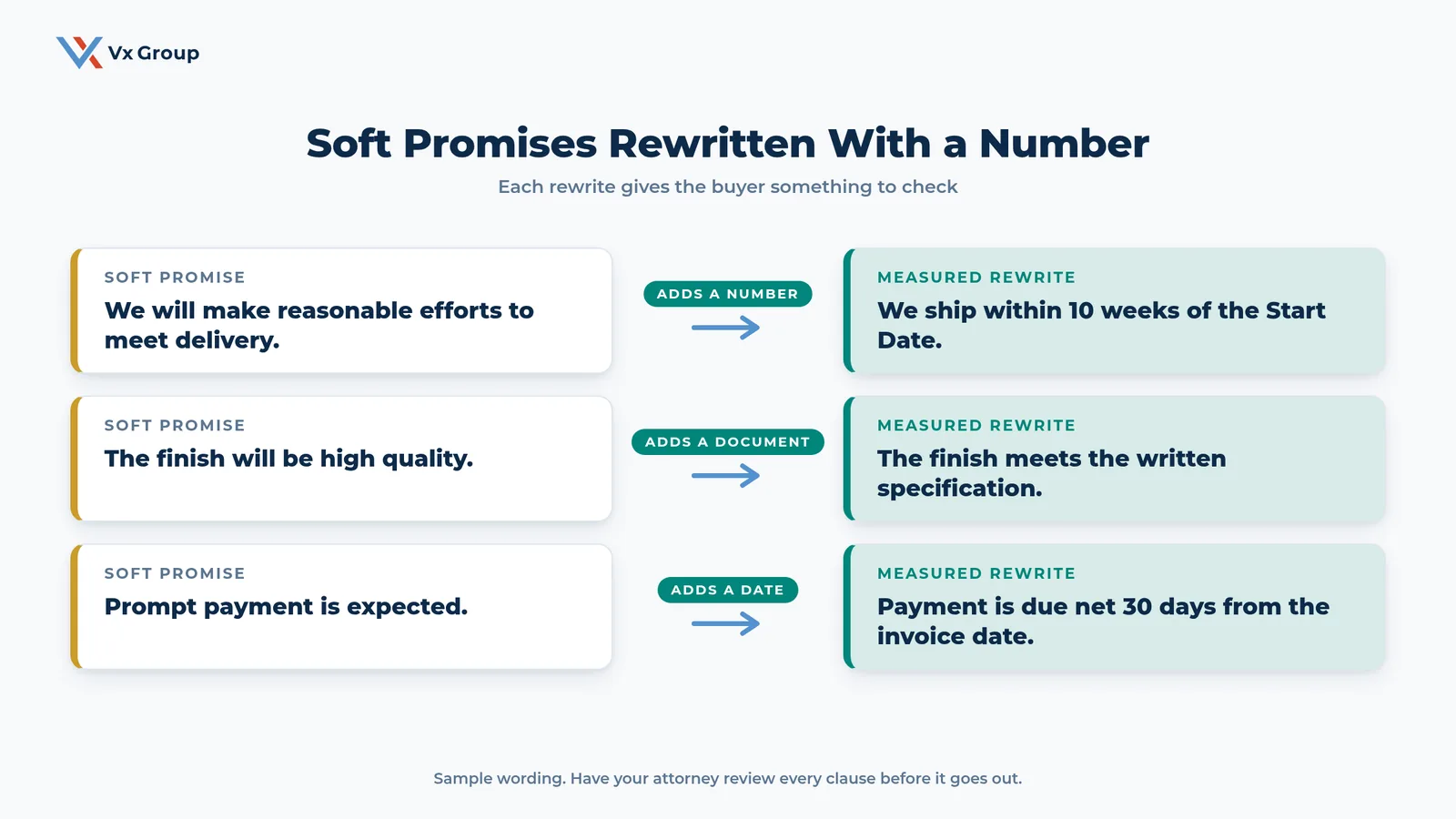
The graphic pairs three vague phrases with their measured versions. In each pair, the right side names a number, a date or a document that anyone can check.
Number every section and keep each one short
Number the sections 1, 2, 3 and so on, and keep each section to a single topic: scope, price, delivery, acceptance, payment, warranty, changes. Short numbered sections let the AI quote one clause exactly, and they let your buyer’s lawyer find it fast.
Define each key term once, in a short list
Open the terms with a list of defined words and use them the same way throughout. Four definitions do most of the work:
- Start Date: the day we receive your signed order and approved drawings.
- Delivery Date: the day the order leaves our dock, as shown on the bill of lading.
- Acceptance: the buyer confirms in writing that the goods meet the written specification, or 10 business days pass without a written objection.
- Specification: the drawing and revision number listed on page one.
Replace every soft promise with a number
Search your terms for “reasonable,” “promptly,” “best efforts,” “industry standard” and “high quality.” Replace each with a number, a date or a named document. A sample rewrite: “We ship within 10 weeks of the Start Date. For each full week of delay that we cause, we credit 1% of the order value, up to 5%.”
Your attorney should review every clause before it goes out. The point of the exercise is to make each clause checkable, and your attorney decides what you can promise.
Keep legal terms in the proposal body as text
Some manufacturers attach terms as a scanned PDF or link to a page on their site. A buyer’s AI may skip both. Paste the terms into the proposal body as text, and link the longer legal document for reference.
What does a Ridgeline proposal look like before and after the rewrite?
A rewritten Ridgeline page one swaps four gaps for four facts. The table compares the made-up original with the rebuilt version, one element at a time. Every figure here is illustrative.
| Element | Before | After |
|---|---|---|
| Buyer’s problem | “Thank you for your inquiry.” | “You need 2,000 stainless brackets for the new washdown line before the March shutdown.” |
| Price | “Total: $84,500” | “$42.25 per bracket, $84,500 for 2,000. Includes material, cutting, bending, powder coat and packaging. Freight is extra, about $2,150.” |
| Lead time | “8 to 12 weeks” | “Ships 10 weeks after signed order and approved drawings.” |
| Certification | “ISO 9001 certification in progress” | “ISO 9001:2015, certified since March 2021, certificate on file.” |
| References | “Available on request” | “Two customers you can call, with names, roles and phone numbers on this page.” |
A buyer’s AI now reports the second version in a single clean sentence: Ridgeline offers 2,000 brackets at $84,500, with the contents of the price listed, a 10-week ship date from a defined start, a current ISO certification and two references. The summary has no gaps to flag.
The rebuilt page also gives the owner something to defend. When the buyer asks why the price is higher than the competitor’s, the answer is already on page one.
How should you send the sales proposal?
Send the proposal as text in the body of your email and as a PDF with selectable text. Name the file after the buyer and the job. Copy every person on the buyer’s side that you know about, since each of them may run their own summary.
Paste the page-one summary into the email body
Copy the five page-one facts into the email itself, above your signature. Anyone who reads only the email, or who asks an AI to summarize it, gets the full picture without opening the attachment.
Check that the PDF text selects and copies
Open the PDF, select a paragraph and paste it into a blank document. If the text comes out garbled or missing, export the PDF again from the original file and skip the scanner. The same check applies to your product catalog, which we cover in our guide on PDF SEO.
Name the file so it makes sense in a list
Use a file name such as “Ridgeline-Fabrication-Proposal-Acme-Foods-Brackets.pdf.” A buyer with six proposals in a folder can tell yours apart at a glance, and an AI reading file names gets the topic for free.
Follow up with one useful fact
Send a short note a few days later with one fact the buyer may not have, such as a finished sample photo or a lead-time update. Our guide on the sales follow-up email covers what to send after the first meeting.
What mistakes make a sales proposal lose?
Most proposals lose on a small set of repeat mistakes. Each of them is easy to fix once you can see it.
- Putting the proof at the back. Case studies and references on page eight never reach the summary. Move them to page one.
- Using a range for lead time. “8 to 12 weeks” invites the buyer to plan around 12.
- Saving key facts as images. Price tables, certification badges and spec sheets pasted as pictures are invisible to AI.
- Stuffing the page with keywords. A 2024 KDD paper on generative engine optimization found that adding figures, quotations and cited sources made pages more visible in AI answers, and repeating keywords made them less visible. Write facts a buyer can check. Our guide on keyword stuffing explains the study.
- Leaving terms vague. “Reasonable efforts” cannot be summarized or enforced.
- Sending to one person. The buyer’s team forwards the proposal, and each forward adds a summary you never see.
- Skipping the follow-up. A proposal with no next step sits in an inbox. End page one with a date for a call.
Where should an owner start this week?
Start with one lost proposal and an hour. Paste it into an AI assistant, read the summary, and rewrite page one with the five facts. Then ask your sales lead to use the new page one on every proposal for the next month.
- Monday: Pull your last three lost proposals and run the four prompts on each.
- Tuesday: Write your two-sentence price explanation and your standard lead-time sentence.
- Wednesday: Ask two customers for permission to be named references.
- Thursday: Replace every soft promise in your terms with a number, then send the terms to your attorney.
- Friday: Rebuild page one on your next open proposal and test it again.
If your proposals pass through several hands, a mutual action plan keeps the buyer and your team working from the same document. For the longer view of how deals move, see our guide on sales cycle stages.
Ready to grow?
Send us a proposal that lost, and we will tell you what a buyer’s AI made of it.
FAQs
About the Author: David Tisdale
