

Building Relationships With Customers in B2B Manufacturing

Building relationships with customers in B2B manufacturing means setting up a repeatable way for your team to know, contact, and serve each customer. Name an owner for every account, write down what you know, set how often each customer hears from you, and review the top accounts every quarter. Then the relationship stays when a salesperson leaves.
TL;DR
- A customer relationship built by one person leaves when that person does. A relationship built by a system stays.
- Sort customers into three tiers. Give each tier a different level of attention.
- Name one owner and one backup for every customer in the top two tiers.
- Keep a one-page record for each top customer: who you know, what they buy, what they care about, and what you owe them.
- Set a contact rhythm for each tier and count only real conversations as contact.
- Review the top 10 to 15 relationships every quarter with five health signs.
Most owners can name the customers who matter most. They know the buyer’s first name, the last time they visited the plant, and which hockey team the purchasing manager follows. That knowledge is real, and it has value.
It also sits in one or two heads. When the salesperson who holds a relationship retires, takes a new job, or gets pulled onto another project, the customer notices within a quarter. Orders slow down. A competitor gets a meeting. Nobody can say exactly what was lost, because nobody wrote down what was there.
This guide is for owners and presidents of privately held manufacturers with roughly $5M to $50M in revenue. It lays out six steps to build customer relationships on purpose, so they survive turnover and grow over time. Most of the work takes an afternoon to start and a few hours a month to keep up.
What does building relationships with customers mean in a B2B company?
Building relationships with customers in a B2B company means knowing the people at each customer, understanding what they need, staying in regular contact, and keeping promises over many years. The goal is trust that lasts across orders, projects, and personnel changes at both companies. A good relationship makes the next ten sales easier.
Most advice on this topic comes from consumer businesses. It tells you to listen more, send thank-you notes, and remember birthdays. Those habits are fine. They skip the problem a manufacturer faces. A handful of customers account for a large share of revenue. Each one has several people in the buying decision. The relationships run for years.
Defined Term: Customer relationship system.
A written, shared way of managing customer relationships. It names who owns each relationship and records what the company knows about each customer. It sets how often each customer hears from the company. It reviews the health of the top accounts on a schedule.
A system protects the human side of selling. A salesperson who knows a buyer’s habits and concerns is doing work no system can do. The system makes sure that knowledge is shared, so the company keeps it when the person moves on.
Vx Group calls the opposite situation founder-dependent sales: growth that lives in one person’s relationships and cannot survive without them. Our article on founder-dependent sales covers what it costs. The steps below are the fix.
Step 1: Sort your customers into three tiers
Sorting your customers into three tiers tells you where relationship effort belongs. Your top customers need an owner and a close watch. Your core customers need a named salesperson. Everyone else needs reliable service and a way to reach you. Without tiers, effort goes to whoever calls loudest.
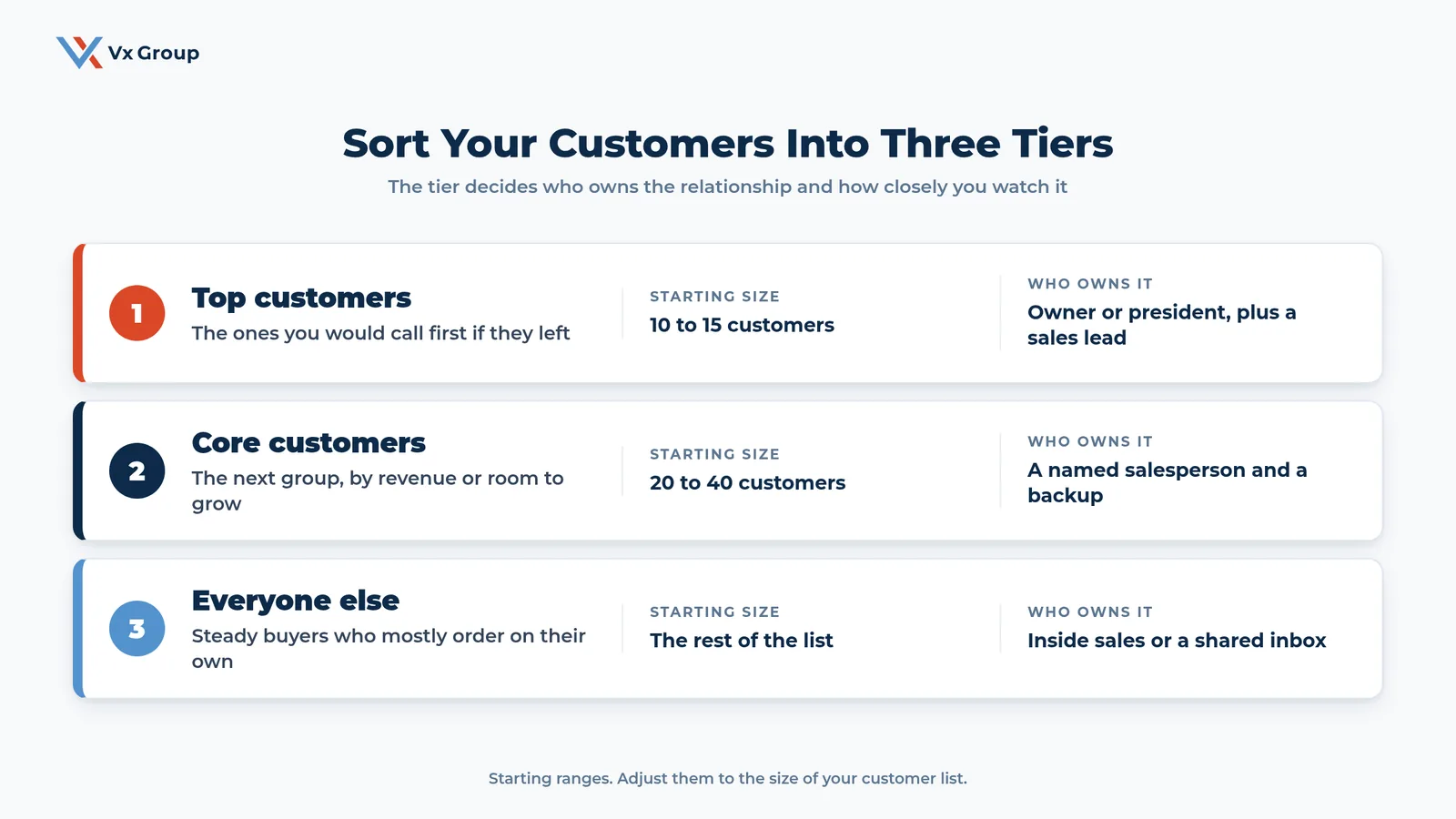
The graphic above shows the three tiers. The top tier holds the 10 to 15 customers you would call first if they left, and an owner or president plus a sales lead owns each one. The core tier holds the next 20 to 40, each with a named salesperson and a backup. The third tier holds everyone else, served by inside sales or a shared inbox.
Pull the last two years of revenue by customer
Ask your finance lead for a list of every customer with revenue for each of the last two years. Put it in a spreadsheet and sort it by the most recent year. You will see two things quickly: how much revenue sits in your top ten, and which customers are growing or shrinking.
If your top ten make up a large share of revenue, you have a concentration question as well as a relationship question. Our guide to customer concentration risk covers how to size it.
Move customers up for room to grow
Revenue alone can mislead. A customer who spends $400,000 with you and $4 million with your competitors deserves more attention than one who spends $400,000 and buys everything from you. Add a column for your estimate of what each customer spends in your product area in total. Move any customer with a large gap into a higher tier. Our article on share of wallet explains how to estimate it.
Write each customer's tier on the list and share the list
A tier list that sits on the owner’s laptop does nothing. Put the tier next to each customer name in your CRM or the shared sheet your team already uses. Tell the sales team how the tiers were set. People accept a ranking when they understand the reasons for it.
Step 2: Name one owner and one backup for every top and core customer
Naming an owner and a backup for every top and core customer puts a name on each relationship. The owner is accountable for the health of the relationship. The backup knows the customer well enough to step in on short notice. Two people who know the customer is the minimum for any account that matters.
Write the owner list
Make a two-column list with each top and core customer and the name of the person who owns the relationship. If you have a customer with no clear owner, assign one this week. If the owner is you, say so on the list. Many owners hold three or four of their largest relationships personally, and that is a fine decision when it is written down and has a backup.
Pick a backup who has met the customer
A backup who has never met the customer is a name on a list. Choose someone who has been on at least one call or visit, and add a joint touchpoint to the next two contacts. A short call where the owner introduces the backup takes ten minutes. The customer hears that the company has depth.
Plan for the day the owner leaves
Write a one-page handoff plan for the top tier. It answers three questions: who takes over, who introduces the new owner to the customer, and what the customer hears in the first week. Run the plan against the customer record from Step 3, so the new owner starts with years of context instead of a blank page.
Our guide to building an infinite team that survives key-person loss covers the same idea for the whole company.
Field Notes:
A composite example. A custom parts manufacturer had one salesperson who handled its largest customer for 14 years. When the salesperson retired, the buyer’s emails went unanswered for nine days because nobody knew the buyer’s preferred contact method. The plant manager at the customer had also been dealing with the retiring salesperson directly. The company had to rebuild both relationships from scratch. A named backup and a one-page record would have covered the gap.
Step 3: Write down what you know about each top customer
Writing down what you know about each top customer turns personal knowledge into company knowledge. A one-page record holds the people, the purchases, the priorities, the last real conversation, the promises you have made, and the next step with a date. It takes about 30 minutes per customer to start. After that it takes a few minutes after each contact.
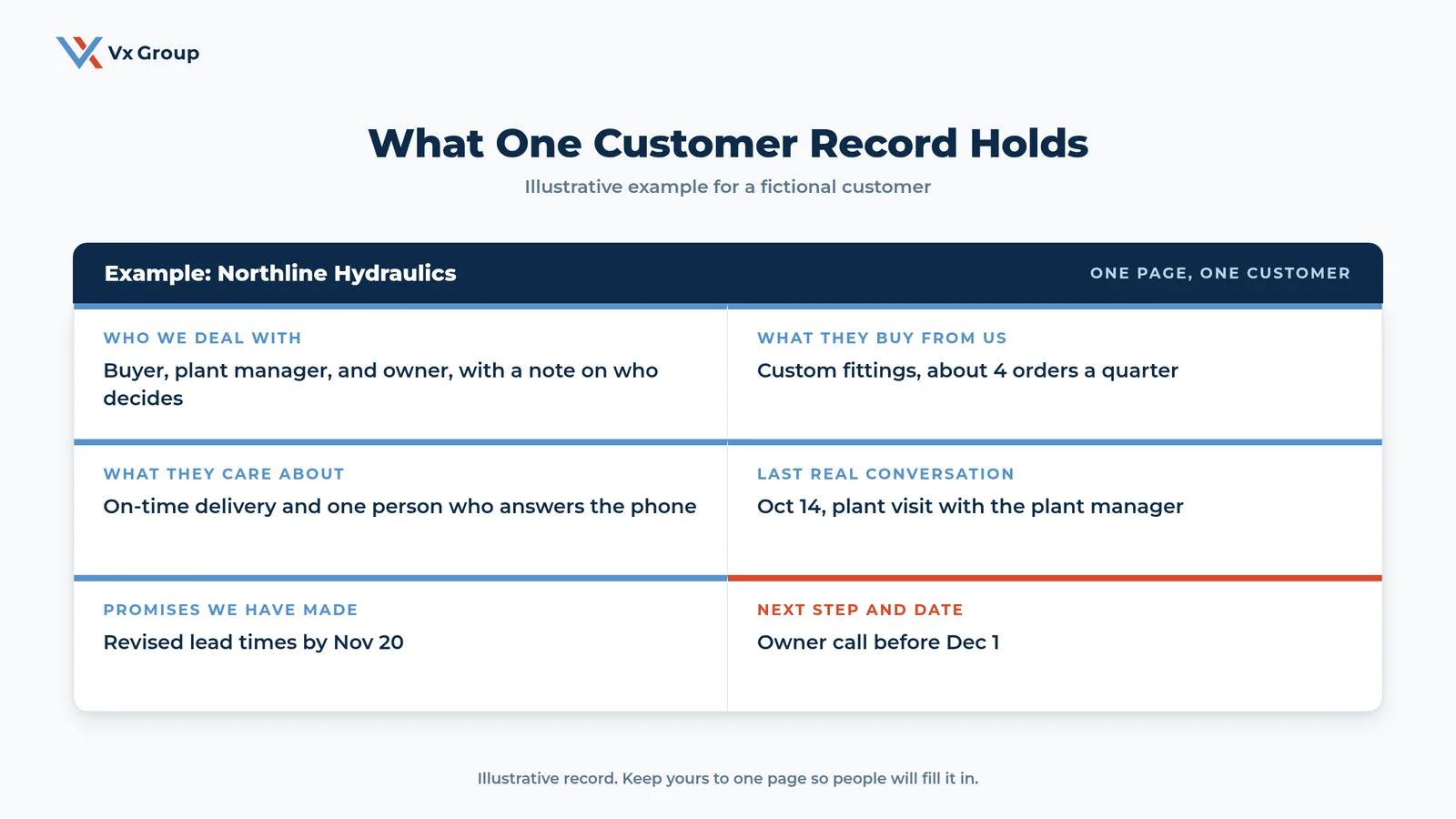
The graphic above shows an example record for a fictional customer. It has six fields. The last two do the most work: “promises we have made” prevents dropped commitments, and “next step and date” keeps the relationship moving between visits.
Build the record around six fields
Use the six fields shown above. Keep each entry to a sentence or two. A record that takes ten minutes to fill in will stay empty. If your CRM has a notes field, use a template there. If your CRM is mostly empty today, start with a shared document and move the records over later. Our article on why your CRM is empty covers how to fix that.
Ask the owner to write the first version
The owner of each top relationship writes the first record. It will be incomplete, which is useful. The gaps show you what the company does not know, such as who signs the purchase orders or what the customer’s own customers are asking for.
Add one line after every real conversation
After each real conversation, the owner adds one line: the date, who was there, and what was said. Do it the same day. The habit matters more than the length. Six months of one-line entries give a new owner the history of the account in five minutes.
Ready to grow?
If your top customer relationships live in two or three heads, we will help you build the owner list and customer records that keep them in the company.
Step 4: Set how often each customer hears from you
Setting how often each customer hears from you gives every tier a contact rhythm. It also sets a rule for what counts as contact. A top customer hears from you every month. A core customer hears from you every quarter. Everyone else hears from you twice a year. Only a real conversation counts. A mass email or an automatic order confirmation does not.
| Tier | Contact rhythm | What counts as contact | Who checks it |
|---|---|---|---|
| Top customers | Every month, plus a visit or video call each quarter | A conversation with a decision maker or an influencer | The owner or president |
| Core customers | Every quarter, plus a call after any large order | A phone call, visit, or personal email with a reply | The sales lead |
| Everyone else | Twice a year | A short call or a personal note | Inside sales |
Count real conversations only
A real conversation is one where the customer talks and you listen. A shipping notice, a newsletter, and a price list are useful, and none of them count. If you cannot say what the customer told you in a contact, it was an announcement. Track real conversations separately, with a date in the customer record.
Give each contact a reason the customer values
Contact with no reason to call feels like a sales check-in, and busy buyers dread those. Bring something useful each time. Good options are a lead-time update before they ask, a note about a supplier change that could affect them, an introduction to someone in your network, or a question about their plans for next year. The best contact reason is a question that helps you serve them better.
Spread contact across more than one person
The monthly contact for a top customer does not have to be the owner every time. Rotate in the backup, an applications engineer, the plant manager, or the owner of your company. A customer who hears from four people at your company has four reasons to stay. A customer who hears from one has one.
Use the calendar as the system
Put the next contact date for each top and core customer on a shared calendar or in the CRM as a task. A reminder you cannot ignore works better than good intentions. Review the list of overdue contacts at your weekly sales meeting. Five minutes is enough.
Step 5: Review your top relationships every quarter
Reviewing your top relationships every quarter keeps problems small. Hold one 45-minute meeting with the owners of the top 10 to 15 accounts. For each account, take two minutes to answer five questions. When did we last talk? Who do we know there? Are orders up or down? How fast do we answer? What have we promised? Then decide one action per account.
Our guide to running a quarterly business review customers want to attend covers the version you hold with the customer. The internal review described here comes first. It tells you what to bring to the customer meeting.
Run the review with the same five questions each time
Using the same questions every quarter lets you see trends. A customer who was “healthy” two quarters ago and is on “watch” now gets attention before they leave. Keep the notes in the customer record.
Pick one action per account
Every account leaves the review with one action, one owner, and one date. Examples: schedule a plant visit, introduce the backup, send the revised quote, call the owner of the customer’s company. If an account has nothing to do this quarter, write that down as well. It means the relationship is healthy.
Escalate accounts in the "act now" column
If an account hits “act now” on two or more signs, the president calls the customer within a week. The call has one purpose: to find out what has changed. Our guide to customer retention strategies covers what to do with what you learn.
How do you measure the health of a customer relationship?
You measure the health of a customer relationship with five signs. They are the time since the last real conversation, the number of people you know there, whether orders are up or down, how fast you answer questions, and how many promises are overdue. Rate each sign healthy, watch, or act now. Two or more “act now” ratings means the account needs a call from the president.
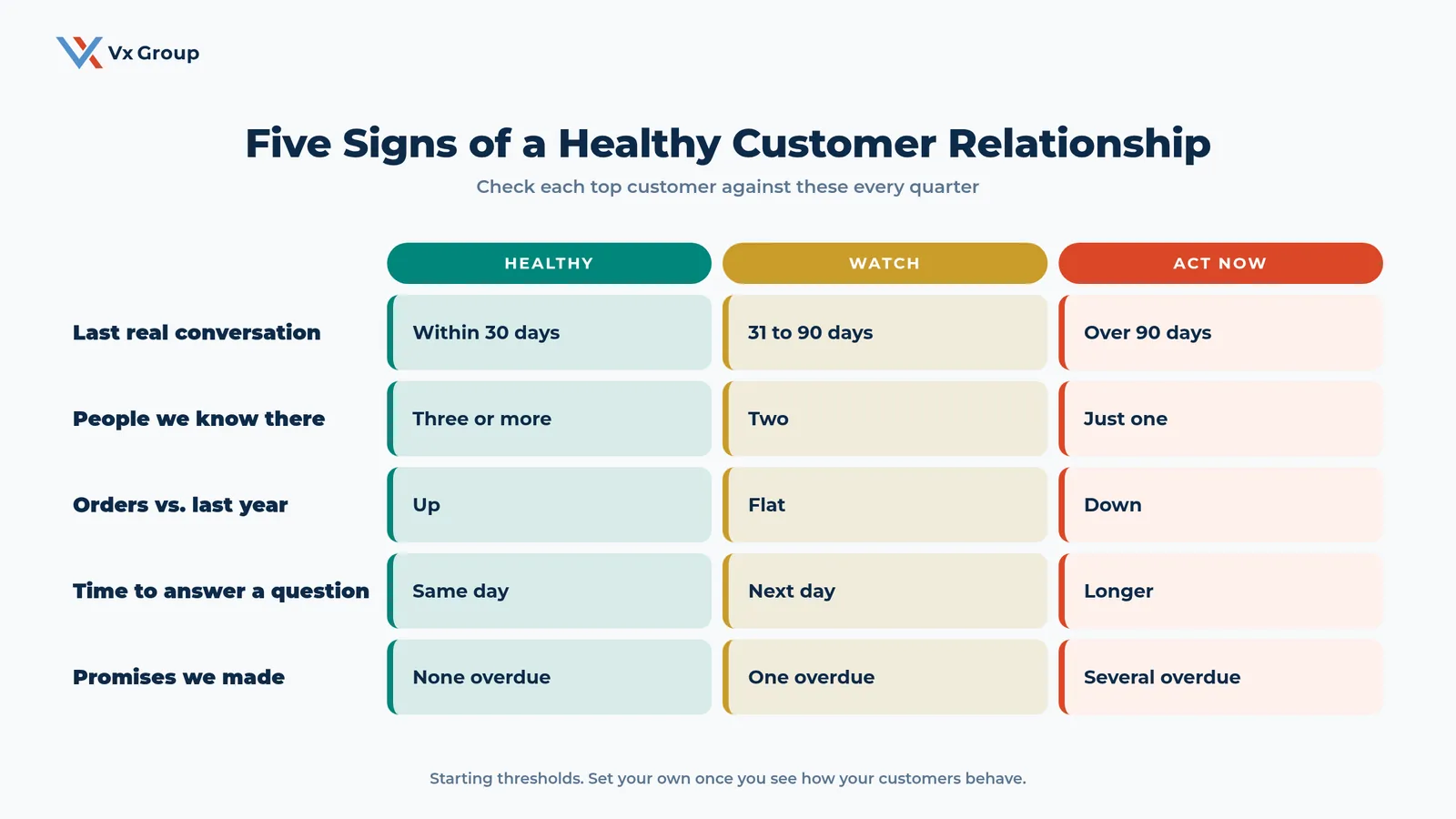
The graphic above gives starting thresholds for each sign. A customer you spoke with within the last 30 days, know three or more people at, and have not let down on any promise rates healthy on those three. A customer you have not spoken with in over 90 days, and know only one person at, rates “act now” on both. Set your own thresholds after your first two reviews. A plant that orders every week has a different normal than one that orders twice a year.
Watch the number of contacts first
The number of people you know at a customer is the sign owners tend to overlook. One contact means one point of failure on their side as well. If your buyer changes jobs, your relationship goes with them. Aim for at least three: a buyer, a user such as an engineer or plant manager, and someone senior.
Read order trends with the customer's calendar in mind
A drop in orders can mean many things: the customer’s own sales slowed, a project ended, or a competitor won a part. Ask before you assume. The owner should know which of these applies from the customer record. If nobody knows, that gap is the finding.
Add a revenue measure once the habit is in place
After two or three quarters, add a number that links relationships to results, such as net revenue retention. Our guide to net revenue retention explains how to calculate it. Start with the five signs above because they warn you earlier than revenue does.
What mistakes weaken customer relationships?
Four mistakes weaken customer relationships in B2B manufacturing. Companies rely on one person per account, call customers only to sell, track activity, and start a system the team cannot keep up. Each one has a simple fix.
- One person holds the account. Fix it with a named backup and a record, as in Steps 2 and 3.
- Contact only happens at quote time. Fix it with the contact rhythm in Step 4 and a reason to call that has nothing to do with a sale.
- The team logs calls and emails. Counting activity says little about the relationship. Count real conversations and write down what the customer said.
- The system is too big. A 40-field record and a monthly report for every customer will die by March. Start with the top 10 to 15 customers and six fields.
One more mistake deserves its own mention: leaving the owner out. If you own the company, you are probably the strongest relationship holder at your top three or four customers. Put your name on those accounts and set your own contact dates. Customers notice when the owner calls.
How long does it take to build a customer relationship system?
A basic customer relationship system takes about 90 days to set up. The first 30 days cover the tier list, the owner list, and the first round of customer records for the top 10 to 15 accounts. Days 31 to 60 cover contact dates and the first quarterly review. Days 61 to 90 cover the backup introductions and the core tier.
| Days | What to finish | Who does it |
|---|---|---|
| 1 to 30 | Tier list, owner list, first records for top customers | Owner, sales lead, finance lead |
| 31 to 60 | Contact dates set, first quarterly review held | Account owners, sales lead |
| 61 to 90 | Backups introduced, core tier records started | Owners and backups |
After 90 days, the system runs on a few hours a month. The first review shows which relationships need attention. The second shows whether the attention worked.
Where should an owner start this week?
Start with the tier list. Ask for the last two years of revenue by customer and mark the top 15. Next to each name, write the person who owns the relationship and the last date anyone had a real conversation with that customer. The blanks and the old dates show where the risk is.
Then pick the customer with the most revenue and the oldest contact date. Call the buyer yourself and ask one question: what should we do better for you next year? Write down the answer. That is the first line in the first customer record.
You do not need new software for any of this. A spreadsheet and a calendar will do. A simple system the team uses will work better than a complex one nobody opens. Our guide to key account management goes deeper on the largest accounts, and our article on account expansion covers how to grow the ones that are healthy.
Ready to grow?
Bring us your top customer list and we will help you set the owners, the records, and the contact rhythm that protect the relationships behind your revenue.
FAQs
About the Author: David Tisdale
