

Quality of Earnings Report for Manufacturers

A quality of earnings report is an independent check on whether a company’s reported profit will repeat. A financial firm rebuilds your earnings from the books, removes one-time items, fixes owner-related costs, and tests your customers. The result is a number buyers trust, called adjusted EBITDA.
TL;DR
- A quality of earnings report (QoE) tests whether your profit is repeatable. It ends in one number, adjusted EBITDA, and a buyer prices your company from that number.
- A QoE is different from an audit. An audit checks that the statements follow accounting rules. A QoE asks what the business will earn next year.
- Buyers adjust for one-time projects, owner pay, family arrangements, below-market rent, deferred maintenance, and customers who are leaving.
- The biggest surprise for most owners is how much revenue sits with one customer, and what that does to the final number.
- A seller can order a QoE before going to market. That gives the owner time to fix problems and keeps a buyer from using them to cut the price.
- Start 12 months before you sell. Clean monthly books, written proof for every add-back, and a clear read on your own customers do most of the work.
Most owners I talk to know their EBITDA to the dollar. They have known it for years. Then a buyer’s accountants spend six weeks in the books and hand back a different number.
The owner is often surprised. The buyer priced next year’s profit from the start, and last year’s number was only the starting point.
This guide is for owners and presidents of privately held manufacturers and distributors with roughly $5M to $50M in revenue. It is written for anyone who may sell in the next few years. It explains what a quality of earnings report checks, what buyers change, and how to get ready.
What is a quality of earnings report?
A quality of earnings report, often called a QoE, is a written analysis from an independent accounting or advisory firm. It answers one question: how much profit does this business make in a normal year? The firm starts with your reported numbers and adjusts them until they show the earnings a new owner could expect.
The work goes beyond the income statement. The firm tests revenue against cash received, checks costs against invoices, and looks at who your customers are and whether they are staying. It also reviews the latest few months, since buyers care most about where the business is heading.
Defined Term: Quality of earnings.
An independent review of reported profit that tests whether it is real, repeatable, and backed by cash. The review adjusts reported earnings for one-time items, owner-related costs, and changes in the customer base, and it ends in a figure called adjusted EBITDA.
A QoE is common in the sale of a company, and a lender may ask for one too. Many sellers now order their own before talking to buyers. The report is also called a QoE analysis or an earnings quality review. Those names all describe the same kind of work.
The report looks forward. A buyer asks whether this level of profit will show up again after the owner hands over the keys. The report is the evidence for that answer.
How is a quality of earnings report different from a financial audit?
A financial audit checks whether your statements follow accounting rules. A quality of earnings report checks whether your profit will repeat. The two reports use the same books and answer different questions. A company can pass an audit and still see its adjusted EBITDA come in well below reported EBITDA.
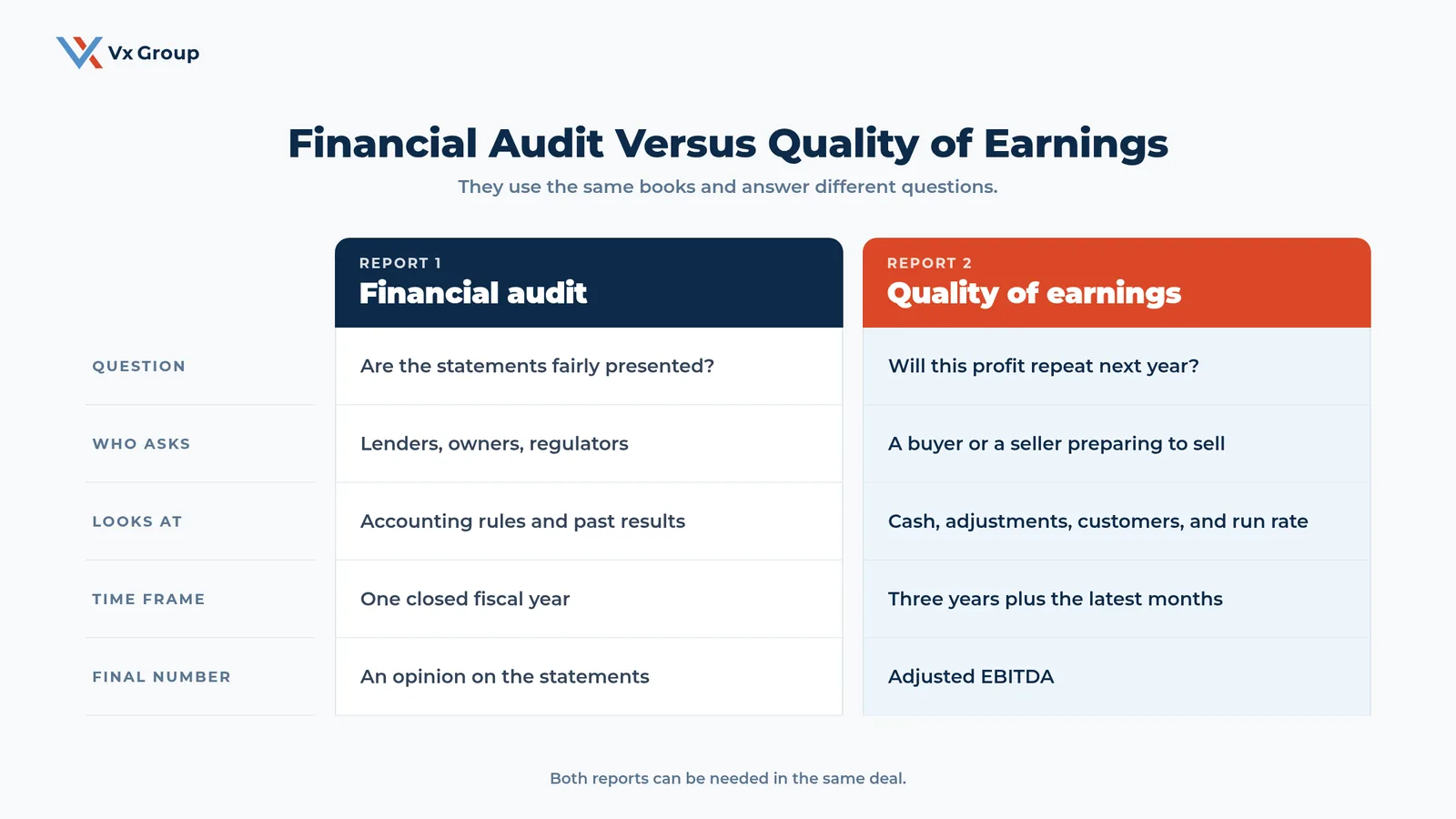
The graphic above lines up the two reports. An audit looks at one closed year and ends with an opinion on the statements. A QoE covers three years plus the most recent months and ends with adjusted EBITDA.
Here is why the difference matters to an owner. Suppose your largest customer told you in September that it is moving half its volume to another supplier. An audit of last year’s books will not mention it. A QoE should find it, because the firm looks at recent orders and asks about the customer list.
Many family-owned manufacturers have clean audited statements. Those owners often assume the sale price will follow from them. The buyer’s QoE can show a lower number, and the owner feels blindsided.
Both reports can be needed in the same deal. A lender may want the audit, and the buyer will want the QoE. Plan for both, and know which one sets the price.
Who orders a quality of earnings report, and when?
Buyers order a QoE after they sign a letter of intent. Sellers can order one earlier, before they go to market. Lenders sometimes ask for one as well. The buyer’s version protects the buyer. The seller’s version protects the price and the timeline.
The table below compares the two common versions.
| Buyer-ordered QoE | Seller-ordered QoE | |
|---|---|---|
| Who pays | The buyer | The owner |
| When it happens | After a letter of intent, inside the buyer’s review | Before the company goes to market |
| Main purpose | Confirm the price and find reasons to adjust it | Find problems early and support the asking price |
| Who sees it first | The buyer | The owner and advisors |
| Risk if skipped | Not applicable to the buyer | Surprises show up late and weaken the owner’s position |
A seller-ordered report gives the owner a head start. The owner learns what a buyer will find and has months to fix it. Our guide to sell-side due diligence covers the full seller preparation process, and the QoE is the financial part of it.
Timing also affects the deal. A late surprise gives the buyer room to bargain. A buyer who finds a problem in week five of a six-week review can ask for a lower price or a longer holdback. The owner has little room to push back.
What adjustments do buyers make to EBITDA?
Buyers adjust EBITDA for anything that will end under new ownership. They also restate any pay or charge between the owner and the company at the market rate. Each adjustment moves the number up or down. Most manufacturers see a mix of both, and the total usually lands below the reported figure.
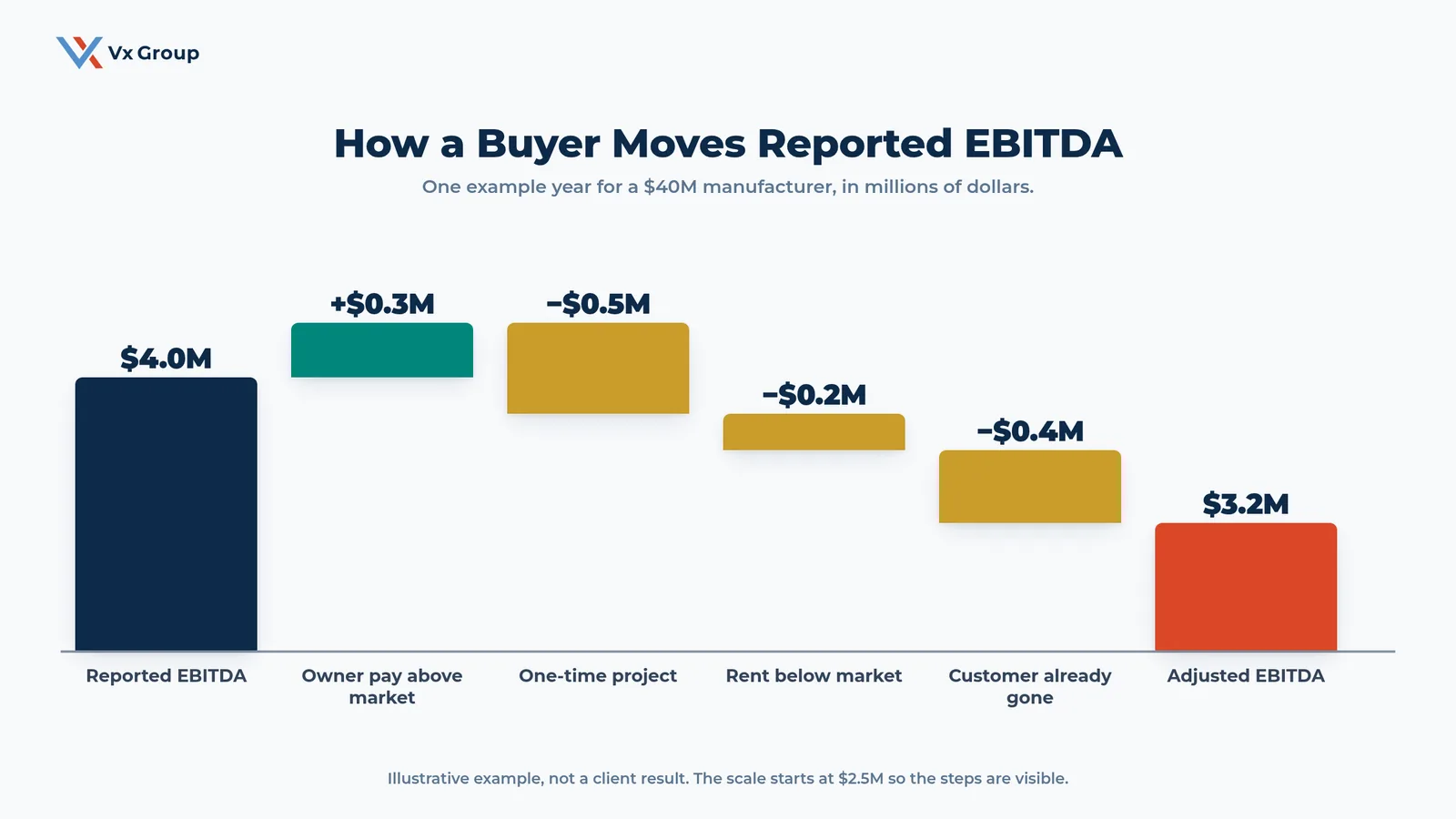
The graphic shows one example year. Reported EBITDA of $4.0M ends at $3.2M after four adjustments. One adjustment helps the owner and three reduce the number. The numbers are an illustration. Your own mix will differ.
Defined Term: Adjusted EBITDA.
Earnings before interest, taxes, depreciation, and amortization, after changes that remove one-time items and set owner-related costs at market rates. Buyers price a company from this number.
Defined Term: Normalization.
The process of restating a company’s earnings as they would look in a normal year under a new owner. Normalization adds back costs that will end and removes income that will not repeat.
Add back costs that will not continue
An add-back raises EBITDA because the cost ends with the sale. Common examples are a one-time legal settlement, a plant move, or a consultant hired for a single project. The firm will ask for invoices and a reason. A cost with no paper behind it will likely be removed from the add-back list.
Owners often list too many add-backs. A cost that shows up every year, even under a different label, usually stays in the numbers. Three years of “one-time” repairs look like normal repairs to a buyer.
Remove income that will not repeat
The same test works in the other direction. A large one-time order, a customer that finished a single project, or a gain from selling equipment all reduce the number. A buyer wants the earnings that will show up next year, so one-time income comes out.
Set owner and family costs at market rates
Many owner-led manufacturers pay the owner above or below what a hired president would earn. Family members may be on payroll. The building may belong to the owner and rent to the company at a low rate. Each of these gets restated at a market rate, and the effect can go either way.
Ready to grow?
Planning a sale in the next few years? Bring your last three years of numbers and your top 20 customers. We will help you see what a buyer will see.
What do the most common EBITDA adjustments look like?
The most common adjustments in a manufacturing QoE fall into six groups: owner pay, one-time revenue, related-party rent, deferred maintenance, customer changes, and unusual costs. Each one has a typical direction and a way to prove it. The table shows how each one moves the number.
| Adjustment | What the firm checks | Typical effect on EBITDA |
|---|---|---|
| Owner compensation | Pay compared to a hired president | Up if the owner is paid above market, down if below |
| One-time revenue | Large orders that will not repeat | Down |
| Related-party rent | Rent paid to an owner-controlled building | Down if rent is below market |
| Deferred maintenance | Repairs and equipment spending put off | Down, since the buyer must catch up |
| Customer changes | Lost, shrinking, or at-risk accounts | Down by the revenue and margin at risk |
| One-time costs | Legal, moving, or project costs with proof | Up when documented |
Keep each line of the table in mind when you review your own numbers. The adjustment you overlook is often the one a buyer finds first.
What does a quality of earnings report find that surprises sellers most?
The most common surprise is how much revenue sits with one customer. After that come a weak final quarter, profit that does not turn into cash, and owner costs the owner had stopped noticing. Each one changes the adjusted EBITDA, and the owner rarely sees it coming.
Check how much revenue sits with one customer
Buyers add up revenue by customer and look at the top five. A customer that makes up 25 or 30 percent of sales changes how a buyer sees the whole business. The question is what happens if that customer leaves. Our guide to customer concentration risk explains how to measure it.
Some owners call a large account rock solid. A buyer sees one purchasing manager and one contract. We call a customer like that a generational customer, and we wrote about the hidden risk in what is a generational customer.
Compare profit to cash
A company can report profit and still run short of cash. The firm compares earnings to cash collected, checks aging on receivables, and looks at inventory that is growing faster than sales. Gaps between profit and cash raise questions about how real the profit is.
Read the latest three months
Buyers care about momentum. The firm reviews the most recent months and compares them to the same months last year. A strong full year with a weak last quarter often leads to a lower price or a longer holdback.
Field Notes:
Picture a Wisconsin precision-parts manufacturer with $3.6M of reported EBITDA. The owner expected a buyer to price the company from that number. The QoE found that one customer made up about 31 percent of revenue and had qualified a second supplier. It also found a below-market lease on a building the owner held personally. Adjusted EBITDA came out near $2.9M. The owner had run the company well for 30 years and had never looked at the numbers this way. This is an illustrative composite based on patterns we see. No single client is described.
How much does a quality of earnings report cost and how long does it take?
Fees vary with the size of the company, the number of locations, and how clean the books are. For companies in the $5M to $50M range, firms commonly quote in the tens of thousands of dollars. Plan for four to eight weeks from kickoff to final report. Ask for a fixed fee in writing before you start.
Cost and timing both depend on how ready your records are. A company with monthly closes, reconciled accounts, and organized contracts moves faster and costs less. A company that closes its books once a year, in a spreadsheet, takes longer.
Three questions help when you pick a firm:
- Has the firm done work for manufacturers or distributors your size?
- Who will do the work, and how many hours will a partner spend on it?
- Will the report support a buyer’s review, or only your internal planning?
A report from a firm that buyers recognize carries more weight. Ask your banker or deal advisor which firms buyers in your industry trust.
How do you prepare for a quality of earnings report 12 months out?
Prepare over 12 months in four steps: clean the books, document every add-back, test your own customers, and run the report before buyers do. Each step takes a few weeks of effort spread across the year. The goal is an adjusted EBITDA you can defend line by line.
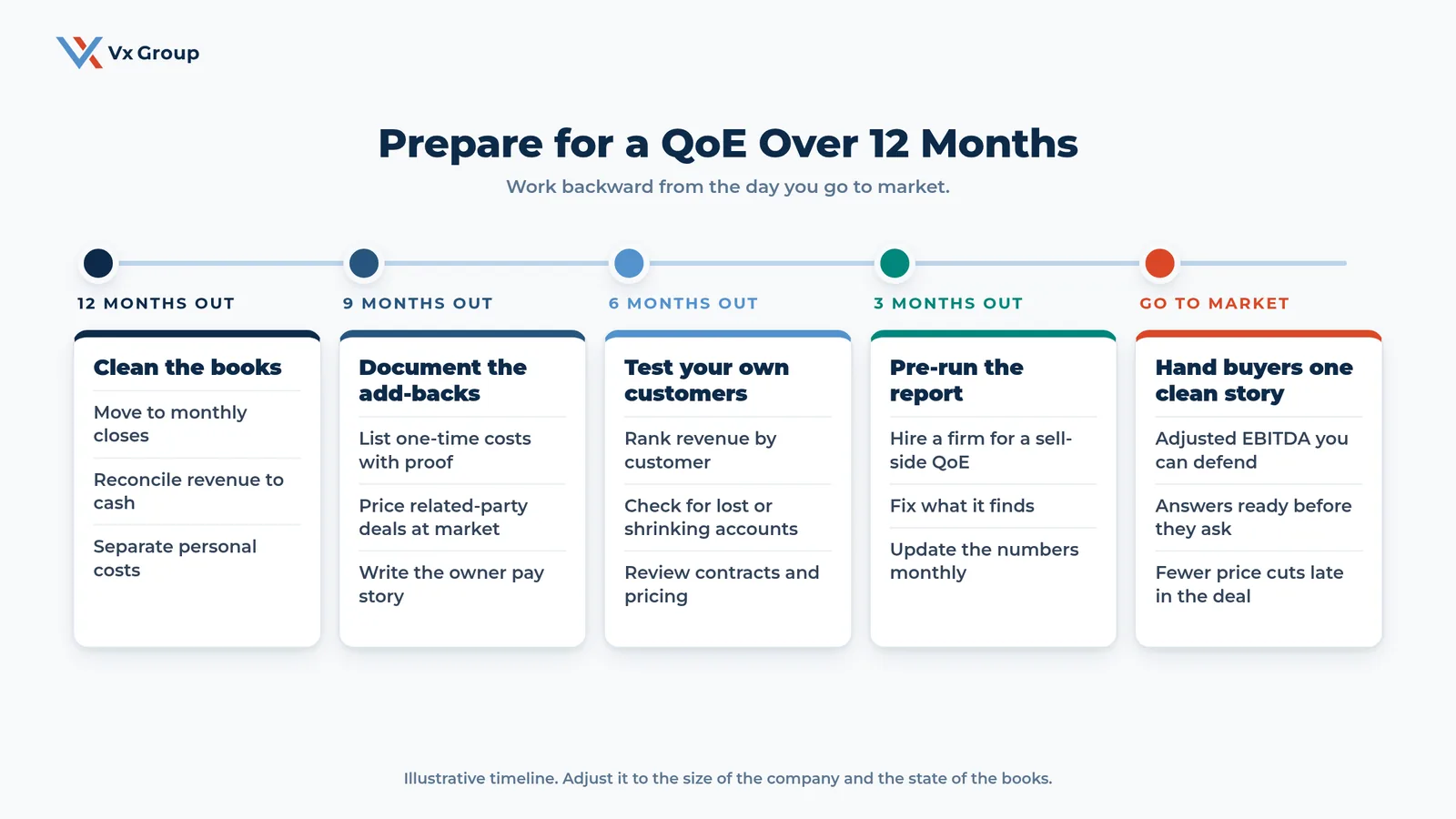
The graphic above shows the order. Books come first because every later step depends on numbers you trust. Customers come before the report because the report will ask about them. The timeline is illustrative, and a smaller company can compress it.
Move to monthly closes and reconcile revenue to cash
Ask your controller or outside accountant to close the books every month, with bank accounts and receivables reconciled. Set a due date, such as the 15th. Monthly numbers give a buyer confidence that the annual numbers are real.
Write a proof file for every add-back
Create one folder with a one-page list of add-backs. For each one, record the amount, the date, the reason, and the invoice or contract. A buyer’s firm will ask for exactly this. A list that is ready on day one saves weeks and builds trust.
Rank your own revenue by customer and score the risk
Sort three years of revenue by customer. For the top 10, note who owns the relationship, how many contacts you have there, and whether the contract is up for renewal. An account with one contact on each side is a risk. Our guide to key account management shows how to add contacts and protect the largest accounts.
Order a seller-side report and fix what it finds
Hire a firm to run a QoE about three months before you plan to go to market. Read the findings with your advisors. Fix what you can fix, and write the answer to what you cannot. Then update the numbers each month until a buyer arrives.
What mistakes do owners make with a quality of earnings report?
Owners make five common mistakes. They wait until a buyer asks, list add-backs without proof, ignore one large customer, mix personal costs into the company, and treat the report as paperwork. Each one weakens the final number or the owner’s position in the deal.
- Waiting for the buyer. The first look at your numbers happens inside a deal that already has a clock on it.
- Add-backs without proof. A buyer’s firm removes any add-back it cannot support with a document.
- Ignoring one large customer. A buyer sees that account on day one. Have a plan for it before then.
- Personal costs in the company. Vehicles, travel, and family payroll are fine to explain. They are hard to defend when they are hidden.
- Treating the report as paperwork. The report decides your price. Give it the same attention you would give a major customer negotiation.
Our guide to selling a manufacturing business covers what buyers look for and what they discount. The commercial side of a buyer’s review is in commercial due diligence. The QoE covers the financial side, and the two reviews overlap on customers.
Where should an owner start this week?
Start with two lists. The first lists your top 10 customers by revenue for each of the last three years. The second lists every cost that exists because of you. Include your pay, family payroll, personal vehicles, and rent on a building you own. Those two lists are about half of a QoE.
Then ask your controller one question: could we close the books by the 15th of each month? If the answer is no, that becomes your first project.
You do not need to sell soon for this work to pay off. Clean books, documented costs, and a clear view of your customers make a company easier to run and easier to borrow against. They also protect the business if the person who holds the numbers in their head leaves. Our guide to founder-dependent sales looks at that same risk on the sales side.
Ready to grow?
Bring your top customers and your cost list. We will help you build a plan that keeps your growth story as strong as your numbers.
If a buyer opened your books tomorrow, which number would they change first? And do you know which of your customers they would ask about before they ask you?
FAQs
About the Author: Eric Zoromski
