

How to Run Sell-Side Due Diligence Before a Buyer Runs It On You

Sell-side due diligence is the process of investigating your own company the way a buyer will, months before a buyer ever sees a document. You pull the financials, contracts, and operating details a buyer’s team will ask for, find the problems first, and decide how to fix or explain each one while you still have time to act on it.
TL;DR
- Sell-side due diligence means investigating your own business before a buyer does, while you still have time to act on what you find.
- The seller who skips this step finds out about their own problems from a buyer’s request list, at the worst possible moment to negotiate.
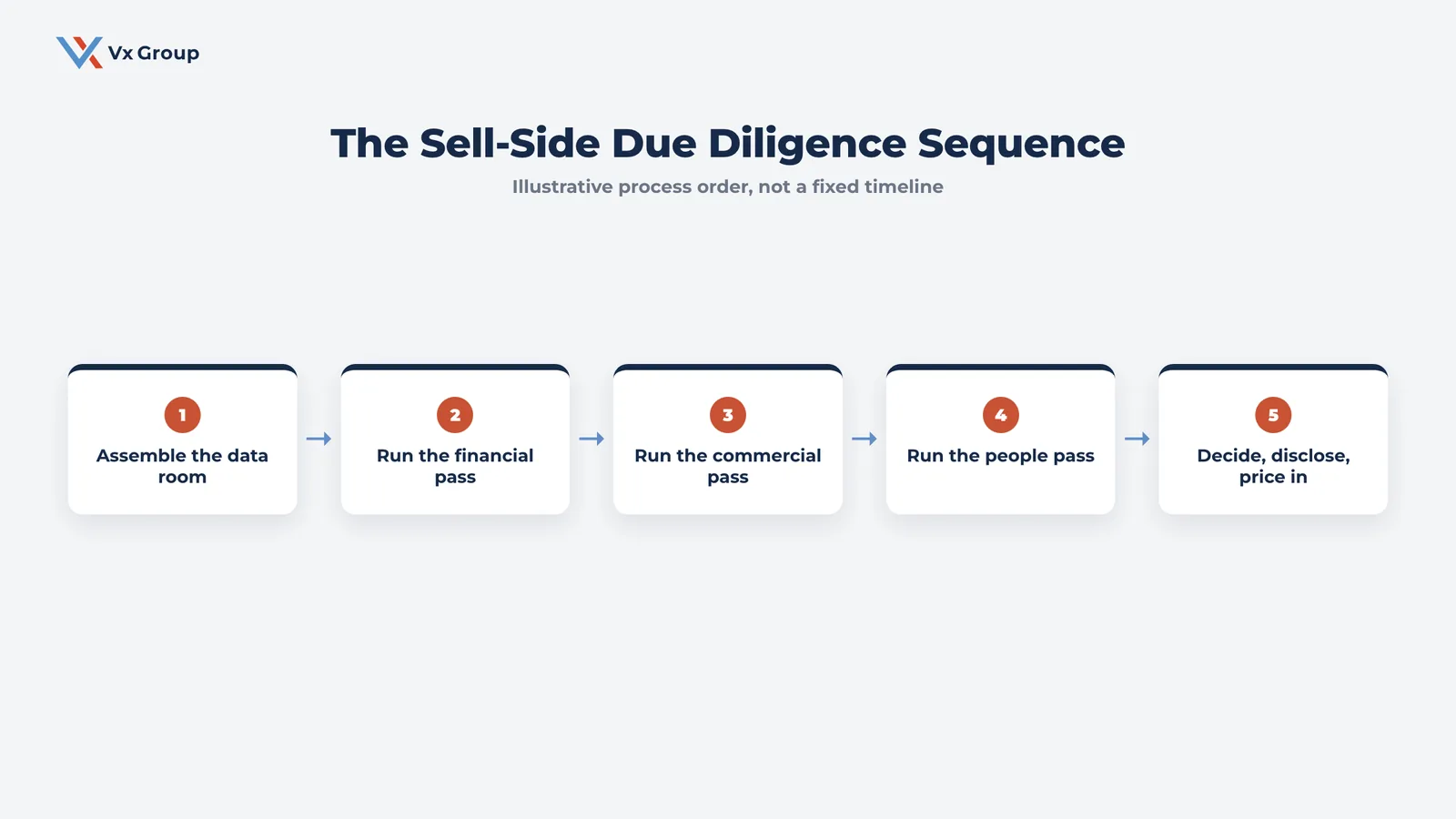
- Work through five passes in order: the data room, the financial numbers, the commercial picture, the people and operations, and then a plan for what to fix, disclose, or price in.
- A known issue disclosed early is a conversation. The same issue found later is a renegotiation.
- Build a diligence readiness checklist and assign an owner to every category before you talk to a single buyer.
Here is how this usually goes wrong. A company gets an offer, or gets close to one, and the owner starts collecting documents for the first time when the buyer’s advisor sends a list. That list runs eight or ten pages. Somewhere on page four is a question the owner has never had to answer out loud: how much of the revenue sits with one customer, whether that customer’s contract has an assignability clause, whether the number on the financial statement matches the number on the tax return. The owner does not know. Nobody flagged it, because nobody was looking for it until someone whose job is to look for it started looking.
That is the moment every ounce of leverage moves to the other side of the table. Once a buyer’s team finds a gap, the seller is no longer negotiating value. They are negotiating a discount, a price reduction, or a chunk of the purchase price held in escrow until the buyer feels safe again. Timing drives most of that cost. A problem found in week one of a process is a fact the two sides can work around together. The same problem found in week eight, after the buyer has already told their investment committee a number, reads as a reason to distrust everything else in the data room.
Sell-side due diligence flips that order. You find your own problems first, while you still have room to fix what can be fixed, price in what cannot, and decide exactly how and when to bring up what a buyer would eventually find anyway. The rest of this guide walks through the five passes, in the order that gives you the most room to act.
Step 1: Assemble the data room before you need it
Defined Term: Data room.
the organized set of financial, legal, commercial, and operational documents a seller makes available to a buyer’s team during due diligence. It used to be a physical room. Now it is almost always a secure online folder structure.
A data room built after a buyer asks for one is a data room built under pressure, with documents pulled from wherever they happen to live: an accountant’s inbox, a filing cabinet, a departed employee’s laptop. A data room built ahead of time is a document you control, and a first real look at where your own records are thin.
Build the document index first
Before you gather a single file, write a list of every category a buyer’s team will ask for. At minimum, that list should cover:
- Three to five years of financial statements and tax returns
- Customer contracts, purchase orders, and pricing agreements
- Supplier and vendor agreements
- Employment agreements, offer letters, and any non-compete or non-solicitation agreements
- Corporate records: formation documents, bylaws or operating agreements, cap table, board minutes
- Insurance policies and claims history
- Licenses, permits, and any regulatory filings specific to your industry
- Intellectual property registrations and any pending litigation
Flag what is missing while you can still fix it
For every category on that index, write down whether the document exists, where it lives, and who has it. Some of what you find will be minor: an old contract that was never renewed in writing, an insurance certificate that expired eighteen months ago and nobody caught it. Some of it will be bigger: a handshake arrangement with your largest customer that was never put on paper at all. Either way, you want to be the one who finds it, on a timeline where you can still get it fixed, signed, or explained before anyone outside the company sees the gap.
Assign an owner to every category
A data room with no owner drifts. Someone on your team, whether that is a controller, an office manager, or an outside advisor, should own each category and be responsible for keeping it current. This matters because due diligence rarely happens once. A buyer’s team will come back with follow-up questions for weeks, and a data room without a clear owner means those follow-ups sit unanswered while the deal clock keeps running.
Step 2: Run the financial pass a buyer will eventually run
This is where the bulk of a buyer’s scrutiny lands, and where the fewest sellers do real preparation before a process starts. A full breakdown of this financial workstream, often handled as a standalone quality of earnings review, deserves its own guide. For sell-side purposes, the goal here is narrower: know what a buyer will adjust before they tell you about it.
List every addback and be ready to defend it
Sellers routinely add back personal expenses, one-time costs, and owner compensation above market rate when presenting adjusted earnings. Every one of those addbacks needs a paper trail. If you cannot produce the invoice, the board approval, or the comparable market salary data behind an addback, expect a buyer’s advisor to challenge it and expect that challenge to reduce your number. Build a spreadsheet now that lists each addback, the dollar amount, and the backup document for each one.
Normalize working capital before someone else does it for you
Buyers adjust purchase price based on a normalized level of working capital, typically calculated as an average over the trailing twelve months. Sellers who have never modeled this get surprised by how much a working capital true-up can move the final number at closing. Run the calculation yourself, using the methodology a buyer is likely to use, so the number on offer day and the number at closing are close enough that nobody is negotiating a surprise.
Reconcile the numbers across every system that touches them
Pull the numbers from your accounting software, your bank statements, and your tax returns for the same period and check that they tie together. Differences are common and usually explainable: timing differences, cash versus accrual accounting, a bookkeeping correction that never got reflected everywhere. Sellers who catch these differences on their own can explain each one in a sentence. Sellers who first hear about them from a buyer’s accountant, mid-process, spend a week rebuilding trust over something that was fixable in an afternoon.
Ready to grow?
If you want a second set of eyes on your numbers before a process starts, this is the conversation to have.
Step 3: Run the commercial pass on customers, relationships, and contracts
Financial diligence tells a buyer what the business earned. Commercial diligence tells a buyer whether that earning power survives a change of ownership, and that second question is often the harder one to answer honestly.
Calculate how much revenue sits with your largest customers
Start with a simple table: your top ten customers, ranked by revenue, with each customer’s share of total revenue next to it. If one customer or a small handful account for a large share of the business, a buyer will treat that as risk and price it in, whether you disclose it upfront or they find it themselves. We have written a full breakdown of how customer concentration risk gets measured and what a buyer does with the number, and it is worth reading before you build this table.
Name who actually owns each key relationship
For every customer that matters to the business, write down who holds that relationship day to day. If the answer is “the owner” for most of your top accounts, that is exactly the kind of finding a buyer’s commercial advisor is trained to look for, because it raises the question of what happens to those relationships after the owner steps back. Our guide to commercial due diligence covers this question from the buyer’s side in detail, including how buyers score relationship ownership as part of their investigation.
Read every customer contract for assignability and change-of-control language
A surprising number of sellers have never read their own customer contracts closely enough to know whether those contracts survive an ownership change. Some contracts require customer consent before they can be assigned to a new owner. Some terminate automatically on a change of control. Pull every contract with a top-twenty customer and check for this language specifically. If a contract has a problem clause, you have time now to renegotiate it quietly, long before a deal is public.
Rank your contracts by quality alongside size
Build a simple table that scores each major contract on term length, renewal terms, pricing protection, and exclusivity. A short list of long, well-priced, auto-renewing contracts with your biggest customers is one of the most valuable things you can hand a buyer. A pile of month-to-month arrangements with no renewal language is a discount waiting to be applied.
Step 4: Run the operational and people pass
This is the pass sellers skip most often, usually because it is the hardest one to be honest about. It asks a version of a question every owner has to answer eventually: what happens to this business without you in it.
List who would leave if the business changed hands
Walk through your leadership team and your key operational staff and ask, honestly, who is likely to leave within a year of a sale. Some departures are expected and manageable. Others, especially a plant manager, a lead salesperson, or an operations lead who holds relationships or knowledge nobody else has, represent real risk to a buyer. You want this list before a buyer’s advisor builds their own version of it during interviews.
Write down who holds knowledge that exists only in someone's head
Every long-running business has a version of this problem: a process, a customer quirk, a vendor relationship, or a piece of institutional history that lives entirely in one person’s memory and nowhere in writing. List every instance of this you can find. Some of it you can document in weeks. Some of it, like a founder’s twenty years of customer relationships, cannot be fully transferred on paper and needs to be addressed through a transition plan instead.
Check whether the business depends on one person more than it should
We have written elsewhere about how founder-dependent sales show up in a growth business, and the same pattern shows up hard in a sale process. If most key decisions, most key relationships, and most institutional knowledge run through one person, a buyer will discount the price to cover the risk of that person leaving. Fixing this takes real time, often a year or more of deliberately spreading decisions and customer relationships beyond one person, so it has to start well before you go to market.
Document the processes that keep daily operations running
Write down, at a level of detail someone new to the company could follow, how your core operating processes work: how orders get fulfilled, how quality gets checked, how customer issues get resolved. A buyer’s operational advisor is checking for whether the business runs on documented process or on the accumulated memory of a handful of long-tenured employees. The more you can show the former, the less risk a buyer prices into the deal.
Step 5: Decide what to fix, what to disclose early, and what to price in
By this point you have a full picture of your own business the way a buyer’s team will eventually see it. Every finding from the first four passes falls into one of three buckets, and getting this sorting right is most of what separates a smooth process from a painful one.
Fix it now. Anything you can genuinely correct before a buyer sees it belongs here: an expired insurance certificate, a missing signature on a contract amendment, a bookkeeping reconciliation that needs an afternoon of work. Fix these and move on.
Disclose it early. Some findings cannot be fixed on a reasonable timeline but can be explained, given context, and priced into an honest conversation about value. A customer concentration issue you are actively working to solve. A key employee you know will retire soon and already have a succession plan for. These belong in an early conversation with a buyer, raised on your own terms and your own timeline, long before anyone finds them sitting in a data room folder.
Price it in. A small number of findings are neither fixable nor disclosable in a way that changes the outcome. You already know they will factor into the number a buyer offers. Build your own expectation of that impact before you hear the buyer’s version of it, so your own analysis sets the starting point for that conversation.
Defined Term: Escrow holdback.
a portion of the purchase price that a buyer sets aside at closing, typically for twelve to eighteen months, to cover potential claims that surface after the deal closes. A larger, longer holdback is one of the most common consequences of diligence findings that surface late or get disclosed poorly.
Why does disclosing a problem early cost less than having it found?
A known issue and a discovered issue are the same fact with two entirely different price tags, and the difference comes down almost entirely to trust.
When a seller raises an issue early, in their own words, with their own explanation and their own plan attached, a buyer hears a business owner who understands their company and is being straight about it. The buyer can factor that single issue into their model, ask clarifying questions, and move on. The deal stays on the track it was on.
When a buyer’s advisor finds the same issue in week six of diligence, the conversation changes entirely. It is no longer about that one issue. It becomes a question of what else has not been disclosed, and every other document in the data room gets a second, more skeptical look. Advisors and lenders who see this pattern often widen the scope of their review, extend the timeline, and increase whatever discount or holdback they attach to the deal, because a single undisclosed issue tends to make every future answer feel less reliable.
The math works the same way almost every time we see it play out with a client. A customer concentration problem disclosed on day one of a process might cost a seller a modest price adjustment and an honest conversation about a transition plan. The identical problem, found by a buyer’s commercial advisor in the eighth week of exclusivity, tends to cost more: a bigger price cut, a longer escrow holdback, and sometimes a buyer who walks because they no longer trust the rest of the file. The underlying issue is identical in both scenarios, and the price tag depends almost entirely on who found it and when.
What does a diligence-ready data room actually look like?
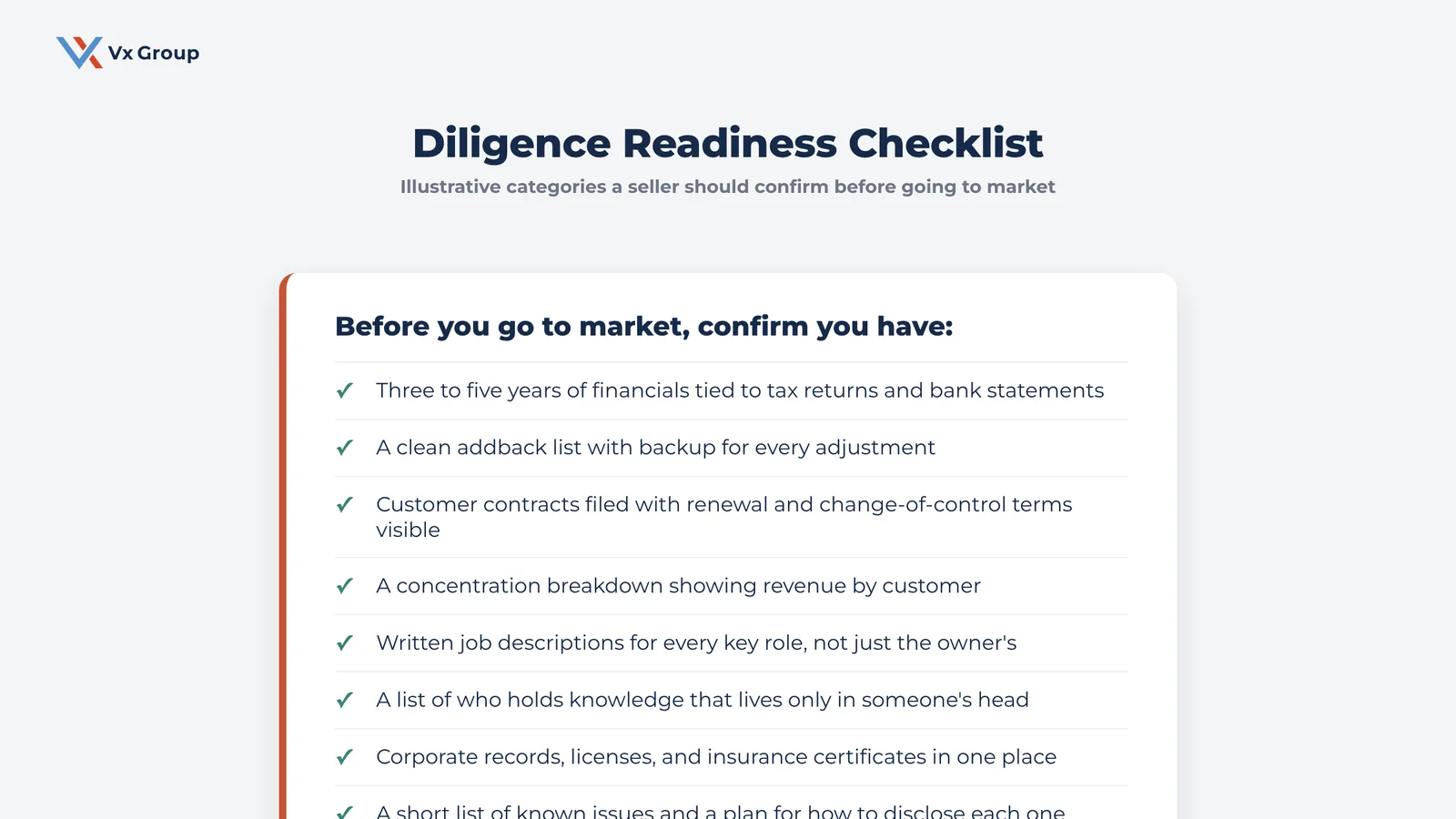
Before you take a company to market, it helps to have a simple way to check readiness category by category. The table below turns a general sense that “the paperwork is mostly fine” into a specific answer for each part of the business. Use it as a starting point and build your own version specific to your business and industry.
| Category | Ready if | Red flag if |
|---|---|---|
| Financials | Three-plus years of statements tie to tax returns and bank records | Numbers differ across systems with no documented explanation |
| Addbacks | Every adjustment has a dated invoice or comparable market data behind it | Addbacks exist only as a spreadsheet line with no backup |
| Customer contracts | Filed, current, and reviewed for assignability and change-of-control terms | Contracts are missing, expired, or never reviewed for these terms |
| Customer concentration | Revenue by customer is calculated and the trend is tracked over time | Nobody has calculated what share of revenue sits with the top customers |
| Key roles | Written job descriptions and at least a rough succession plan exist | Critical functions depend on one person with no documented backup |
| Institutional knowledge | Core processes and customer relationships are documented in writing | Key knowledge exists only in one or two people’s memory |
| Corporate records | Formation documents, cap table, and board minutes are complete and filed | Records are scattered, outdated, or incomplete |
| Insurance and licenses | Current certificates and permits are on file and easy to produce | Certificates are expired or nobody can locate the current permits |
| Disclosure plan | A short list of known issues exists with a plan for raising each one early | Known issues exist only as something the owner hopes nobody asks about |
The five passes above do not need to happen in a rigid sequence every time, but the order matters more than a lot of sellers expect. Assembling the data room first tells you what evidence you even have. The financial and commercial passes tell you what a buyer will actually scrutinize. The people and operations pass tells you what survives an ownership change. Only after all four are done can you make good decisions about what to fix, disclose, or price in.
Running this full process takes real time, usually a few months, and it works best when started well ahead of a process, leaving the final few weeks for last-minute cleanup only. Owners who are still a year or more out from a sale have room to fix the deeper issues, like founder dependence or thin contract terms, that a rushed pre-sale cleanup cannot touch.
Sell-side due diligence works because it changes who is in control of the story. A seller who has already found their own problems walks into a process able to set the agenda: here is what we found, here is what we fixed, here is what we are asking you to factor in. A seller who has not done this work is stuck reacting to whatever a stranger’s advisor finds first, on that stranger’s timeline, framed the way that stranger chooses to frame it.
The methodology we use with owners preparing for an exit, which we call Measured in Millions®, treats this kind of preparation as a business discipline that pays off whether or not a sale happens on the timeline an owner originally had in mind. A company that has run its own diligence, cleaned up its contracts, documented its key knowledge, and reduced its dependence on any one person is simply a stronger company, with or without a buyer at the table.
Ready to grow?
If you want help running this process before you go to market, or before you sign with an advisor who will run it for you either way.
About the author: Eric Zoromski is the founder and CEO of Vx Group, where he works with the owners of relationship-driven B2B companies to build growth systems that hold up under real scrutiny, including the scrutiny of a sale process. He has spent his career helping owners see their own businesses the way a buyer, a lender, or a board eventually will.
Related reading
- Commercial Due Diligence: What Buyers Actually Check
- Customer Concentration Risk: What It Is and How to Reduce It
- The 100-Day Plan for Private Equity
FAQs
About the Author: Eric Zoromski
