

Key Account Management for B2B Manufacturers

Key account management is a program for a short list of your biggest and most important customers. It names an owner for each account, builds a team around it, sets a meeting rhythm, and tracks whether the account is growing. It works when you pick the accounts with a score and staff them on purpose.
TL;DR
- Key account management is a staffing and rhythm decision. A label on a customer list changes nothing.
- Pick key accounts with a score. Revenue is one of five criteria.
- Keep the list short enough that your senior people can cover every account well.
- Give each key account an executive sponsor, a key account manager, and a technical and a service lead.
- Build relationships in four pairs, so the account survives a retirement or a job change on either side.
- Hold a monthly check-in, a quarterly review, one executive visit, and a one-page plan refresh each year.
- Judge the program by share of wallet, contacts per account, retention, and reorder timing.
What this guide covers
- What key account management is
- What makes a customer a key account
- How to choose key accounts with a score
- How to staff a key account team
- What a key account plan holds
- The meeting and review rhythm
- How to build relationships that survive turnover
- How to grow inside a key account
- How to measure the program
- A field example
- Mistakes that sink key account programs
- Where to start this week
Most owners already know who their biggest customers are. They use the words “key account” in sales meetings. They have a few names on a whiteboard or a tab in a spreadsheet.
Then they assign each account to whoever already had it, and they change nothing about how the account is served. The label becomes the program. The customer sees the same invoices, the same one contact, and the same quarterly surprise when an order slows down.
This guide is for owners, presidents, and sales leaders at privately held manufacturers and distributors. It covers how to pick key accounts and who should work on them. It also covers what to do each month and quarter, and how to tell if the program pays. Each section gives you something to build.
What is key account management?
Key account management is the practice of giving a small number of high-value customers dedicated attention, a named team, and a written plan. A company runs it to protect revenue it cannot afford to lose and to grow it. The accounts are chosen by score, and each one has an owner.
The program has four parts: selection, staffing, rhythm, and measurement. Each part needs a decision from the owner or president. Selection says which customers are in. Staffing says who works on them. Rhythm says when the teams meet. Measurement says whether any of it works.
Defined Term: Key account.
A customer that your company has chosen, by a written score, to receive a named team, a plan, and a meeting schedule. The pick reflects what the customer is worth to you and what it could become. Revenue is only part of that.
Some companies say “strategic account” or “major account” for the same idea. Searches for strategic account management show the same intent, and this guide covers both terms.
What makes a customer a key account?
A customer is a key account when losing them would hurt the company, or when growing with them would move the company forward. Revenue is the first thing owners check. It is also the weakest test on its own.
Consider two customers who each buy $2 million a year. One pays on time, buys at full margin, and sources three other product lines from competitors. The other negotiates every order, runs thin margins, and buys only one part from you. They look equal on a revenue report. They deserve different levels of attention.
Four questions sort the list better than revenue alone:
- How much margin does this customer produce after discounts and service costs?
- What could they buy from us that they buy elsewhere today?
- What would happen to our plant, our people, and our cash if they left?
- How many people on both sides know each other well?
Companies that already track how much revenue sits with a few customers will recognize the third question. Our article on customer concentration risk covers how to measure that exposure. Key account management is one of the main ways to reduce it.
A fifth test looks forward. A mid-size customer in a market you want to win can be a better key account than a larger customer in a shrinking market. Your growth plan decides that, which is why the owner belongs in the room when the list is set.
How do you choose key accounts?
You choose key accounts by scoring every large customer on the same five criteria and ranking the results. The score takes an afternoon to build. It replaces the argument about whose customer matters more with a shared list the leadership team can defend.
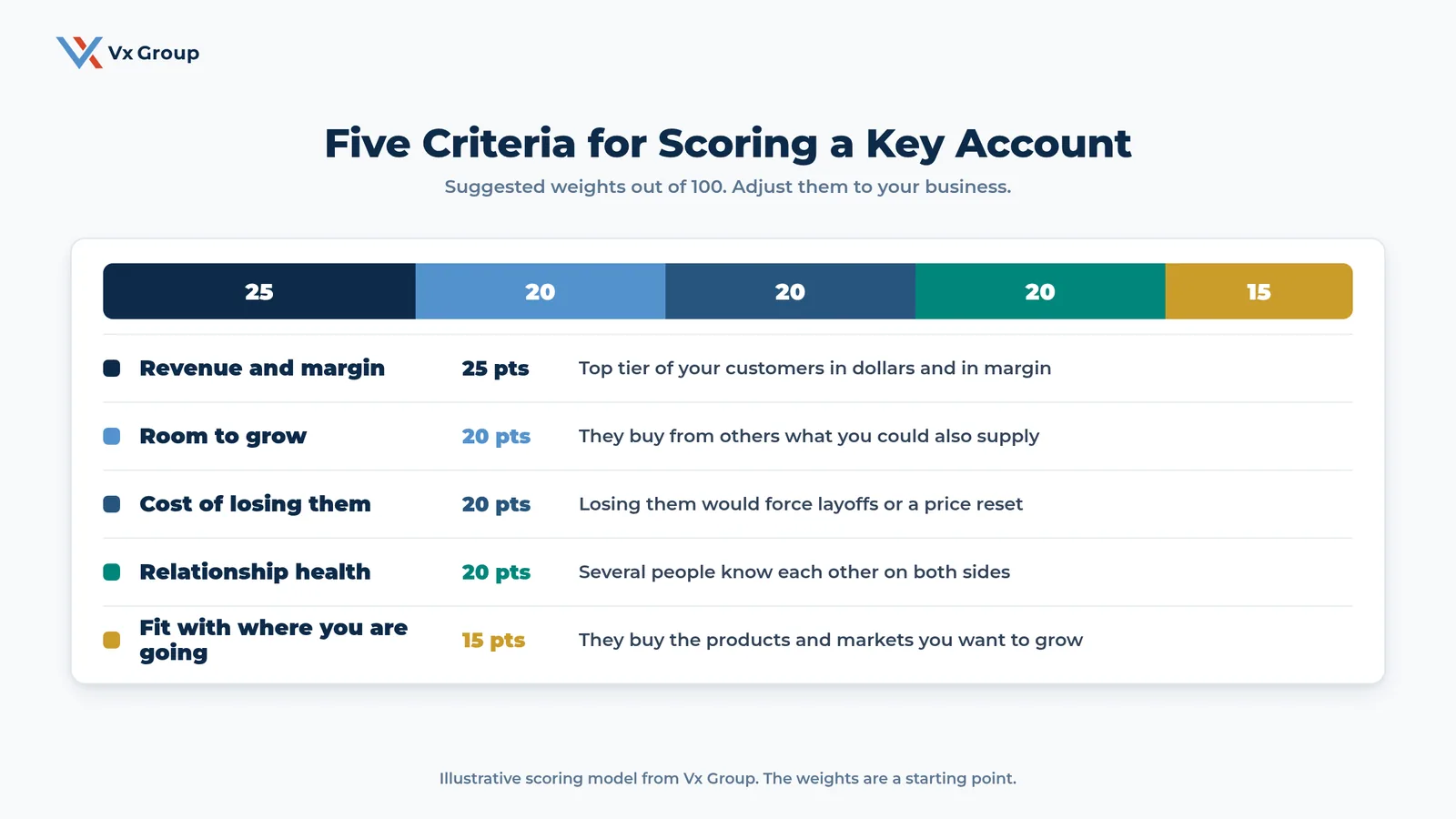
The graphic shows a suggested split out of 100 points. Revenue and margin carry 25 points. Room to grow, cost of losing the customer, and relationship health carry 20 points each. Fit with where the company is going carries 15. Change the weights to match your business, and keep them the same for every account.
List every customer above a revenue floor
Start with a simple cut. Pull the last twelve months of revenue by customer and list every customer above a floor you set. A good floor is the point where a customer would be missed in a quarterly forecast. Many manufacturers end up with 20 to 40 names.
Add margin next to revenue if your system can produce it. If it cannot, ask the finance lead for a rough read of high, medium, or low. A rough margin beats none.
Score each account from 1 to 5 on the five criteria
Give each customer a score from 1 to 5 on each criterion. Multiply by the weight and add them up. The sheet below shows what a 1, a 3, and a 5 look like. Write these anchors down before anyone scores, so two people scoring the same customer land close together.
| Criterion | A score of 1 | A score of 3 | A score of 5 |
|---|---|---|---|
| Revenue and margin | Bottom half of the list on dollars and margin | Middle of the list | Top five on dollars and on margin |
| Room to grow | Buys everything we make already | Buys from us and from others in two lines | Buys several lines from others that we could supply |
| Cost of losing them | We would replace the revenue within a quarter | We would cut shifts or delay hiring | We would lay people off or reset prices |
| Relationship health | One contact on each side | Two or three contacts, some turnover risk | Four or more contacts and regular meetings |
| Fit with where you are going | They buy products we plan to phase down | Mixed fit | They buy the products and markets we plan to grow |
Score as a group. Have the sales lead, the operations lead, the finance lead, and the owner each score the list alone first, then compare. Wide gaps in a score show where the company disagrees about a customer, and that conversation is worth having.
Cap the list at what your leaders can cover
Pick a number before you look at the ranking. Most owner-led manufacturers do well with 5 to 12 key accounts. Each key account needs an executive sponsor, and an executive can sponsor two or three accounts well.
Cut the list at the number your people can cover. A program with 30 key accounts has the same coverage problem the company started with.
Review the list once a year
Re-score at budget time. Accounts move up and down as markets, contracts, and plants change. Tell the teams on the accounts that dropped off, and move those customers to your standard service. Our article on account management strategy covers how to tier the full customer base. That keeps the accounts below the cut on an owner and a contact schedule.
How do you staff a key account team?
You staff a key account team by naming four roles for each account: an executive sponsor, a key account manager, a technical lead, and a service lead. Each role has a defined job and a time budget. In most cases people already on your payroll fill them.
| Role | What the person does | Time to plan for |
|---|---|---|
| Executive sponsor | Holds the owner-level relationship and clears roadblocks | A few hours a month |
| Key account manager | Runs the plan, the meetings, and the day-to-day contact | A set share of the week, sized to the account |
| Technical lead | Answers engineering questions and works on specs and new products | As needed, with a named backup |
| Service lead | Owns delivery, quality, and issue response | As needed, with a named backup |
Name an executive sponsor for every key account
The sponsor is an owner, president, or senior leader. Their job is to know the customer’s leadership and to say yes when the account manager needs help. In an owner-led company, the owner often sponsors the largest two or three accounts and hands the rest to senior leaders.
A sponsor who never calls the customer is a name on a slide. Put the monthly call or visit on the sponsor’s calendar.
Choose the key account manager for fit and time
The key account manager runs the account day to day. Pick someone the customer trusts and who can keep a plan moving. Seniority matters less than follow-through and time.
Some manufacturers use the top salesperson. That works when the person has room on their calendar. A top seller already buried in new-customer work will give the account less attention than it needs. Check the load before you name the person.
Add a technical lead and a service lead
Engineers talk to engineers. Name a person from engineering or operations who joins the account calls when specs, quality, or new products are on the table. Name a service lead who answers when a shipment is late or a part fails.
Write a backup next to each name. A role with no backup depends on one person staying healthy and employed.
Set a time budget for each role
Estimate the hours per month for each role and put them on the plan. The estimate keeps the program honest when the quarter gets busy. It also shows the owner what the program costs, so the cost sits next to the revenue it protects.
Ready to grow?
Share your top accounts and we will help you set up a key account program your team can run without the owner on every call.
What goes into a key account plan?
A key account plan is a one-page document that holds the account’s goals, its people, its risks, and the next ninety days of actions. The plan belongs to the whole account team. The key account manager keeps it current, and the team reviews it every quarter.
This guide keeps the plan short on purpose. The plan document and its yearly cycle are a topic of their own, and a separate article will cover it. A plan that fits on one page gets read, so start with these seven blocks:
- Account snapshot: twelve-month revenue, margin range, and share of the customer’s spend with you, if known.
- Their goals: the two or three things the customer is trying to achieve this year, in their words.
- Our goals: revenue, share of wallet, and new products or lines we want to win.
- People map: who is on each side and who owns each relationship.
- Risks: a late-delivery pattern, a new competitor on site, a change of buyer, a contract renewal date.
- Next 90 days: five actions, each with an owner and a date.
- Asks: what we need from the customer and what they may need from us.
Keep the language plain. If the customer would be uncomfortable reading the plan, rewrite it. Some teams share a version of the plan with the customer at the quarterly review. It opens good conversations.
What meeting rhythm does a key account need?
A key account needs four routines: a monthly check-in, a quarterly review, one executive visit, and a one-page plan refresh each year. The dates go on calendars for the full year in January. A rhythm that depends on someone remembering to call will break in the busiest month.
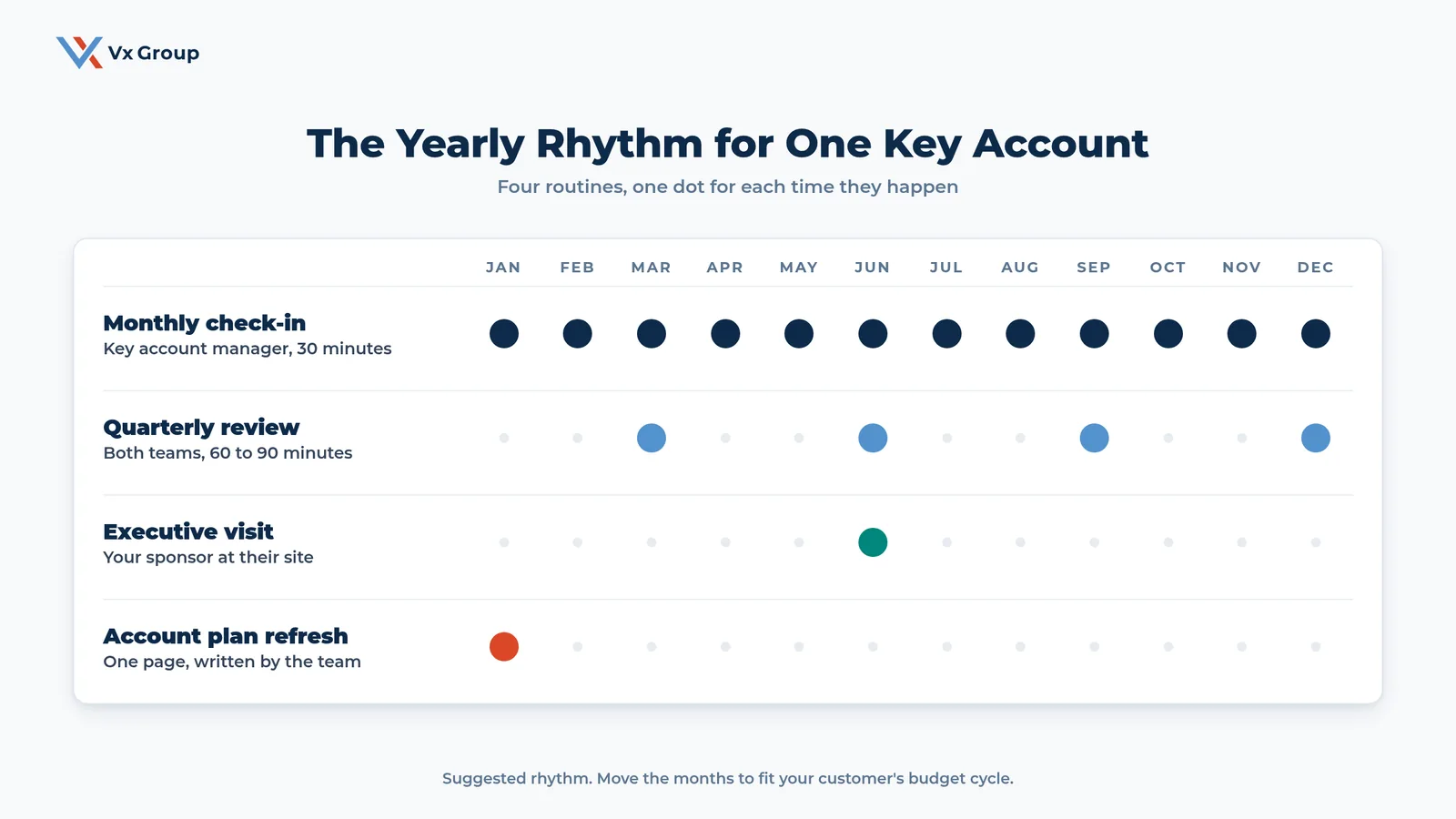
The calendar above puts a monthly check-in in every month, a quarterly review in March, June, September, and December, an executive visit in June, and the plan refresh in January. Shift the months to follow the customer’s budget cycle.
Hold a 30-minute check-in every month
The key account manager calls the main customer contact once a month. The agenda is short: orders in flight, any open issue, and one question about what is coming. Write down the answers the same day.
Run a quarterly review with both teams
Bring the account team and the customer’s team together for 60 to 90 minutes. Review delivery and quality results, share the plan, and ask what the customer wants from you next quarter. Our article on how to run a quarterly business review has an agenda you can copy.
Schedule one executive visit a year
The executive sponsor visits the customer once a year, ideally at the plant or office where decisions get made. A visit gives the sponsor a look at how the customer works and gives the customer’s leaders a reason to see your face.
Refresh the plan every January
Rewrite the one-page plan once a year. Use last year’s results and this year’s customer goals. Share the update with the sponsor, the account manager, and the leads.
How do you build relationships that survive turnover?
You build relationships that survive turnover by connecting several people on your team to several people on the customer’s team, in matched roles. This is called multi-threading. If one person leaves or retires on either side, the others keep the account moving.
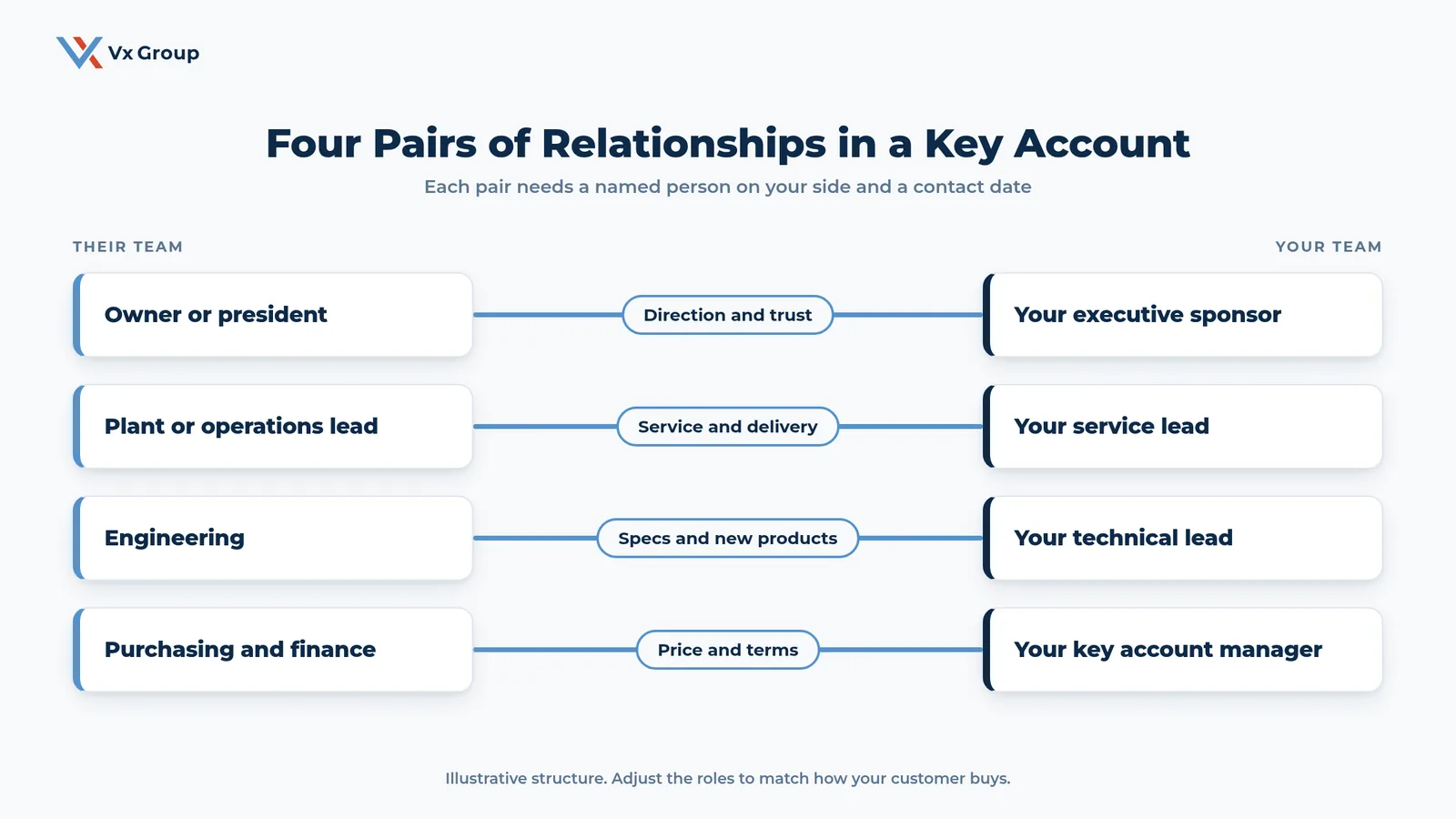
The graphic pairs the customer’s owner or president with your executive sponsor, their operations lead with your service lead, their engineers with your technical lead, and their purchasing and finance contacts with your key account manager. Each pair covers a different kind of conversation.
Map the people on both sides
List every person on the customer’s side who touches your product. That runs from the buyer to the line supervisor to the engineer who wrote the spec. Next to each name, write who on your team knows them and when they last spoke. Blank spaces show the gaps.
Fill the thinnest pair first
Look at the four pairs and find the weakest. Many manufacturers have a strong purchasing relationship and almost no contact with engineering or with the customer’s leadership. Set a date for the first conversation in the weakest pair this quarter.
Plan for the retirement you can see coming
Ask each customer contact how long they plan to stay. If a key buyer is three years from retirement, introduce a second person now. Our article on generational customers explains why these handoffs carry so much risk, and how to prepare for them.
Protect your own side the same way
A key account run by one salesperson has the same risk in the other direction. If that person leaves, the customer’s relationship may leave with them. Our guide on founder-dependent sales covers the owner version of this problem. The article on building an infinite team covers how to spread knowledge across people.
How do you grow revenue inside a key account?
You grow revenue inside a key account by finding what the customer buys from other suppliers that you could also supply. Then the account team works that list. Much of the growth in a key account program comes from this work, because the trust is already built.
Measure how much of their spend you hold
Share of wallet is the percentage of a customer’s spend in your categories that goes to you. Ask the customer’s buyer which of your product families they source elsewhere. Even a rough answer shows where the open room sits. Our article on share of wallet walks through how to estimate it.
List five adjacent needs for each account
Sit with the account team and write five things the customer buys elsewhere that you could supply. Examples are a product line, a service, a faster delivery option, or a stocking program. Rank them by fit and by how many relationships you would need to win them.
Bring one idea to every quarterly review
Pick one item from the list and bring a specific proposal to the next review. A sample, a pilot order, or a stocking quote gives the customer something concrete to react to. Our guide to account expansion covers the moves in more detail.
Treat your top ten as a growth plan
Owners who work their biggest customers on purpose often find more growth there than in new-customer campaigns. We wrote about this in your top 10 customers as a growth strategy.
How do you measure a key account program?
You measure a key account program with a short set of numbers per account, reviewed every quarter. The numbers show whether relationships are widening and revenue is growing. They also show trouble early, when a fix is still cheap.
| Measure | What it shows | How to track it |
|---|---|---|
| Revenue and margin by account | Whether the account is growing at a healthy price | Monthly from your accounting system |
| Share of wallet | How much of their spend you hold | Estimate each quarter from the buyer’s answers |
| Contacts per account | How many people know each other on both sides | Count from the people map |
| Reorder timing | Whether orders are arriving when expected | Compare actual to usual order dates |
| Retention and renewals | Whether the customer stays and renews | Track contract and order history |
Reorder timing deserves a close look. A late reorder is often the first sign that a customer is changing how they buy. Mark each key account’s usual reorder window and have the account manager call when the window passes.
For the broader view, net revenue retention shows whether your existing customers are growing as a group. Our article on net revenue retention explains how to calculate it. Review the program numbers at the quarterly leadership meeting, with the owner in the room.
What does a key account program look like in practice?
Field Notes:
This is a composite example built from patterns we see in manufacturers with $5 million to $50 million in revenue. It is illustrative and describes no single client.
A family-owned maker of industrial components had one customer at roughly a quarter of its sales. The owner handled that relationship himself, and the next three biggest customers sat with a single salesperson who also covered new accounts. Both relationships lived in two heads.
The leadership team scored its 24 largest customers and picked eight key accounts. The owner took the top two as sponsor. A senior sales leader took three, and the operations vice president took the rest. Each account got a key account manager, a named engineer, and a named service contact.
The first quarterly reviews found two surprises. The largest customer’s engineering group had never met the company’s engineers, and one mid-size customer was sourcing a second product line from a competitor. Within a year the company had a new contact in the largest account’s engineering group and a pilot order on the second line.
The example shows what the program changes. The work involves a short list, named people, and dates on calendars. None of it needs new software.
What mistakes sink key account programs?
Most key account programs fail for the same handful of reasons. Each one has a plain fix.
- Picking accounts by revenue alone. Fix: use the five-criteria score and re-score yearly.
- Naming too many key accounts. Fix: cap the list at what your leaders can cover, and cut the rest.
- Assigning accounts to whoever had them. Fix: choose the account manager for fit and time available.
- An executive sponsor who never calls. Fix: put the sponsor’s monthly touch and yearly visit on a calendar.
- One contact on each side. Fix: map the four pairs and fill the thinnest one first.
- A plan nobody reads. Fix: keep it to one page and review it every quarter.
- No numbers. Fix: track share of wallet, contacts, and reorder timing for every key account.
- Treating the program as a sales initiative. Fix: include operations, engineering, and finance on the account teams.
Where should you start this week?
Start with the list. Pull twelve months of revenue by customer, set a floor, and score the customers above it with the five criteria. Pick your key accounts, name an executive sponsor for each, and put the first monthly calls on calendars.
A short plan for the first month:
- Week one: build the customer list and the scoring sheet.
- Week two: score as a group and settle the list.
- Week three: name the sponsor, account manager, and leads for each account.
- Week four: write the one-page plan for the largest account and schedule its first quarterly review.
Pick the accounts, name the people, set the dates
Key account management works when a short list of customers gets named people, a written plan, and dates on the calendar. Score the list, staff each account, and review the numbers every quarter. The first quarterly review usually shows what the company has been missing.
Ready to grow?
Bring your top ten accounts and we will help you score them, staff them, and build a rhythm your team can keep.
FAQs
About the Author: David Tisdale
