

How to Announce a Price Increase Without Losing the Relationship

A price increase announcement has to give every customer the new price, enough notice to plan, one honest reason, and a way to respond. Sort your accounts into tiers first. Your top relationships get a phone call before they get a document. Everyone else gets a personal letter that reads like it came from a person.
TL;DR
- The mass email sent on the first of the month treats a twenty-year customer like a one-time buyer. Avoid it.
- Sort accounts into tiers before you write a word. Then match the method to the tier: a call from the owner, a call from the account lead, or a letter.
- Build the notice period around your open quotes and backlog. Pick a quote-honor date and put it in the letter.
- Write a short letter with six parts: relationship, change and date, one reason, protections, an offer to talk, and a named signer.
- Script the call for top accounts. Rehearse the three objections you will hear with your sales team.
- Write the exception policy before you announce. Then exceptions follow a rule, and nobody negotiates with whoever complains loudest.
Most manufacturers and distributors raise prices the same way. Someone in finance picks a percentage. The marketing coordinator builds an email. It goes to the whole customer list on the first of the month.
That send reaches a customer who has bought from you for twenty years in the same way it reaches someone who bought once in 2022. In one click, a relationship becomes a transaction. The buyer who used to call you first now opens a spreadsheet and starts pricing your competitors. We cover this pattern in transactional selling, and a price increase is the moment it costs the most.
A price increase tests every customer relationship you have. Some of those relationships hold, and a few end. Which ones hold depends largely on how you handled the conversation.
The six steps below cover the full order of work: sort accounts, set the timing, write the letter, make the calls, prepare the team, and set the exception rule. Each step gives you something you can use this week, including a tier table, a full letter template, and a call script.
Defined Term: Price increase communication.
All the messages, calls, and documents that tell customers about a change in price. It includes who delivers each one, in what order, and how much notice each customer gets. The letter is one piece of it.
Step 1. How do you sort customers before you announce a price increase?
Sort your customers by relationship value and exposure before you write the announcement. The top ten or so relationships should hear it from a person. Each tier below gets a lighter method. These tiers decide who calls, who writes, and how much room each account gets to respond.
Rank every account by relationship value and exposure
Pull twelve months of orders and sort accounts by revenue. Then add two columns that revenue alone hides.
- Years as a customer. A twenty-year account has history you cannot replace.
- Share of their spend. Say you supply 60% of what a customer buys in your category. They have more to lose from switching than a customer who buys 5% from you and the rest elsewhere.
Add a third column for risk. Flag accounts that have already asked a competitor for a quote, accounts with a recent service problem, and accounts whose buyer recently changed. These need extra care at any size.
If you already run a top-customer program, this ranking exists. Your top 10 customers are a growth strategy, and this is the first time many owners use that list for a pricing decision. If you worry about how much revenue sits with one customer, read how to reduce customer concentration risk before the calls begin.
Assign each account a tier and a method
Use four tiers. The table below is a starting point. Adjust it to your own customer count.
| Tier | Who belongs here | Delivered by | Method | Timing |
|---|---|---|---|---|
| Tier 1 | Your top ten relationships, plus any account that would hurt to lose | Owner or president | Phone call or in-person visit, then a short follow-up letter | First, at least 60 days before the effective date |
| Tier 2 | The next 20 to 40 accounts, and accounts with a competitor quote on the table | Account lead or sales manager | Phone call, then the letter | Second, about 60 days before |
| Tier 3 | Steady mid-size accounts | Account rep | Personal letter with an item-level price list and a named contact | About 45 days before |
| Tier 4 | Small and occasional buyers | Customer service | Letter or email with the new price list and the effective date | About 45 days before |
Tier 1 hears first, on purpose. A top customer who learns about the increase from a peer, a distributor, or a forwarded email will wonder why nobody told them personally.
Name the person who owns each Tier 1 and Tier 2 call
Write one name next to every Tier 1 and Tier 2 account. Add the date by which the call will happen and a field for what the customer said. A shared spreadsheet with four columns is enough: account, caller, call date, and result.
Owners often keep two or three of the largest relationships for themselves. That is the right call. A customer who has known you for years wants to hear it from the person whose name is on the building.
Step 2. How much notice does a price increase need when you have quoted backlog?
Give customers 60 to 90 days of notice when your sales cycle includes quotes, blanket orders, or scheduled releases. Name a date through which you will honor existing quotes. The right length depends on how long your quotes stay open and how far ahead your customers plan their own budgets.
Pull every open quote and note its expiration date
List all open quotes, blanket purchase orders, and scheduled releases. For each one, record the customer, the dollar value, and the date it expires.
This list shows how much revenue will ship at the old price after the effective date. It also shows which customers have a reason to feel protected. A customer holding a quote that expires in six weeks has already been told, in effect, that the old price is safe for now.
Set a quote-honor date and put it in the letter
Defined Term: Quote-honor date.
The last date through which you will accept orders against previously issued quotes at the old price. After that date, quotes are reissued at the new price.
The quote-honor date is one short sentence that matters a lot. It tells the customer exactly how much time they have. It also gives a procurement manager something to take to their own boss. Choose a date that matches your normal quote validity, and apply it to everyone the same way. Honoring quotes for some customers and not others creates a fairness problem you will hear about.
Pick an effective date that avoids your customers' budget deadlines
Ask your sales team when your largest customers set annual budgets and when their purchasing slows or peaks. An effective date in the middle of a customer’s annual planning window lets them build the new price into next year’s numbers. An effective date the week after they finalize a budget gives them a reason to be frustrated.
Many owners choose the first of a quarter or the first of a calendar year. Either works when the notice period is long enough. If you sell through a distributor channel with its own price lists, allow more time. Our guide on setting a distributor pricing strategy covers how channel price lists interact with your own.
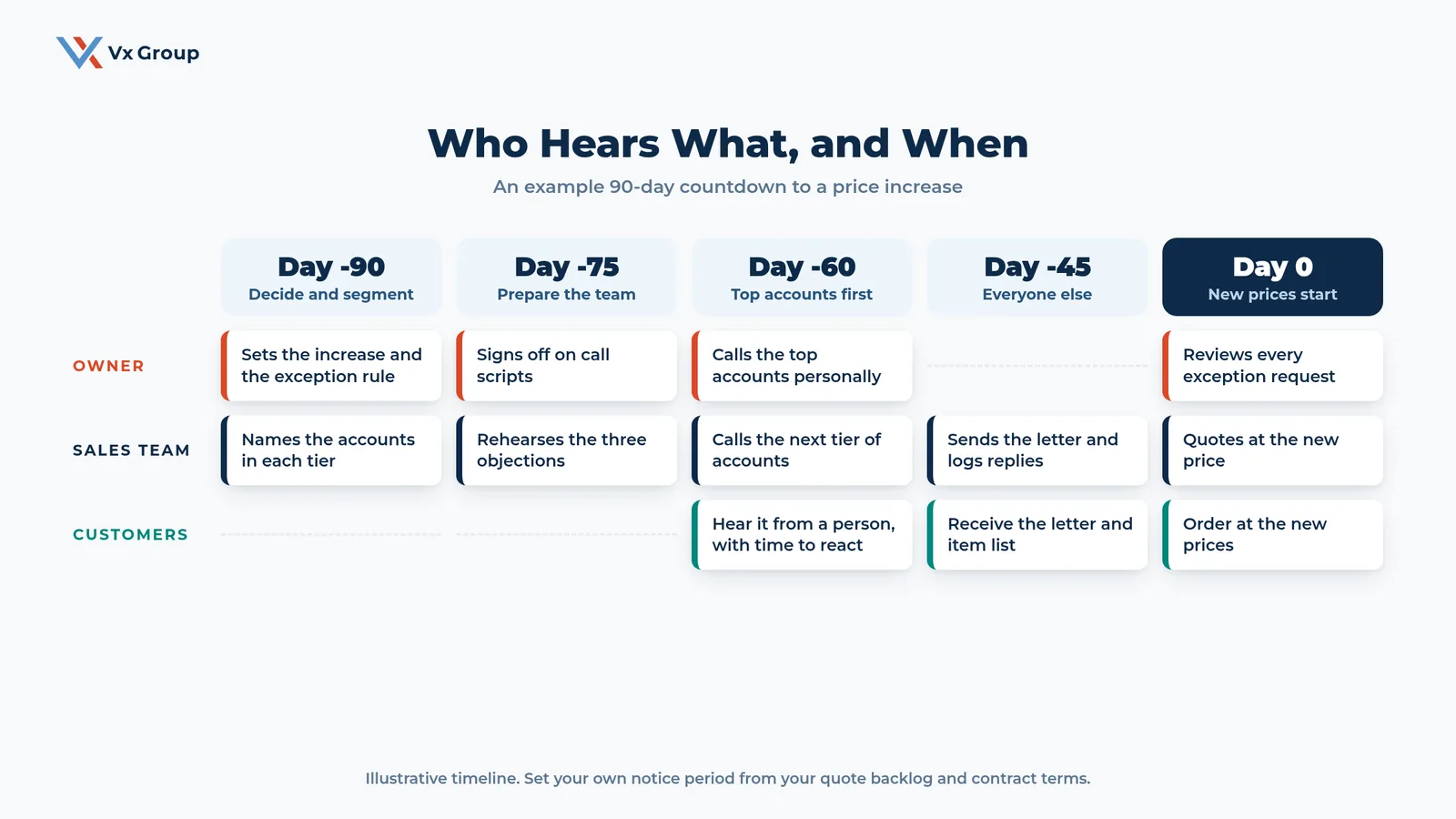
The graphic below shows one example schedule for a 90-day countdown. The owner, the sales team, and the customer each have their own row.
Step 3. What should a price increase letter say?
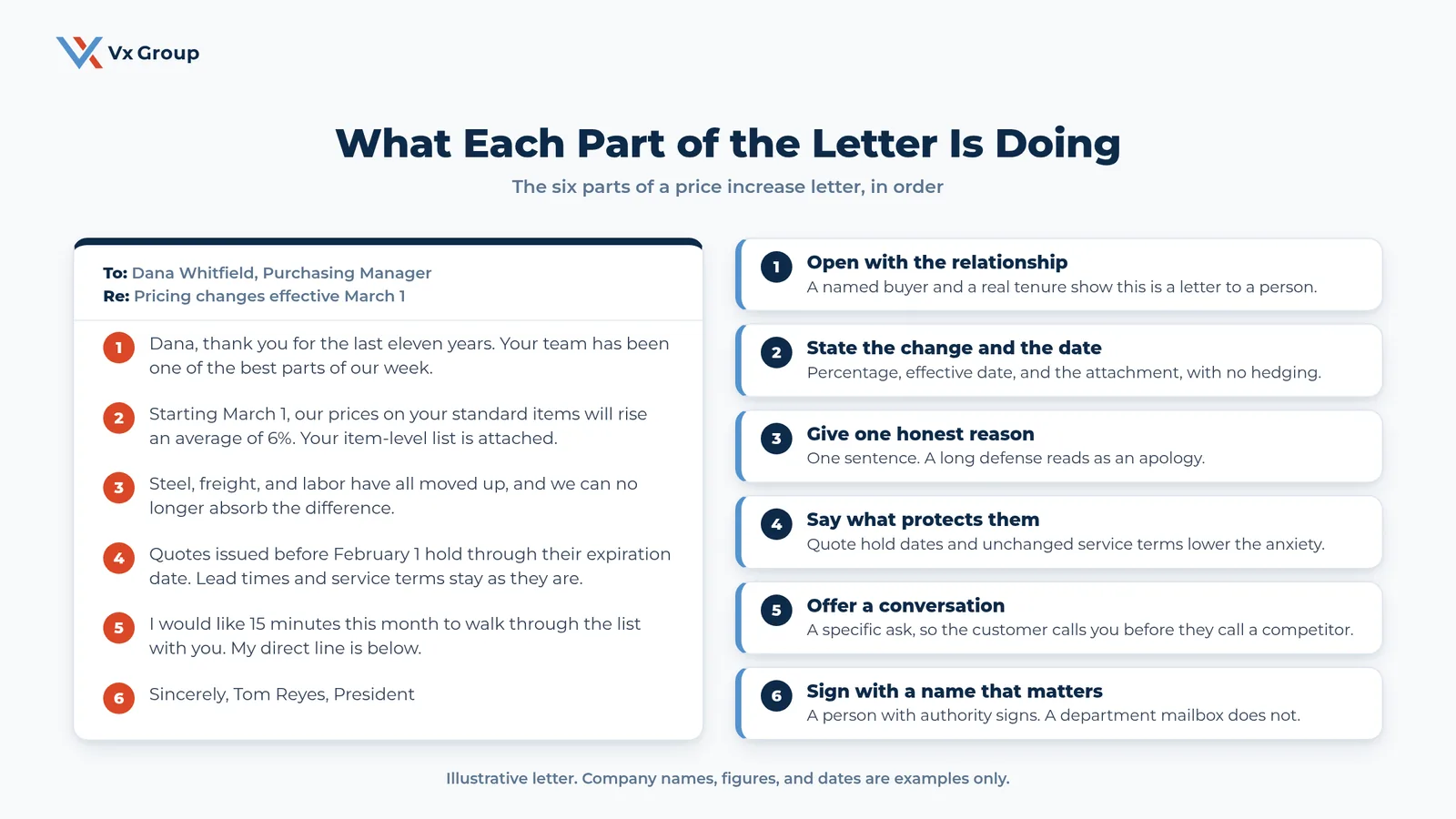
A price increase letter should say six things in order: what the relationship means to you, what is changing and when, why in one sentence, what stays protected, how to reach you, and who signed it. Keep it to one page. A short letter reads as confident.
Use this letter template
Replace the bracketed items with your own details. Send the letter on letterhead, signed by a person with authority, and attach an item-level price list.
[Date]
Dear [First name],
Thank you for [number] years of working with us. [One specific sentence about the relationship, such as a project you shipped together or a problem you solved.]
Beginning [effective date], our prices on [product lines or “your standard items”] will increase by an average of [percentage]. An item-level price list is attached so you can see the effect on the products you buy most.
[One sentence naming the real reason, such as material costs, freight, or labor.] We held prices as long as we could, and we can no longer absorb the difference.
Quotes issued before [date] will be honored through their expiration date. Your lead times, service terms, and the people who support your account stay the same.
I would like 15 minutes this month to walk through the list with you. You can reach me directly at [phone] or [email], and [account lead name] will follow up this week to find a time.
Sincerely,
[Name]
[Title]
Check each line against the job it does
Every sentence in the letter has a job. If you edit the template, make sure each job is still covered.
- Opening line. Names the person and the history. The letter goes to a human being who has a long record with you.
- Change and date. Gives the average percentage, the effective date, and the price list. A customer should never have to calculate their own increase.
- Reason. One sentence. A paragraph of justification invites a debate about each cost you list.
- Protections. The quote-honor date and the unchanged service terms tell the customer what stays the same.
- Offer to talk. A named person, a time frame, and a direct phone number. This is how you hear about problems before the customer starts shopping.
- Signature. An owner, president, or general manager signs. A department name tells the customer that nobody senior is paying attention.
Cut these phrases before you send
Two lines appear in nearly every first draft. Both should come out. “We value your business” says nothing a customer believes. “We apologize for any inconvenience” tells them you expect them to be upset, and it invites a talk about discounts.
Say the price is changing, say why, say what is protected, and offer to talk.
Ready to grow?
See how a pricing conversation fits into a relationship plan for your top accounts.
Step 4. How do you run the price increase call for accounts that matter?
Open the call with the relationship. State the new price and date within the first two minutes. Then stop talking and listen. This is a conversation with a customer you want to keep. Your job is to hear their reaction and respond to what they say.
Prepare a one-page call sheet before you dial
For each Tier 1 and Tier 2 account, the caller should have one page in front of them with five items:
- The customer’s twelve-month spend and the effect of the increase in dollars.
- Open quotes and their expiration dates.
- Any recent service issue, good or bad.
- Who else at the customer has a say in the buying decision.
- What the caller is allowed to offer, if anything. Step 6 explains how to set this.
If the caller cannot say the dollar effect in one sentence, they are not ready to call.
Follow this call script
Change the wording so it sounds like you. Keep the order.
- Open with the relationship. “Dana, it’s Tom. I wanted to call you myself before anything arrives in the mail. You have been with us eleven years, and I would rather you hear this from me.”
- State the change. “Starting March 1, our prices on your standard items go up an average of six percent. On what you bought last year, that works out to about [dollar amount].”
- Give the reason in one sentence. “Material and freight costs have moved enough that we cannot hold the old pricing.”
- Name the protection. “Any quote we’ve issued before February 1 stays good through its expiration date, and nothing changes on lead times or who supports your account.”
- Ask and listen. “How does that land for you? Is there anything on your side that makes this harder than it sounds?”
After step 5, stop. Silence helps here. Customers often say the real concern in the first ten seconds after an open question. A caller who fills the quiet misses it.
Answer the exception question with a prepared line
Some customers ask for an exception right away: “Can you hold the old price for us?” The caller should not say yes or no on the spot.
Here is a response that works: “I hear you. Let me look at your account and the volumes you’re planning, and I’ll call you back by Friday with what I can do.” That buys time and shows respect. It also sends the request through the process you set up in Step 6.
Step 5. How do you prepare your sales team for the three objections?
Prepare your sales team for three objections: a competitor is cheaper, the customer has already set a budget, and the customer wants to know why the increase is that large. Give each salesperson a short, honest answer to each. Rehearse them together before the first call goes out.
Teach the three objections and the answer to each
| Objection | What the customer is really asking | A response that works |
|---|---|---|
| “Your competitor quoted us less.” | Is the difference big enough to justify switching? | Ask what they were quoted on, and compare lead time, quality history, and service. Offer to review the comparison together. Never match a price until you understand the whole offer. |
| “We already set our budget for the year.” | Can you give me time to adjust? | Point to the quote-honor date. If the account qualifies under your exception policy, offer a phase-in across two steps. Send any larger ask to the owner. |
| “Why is it that much?” | Can I trust the number? | Show the cost drivers in plain terms and walk through the item-level list. Share what you can, and skip anything confidential. |
Run a 30-minute rehearsal
Pair salespeople and have one play the customer. The customer should use real objections from last year’s pricing conversations. Each pair runs the script twice and switches roles.
Look for three things. The caller states the increase in the first two minutes. The caller stops talking after the open question. The caller never promises an exception on the call. Fix those three habits and the calls improve a lot.
Give the team the right to say "I'll find out"
New callers feel pressure to answer everything right away. Tell them in writing that “let me look into that and call you back by Friday” is the correct answer to any request outside the script. A wrong answer given under pressure sets a precedent, and the whole customer base hears about it.
Step 6. How do you decide the exception policy before anyone asks?
Write the exception policy before you announce the increase, and name one person who approves every exception. A policy written in advance lets you judge each request against set rules. Without one, exceptions go to whoever pushes hardest, and your best customers find out others paid less.
Write the rule down with clear criteria
Keep the criteria short enough to fit on one page. This table shows a sample layout.
| Situation | What the policy allows | Who approves |
|---|---|---|
| Customer signs a volume or term commitment | A phase-in across two price steps, or a fixed price for the commitment period | Owner or president |
| Customer holds a documented competitor quote on the same specification | A review of the account, with a result inside five business days | Owner or president |
| Customer has open quotes with long lead times | The quote-honor date applies, with no extension | Account lead |
| Customer asks for relief with no commitment or documentation | The standard increase applies | Account lead |
Prefer phase-ins and commitments over discounts. A phase-in lowers the first-year cost while the customer still ends up at the new price. A commitment gives you something in exchange.
Route every request to one person
One person sees every exception request, even when several people can approve different kinds. That person spots patterns, such as three customers in the same market citing the same competitor. You want that information in the first month.
Log every exception and review it in 90 days
Record the customer, the request, the decision, and the reason. Review the log at the 90-day mark. If a lot of exceptions cluster in one segment, the increase may be too large for that segment. You want to know that before the next one.
What should you do when a large customer threatens to leave?
When a large customer threatens to leave, ask what they are comparing before you respond. Work out what switching would cost them in total. Decide in advance the lowest price you will accept. A threat is the start of a negotiation, and a prepared owner can handle it calmly.
Ask what they are comparing
Say: “Help me understand what you’re looking at.” Many threats turn out to be a single quote for a narrower product or a different lead time. Customers who say they will leave often have less to compare than they suggest.
Work out their total cost to switch
A new supplier brings qualification time, sample approvals, a new set of contacts, and risk on first deliveries. Walk through those costs with the customer in plain terms. Stay respectful and keep the talk on total cost.
For customers who bring in a large share of your revenue, review the rest of the relationship too. Our guide to account management strategy explains how to build a plan that covers more than price. A regular quarterly business review gives you a standing place to have this conversation before a threat arrives.
Set your walk-away number before the call
Decide the lowest margin you will accept on this account, and write it down before you pick up the phone. With the number set in advance, you can negotiate calmly. You are also less likely to give away more than the account is worth during the call.
Field Notes:
Consider a composite from conversations with owners of manufacturers in the $20 million range, with details changed. A president planned to send one email to 600 customers. His top account, a customer of 15 years, represented roughly a fifth of annual revenue. His sales lead asked for two weeks to sort the list first. The president called the top account himself and made eight more calls to the next tier of accounts. He sent a letter to everyone else. The top account asked for a phase-in, and under a written exception policy that included a volume commitment, he agreed. No customer in the top tier left that year. The calls took about two days of the president’s time.
What mistakes make a price increase go wrong?
Five mistakes cause most of the damage. Each one has a direct fix.
- Sending one message to everyone. Sort accounts first and match the method to the relationship.
- Giving too little notice. Base the notice period on your quote backlog and your customers’ planning cycles.
- Apologizing in the letter. State the change plainly, give one reason, and offer to talk.
- Letting each salesperson improvise. Rehearse the three objections and share the script.
- Deciding exceptions case by case. Write the policy first and name one approver.
Where do you start this week?
Start with the account ranking in Step 1. It takes an afternoon, and every later decision depends on it.
- Pull twelve months of orders and rank accounts by revenue, years as a customer, and share of their spend.
- Mark the Tier 1 accounts and assign a caller to each.
- List every open quote and its expiration date to set your quote-honor date.
- Draft the letter from the template and have one person outside the pricing decision read it.
- Write the exception policy on one page.
After the increase takes effect, track whether the relationship held. Watch repeat orders from your top accounts and net revenue retention over the next two quarters. Use the conversations you had to find where account expansion is possible. Price conversations often show what a customer wants more of, and that deserves a follow-up.
Top accounts also deserve a plan that goes beyond one announcement. Key account management is the work of setting staff and meeting schedules for your largest customers. It makes the next pricing conversation easier.
Ready to grow?
Bring your top 20 accounts, and we will map who should hear the news, from whom, and when.
FAQs
About the Author: David Tisdale
