

How to Align B2B Marketing and Sales Around One Growth Plan

B2B marketing and sales alignment means both teams use one written definition of a qualified relationship, one handoff rule, and one scoreboard tied to revenue. One person is accountable for what happens between the two teams. You get there in five steps: define qualified, write the handoff rule, share one scoreboard, review every handoff monthly, and name an owner.
TL;DR
- Marketing and sales friction in most owner-led companies comes from how the teams are set up. Marketing is measured on volume. Sales is measured on closed revenue. The handoff in the middle belongs to no one.
- A standing weekly meeting rarely fixes it. The meeting has no written rule to enforce and no shared number to review.
- Step 1 is a one-paragraph definition of a qualified relationship that both team leaders sign.
- Steps 2 and 3 put a written handoff rule and a six-number scoreboard where both teams can see them.
- Steps 4 and 5 add a monthly review of every handoff and one named person accountable for the gap.
Most companies try to fix marketing and sales friction with a meeting. Someone puts a standing Tuesday call on the calendar. Both teams show up and wait for the tension to ease. A few months later the call is shorter, half the seats are empty, and the same complaints are back.
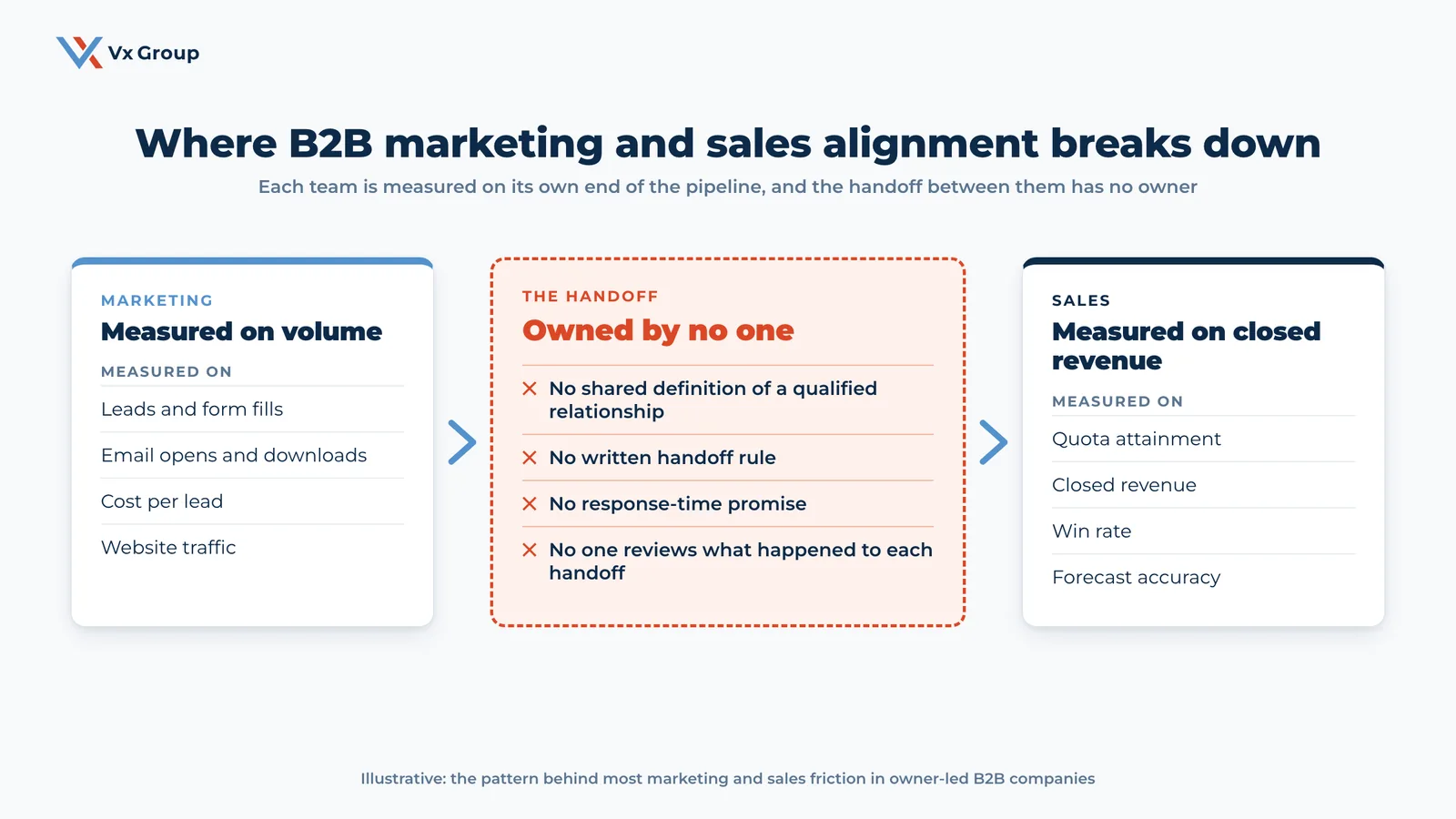
The friction comes from how the two teams are built. Marketing is measured on volume: leads, form fills, cost per lead. Sales is measured on closed revenue. The handoff in the middle, where a marketing contact becomes a sales conversation, has no definition, no rule, and no owner. A weekly meeting gives both sides a place to describe the problem. All three gaps stay open.
This guide is for the owner of a relationship-driven B2B company, or the president hired to run one. You hear both teams blame each other and cannot tell which one is right. Marketing says sales never follows up. Sales says the leads are junk. Both are usually partly right. The five steps below show you where the handoff breaks and how to fix it.
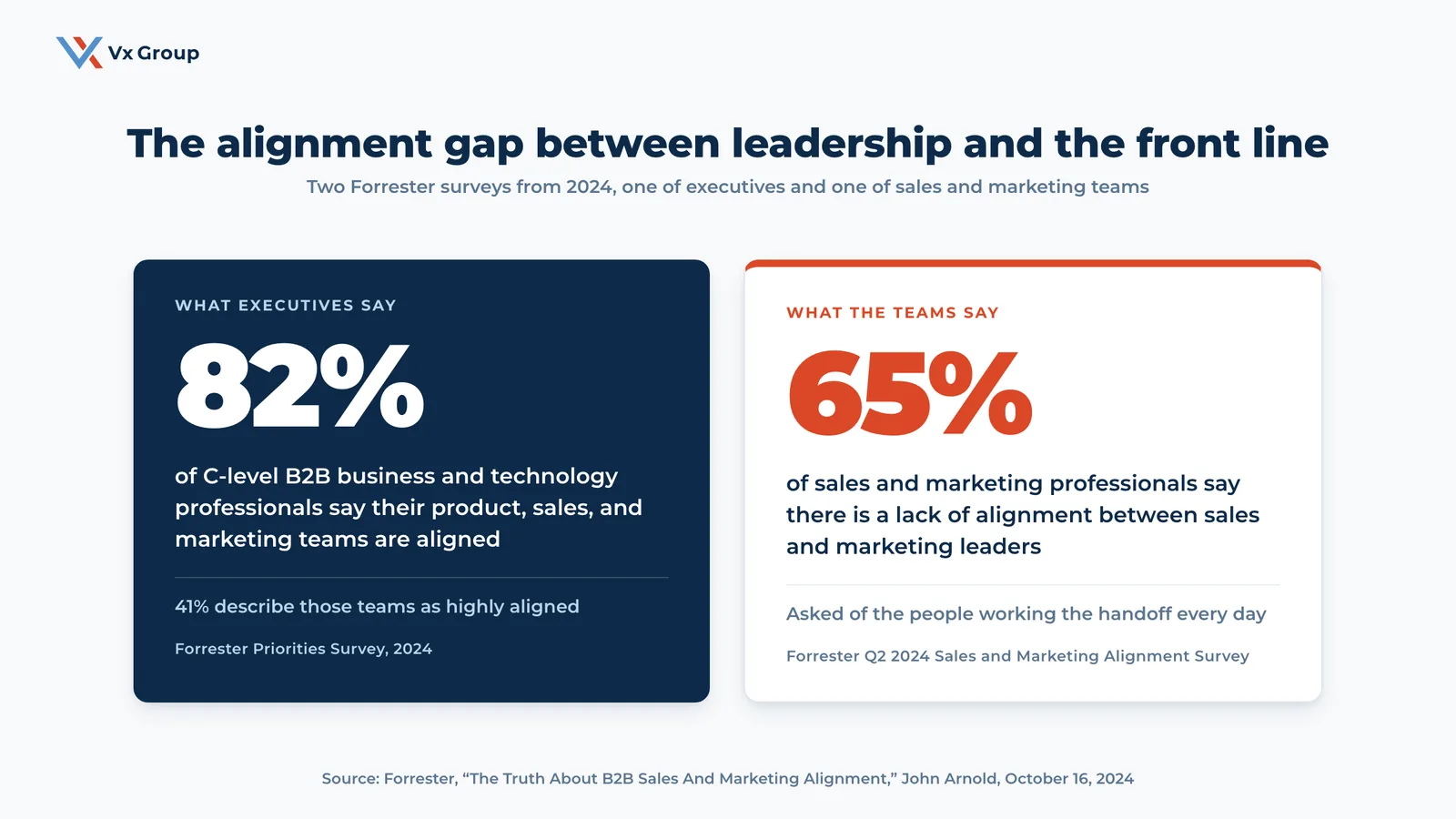
The gap shows up in survey data too. In 2024, Forrester reported that 82% of C-level B2B business and technology professionals described their product, sales, and marketing teams as aligned. In a separate Forrester survey that year, 65% of sales and marketing professionals said there was a lack of alignment between sales and marketing leaders. Leadership sees one picture. The people working the handoff every day see another.
What is B2B marketing and sales alignment?
B2B marketing and sales alignment is an agreement between the two teams on three things. Which contacts are worth a salesperson’s time. What happens when one of those contacts is handed over. Which numbers both teams are judged on. When those three are written down and reviewed every month, the teams can see which step lost a deal and fix that step.
Defined Term: Marketing and sales alignment.
A written agreement between marketing and sales on what a qualified contact looks like, how and when that contact is handed off, and which shared numbers both teams report. One person is accountable for the result.
Alignment matters more in a relationship-driven B2B company than in a high-volume software business. Sales cycles run six to eighteen months. A single customer can stay for twenty years. Most new business comes from a small number of long conversations. One dropped handoff can be a seven-figure relationship that never starts.
Most misalignment traces back to the same three gaps:
- Two different scoreboards. Marketing reports leads and traffic. Sales reports bookings and quota. Neither report shows what happened to a contact after it changed hands.
- No shared definition of qualified. Marketing counts anyone who downloaded a guide. Sales wants someone ready to buy this quarter. Both teams use the same word for different people.
- No owner for the middle. Marketing’s job ends at the handoff, and sales’ job starts at the first meeting. Nobody is responsible for the days in between. That is where most good contacts go cold.
What are the benefits of sales and marketing alignment?
The main benefit of sales and marketing alignment is that fewer good conversations go cold between the two teams. The other benefits follow from that one:
- Faster first meetings. A written response-time rule means a qualified contact hears from a salesperson within days.
- A forecast leadership can trust. When every handoff is tracked to an outcome, the pipeline report shows where revenue is actually coming from.
- A marketing budget tied to revenue. Marketing spend gets judged on the pipeline and revenue it starts. That makes the annual budget conversation shorter and more honest.
- Less blame in leadership meetings. Disagreements about lead quality get settled by looking at the handoff record.
- Less dependence on one person. When the handoff rule lives in the CRM, the process keeps working after a salesperson or marketer leaves.
Each of these comes from five pieces of work you can do with the CRM you already have: a definition, a rule, a scoreboard, a review, and an owner. The steps below follow that order.
Step 1. How do you define a qualified relationship both teams will accept?
Look back at the deals you have already won. Write one paragraph that describes those deals at the moment marketing could have handed them over. Both team leaders sign it, and it becomes the only definition either team uses.
Most companies inherit a definition from their marketing software. It is an activity score built from email opens, page visits, and downloads. That kind of score works for a company selling a low-cost product to thousands of buyers. In a business where customers stay for a decade, a purchase involves an engineer, a plant manager, and a purchasing lead. A download tells you very little about whether a relationship exists. A qualified relationship sets a higher bar that both teams can check.
Defined Term: Qualified relationship.
A person at a best-fit company who has had a real two-way conversation with someone at your company about a problem you solve, and who has agreed to a next step with sales. It is the unit both marketing and sales count at the handoff.
Trace your last 20 closed deals back to the first conversation
Pull the last 20 deals you won. Use the CRM if the history is there, and your salespeople’s memory if it is not. For each deal, write down how the first conversation started and who at the customer was in it. Write down what problem they described and how long it took to reach a first meeting.
Then look for what most of the 20 had in common when they first talked to your company. You will build the definition from that pattern.
Write the definition in one paragraph
Use what the 20 deals share to fill in five elements:
- Fit: the type and size of company, taken from your ideal customer profile.
- Role: the job titles that usually start a buying conversation with you.
- Problem: the specific problem they described, in their words.
- Conversation: a real exchange with someone at your company, by phone, at a trade show, or in person.
- Next step: an agreed meeting or call with sales.
A finished definition might read: “A qualified relationship is a plant manager, maintenance manager, or engineering lead at a food or beverage processor with more than $50 million in revenue. They have described an uptime or changeover problem in a conversation with our team and agreed to a call with a salesperson.”
Agree on three disqualifiers
Write down three conditions that remove a contact from the handoff, however engaged it looks. Common examples are a company below your minimum size, a student or job seeker, and a competitor researching your pricing. Disqualifiers settle most arguments about lead quality before they start.
Have both leaders sign it
Put the definition at the top of a handoff page in the CRM. Add the names of the marketing lead and the sales lead and the date they agreed to it. Review it once a quarter. When it changes, both names go back on it with the new date.
Step 2. How do you write the handoff rule down where both teams can see it?
Write the handoff rule as a short page with six fields. Store it in the CRM, where every handoff happens. Make each field specific enough that a new hire could follow it on day one. In many owner-led companies the handoff rule lives in one sales manager’s head. It changes every time that person is busy.
Defined Term: Handoff rule.
The written agreement that says when marketing passes a contact to sales, what information comes with it, who receives it, how fast sales responds, and what happens if sales sends it back. Many companies call this a service-level agreement, or SLA.
A complete handoff rule covers these six fields:
| Field | What it says | Example |
|---|---|---|
| Trigger | The moment a contact becomes a handoff | Meets the qualified relationship definition and agrees to a call |
| Handoff note | What marketing passes along | Who they are, how the conversation started, what they said, what they asked for |
| Receiver | Who gets it | The salesperson who owns that territory or account, or the sales lead if it is unassigned |
| Response time | How fast sales acts | First contact within 2 business days, first meeting held within 14 days |
| Return path | What sales does with a poor fit | Return to marketing within 5 business days with one of four reason codes |
| Escalation | What happens when the rule is missed | The gap owner from Step 5 sees it at the monthly review |
Write the handoff note template
Most companies skip the handoff note, and salespeople care about it most. Give marketing a five-line template:
- Name, title, company, and how to reach them.
- How the first conversation happened: trade show, referral, webinar, inbound call, or outreach.
- The problem they described, in their words.
- What they asked for or agreed to.
- Anything sales should know before calling, such as timing, other people involved, or a competitor already in place.
A salesperson who reads that note can open the first call with the customer’s own problem. A salesperson who receives a name and an email address starts cold, and the contact can tell.
Put the rule in the CRM
Store the rule as a pinned page or record in the CRM. Set up the handoff as a task or stage change so the response clock starts automatically. A rule that lives in a slide deck from last year’s planning meeting stops being followed within a month. Our guide to CRM adoption covers how to get both teams using the system once the rule is in it.
Build the return path
Give sales four reason codes for sending a handoff back: wrong fit, wrong person, wrong timing, or no response after three attempts. Each returned contact goes back to marketing with its code attached.
The return path protects good contacts that are simply early. The reason codes also become the most useful data you will review in Step 4.
Write the response time as a promise sales can keep
Set the response time in business days. Pick a number the sales team can hit every week. Two business days to first contact and 14 days to a first meeting are reasonable starting points for most long-cycle B2B companies. A faster promise the team breaks every week does more damage than a slower one it keeps.
Ready to grow?
We help owner-led companies decide who owns growth between their marketing and sales teams, then put the definition, the handoff rule, and the scoreboard in place.
Step 3. How do you put marketing and sales on one scoreboard?
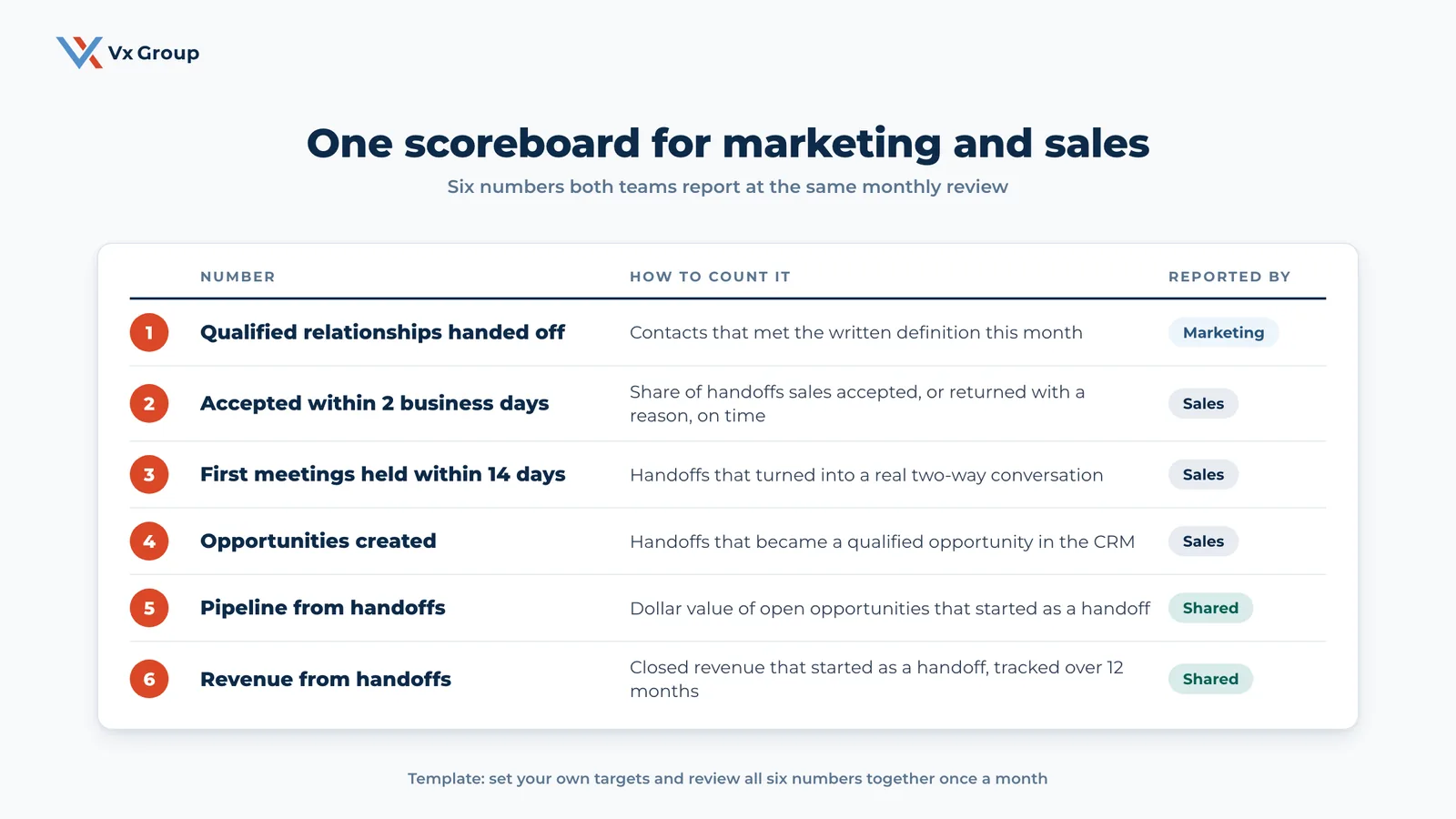
Choose six numbers that follow a handoff from the moment marketing passes it to the moment it becomes revenue. Report all six at the same meeting every month. Each team keeps its own working metrics for running its own department. The leadership conversation uses the shared six.
Pick the six numbers
These six work for most relationship-driven B2B companies:
- Qualified relationships handed off this month.
- Accepted within 2 business days: the share sales accepted, or returned with a reason, on time.
- First meetings held within 14 days of the handoff.
- Opportunities created from handoffs.
- Pipeline value from handoffs.
- Closed revenue from handoffs, tracked over 12 months.
The first number belongs to marketing. The middle three belong to sales. The last two belong to both teams. A leadership team that reviews these six together can see which step is breaking. The answer is usually specific: plenty of handoffs with slow acceptance, or fast acceptance with few first meetings.
Move single-team metrics out of the leadership meeting
Keep website traffic, email open rates, and form-fill counts on marketing’s own dashboard. Keep call counts and activity logs on the sales dashboard. Both teams need those numbers to run their departments. In the leadership meeting, they invite each side to report its best number and skip the handoff.
Build one CRM report from first conversation to closed revenue
Tag every handoff in the CRM with its source and date. Build one saved report that shows the current stage of every handoff. Most CRMs can do this with one custom field and one report. If yours cannot, a shared spreadsheet updated weekly by the gap owner works for the first two quarters.
Agree on what each pipeline stage means before you build the report. Then a “qualified opportunity” means the same thing to everyone reading it. Our guide to sales pipeline management walks through how to define the stages.
Tie part of each leader's pay to the shared numbers
Suppose the marketing lead’s bonus pays on lead volume and the sales lead’s bonus pays on bookings alone. Then both leaders will follow their paychecks, and the scoreboard will be ignored. Move part of the marketing lead’s variable pay onto pipeline from handoffs. Move part of the sales lead’s onto acceptance and first-meeting rates.
The shares can start small, as long as both leaders have money riding on the same two or three numbers.
Set the marketing plan's targets from the scoreboard
Your annual B2B marketing plan should set its targets from the same six numbers. Start with qualified relationships handed off and pipeline from handoffs. When the plan and the scoreboard measure the same things, the quarterly plan review and the monthly handoff review tell one story.
Step 4. How do you run a monthly review of every handoff?
Run a 60-minute review once a month. Marketing and sales look at every handoff from the previous month, one row at a time, and agree on one change. Review every handoff, including the ones that went well. That is how the scoreboard leads to decisions.
Pull every handoff from the month into one list
Before the meeting, the gap owner pulls every handoff from the prior month into one list. Use six columns: contact, company, source, date handed off, date accepted or returned, and current status. For most long-cycle B2B companies, that list is short enough for the team to read in one sitting.
Ask the same four questions of every handoff
- Did sales accept it, or return it with a reason, within two business days?
- Did a first meeting happen within 14 days?
- What happened after the first meeting?
- If it stalled, which step broke?
Sort every miss into one of three buckets
Each stalled handoff points to a specific fix:
| Where it broke | What it usually means | What to fix |
|---|---|---|
| Wrong fit or wrong person | The definition is loose, or marketing is stretching it to hit a number | Tighten the definition or the disqualifiers from Step 1 |
| Slow or no follow-up | Sales capacity, unclear territory ownership, or a missed response time | Fix the receiver field or the response time from Step 2 |
| Lost after the first meeting | The sales conversation, the offer, pricing, or timing | Take it to the sales team’s own pipeline review |
Keep the meeting to a fixed agenda
Use the same 60-minute agenda every month:
- Minutes 0 to 10: the six scoreboard numbers against last month.
- Minutes 10 to 35: the handoff list, row by row, with the misses first.
- Minutes 35 to 50: returned contacts, their reason codes, and any pattern.
- Minutes 50 to 60: one decision for next month, with an owner and a date.
Write down one change per month
End every review with one change, written down with an owner’s name and a due date. It might be a tighter disqualifier, a new line in the handoff note, or a second receiver for a busy territory.
Twelve small changes a year will fix more than one large reorganization. Keep the change log on the same CRM page as the rule. Then anyone can see why the rule looks the way it does.
Step 5. How do you name one person accountable for the gap?
Name one person who owns the space between marketing and sales: the definition, the handoff rule, the scoreboard, and the monthly review. In most owner-led companies that person is the president or a senior revenue leader. The job requires the authority to change how both teams work.
Shared ownership feels fair. It is also the main reason handoff problems survive for years. When both leaders own the gap, each one can point at the other.
Choose the owner by authority
Pick the person who can tell both the marketing lead and the sales lead to change something and have it happen. In a smaller company that is often the owner or president. In a larger one, it may be a vice president of revenue or growth who manages both teams.
Write the owner's job in four lines
- Owns the qualified relationship definition and the handoff rule, and approves every change to both.
- Runs the monthly handoff review and keeps the change log.
- Reports the six-number scoreboard to the leadership team every month.
- Settles any dispute between the two teams about a specific handoff within one week.
Give the owner a seat in annual planning
The gap owner should be in the room when the marketing plan and the sales targets are set for the year. That way the numbers in both plans match the scoreboard. This is where alignment connects to the company’s larger growth framework. The person who owns the handoff helps set the targets that feed it.
If your company has a written B2B go-to-market strategy, the handoff rule turns that strategy into daily work for both teams.
Write the role down so it survives a departure
Write the owner’s four lines, the definition, the rule, and the change log into the CRM page from Step 2. If the gap owner leaves or changes roles, the next person inherits a working system.
A handoff process that lives in one person’s head carries the same risk as founder-dependent sales: it works until that person is gone.
How do you know if your sales and marketing is aligned?
Your sales and marketing teams are aligned when both leaders give the same answers to five questions. What counts as qualified? How many contacts were handed off last month? How many did sales accept on time? How many became first meetings? How much revenue started that way? Different answers mean different definitions.
Run this ten-question check with both leaders in the same room, and answer each one yes or no:
- Is there a written definition of a qualified contact that both leaders have signed?
- Can a new marketer and a new salesperson find that definition in the CRM?
- Is there a written handoff rule with a response time in business days?
- Does every handoff arrive with a note describing the conversation?
- Can sales return a contact with a reason code?
- Do both teams report the same handoff numbers to leadership?
- Can you see how much closed revenue started as a marketing handoff in the last 12 months?
- Does someone review every handoff from the prior month?
- Is one named person accountable for what happens between the two teams?
- Is part of each leader’s pay tied to a shared number?
Use the count as a rule of thumb. Eight to ten yes answers means the structure is in place, and the remaining work happens in the monthly review. Five to seven means the teams agree on some pieces and are still guessing on others. Start with the first “no” on the list. Four or fewer means the friction is structural. Begin with Step 1.
A second test takes one question. Ask each leader, separately, to explain the last good deal the company lost. If marketing blames the follow-up and sales blames the lead, the handoff has no shared record yet.
What are the most common sales and marketing alignment mistakes?
The most common sales and marketing alignment mistakes add more meetings, more software, or more leads. The definition, the rule, and the owner stay the same.
- Adding a meeting with no rule to enforce. A weekly sync without a written handoff rule turns into a weekly argument.
- Buying software first. A new marketing automation platform or CRM integration moves the same undefined handoff faster. Write the rule first, then set up the tool to follow it.
- Letting marketing grade its own handoffs. When marketing decides alone what qualified means, the definition drifts toward whatever volume target marketing has that quarter.
- Punishing the return path. If every returned contact counts against marketing, marketing pushes back on returns and sales stops sending them. Treat returns as information. The reason codes are the most useful data in the system.
- Handing the gap to a committee. A four-person committee that owns the handoff has the same problem as two teams that share it.
- Asking for more leads to fix a handoff problem. When handoffs stall, the first move is to ask marketing for more of them. That adds volume to the step that is already breaking. We wrote about this pattern in Why “More Leads” Is Almost Never the Answer.
How long does it take to align marketing and sales?
Most companies can put the definition, the handoff rule, and the scoreboard in place within 60 days. They see the handoff numbers improve within two quarters. The timeline below assumes the gap owner spends a few hours a week on the work.
| Timeframe | Work | What you should see |
|---|---|---|
| Weeks 1 to 2 | Trace the last 20 closed deals; write and sign the definition | One paragraph both leaders agree on |
| Weeks 3 to 4 | Write the handoff rule and the note template; set up the handoff stage in the CRM | Every new handoff follows the rule |
| Weeks 5 to 8 | Build the six-number scoreboard; run the first monthly review | A baseline for all six numbers |
| Months 3 to 6 | Monthly reviews with one change each; tie part of each leader’s pay to the shared numbers | Faster acceptance, more first meetings, fewer returns for wrong fit |
Revenue from handoffs takes longer to show up. With a long sales cycle, a handoff made in month two may close in month nine or later. Acceptance, first meetings, and opportunities created tell you the system is working while the revenue catches up.
Where to start this week
Start with Step 1. Pull your last 20 closed deals and trace each one back to its first conversation. Write down what they had in common. Bring that list to a 45-minute meeting with your marketing and sales leads. Leave with a one-paragraph definition both of them sign.
That paragraph gives the next four steps something to build on. It also settles most arguments about lead quality in the first meeting.
Ready to grow?
If your marketing and sales leads blame each other and you cannot tell who is right, start with a conversation about who owns growth between your teams.
Related posts
- How to Build a B2B Go-to-Market Strategy
- Sales Pipeline Management: How to Run a Pipeline That Doesn’t Live in One Person’s Head
- What Is a Growth Framework (and What Makes One Actually Work)
FAQs
About the Author: Jacob Camhi
