

The Four Beliefs Behind Measured in Millions

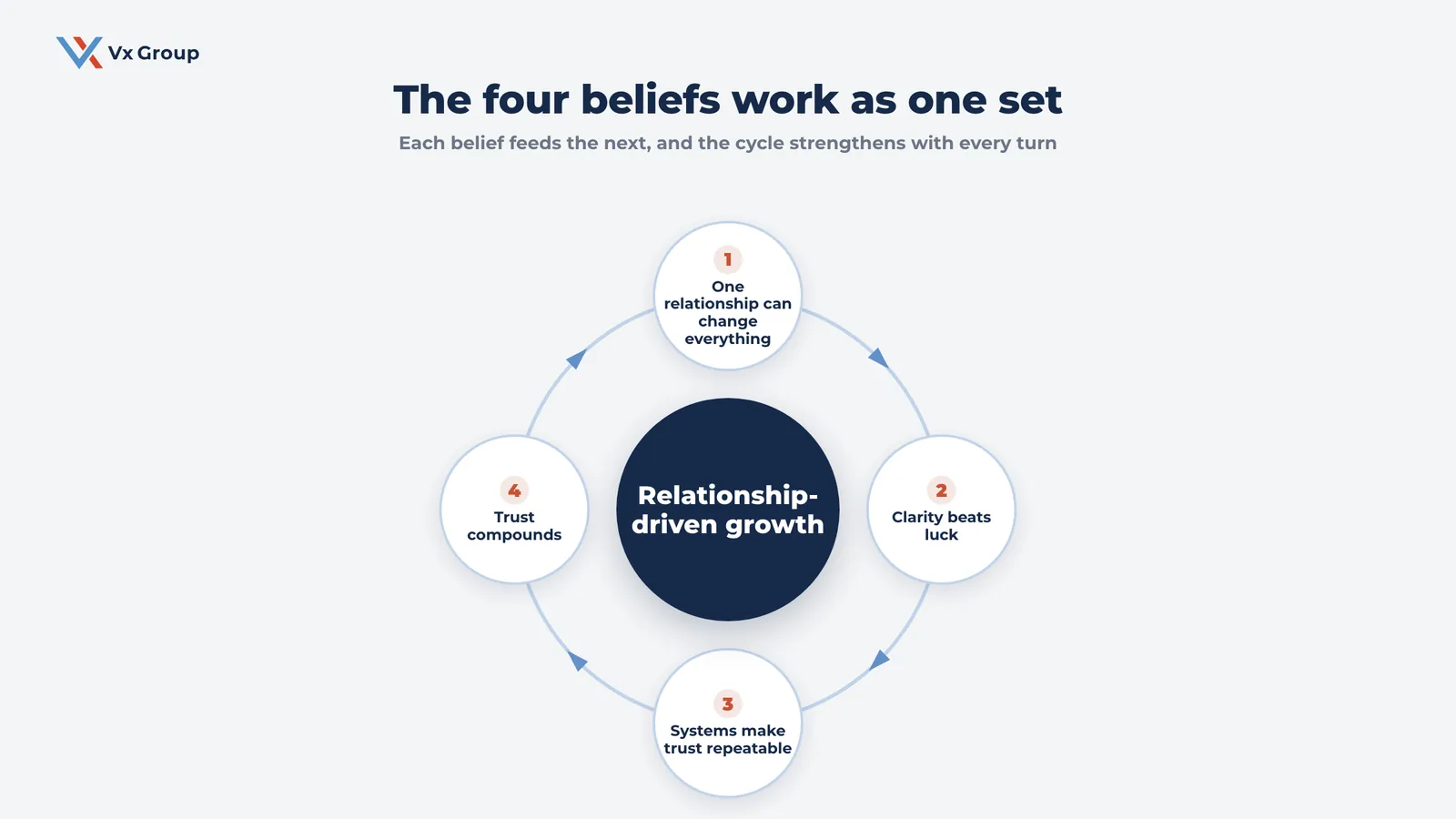
Relationship-driven growth is a way of building revenue where the money comes from a managed set of deep, long-lived customer relationships. Measured in Millions® rests on four beliefs: one relationship can change everything, clarity beats luck, systems make trust repeatable, and trust compounds. Held together, they explain why some companies grow quietly and steadily for decades.
TL;DR
- Relationship-driven growth treats a small number of long-lived customer relationships as the asset that produces revenue, and manages them accordingly.
- Belief one: one relationship can change everything. A single conversation can open a twenty-year account, which changes what is worth your attention today.
- Belief two: clarity beats luck. Companies that can say precisely where they win outgrow companies that stay busy and hope.
- Belief three: systems make trust repeatable. Writing down how you build relationships protects them from turnover and busy quarters.
- Belief four: trust compounds. Every kept promise makes the next one cheaper to keep, and the curve bends upward late.
- The four only work as a set. Any one of them alone produces a company that is either sentimental about relationships or mechanical about them.
I have spent more than twenty years inside relationship-driven B2B companies. Manufacturers, distributors, industrial firms, mostly family-held, mostly between $25M and $100M. The pattern that kept showing up is the reason Measured in Millions® exists, and it is worth stating plainly before I get to the beliefs.
These companies almost always grow well for a long time, then stop. When they stop, the diagnosis they reach for is that they need more leads, a better website, a bigger sales team, or a new CRM. They buy one or more of those. Growth stays flat. What is actually happening is that the thing producing their revenue, a small set of relationships built over years, has never been managed as an asset. Nobody owns it. Nobody measures it. Nobody wrote down how it works. It sits in a few people’s heads and in a few people’s calendars, and it degrades quietly while everyone is busy.
The four beliefs below are the answer to that. I want to be honest that they are beliefs, and not laws of physics. They are what I have watched hold up across two decades of doing this work.
What is relationship-driven growth?
Relationship-driven growth is a growth model where most revenue comes from a limited number of customer relationships that are actively owned, measured, and developed over years. Revenue expands by going deeper with people who already trust you, and by being introduced to people they trust.
Defined Term: Relationship-driven growth.
A growth model in which the primary revenue engine is a managed portfolio of long-lived customer relationships. The company knows which relationships matter, who owns each one, how healthy each one is, and what each is worth over its full life.
The opposite model, which most of the marketing world is built around, runs on volume. Fill the top of the funnel, convert a percentage, replace the churn. That model works beautifully for companies selling a $200-a-month product to twenty thousand customers. It works poorly for a company selling a $400,000 system to forty customers who will still be customers in 2046.
The tell is arithmetic. Pull your revenue for last year and sort your customers by dollars. If your top ten are more than half your revenue, you are a relationship-driven company whether or not you have ever called yourself one. What remains is whether you run like one.
Why do the four beliefs have to be held together?
Each belief on its own produces a company with a specific and predictable failure.
A company that believes only that one relationship can change everything becomes sentimental. Everyone is precious, nothing is prioritized, and the sales team spends its week on whoever called most recently.
A company that believes only in clarity becomes analytical and cold. Beautiful segmentation, precise targeting, and no actual human warmth in how it shows up.
A company that believes only in systems turns its relationships into a workflow. You have all met a company like this. The quarterly check-in arrives right on schedule and it is obviously a task somebody closed in a CRM.
A company that believes only that trust compounds waits. It assumes the good work will be noticed eventually, and it is often still waiting five years later while a competitor with half the craftsmanship has been actively building the relationships.
The four together produce something different: a company that knows exactly which relationships matter, treats each one as capable of changing the trajectory of the business, has written down how it earns and keeps trust, and gives that trust enough time to do what compounding does.
Why can one relationship change everything?
Because in a long-cycle B2B business, the size of a first order tells you almost nothing about the size of the relationship.
This is the belief that changes what a company pays attention to on an ordinary Tuesday. A maintenance manager at a plant you have never sold to calls about a single replacement part. The order is $1,800. In a volume business, that is a rounding error and it gets handled by whoever is closest to the phone. In a relationship-driven business, that call is the first frame of a movie that might run twenty years. The same plant has fourteen other lines. The manager is three years from running the whole facility. His company owns four other sites.
I have watched a $1,800 part order become the front end of a relationship worth millions across a decade. I have also watched a company hand that exact call to a temp with no context and lose the whole arc before it started.
Defined Term: Generational Customer.
A relationship that has produced revenue across more than one generation of leadership at both companies. These accounts feel permanently safe, which is precisely what makes them dangerous. They are usually unmanaged, and the people who built them are usually close to retiring.
The practical consequence of this belief is that you cannot triage by deal size. You triage by relationship potential, which means somebody has to be able to see potential, which means somebody has to know what a good long-term customer looks like for you. That requirement is what makes the second belief necessary.
Why does clarity beat luck?
Because a company that can say precisely where it wins will put its people and its money in the right place, and a company that cannot will spread both evenly across everything and call the result a strategy.
Most of the growth I have seen in these companies came from subtraction. A distributor stops chasing three market segments where it has never won and puts that time into the one where it wins two out of three. Revenue moves within two quarters. Nothing new was purchased. The team just stopped spending itself on ground it was never going to take.
Here is the villain, and I want to name it clearly because a lot of good companies are living inside it. Growth by luck is when a company grows without being able to explain why. Referrals show up. Deals close. The line goes up. Because nobody can articulate the pattern, nobody can repeat it on purpose. When the line eventually flattens, and it always eventually flattens, the company has no idea which lever to pull, so it pulls all of them at once. That is where the random acts of marketing come from. They are what a smart team does when it has no clarity to act on.
Clarity in this context is specific and writable. Four things:
- Which customers you are genuinely better for, described concretely enough that a new salesperson could pick the better of two prospects and explain why.
- Why you win when you win, taken from your actual closed deals and written in the customer’s words.
- Which relationships carry the most future value, ranked, with the ranking written down.
- Who owns each of those relationships, by name.
If you cannot produce those four on paper today, the growth you have had so far has been partly luck. That is not an insult. Nearly every company I have worked with started there, including good ones with fifty years of history. Why Most B2B Companies Grow By Accident walks through what that costs in more detail.
Ready to grow?
If you want a second set of eyes on where your company actually wins, that is a conversation we are glad to have.
How do systems make trust repeatable?
By moving what your best people know out of their heads and into something the company owns.
This is the belief that gets the most resistance, and I understand why. When you tell a founder who has spent thirty years building relationships that you want to systematize them, what they hear is that you want to make them fake. That fear is reasonable and it is also backwards.
Think about what actually happens without a system. Your best salesperson knows that the buyer at your largest account cares about lead times more than price, that his plant manager has to be included early or the deal stalls, that the company does its budgeting in September, and that he lost a brother two years ago. None of that is written down anywhere. When your salesperson retires, that knowledge walks out with him. The next person shows up and treats a twenty-year partner like a stranger. The relationship does not survive being treated like a transaction, and nobody in your building can name the moment it broke.
The human being stays at the center of that relationship. What a system does is make sure that when the human being changes, the relationship does not have to start over. Writing down that the buyer cares about lead times is an act of respect. It is a company remembering a customer institutionally.
Defined Term: MiMOS.
The Measured in Millions® operating system. It runs a company’s growth on the same cadence as its operations: named relationship owners, a documented contact rhythm, relationship health tracked like pipeline, and planning that starts from the accounts themselves.
What a working system covers is short and unglamorous:
- Named ownership. Every relationship that matters has one human being responsible for it, and that person is usually not the same person chasing new deals, because urgent always beats important.
- A documented contact rhythm. Real conversations happen on a schedule that does not wait for a problem to create the excuse.
- Relationship health as a tracked measure. How recently did a real conversation happen. Is spend growing or flat. How many people at their company have a relationship with someone at yours. Most companies report in detail on open deals and almost nothing on the accounts they are trying to keep.
- Executive involvement in the top accounts. Do not leave all the knowledge and the responsibility with the sales team. A lot of them are order takers, and if they leave tomorrow the knowledge leaves with them, and the relationship might follow.
How to Build an Infinite Team That Survives Key-Person Loss goes deeper on the turnover half of this, and What Is a Business Growth Operating System? covers the mechanics of the operating layer itself.
Why does trust compound?
Because each kept promise lowers the cost of the next one, and the savings accumulate on both sides of the relationship.
The first order from a new customer is expensive for everybody. They have to check your references, write the spec tightly, build in a contingency, and watch the delivery. You have to prove out a process, absorb the friction, and probably eat something. By the fifteenth order, the spec is a phone call, the contingency is gone, and both companies have quietly redirected the money they used to spend protecting themselves against each other.
That is the mechanism, and it explains a thing that confuses people about relationship-driven companies. The growth curve looks unimpressive early and then bends hard. Years one through three of a serious account look like a lot of effort for modest revenue. Years four through twenty are where the account becomes what it becomes: bigger orders, more sites, introductions to their suppliers and their customers, and the informal position of being the company they call before they issue an RFP.
Field Notes:
A company we work with had a decade-long account everyone called rock solid. No one formally owned it because no one thought it needed managing. Their champion retired. The new decision maker had no history with them. Within eighteen months a competitor who had been quietly building that relationship picked up seven figures in annual revenue. The first warning sign was an RFP they were not invited to.
Compounding runs in both directions, and that is the part worth sitting with. The same mechanism that makes a well-tended relationship worth more every year makes a neglected one worth less every year, and both curves are invisible until they are steep.
What does a company look like when it runs on all four beliefs?
It looks calmer than its competitors, and its numbers look different in four specific ways.
| What you would see | Growth by luck | Relationship-driven growth |
|---|---|---|
| Where revenue comes from | Hard to explain, varies by year | Named accounts, ranked, with owners |
| What the sales meeting covers | Open deals only | Open deals plus health of the top accounts |
| What happens when a rep leaves | Accounts wobble, some are lost | Handoff from documented history |
| Where growth comes from next year | New logos, mostly | Expansion inside known accounts, plus introductions |
| How marketing spend is decided | Whatever seems to be working | Where the company demonstrably wins |
| Time from first contact to trust | Restarts with every new person | Carries across people because it is written down |
The most visible difference is the second row. In a company running on these beliefs, the weekly leadership meeting spends real time on accounts that are not currently in a deal cycle. That single change is the clearest signal I know that a company has moved from agreeing with this in a meeting to actually running on it.
How do you tell whether your company grows by relationship or by luck?
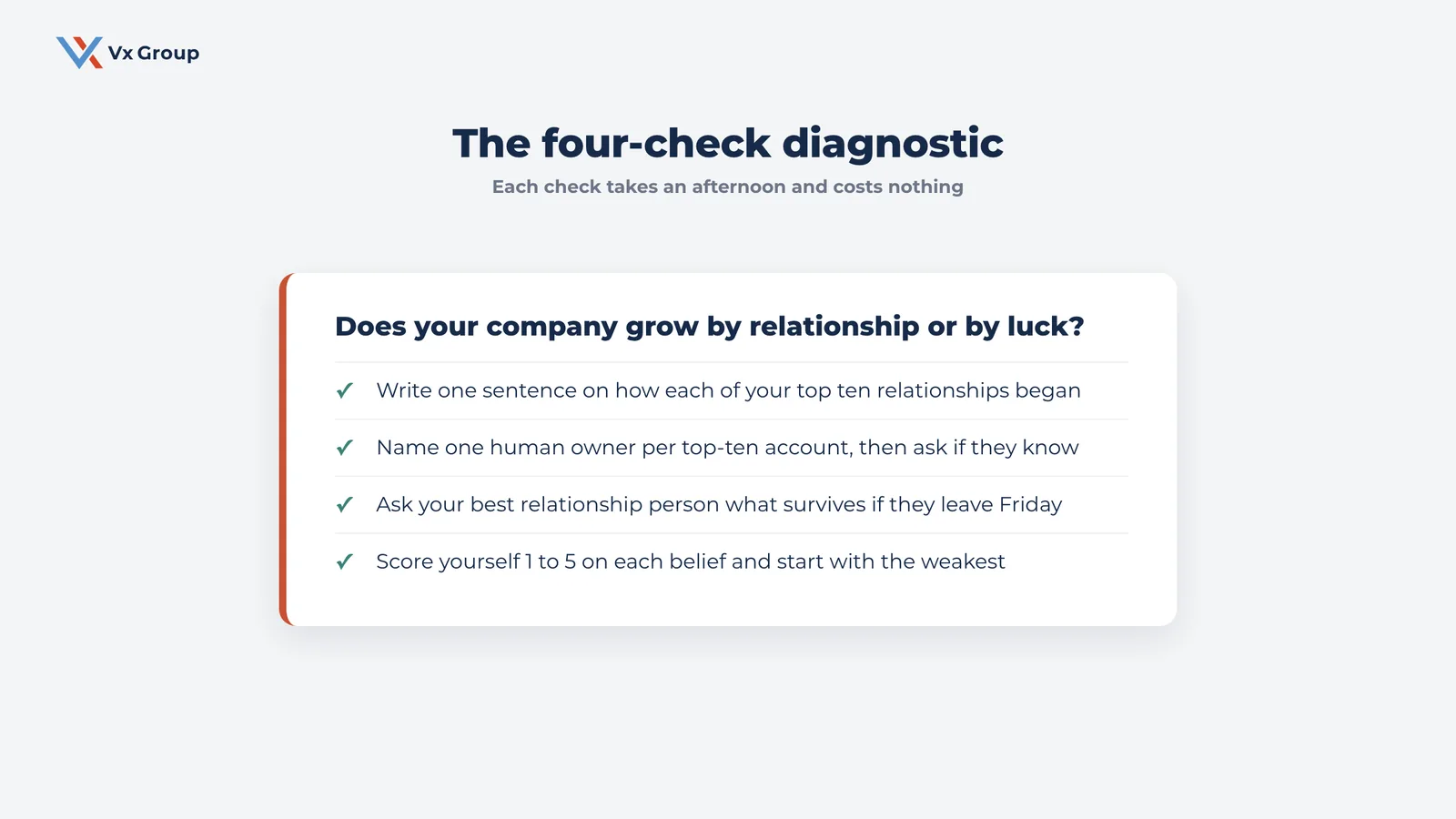
Run four checks. None of them takes more than an afternoon, and all four can be done without hiring anyone.
Write down where your last ten million dollars came from
Pull the revenue and sort by customer. Then write one sentence per customer in the top ten explaining how that relationship started. If you cannot write the sentence, that is the finding. A company that does not know how its biggest relationships began cannot repeat the mechanism that created them.
Name the owner of each of your top ten relationships
One name per account. Not a department, not “sales,” a person. Then ask that person whether they know they own it. The gap between the list you wrote and what those people would say is the most reliable measure of relationship risk I have found, and it is usually wider than leadership expects. Your Top 10 Customers Are a Growth Strategy has the full version of this exercise.
Score how much of what you know lives only in someone’s head
Take your most experienced relationship person and ask a simple question: if they left on Friday, what percentage of what they know about your top accounts still exists on Monday? Whatever number they give you is the percentage of your relationship value that is actually owned by the company. The rest is on loan.
Pick the belief you are weakest on and start there
Score yourself 1 to 5 on each of the four. Clarity weakest means start by writing down where you actually win. Systems weakest means start by capturing what your top people know. Compounding weakest usually means you are undercounting how long a relationship takes to pay, and the fix is changing what you measure and over what horizon. The first belief, that one relationship can change everything, is rarely the weak one in these companies. Most of the founders I talk to believe it in their bones. What they lack is the other three that turn the belief into an operating reality.
Where to start
Start with the ten sentences. Sort your revenue, take the top ten customers, and write one sentence each on how the relationship began. Most leadership teams can get through eight of them and then stall, and the stall is the useful part, because it shows exactly where the institutional memory ends and the individual memory begins.
That afternoon has produced more genuine change in the companies I work with than any tool purchase I have ever watched. It costs nothing and it cannot be delegated.
Then sit with two questions. Of your ten most important relationships, how many would survive the person who owns them leaving next month? And if the honest answer is fewer than half, what exactly are you building?
Ready to grow?
Bring us your top ten and we will work through the ownership question with you honestly.
Subscribe to Insights → for how relationship-driven B2B companies build growth that lasts.
FAQs
About the Author: Eric Zoromski
