

Why Your CRM Is Empty (and How to Fix Adoption for Good)
CRM adoption fails when the system takes time from a salesperson and gives nothing back. Reps skip it for rational reasons, and mandates, training, and dashboards do not change that math. Adoption changes when the CRM starts returning something useful on the first day: account history before a call, and a reminder that saves a dropped follow-up.
TL;DR
- An empty CRM is a design problem. A rep who spends twelve minutes entering data so a manager can run a report is making a sensible trade by skipping it.
- Forrester has published data showing high CRM adoption alongside low satisfaction, which is the shape of the real problem: the software is installed everywhere and trusted almost nowhere.
- Cut required fields to the ones that change a decision. Most teams can delete over half of what they currently require and lose nothing.
- Fix the manager behavior. A leader who asks in a meeting for information already in the CRM teaches the whole room that the CRM does not count.
- Load the relationship history before you ask for compliance. A system worth opening has to contain something worth reading.
- Measure adoption on two or three fields that matter. Login counts measure obedience.
Why do salespeople refuse to use the CRM?
Because the exchange is bad for them. A salesperson enters call notes, updates a stage, fills six required fields, and receives nothing in return except the absence of a reminder from their manager. Twelve minutes of admin per account, repeated across forty accounts, buys them no advantage in their own week. Skipping it is the rational choice.
Most explanations blame something else. The team is resistant to change. The reps are old-school. Nobody was trained properly. Those explanations survive because they are easy to act on: run another training, send another reminder, escalate to the VP. And they never work, because the underlying trade has not changed.
There is a specific villain here and it is worth naming: the CRM installed as a management reporting tool. Somebody decided the business needed pipeline visibility, the system was configured to produce that view, and the required fields were chosen to populate a dashboard. The design brief was leadership’s question, and the salesperson became the data-entry mechanism for someone else’s report. Every symptom that follows comes from that original decision.
Defined Term: CRM adoption.
The degree to which a sales team uses the CRM as its working system of record during the normal course of selling. Real adoption shows up as reps opening the system before customer conversations because it holds something they need, and it is measured on a small number of decision-relevant fields.
The cost of getting this wrong compounds quietly. When the CRM stays empty, relationship history lives in individual memories and personal notebooks. The company then carries key-person risk on every significant account, cannot onboard a new salesperson without months of shadowing, and cannot answer a basic question about what was promised to a customer three years ago. That exposure is the same one described in what is a generational customer and how to build an infinite team.
Step 1: Decide what the CRM is for, and say it out loud
Write one sentence naming the primary purpose of the system, and be honest if the current answer is management visibility. Everything downstream depends on this answer, and a team can tell within a week which answer you actually chose.
Write the purpose sentence and test it against the field list
Three honest candidates:
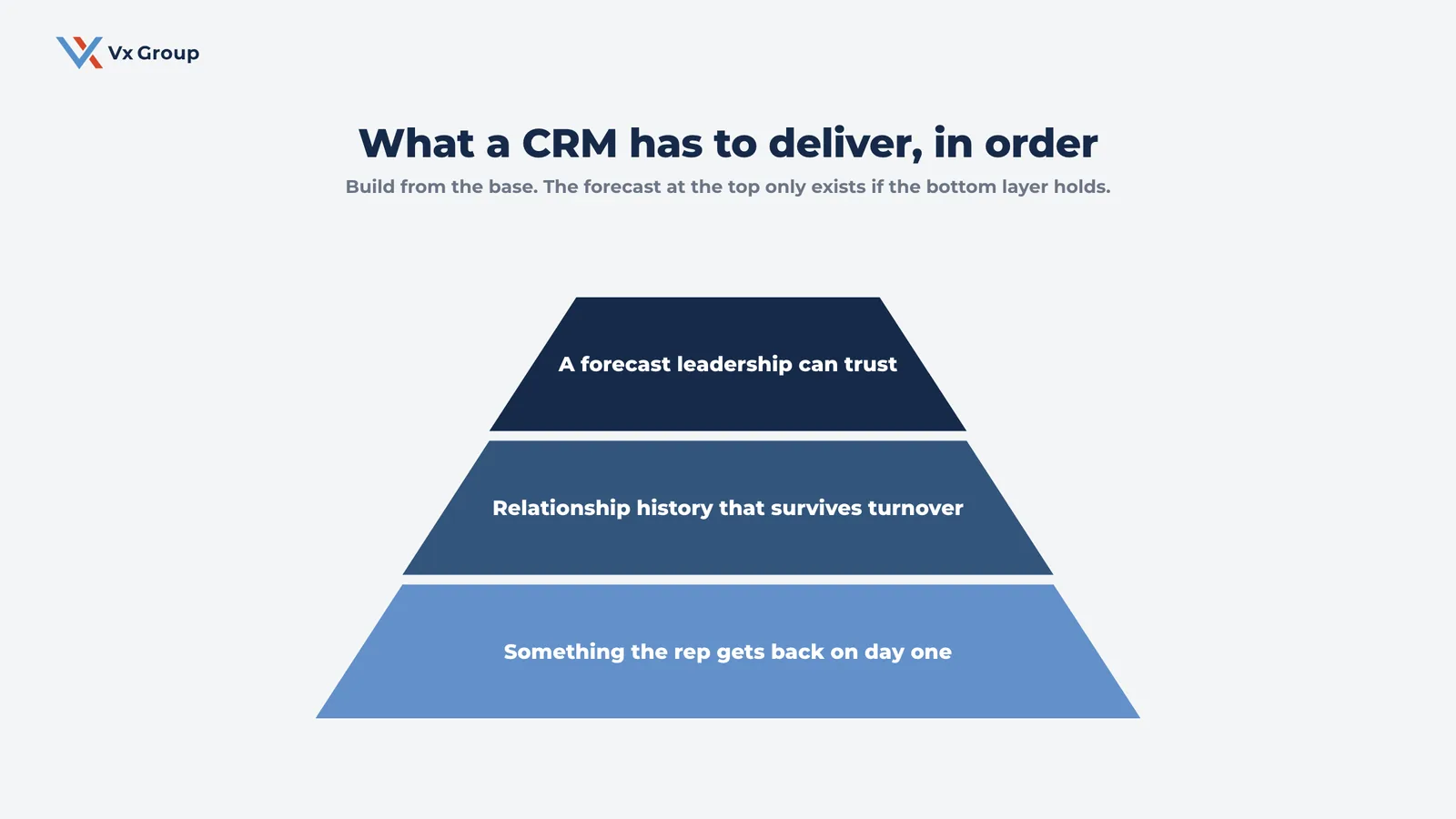
- A forecast leadership can trust. Legitimate, and a poor foundation. Built first, it produces the empty CRM.
- Relationship history the company owns. Strong foundation for a business with long cycles and long customer tenure.
- A working tool that makes a salesperson better at their own job. The only answer that earns voluntary use on day one.
The workable order is three, then two, then one. Give the rep something back, use that adoption to accumulate a real relationship record, and let the forecast emerge from data that people maintain because maintaining it helps them. A forecast built on fields nobody believes in produces a number nobody trusts, which is where most of these systems already are.
Say it to the team in plain language
Tell the sales team what the system is for and what you are changing. Something close to: “This has been a reporting tool and you have been doing data entry for my dashboard. We are rebuilding it as something you use before a customer call. Here is what is being deleted.” That conversation buys more goodwill than any training session, because it acknowledges what everyone already knows.
Step 2: Cut the required fields to the ones that change a decision
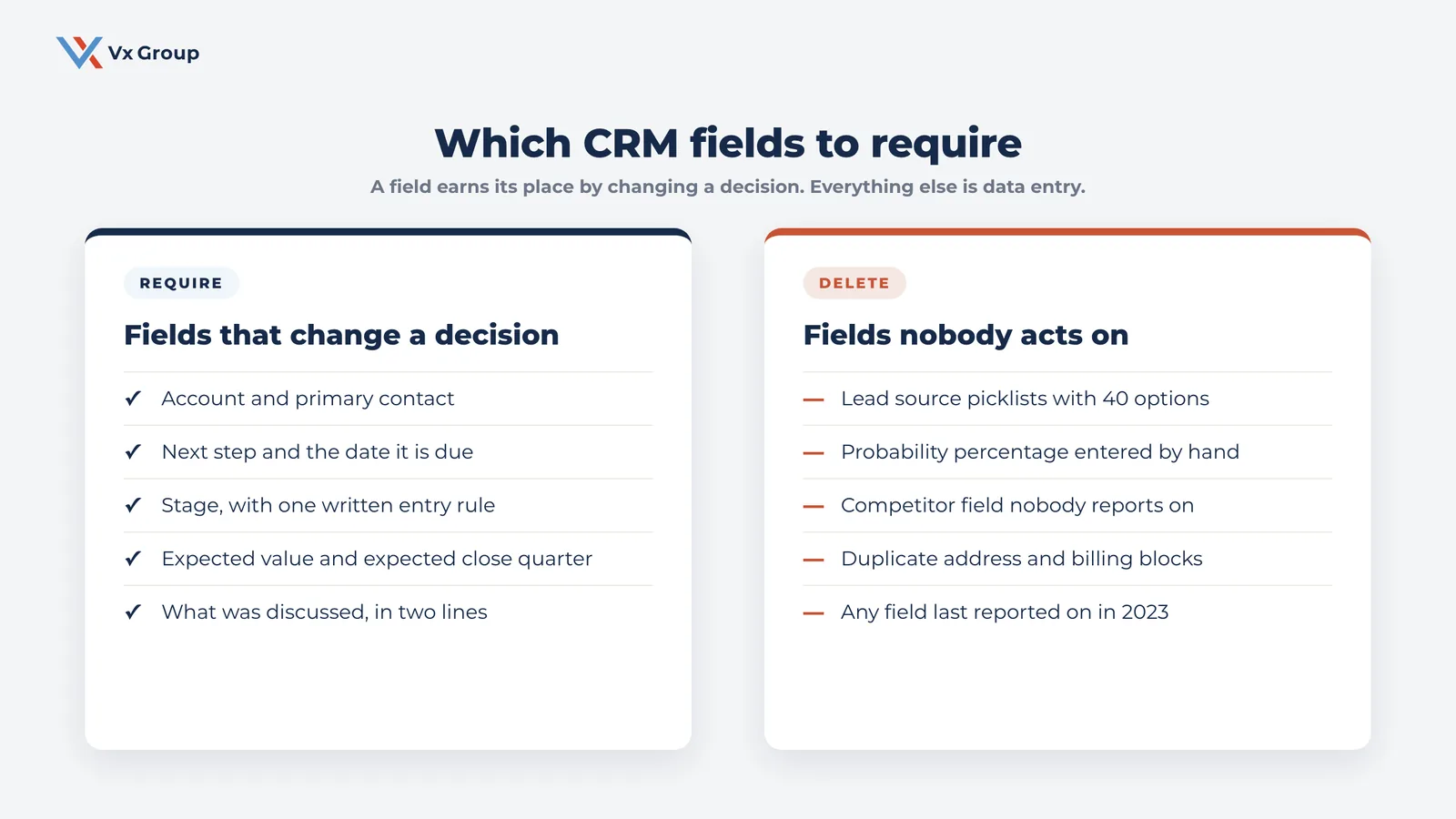
Delete every required field that does not change a decision somebody actually makes. For most teams that means removing more than half of the current list, and the result is a system a rep can update in ninety seconds.
Run the field audit with one question
Print the list of required fields. For each one ask: what decision changes based on this field, and who makes it? If nobody can answer in ten seconds, the field is deleted. Do this with the sales manager and one senior rep in the room, and expect the meeting to take forty-five minutes.
| Field | Decision it changes | Keep it? |
|---|---|---|
| Next step and due date | Whether anything is falling through this week | Yes, the single most valuable field in the system |
| Stage | Where coverage and effort are needed | Yes, with one written rule per stage |
| Expected value and close quarter | Capacity planning and forecast | Yes, quarter-level precision only |
| Two lines on what was discussed | Whether the next person can pick this up | Yes |
| Probability percentage | None, it is guessed and then averaged | No, derive it from stage |
| Lead source with 40 picklist options | None, nobody reports at that granularity | No, reduce to five options or delete |
| Competitor named on the deal | Useful in theory, unreported in practice | Optional, never required |
Write one entry rule per stage
Ambiguous stages are the most common source of a forecast nobody believes. Write the observable condition for each stage in one line: “Quoted” means a written quote has been sent. “Verbal” means the buyer has stated intent and named a timeline. If two reps would classify the same deal differently, the definition is not finished. The full treatment of this is in sales pipeline management.
Remove the deleted fields from the layout entirely
An optional field that stays visible still creates a small sense of incompleteness every time a rep opens the record. Remove them from the layout. The visible simplicity is a large part of the effect.
Step 3: Make the system give something back on day one
Configure at least two things a rep gets for free before they enter anything new: the account history they need before a call, and a reminder that prevents a dropped follow-up. Adoption follows utility, and utility has to arrive first.
Build the pre-call view
A rep should be able to open an account and see, in one screen: last contact and what was discussed, open quotes and their dates, what was promised, who else at the company has touched this account, and the next step with its due date. Someone walking into a customer meeting with that in front of them looks prepared, and looking prepared in front of a customer is worth more to a salesperson than any internal argument about compliance.
Turn on the follow-up reminder and let it save somebody
The next-step field with a date produces a daily list of what is due. In long-cycle B2B, dropped follow-ups are a steady and invisible source of lost deals, since a commitment made in March comes due in July and nothing external reminds anyone. The first time the system catches a follow-up that would have been missed, the argument for using it changes from policy to self-interest.
Give the team one report they asked for
Ask the reps what they would like to see and build one of those, whether it is their own open quotes by age, accounts with no contact in ninety days, or reorder timing across their book. One report that belongs to them changes how the system is perceived.
Ready to grow?
We help sales teams rebuild a CRM into something reps open by choice, without a software migration.
Step 4: Fix the manager behavior
Stop asking in meetings for information that already lives in the CRM. A leader who asks a rep to walk through their pipeline verbally, while the CRM sits open on a screen showing the same data, teaches the entire room that the CRM does not count.
Run the pipeline meeting from the system
Open the CRM on the screen and run the meeting from what is there. Where a record is thin, say so in the moment and ask for it to be updated during the meeting. This single change does more for adoption than any training, because it makes the system the authoritative version of reality.
Stop accepting parallel reporting
When a rep sends a spreadsheet, a text summary, or a verbal update instead of an updated record, accept the information and then ask for the record to be updated before the next meeting. Every accepted workaround adds another week to the timeline. Managers who keep a private spreadsheet are the largest single obstacle in most of these projects, and the fix is to delete the spreadsheet.
Use the record to help, visibly
Notice things in the system and act on them where the team can see: an account with no contact in four months, a quote aging past thirty days, a commitment that came due. When the CRM is visibly how a manager finds ways to help, the incentive to keep it current shifts.
Have leadership use it themselves
If the owner or sales leader asks about an account, they should look it up first and open the conversation with what they read. That behavior propagates faster than any policy, and its absence explains most stalled rollouts.
Step 5: Load the relationship history that makes the system worth opening
Backfill the history on your most important accounts before asking the team to maintain it. A system that opens to an empty screen has nothing to offer, so nobody looks, so it stays empty.
A loaded record is also what lets a new hire become useful inside a long cycle instead of shadowing someone for two quarters, which is the practical argument made in sales onboarding.
Write one-page records for the top twenty accounts
For each major account, capture who decides, who influences, who has to be kept satisfied operationally, the commitment history, why the account is at its current price, and what would put the relationship at risk. The rep or owner talks, someone else types, roughly forty minutes each.
Two working days across the top twenty accounts converts the largest undocumented asset in the business into something the company owns. Use top 10 customers as strategy to decide which accounts get this treatment first.
Import what already exists in scattered form
Quote history, order history, service tickets, and shipping records already sit in your ERP or accounting system. Pull them in so an account record shows what this customer has bought and when. For distributors and channel businesses, include the partner-side history too, which is the point made in distributor management.
Set a decay rule so it stays true
Records age. Put a review date on the top-twenty pages, quarterly for the largest accounts and annually for the rest, with a named owner. A record everyone knows is eighteen months stale gets ignored, and one ignored record teaches people to distrust the whole system.
Step 6: Measure adoption on the fields that matter
Track two or three decision-relevant fields and report on those. Login counts, activity totals, and time-in-system measure compliance theater and correlate with nothing you care about.
| Measure | What it tells you | Target |
|---|---|---|
| Percentage of open opportunities with a next step and a future date | Whether the pipeline is actually being worked | Above 90% |
| Percentage of top accounts with contact logged in the last 90 days | Whether important relationships are being maintained | Above 95% |
| Percentage of closed deals with two lines on why they were won or lost | Whether the company is learning anything | Above 80% |
| Forecast accuracy at the quarter level | Whether stage definitions are being applied consistently | Improving quarter over quarter |
| Logins per week | Very little | Stop tracking it |
Publish the numbers to the team, by team rather than by individual at first, and talk about them in terms of what they enable. When a next-step compliance number moves from 40% to 90%, the visible consequence is fewer dropped commitments and a forecast that begins to hold, and saying so out loud is what keeps the number up.
The same discipline is what makes a documented sales approach stick, which is covered in how to build a sales playbook your team can’t live without.
Field Notes:
A distributor with eleven salespeople had a CRM in place for four years with almost nothing in it. Nineteen required fields on the opportunity record. We ran the field audit with the sales manager and two senior reps and cut it to five. Then we built one screen: last contact, open quotes, commitments, and next step, and turned on a daily due-list. Nobody was told to use the system more. Within six weeks, opportunities carrying a next step with a real date went from roughly a third to over ninety percent, and the manager stopped keeping her own spreadsheet, which she later said was the part that actually changed the team’s behavior.
Common CRM adoption mistakes
- Solving it with training. Training explains how to use a system that still takes more than it gives. The trade has to change first.
- Requiring fields nobody reports on. Every unused required field is a small tax that teaches the team the system is bureaucracy.
- Building for the dashboard first. It produces a forecast built on numbers nobody maintains and a team that resents the tool.
- Managers keeping private spreadsheets. The single most reliable way to guarantee an empty CRM.
- Asking in meetings for what is already recorded. It signals which source of truth actually counts.
- Launching with no data in it. An empty system offers a rep no reason to open it, so nobody does.
- Measuring logins. It generates activity that looks like adoption and changes nothing about the record.
- Blaming a software choice. Nearly every CRM on the market will work if the field list is short and the system returns something useful. Changing platforms without changing the design reproduces the same result at a new price.
Where to start
Print your required-field list and hold a forty-five minute meeting with the sales manager and one senior rep. For each field, ask which decision it changes and who makes it. Delete everything that gets no answer. Most teams cut the list in half in that one meeting.
Then build the pre-call view and turn on the daily due-list. Two changes, no software purchase, and the exchange the rep is being offered is fundamentally different by the end of the week. Adoption follows from there, and the forecast follows adoption.
The CRM is only as good as what it gives back
Teams that fix this end up with a system reps open before customer calls because it holds something they need, a relationship record the company owns, and a forecast that holds up because the underlying fields are maintained by people who benefit from maintaining them. None of that requires new software.
Start with the field audit. Forty-five minutes, three people, one question per field. It is the cheapest hour available in most sales organizations, and the effect shows up within a month.
Ready to grow?
We rebuild sales systems around what the team actually needs, then make the forecast a byproduct.
Subscribe to Insights → New articles on relationship-driven B2B growth, roughly weekly.
FAQs
About the Author: David Tisdale
