

Founder-Dependent Sales: Why Growth Stalls When One Person Carries Every Relationship

Founder-dependent sales describes a business where new revenue requires the founder personally: they hold the relationships, set the price, close the deal, and rescue the account when something goes wrong. It works well up to a point, then becomes the ceiling on growth, the largest single risk in the business, and the first thing a buyer discounts.
TL;DR
- Founder-led selling is the right model early. It becomes a structural problem the year the founder’s calendar becomes the constraint on revenue.
- Six signals tell you which side of the line you are on. The clearest one: a new salesperson has been in the seat a year and still cannot close without the founder in the room.
- The value sitting in the founder’s head is mostly judgment: which accounts are at risk, why this customer gets that price, what was promised in a hallway two years ago.
- Buyers price this risk directly. M&A advisers who write about founder dependency commonly describe discounts in the range of 30% to 50% against comparable businesses.
- The fix is a business that holds a written copy of what the founder knows, so other people can carry the work forward while the founder keeps the relationships only they can hold.
What is founder-dependent sales?
Founder-dependent sales means the company’s revenue depends on one person’s relationships, judgment, and availability. Deals stall when that person is traveling. Pricing decisions wait for their read. Customers ask for them by name and get uneasy when someone else calls. Every new salesperson eventually gets described as “still ramping up.”
This describes most successful companies in their first decade, and it describes a meaningful share of good companies in their fourth. The founder built the customer base by being trustworthy in a market where trust is the product. The relationships are real, they run deep, and in most cases the founder is genuinely the best salesperson in the building.
Defined Term: Founder-dependent sales.
A sales model in which new and repeat revenue requires the founder’s personal involvement to progress, because the relationship history, pricing judgment, and decision authority all live with that one person and exist nowhere in writing.
The reason it deserves a name is that the strength and the problem come from the same source. Every year the founder personally holds the commercial relationships, those relationships get deeper, and the business becomes more dependent on one calendar. Growth then arrives at a hard ceiling defined by how many customers one person can meaningfully know.
When does founder-led selling stop working?
Founder-led selling stops working the year the founder’s available hours become the binding constraint on revenue. Before that point it is an advantage. After it, every growth plan quietly routes through a calendar that is already full.
Six signals indicate you have crossed the line:
- Deals wait on one calendar. Quotes, negotiations, and closing conversations queue up behind the founder’s travel schedule, and the pipeline moves in bursts that match their week.
- New sales hires do not reach quota. You have hired capable salespeople who never got traction. After a year they are still bringing the founder into every serious conversation.
- Customers escalate past the account owner by default. Your largest customers have the founder’s cell number and use it first, which tells you where they believe the real relationship lives.
- Pricing has no written rules. Every non-standard price is a judgment call the founder makes from memory, and nobody else can reconstruct why an account is at the number it is at.
- Nobody can brief a new person on an account in ten minutes. The history exists as anecdotes rather than a record, so onboarding into a territory means shadowing the founder for months.
- The founder cannot take three consecutive weeks off. The business would keep running, and a handful of commercial decisions and relationships would sit untouched until they returned.
Three or more of those signals means the constraint is structural and no amount of additional effort from the founder will move it. This is the same ceiling described in why owner-led companies stall at 5 million, approached from the sales side.
Why does founder-dependent sales cap growth?
Because the thing being sold is judgment, and judgment that exists only in one head cannot be delegated, hired against, or scaled. The company can add salespeople, territories, and marketing spend, and revenue still tracks the founder’s personal capacity.
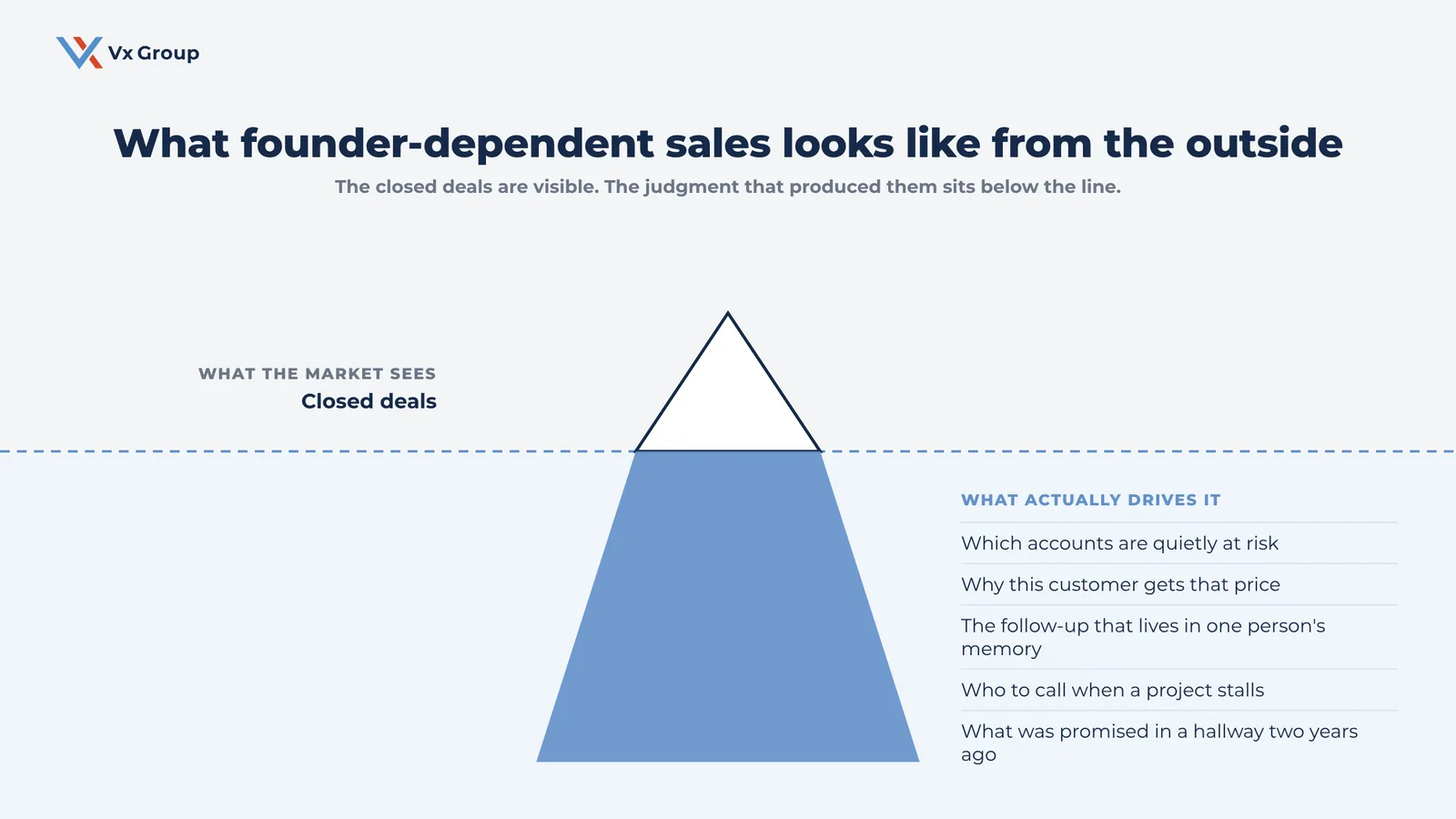
What sits below the waterline is specific and valuable. The founder knows that the purchasing manager at one account has to justify every dollar to a controller who was burned by a competitor in 2019, so the quote needs a line item explanation. They know that a customer’s plant manager decides in practice while the corporate office signs. They know which two accounts are quietly at risk because a champion retired. None of it is written down, and all of it is the difference between a quote that lands and one that gets ignored.
A new salesperson without access to that layer is doing a materially harder job than the founder does, with the same title and a fraction of the context. They lose deals for reasons they cannot see, conclude they are underperforming, and either leave or settle into order-taking. The founder concludes that good salespeople are hard to find, hires again, and repeats the cycle. This is the most expensive pattern in the whole category, because it burns two years and two salaries per iteration while the ceiling stays exactly where it was.
There is a second cost that is easier to miss. A founder spending most of their week on active deal work is a founder not working on the things only they can do: which markets to enter, which capabilities to build, which customers to walk away from. Growth in relationship-driven businesses tends to come from those decisions, and they are the first things crowded out by a full calendar of deal work.
Ready to grow?
We help owner-led companies move sales onto a system without putting a single relationship at risk.
What does founder dependency do to the value of the business?
Buyers price it as risk and reduce their offer accordingly. M&A advisers who write about founder dependency commonly describe discounts in the range of 30% to 50% against comparable businesses, along with longer transition periods, larger earnout components, and in some cases a decision to walk away because the revenue does not look transferable.
The logic is straightforward from the buyer’s side. They are purchasing future cash flows. If those cash flows require a specific person who is about to be paid to leave, the risk sits entirely with the buyer, and they will either price it in or structure around it.
| What a buyer looks for | What founder-dependent sales shows them | How it affects the deal |
|---|---|---|
| Revenue that continues after close | Relationships held personally by the departing owner | Lower multiple, or a larger share of price moved into an earnout |
| A repeatable sales process | One person’s instinct, undocumented | Buyer assumes they must build a sales function post-close and prices that cost in |
| A management team that can run without the owner | A team that executes, with all commercial decisions escalated | Longer required transition period and tighter non-compete terms |
| Customer relationships spread across the organization | Top accounts with a single point of contact | Concentration and key-person risk flagged in diligence |
| Documented pricing and margin discipline | Pricing set case by case from memory | Buyer questions margin durability under new ownership |
This shows up long before anyone sells anything. It appears whenever an outside party looks closely at the business: a bank, an insurer, a large customer running supplier risk assessments, or a private equity firm doing early work. The specific mechanics of what buyers examine are covered in commercial due diligence, and the value side is worked through in how private equity creates value in relationship-driven B2B companies.
Worth saying plainly to any owner reading this with no intention of selling: the same structure that lowers a valuation also caps what the business can do while you own it. The exit conversation just makes the cost legible.
How do you move sales off the founder without losing the relationships?
Move the information first, the activity second, and the relationship last. The order matters. Most attempts fail because they start by reassigning accounts, which the customer experiences as being demoted.
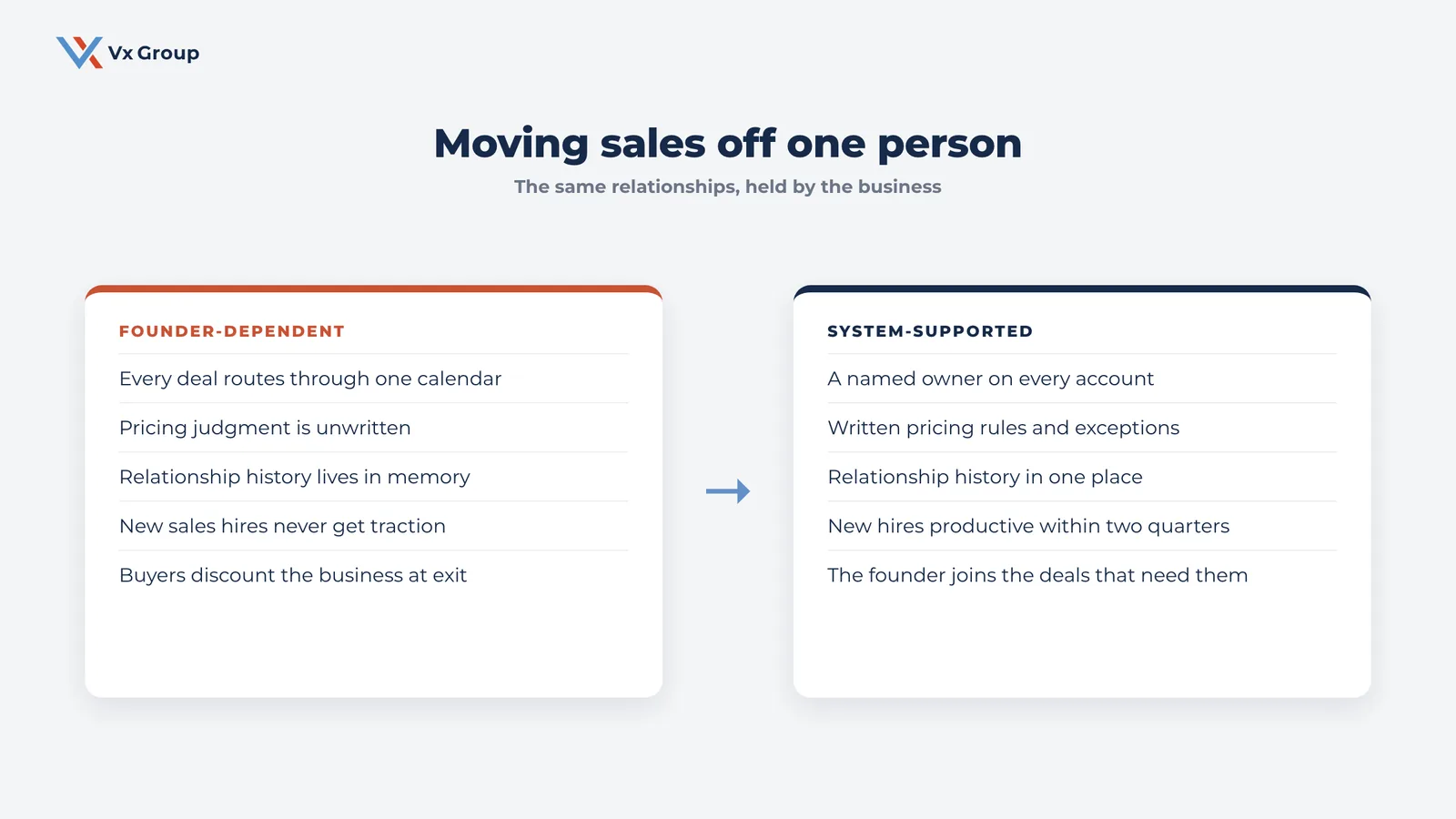
Write down the top twenty accounts, one page each
Start with the accounts that carry the most revenue. One page per account: who decides, who influences, who has to be kept happy operationally, the history of what has been promised, why they are at their current price, what almost went wrong and when, and what would put the relationship at risk. The founder dictates, someone else writes.
Budget about forty minutes per account and expect the first three to take an hour. Twenty accounts is roughly two working days of the founder’s time, spread over a month, and it converts the single largest undocumented asset in the business into something the company owns. Use the structure in top 10 customers as strategy to decide which accounts qualify for this treatment first.
Write the pricing rules, including the exceptions
Take the last thirty non-standard prices and reconstruct the reasoning. Patterns will emerge: volume thresholds, freight arrangements, competitive situations, accounts that get a specific concession for a specific historical reason. Write the rules and write the exceptions, then name who can approve a deviation and up to what limit.
This is usually the single highest-relief change for a founder, because pricing questions are the interruption that arrives daily. It also protects margin, since undocumented pricing tends to drift downward as salespeople guess low to stay safe.
Put a named owner on every account, with the founder still on the call
Assign each account an owner who is responsible for knowing what is happening and for making the routine contact. For the first two quarters, the founder stays in the relationship and joins the important calls, introducing the owner as the person who will now be closest to the account. Customers accept this readily when the founder frames it as more attention on their business.
The failure mode to avoid is a silent handoff. A customer who learns from an email signature that they have a new contact will call the founder, and the founder will answer, and the arrangement reverts.
Give the record a single home that people actually use
The account pages, the contact history, the next steps, and the open questions belong in one place that the team opens as part of doing the work. This is where most efforts quietly die, because a system that only feeds a management report gets abandoned within a quarter. The design and behavior questions that decide this are worked through in sales pipeline management.
Document the sales approach so a new hire can learn it
Write the playbook: how a deal typically progresses, what qualification looks like in your market, the questions that surface a real project, the objections that recur and the honest answers to them, and what the first ninety days of an account relationship should include. How to build a sales playbook your team can’t live without covers the build, and sales onboarding covers how to get a new person productive inside a long cycle.
Set the founder's remaining role in writing
Decide which conversations still require the founder and put it on paper: new accounts above a certain size, the annual conversation with the top ten, the technical or strategic discussions where their history is genuinely irreplaceable. Everything else routes to an owner. Without this step, the founder gets pulled back in by habit, because saying yes to a customer who asks for you is the most natural thing in the world.
What should the founder keep doing?
Keep the relationships that only they can hold, and keep the judgment work the business cannot buy. Founders often hear “reduce dependency” as “step away from customers,” and that reading produces a worse business.
The founder of a relationship-driven company holds real assets: two decades of market knowledge, standing with peers and competitors, the credibility that opens a door at a large account, and the pattern recognition that says a project is real before the RFQ arrives. Those belong in play. The annual conversation with the top ten customers is one of the highest-value uses of a founder’s time in any B2B business, and it is worth protecting even as everything routine moves to an owner.
What changes is the founder’s involvement in routine deal mechanics: quoting, chasing, scheduling, reminding, and rescuing. Those are the hours that come back, and there tend to be a lot of them. The concept of building an organization that holds capability past any single person is covered in how to build an infinite team.
Field Notes:
A specialty manufacturer doing about twelve million in revenue had hired three salespeople in five years. None lasted past eighteen months. The owner’s read was that the market was too technical for anyone else to sell into. We spent two days writing account pages for the top eighteen customers, with the owner talking and someone else typing. Halfway through the second day the owner stopped and said that the fourth-largest account had been at the same price for eleven years for a reason nobody else in the company knew, and that if anyone had raised it the relationship would have gone sideways. That was the moment the argument changed. The next hire, with the account pages in hand, wrote her first order in the fourth month.
Common mistakes when moving off founder-led sales
- Reassigning accounts before documenting them. The new owner inherits a name and a phone number with no history, and the customer notices immediately.
- Hiring a salesperson as the fix. A new hire without the account record and the pricing rules is being asked to do the founder’s job without the founder’s information.
- Building the system for management reporting. If the first visible outcome is a dashboard for the owner, the team correctly reads it as surveillance and stops feeding it.
- Announcing the handoff to customers by email. Relationship transitions happen in person or by phone, with the founder present, framed as more coverage for the customer.
- Treating it as a documentation project with no owner. Account pages get written in a burst, then age out. Somebody has to own keeping them current, with a review date.
- Expecting it to be quick. Moving twenty relationships to named owners takes two to four quarters in a business with a long sales cycle. Companies that force it in one quarter tend to damage something.
- Removing the founder entirely. The goal is a business that can operate without them and still benefits when they show up.
Where to start
Pick your five largest customers and write the one-page account record for each. Founder talks, someone else types, forty minutes per account. Three hours total, and it will surface at least one piece of information that exists nowhere in the company and would be genuinely expensive to lose.
Then read the five pages back and ask a simple question: if the founder were unreachable for a month, could somebody else run these five relationships from what is written here? The gap between the answer and yes is the actual work, and now it is visible and finite rather than a vague worry about key-person risk.
The goal is a business that holds its own relationships
Companies that solve this end up with a business where the relationship history, the pricing logic, and the account ownership live in the organization, and where the founder’s time goes to the conversations that genuinely require them. The founder stays close to customers throughout. Revenue stops tracking one calendar. New salespeople start producing in their first year because they can see what the founder sees.
Start with five account pages and three hours. What surfaces in those three hours usually settles the argument about whether this work is worth doing.
Ready to grow?
We work with owner-led B2B companies to get relationship knowledge out of one head and into the business.
Subscribe to Insights → New articles on relationship-driven B2B growth, roughly weekly.
FAQs
About the Author: Jacob Camhi
