

How to Onboard a Salesperson Into a 12-Month Sales Cycle

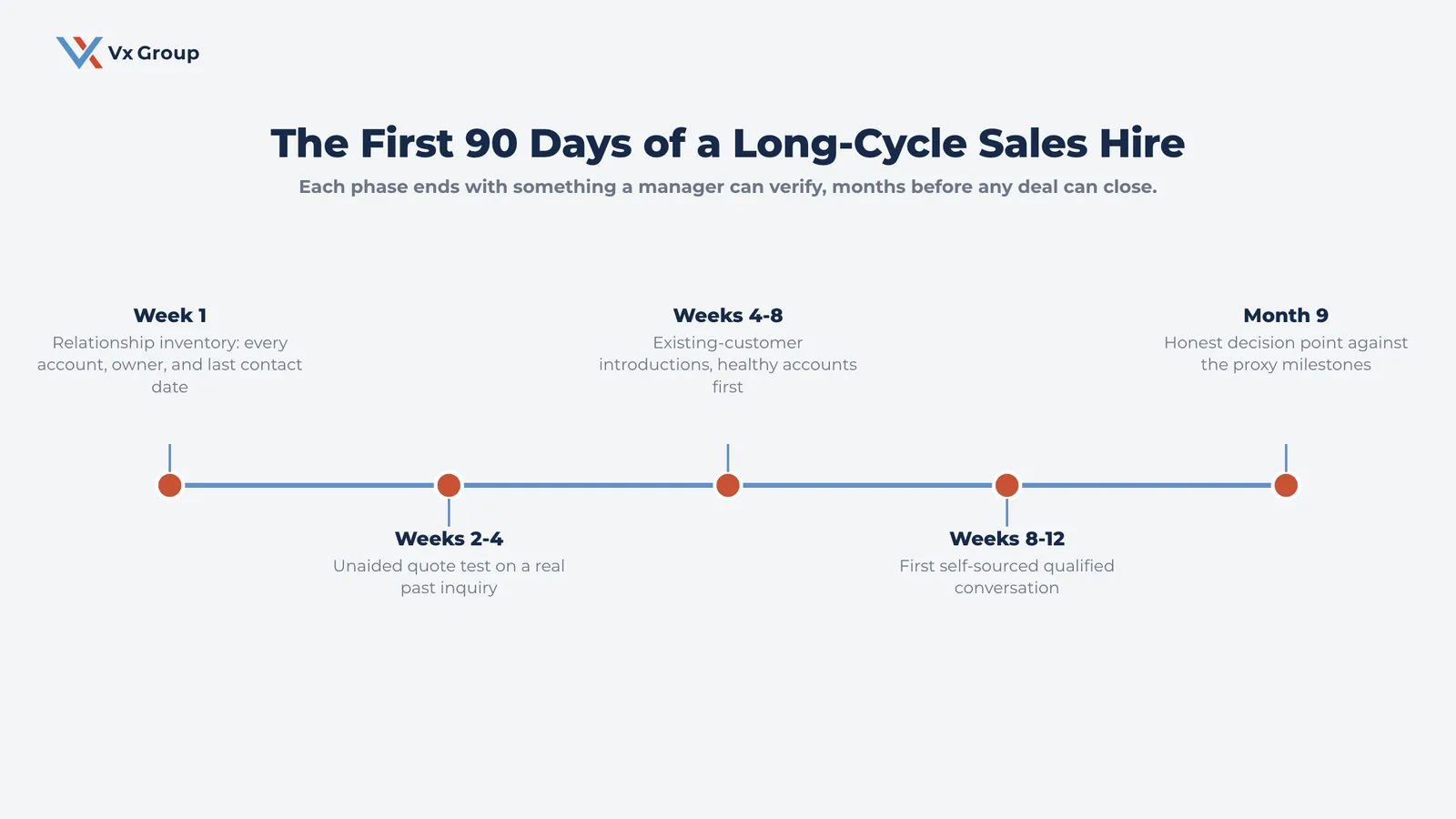
Sales onboarding in a long-cycle business means proving competence through milestones that arrive long before the first closed deal: quoting unaided, named relationships added, and a first self-sourced qualified conversation. Revenue is the wrong ninety-day test when revenue takes a year.
TL;DR
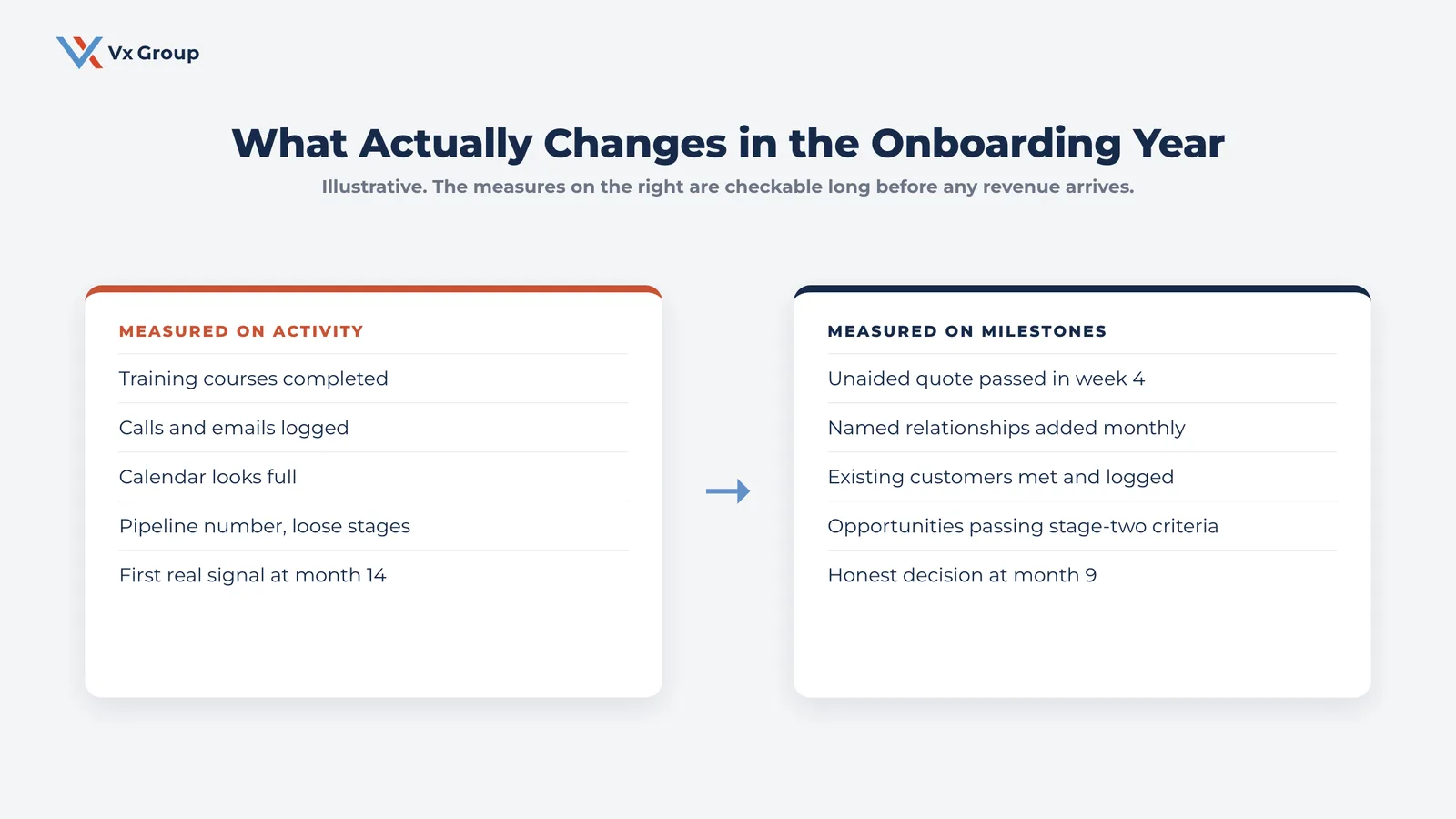
- In a 12-month cycle, a new rep can look fully ramped at month three and produce nothing at month twelve. Activity metrics will not tell you which.
- Week 1 is a relationship inventory. The rep needs to know which accounts exist, who owns each one, and when anyone last spoke to them.
- The single best predictor of a productive rep is whether they can configure and quote your product unaided by week four.
- Introduce a new rep to existing customers before asking them to find new ones. It is faster, and it fixes single-threaded accounts on the way.
- Use proxy milestones through month six: relationships added, opportunities registered, stage progression. Closed revenue arrives too late to manage.
Why does sales onboarding fail in long-cycle businesses?
It fails because the scoreboard is borrowed from a business that closes deals in six weeks. A new rep completes product training, logs calls, fills a calendar, and every visible signal says ramped. The first real close is nine to fourteen months out, so nothing in the first two quarters actually tests whether this person can sell your product to your buyers. By the time the answer arrives, you have spent a year of salary, a territory has gone quiet, and the accounts they inherited have not heard from anyone since the last person left.
The cost is bigger than the salary. A territory handed to a rep who cannot work it is a territory losing relationships in real time, which is a slower and more expensive failure than an empty seat. Meanwhile the honest early signals were all available: whether the rep could quote without help in week four, whether existing customers took their calls in week six, whether they had generated one real conversation by week twelve.
This guide is the fix. Five steps, each with a milestone somebody can verify, arranged so you know by day ninety whether this hire is working.
Defined Term: Proxy milestone.
A checkable early indicator that stands in for closed revenue during the months before a long-cycle deal can possibly land. Good proxy milestones are observable, hard to fake, and correlated with eventual production.
Step 1: What should a new salesperson do in their first week?
Give them a relationship inventory before a product tour. The new rep’s first job is learning which accounts exist, who owns each relationship today, and what state each one is in, because that map determines everything they do for the next six months.
Hand them the account list with owners attached
Print the territory: every account, trailing twelve-month revenue, the three-year trend, who owns the relationship today, and when anyone last had a substantive conversation there. Most companies discover during this exercise that the last column is empty for a third of the list, which is itself the most useful finding of week one.
Sit with the rep and mark each account into one of four states:
- Active and healthy. Someone talks to them, revenue is stable or growing.
- Active and drifting. Still buying, but quoting less or narrowing to one product line.
- Dormant. Bought within three years, nothing since.
- Never bought. On the list because they are in the territory.
That takes about two hours and gives the rep a work order for the next quarter.
Introduce them to the internal people who make them useful
A new salesperson’s first bottleneck is almost never the customer. It is not knowing who inside the company can turn a customer question into an answer. In week one, book fifteen-minute conversations with the estimator, the technical or application lead, the person who runs scheduling, and whoever handles quality complaints. Have the rep write down each person’s name, what they own, and how to ask them for something.
Set the ninety-day expectations in writing
End week one by giving the rep the milestone table you will actually use, so the standard is known from day one. It goes in a shared document with dates and a named manager against each check.
Step 2: How do you test product competence before month two?
Have them build a real quote, unaided, by the end of week four, and check it against what an experienced person would have produced. This one test predicts long-cycle productivity better than any training completion record.
Run the unaided quote test
Pick a real inquiry from the last six months, one with a specific application and enough complexity to require a decision. Give the rep the same information the original salesperson had. Ask them to produce the full quote: configuration, options, pricing, lead time, and the note that goes to the customer.
Then compare it line by line with what actually went out. You are checking four things:
| What you check | What a pass looks like |
|---|---|
| Configuration | Selects a workable configuration for the stated application |
| Pricing | Lands inside your normal range and can explain the number |
| Lead time | Quotes a real lead time they checked with scheduling |
| The customer note | Writes something a buyer would understand without a follow-up call |
A rep who passes this in week four is on track. A rep who cannot pass it by week six needs a different training approach immediately, and you have found that out with ten months to spare.
Have them sit in on live technical calls
Book the new rep onto three application calls where an experienced person is working a real problem with a customer. They listen and take notes. Afterward, ask them one question: what did the customer actually need that they did not ask for directly? That question trains the diagnostic habit that consultative selling depends on, and it surfaces quickly whether the rep hears the difference between a stated request and an underlying problem.
Build their one-page product cheat sheet
Have the rep write their own reference: the lines you sell, the application each one fits, the three questions that identify which line a customer needs, and the two configurations that cause the most trouble. Writing it is the point. A cheat sheet handed to them is a document; one they wrote is knowledge you can test.
Ready to grow?
We help manufacturers build onboarding that shows whether a hire is working before the year is out.
Step 3: How soon should a new rep meet existing customers?
Weeks four through eight, alongside the outgoing or senior rep, before they are asked to find anything new. Existing customers are the fastest place for a new person to become useful, and the introductions fix single-threaded accounts while you are at it.
Sequence the introductions by account state
Use the four states from step one. Start with active and healthy accounts, because those conversations are low-stakes and let the rep practice. Move to active and drifting, where a second relationship is genuinely valuable. Get to dormant accounts by week eight, where a new person is actually an advantage, since they can call without carrying whatever history caused the account to go quiet.
| Weeks | Accounts | Who leads | Goal |
|---|---|---|---|
| 4-5 | Active and healthy, top tier | Senior rep leads, new rep observes | Named introduction, second relationship established |
| 5-6 | Active and healthy, remainder | New rep leads, senior rep present | Rep runs the conversation |
| 6-7 | Active and drifting | Joint, with a prepared agenda | Find out what changed |
| 7-8 | Dormant | New rep alone | Reopen a conversation with no baggage |
Script the introduction as a continuity conversation
The introduction call has one job, which is to make the customer comfortable that continuity is protected. Three parts, five minutes:
- The senior person explains the change plainly and says what stays the same.
- The new rep asks two questions about how the customer’s business is running this year.
- Both agree the next specific touch, with a date.
Say nothing about a product on the first call. A customer who has been buying from you for eleven years does not need a capabilities overview; they need to know their account is still covered.
Log every introduction into the company record
Each conversation goes into the CRM the same day: who was met, what was discussed, what was promised, next step, and date. This is the step that decides whether all of this survives the next transition, and it is the one that gets skipped. The wider argument for it is in how to build an infinite team, which works through what it costs when relationships live only in a person’s head.
Step 4: What should a new rep produce by day ninety?
One independently sourced qualified conversation, with a named end customer, a specific application, and an agreed next step. A single real conversation they created themselves is the whole ninety-day bar, and it tells you more than a pipeline figure would.
Define what counts before they start
Write the bar down so the ninety-day review is a simple check against agreed criteria. A qualified conversation means all four of these are true:
- The rep found the opportunity themselves, from their own outreach or an existing-customer referral.
- There is a named person with a role in the decision.
- There is a specific application or problem, described in the customer’s terms.
- There is a next step with a date, agreed by the customer.
One of these, properly documented, tells you more about a new rep than fifty logged calls.
Give them a narrow prospecting target
A new rep pointed at an entire territory will spread themselves across it and produce nothing. Give them twelve named accounts for the first ninety days, chosen from the dormant and never-bought lists, matched to your ideal customer profile. Twelve is small enough to work properly and large enough to produce one conversation. The approach patterns in sales prospecting apply directly here.
Review the pipeline against your written stage criteria
At day ninety, walk their pipeline against your written stage criteria. The question is whether each opportunity genuinely meets the stage it sits in, because a new rep with an inflated pipeline is a training problem worth catching in month three, while there is still time to correct the habit. If your stage definitions are loose, sales cycle stages covers how to tighten them, and sales pipeline management covers the review rhythm.
Step 5: What do you measure between month three and month twelve?
Measure proxy milestones that move before revenue: named relationships added, opportunities registered against stage criteria, product breadth quoted, and stage progression on the deals they own. These are the months where onboarding usually goes unmanaged, and where most of the risk actually sits.
Track four proxy milestones monthly
| Milestone | Month 6 target | Month 12 target | Why it predicts production |
|---|---|---|---|
| New named relationships in territory | 25 | 60 | Coverage precedes opportunity in a relationship-led market |
| Self-sourced qualified conversations | 6 | 18 | Direct measure of whether they can create demand |
| Product lines actively quoted | 2 | All primary lines | Narrow quoting signals shallow product confidence |
| Opportunities passing stage-two criteria | 3 | 10 | Tests whether their pipeline is real |
Set your own numbers from what your producing reps actually did in their first year. Borrowed benchmarks will mislead you, and you already have the data.
Run a real monthly coaching conversation
Thirty minutes a month, spent on coaching. Leave the status update to the pipeline review and use this time for three questions:
- Walk me through the account you are most worried about.
- What did you hear this month that surprised you?
- Where did you get stuck and not ask for help?
The third question is the one that matters. New reps in long-cycle businesses fail quietly, and they fail by not asking, because asking feels like admitting they should already know.
Set the honest decision point at month nine
Pick the month where you will make a real call, and say so in advance. Month nine works for most 12-month cycles: there is enough evidence in the proxy milestones to judge, and enough runway to act. A rep hitting the milestones with nothing closed is on track and should be told so plainly, because that reassurance keeps good people from quitting in month eight. A rep missing most of them at month nine will not be rescued by month twelve.
What do you do when a rep inherits a territory with no documentation?
Treat the first sixty days as recovery work and adjust every milestone accordingly. When the previous salesperson left without writing anything down, the new rep starts behind zero, carrying accounts that have already been unattended for months, and holding them to a standard timeline will cost you the hire.
Three things change:
Week one becomes reconstruction. Instead of reading a relationship inventory, the rep builds one from invoice history, quote records, and email archives the company can access. Budget a full week and have someone from inside help.
The introduction calls become discovery calls. Nobody is available to make a warm handoff, so the rep is calling cold into accounts that already know the company. That is a harder conversation and a slower one. Add four weeks.
The first customer conversation is an apology of sorts. Not a literal apology, but an acknowledgment that the customer has been unattended. Say it plainly, ask what they need, and fix one thing quickly. Customers are usually more forgiving than the company expects, provided nobody pretends the gap did not happen.
This situation is entirely preventable, and preventing it is cheaper than recovering from it. A one-page handoff document per significant account, kept current, turns a bad quarter into a normal one. The same key-person exposure shows up on the customer side as customer concentration risk, and the pattern is identical: value that lives in one person’s head leaves when they do.
Common sales onboarding mistakes
- Measuring training completion. Finishing a course proves attendance. The unaided quote test proves capability.
- Pointing a new rep at the whole territory. Twelve named accounts produce more than four hundred.
- Sending them to new prospects before existing customers. The existing base is faster, warmer, and needs the second relationship anyway.
- Waiting for revenue to judge. In a 12-month cycle, revenue as your first signal means finding out in month fourteen.
- Skipping the monthly coaching conversation once they seem busy. Busy is not the same as effective, and quiet struggle is the default failure mode.
- Letting them log conversations in a notebook. If it is not in the company record, you will repeat this whole exercise with the next hire.
Where to start
Build the ninety-day milestone table this week, before your next hire starts. Five rows, a date and a named manager against each, and the unaided quote test in week four. It takes a sales leader about an hour, and it converts the most expensive guess in your sales organization into something you can check.
Then write one handoff document for your largest territory. If the person covering it left tomorrow, that page is the difference between a normal quarter and a lost year.
Give the year a scoreboard
A 12-month sales cycle hides a bad hire for most of a year and hides a good one just as long. The five steps here put checkable evidence into the months where there is otherwise nothing to look at: a quote in week four, an introduction in week six, a conversation in week twelve, and four proxy milestones after that.
Build the milestone table before the next person starts. It is an hour of work, and it turns the most expensive guess in the sales organization into a set of dates somebody owns.
Ready to grow?
Bring your last two sales hires and we will build the milestone table against your real cycle.
Subscribe to Insights → New articles on relationship-driven B2B growth, roughly weekly.
FAQs
About the Author: David Tisdale
