

What Transactional Selling Costs Long-Cycle B2B

Transactional selling is a sales approach built around closing one deal at a time, with little effort to build an ongoing relationship. Each sale stands on its own. Price and speed decide the outcome, and the seller starts over from zero on the next call. In long-cycle, relationship-driven B2B, it caps how big and how profitable a company can become.
TL;DR
- Transactional selling closes one deal at a time and treats every sale as a fresh start.
- It works well for commoditized, low-stakes, one-off purchases where speed and price decide the winner.
- In long-cycle, high-value B2B, it caps growth. Margins get squeezed, trust never compounds, and revenue stays dependent on whoever is prospecting today.
- A relationship-driven approach turns the same account into a source of repeat revenue and referrals for years.
- Vx Group helps relationship-driven B2B companies build the system that makes that compounding possible.
Every sales leader has run both plays, often without naming either one. A team chases a bid, wins on price, and moves to the next opportunity without a second thought about the account they just closed. Somewhere else in the same company, a rep spends three years developing a single relationship that eventually becomes the largest account on the books. Both are real sales motions, and both have a place. The trouble starts when a company runs the first motion on relationships that could have been the second.
Most companies never actually choose between the two. They inherit whatever motion the founder ran twenty years ago, or whatever the last VP of sales built, and nobody revisits whether it still fits the accounts on the books today. That default carries real cost in a market where switching to the wrong motion, even once, can leave real revenue behind for years.
What is an example of transactional selling?
A transactional sale is any deal where the buyer and seller interact once, decide on price and speed, and part ways with no plan to build on what just happened. It shows up constantly in B2B, even inside companies that think of themselves as relationship-driven.
Common examples include:
- A commodity component ordered against a spec sheet. The buyer sends the drawing to five vendors, takes the lowest qualified bid, and the winner never hears from them again until the next RFQ.
- A one-time equipment purchase decided by lowest bid. Procurement runs the process, the sales rep never meets anyone past the buyer, and the relationship ends at delivery.
- A reorder placed through a procurement portal. No human conversation happens at all. The system reorders from whichever vendor holds the current price point.
- A rush job awarded to whoever can turn it around fastest. Speed wins the deal, and nothing about the interaction builds toward the next one.
- A one-time service call with no maintenance plan attached. The technician fixes the problem, closes the ticket, and the account sits dormant until something else breaks.
- A trade show badge scan that turns into a single email blast. The interaction never becomes a real conversation, so it produces, at best, one transaction and nothing durable.
Defined Term: Transactional selling.
A sales approach focused on closing individual deals quickly, with little to no investment in an ongoing relationship. Each sale is evaluated and won on its own terms, independent of what came before or what might come after.
None of these examples are failures of salesmanship. They are the correct way to sell a commodity. The problem only shows up when a company treats a complex, high-value, long-cycle relationship the same way it treats a spec-sheet reorder. A capital equipment sale that will need parts, service, and upgrades for fifteen years runs on an entirely different timeline than a pallet of shrink wrap, even when both get closed by the same sales team using the same CRM fields.
Many companies run both motions at once without realizing it. A distributor might sell truly commoditized fasteners transactionally to one segment of buyers while running a relationship-driven motion with the manufacturers who depend on that same distributor for engineering support and rush capacity. The mistake is running a transactional motion on the wrong accounts, simply because nobody ever sorted the two apart.
When does transactional selling actually work?
Transactional selling works well when the product is commoditized, the stakes are low, and speed or price is genuinely the only thing the buyer cares about. In those situations, it is the correct strategy, and running a heavier relationship motion on a deal like this usually just adds cost without adding value. A company that insists on a quarterly business review for a customer buying a single case of gaskets once a year is spending real hours on a relationship that was never going to compound, no matter how well it is managed.
The conditions where it earns its place:
Confirm the product is a true commodity
Buyers cannot tell one supplier’s output from another’s, so price and delivery speed end up as the only real differentiators. There is no story to tell about superior engineering or service depth if the product itself does not actually differ from a competitor’s.
Check whether switching costs are low
The buyer can move to a different vendor next quarter with no disruption, no retraining, and no risk. When switching is genuinely painless, there is little reason for either side to invest heavily in the relationship.
Verify the purchase is genuinely one-off
A single piece of equipment, a one-time project, a purchase the buyer does not expect to repeat. Without a reasonable expectation of a next order, there is nothing for a relationship motion to compound.
Rule out any ongoing need for support
No implementation, no training, no account management, nothing that benefits from continuity. A transaction that ends cleanly at delivery does not need an owner watching over it afterward.
Weigh volume against depth
High-velocity, low-consideration categories reward a seller who can close many small deals quickly over one who invests deeply in a few. Depth only pays off where a single account can grow into something far larger than the first order.
A company selling shrink wrap by the pallet is right to run a transactional motion, and adding a dedicated account manager to that relationship would be a waste of a good salary. A company selling a piece of capital equipment that a customer will run for fifteen years, and will need parts, service, and upgrades for the entire time, is running the wrong playbook if it treats the sale the same way. The signal worth watching is whether anything about the buyer’s future need for the product, service, or relationship should change how the sale gets handled, regardless of the size of the deal.
Why does transactional selling stall long-cycle, high-value B2B?
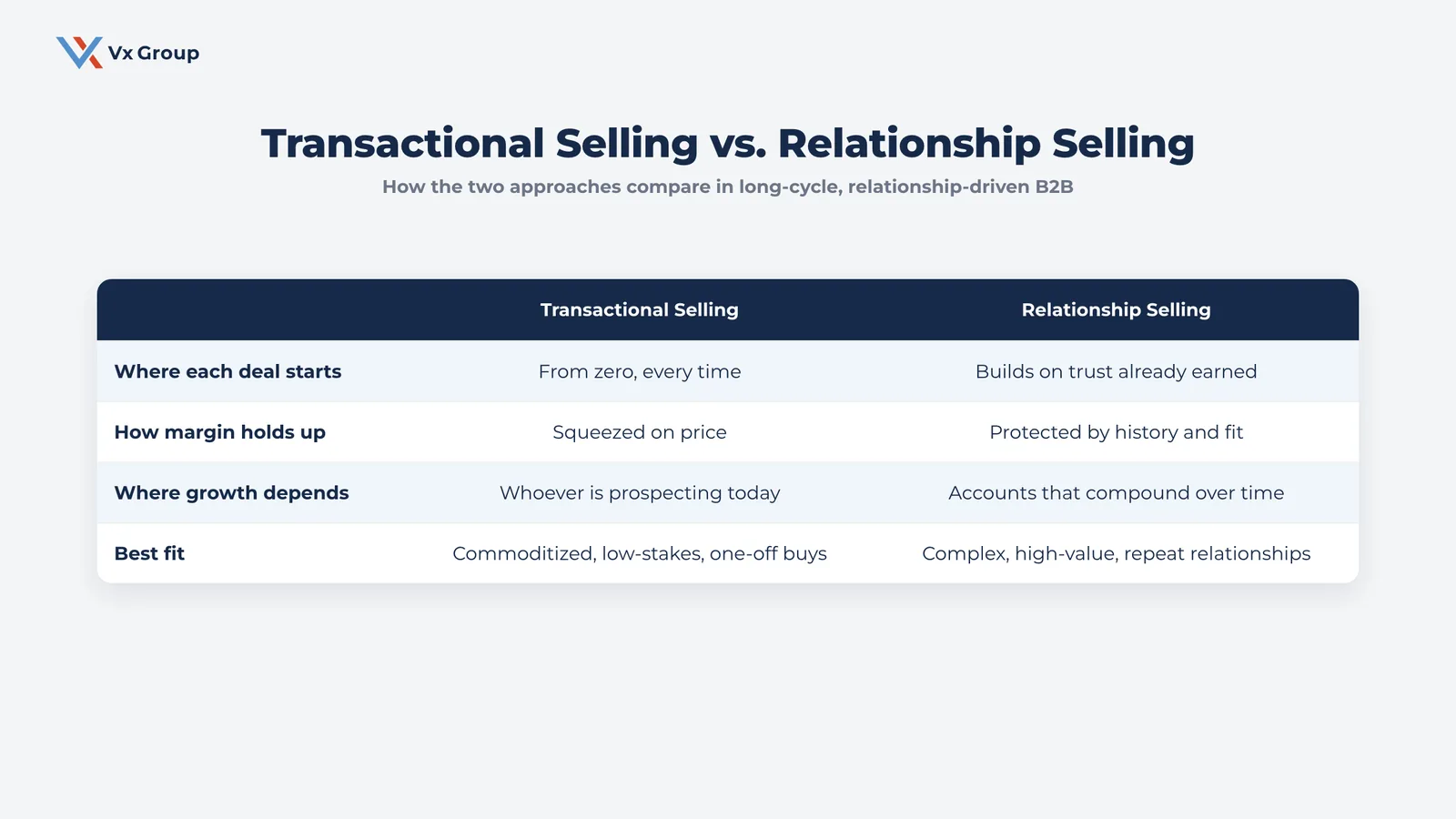
Transactional selling stalls long-cycle B2B because every deal starts from zero, price does the work that trust should be doing on margin, and growth depends entirely on whoever is prospecting this quarter.
Check whether every deal starts over from zero
Nothing carries forward from the last sale in a transactional motion. No shared history, no earned benefit of the doubt, no shortcut through the buyer’s evaluation process. The seller re-proves the entire case from scratch, every single time, even with a buyer they have sold to before. Over a long enough sales cycle, that repeated cost adds up to real hours and real dollars that a relationship-driven seller never has to spend twice.
Watch price take over the margin conversation
Without a relationship to justify the number, price becomes the primary lever a buyer can pull. Deals close smaller and discounts run deeper. The sales team spends its energy defending the number, and little is left over for growing the account. A buyer who trusts a vendor’s judgment negotiates differently than a buyer who has no reason to believe this vendor is any different from the other four bidders on the spec sheet.
Track whether growth depends on new prospecting or existing accounts
A transactional pipeline only produces revenue when someone is actively filling it. There is no compounding base of accounts generating repeat business on its own, which means growth flatlines the moment prospecting slows down, a rep leaves, or a hiring freeze hits the business development team. A relationship-driven base keeps generating revenue even in a quarter with a thin new-business pipeline.
Notice whether trust actually carries into the next order
Each sale is isolated in a transactional motion, so the buyer never builds the kind of confidence that shortens the next cycle, expands the scope of the next order, or turns into a referral. A buyer who has been burned or ignored after the sale has no reason to think about this vendor the next time a related need comes up, even if the original product performed exactly as promised.
Field Notes:
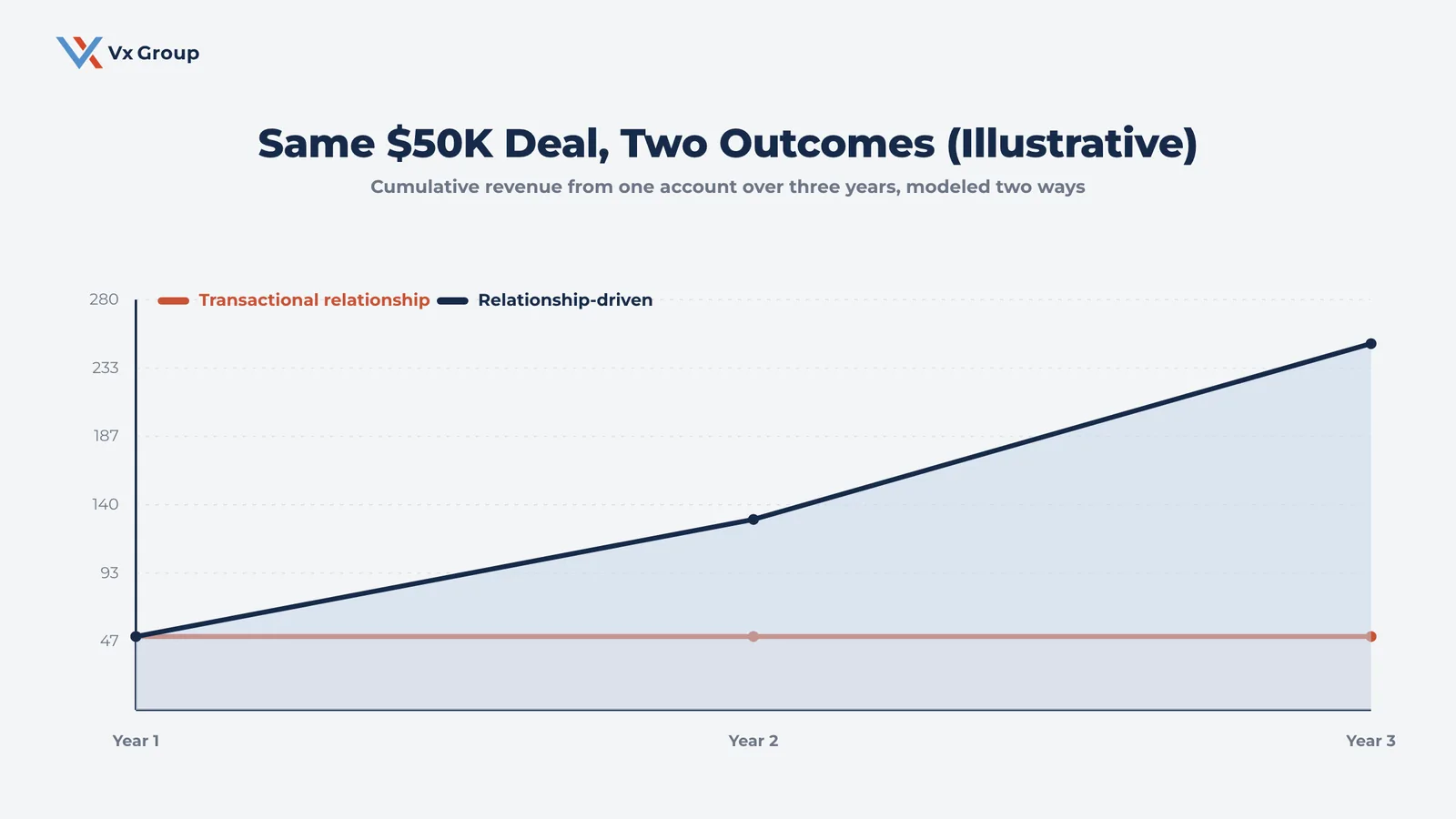
A $50,000 order handled transactionally closes once. The buyer got a competitive price, the vendor got a check, and neither side expects to hear from the other again until the next bid goes out. The same $50,000 order, handled as the start of a relationship, plays out differently. The vendor follows up after delivery, catches a small implementation issue before it becomes a complaint, and earns the next order without a competitive bid. Within three years, that single account is worth several times the original order. The product never changed. Someone simply kept working the relationship after the invoice went out.
Defined Term: Customer lifetime value.
The total revenue a company can reasonably expect from a single account across the full life of the relationship, beyond the value of the current deal alone. In relationship-driven B2B, lifetime value is almost always the more accurate number to plan around, and it is almost always higher than the number sitting on the current invoice.
The math is not subtle once it is laid out. A transactional motion caps each account at the value of a single deal. A relationship-driven motion treats that same account as the start of a multi-year revenue stream, and multi-year revenue streams are what make a long-cycle B2B company valuable to a buyer, a bank, or an eventual acquirer down the road. Add up that gap across even a modest book of accounts, and the difference between the two motions stops being a rounding error and starts being the whole growth plan.
How can you tell if your team is selling transactionally without meaning to?
Most companies that run a transactional motion inside a relationship-driven market never decided to. It happened by default, one habit at a time, until the whole pipeline runs that way without anyone signing off on it. A few signs are worth checking for directly:
Check whether anyone actually owns your ten most important accounts
If the honest answer is “whoever closed it,” the account has no real owner, and no real owner means no real relationship strategy. Ownership has to be named. It cannot be assumed.
Look at what your existing customers actually hear from you
If the only outreach an existing customer gets is a renewal notice or an upsell email, the relationship has been running on autopilot. A first contact in months that arrives as a request for more money is a clear signal.
Compare win rates on repeat business to win rates on cold business
In a real relationship-driven motion, an existing account should close faster and more often than a stranger does. If it does not, no trust premium has actually built up, and the account is being treated like a brand-new prospect every time.
Check whether your CRM tracks relationship health at all
Companies track what they measure. If nothing tracks the strength of the relationship, nothing manages it either, and problems only surface once an account is already at risk.
Notice whether account knowledge lives in one person's head
If a single departure would mean losing the history, the preferences, and the trust built with a key account, the relationship was never actually owned by the company. It was on loan from one employee the whole time.
Listen for whether sales conversations ever look past the current deal
If nobody on the call ever asks about the customer’s plans two years out, the conversation stays scoped to a single transaction, even when the deal itself is large.
Any single sign is worth noting but rarely urgent on its own. Three or four of them together are a clear sign that a relationship-driven business has been running a transactional motion by accident, and paying for it in margin, growth, and risk without ever deciding to. The fix rarely starts with new tools or new headcount. It starts with someone in leadership sitting down with the account list and asking, deal by deal, whether the motion in place actually matches the relationship the account deserves.
What is the alternative to transactional selling?
The alternative to transactional selling is a relationship-driven motion built to compound trust across every interaction, expand accounts over time, and generate revenue that does not depend entirely on new prospecting. Vx Group calls this approach consultative selling, and it changes what a sales team spends its time doing.
Name an owner for every account that matters
Someone owns the ongoing health of the relationship, and that ownership continues after the next deal closes. Ownership survives turnover because it lives in documentation, available to whoever takes over the account. The owner’s job includes the quiet parts of a relationship: catching a shipment issue before it becomes a complaint, knowing who else at the account should be in the loop, and noticing when engagement quietly cools off.
Build a contact rhythm that runs on its own schedule
Real conversations happen on a fixed schedule, independent of whether something is wrong or a contract is about to expire. A quarterly check-in that has nothing to sell is often the single most valuable habit a relationship-driven sales team can build, because it is the only signal a buyer gets that the relationship matters outside of an invoice. Put the date on the calendar before there is any reason for the call. Scheduled that way, the habit survives a busy quarter instead of getting bumped every time something more urgent shows up.
Treat account expansion as its own discipline
Growing an existing relationship gets the same attention and measurement as winning a new one. That means a real target for expansion revenue, a regular review of which accounts are under-penetrated relative to their potential, and real credit on comp plans for growing an account.
Document what your top performers already know
What a top performer knows about an account, the history, the preferences, the personalities, the unwritten rules, gets documented well enough that the relationship survives if that person leaves. A one-page account profile that stays current does most of the work here. This is the same discipline behind customer retention strategies built for relationship-driven B2B: the highest-value accounts a company already has are almost always worth more, and cost far less to grow, than the next unknown prospect in the pipeline.
None of this requires abandoning speed or discipline. A relationship-driven sales motion can move fast and close cleanly. What changes is the assumption underneath it. The deal closing today becomes the first data point in a relationship the company intends to keep building for years.
Where this leaves a long-cycle B2B sales team
Transactional selling is the correct approach for a real category of B2B purchases, and pretending otherwise does not help anyone. The actual mistake is applying it by default, everywhere, including to the accounts that could be worth ten times their current value if someone treated the first order as a beginning.
A long-cycle, relationship-driven company grows fastest when it can tell the difference: run the transactional playbook where the product genuinely is a commodity, and run a relationship-driven motion everywhere trust, history, and repeat business actually decide the outcome. Most companies never sit down and make that call on purpose. They just sell the way they’ve always sold, and the mix decides itself, one habit at a time, until it is baked into the culture and nobody remembers agreeing to it.
That default carries a real cost. Every account running the wrong motion is either paying for a relationship investment it never needed, or missing a compounding relationship it could have had. Neither mistake shows up on a single month’s report. Both show up clearly after a few years, once one company’s top ten accounts look nothing like a competitor’s, purely because of which motion got applied where. Sorting the two apart on purpose, even once a year, is a cheap habit that changes how much of the existing book of business ever gets a chance to compound.
What would change if your team named, account by account, which motion each relationship should actually be running on? And how much revenue is currently sitting inside accounts that get treated transactionally simply because no one has made that call yet?
Ready to grow?
See how this applies to your own pipeline and your highest-value accounts.
—
FAQs
About the Author: David Tisdale
