

Dealer Engagement: How to Keep Your Distribution Channel Active

Dealer engagement is the ongoing work of keeping the dealers and distributors who carry your product informed, supported, and actively selling. It stays high when one person owns each relationship and runs a planned schedule of contact, shared goals, and support, instead of reaching out only after a dealer’s numbers slip.
TL;DR
- Most dealer channels lose momentum because no one owns the relationship between order cycles.
- Engagement is a management discipline: segment your dealers, assign an owner to each tier, and run a contact schedule you actually keep.
- Reactivating a dormant dealer takes far more effort than keeping an active one warm, so the cheapest engagement work is the work you do before a dealer cools.
- Define what “engaged” means in measurable terms so you catch a fading dealer months before the revenue shows it.
- Support and shared goals are what keep dealers selling, more than price or product on their own.
Most manufacturers manage a dealer network the same way. They work hard when a new dealer signs, then go quiet until the quarterly numbers come in soft. By the time a sales report shows a dealer has gone cold, the relationship has usually been drifting for two or three quarters. The dealer found an easier product to push, a competitor’s rep started showing up more often, or the one person at your company who knew them well moved on. When engagement depends on whoever happened to make the last call, you are running on luck, and luck eventually runs out.
The villain here is the dealer relationship managed ad hoc and reactivated only when the numbers slip. Keeping a distribution channel active is a repeatable discipline, and the steps below lay it out in order.
Defined Term: Dealer engagement
the degree to which a dealer or distributor actively stocks, promotes, and sells your product, measured by order frequency, the share of their relevant business you hold, and how responsive they are to your team. High engagement means the dealer treats your line as a priority rather than a backup option.
Step 1: Segment your dealers by relationship value and current activity
Start by sorting the network, because you cannot give 200 dealers the same attention and you should not try. Plot every dealer on two axes: how much they sell today, and how much the relationship is worth over its life, including growth potential, strategic territory, and referral influence. That second axis is the one most manufacturers skip, and it is where dealer network management either works or quietly fails.
The sort matters because the high-value account that has quietly gone cold is the one that should worry you most: a lot of revenue is at risk there and no one has noticed yet. The small dealer who buys little was never the real threat. Those accounts deserve a named recovery plan before you spend another hour recruiting new dealers.
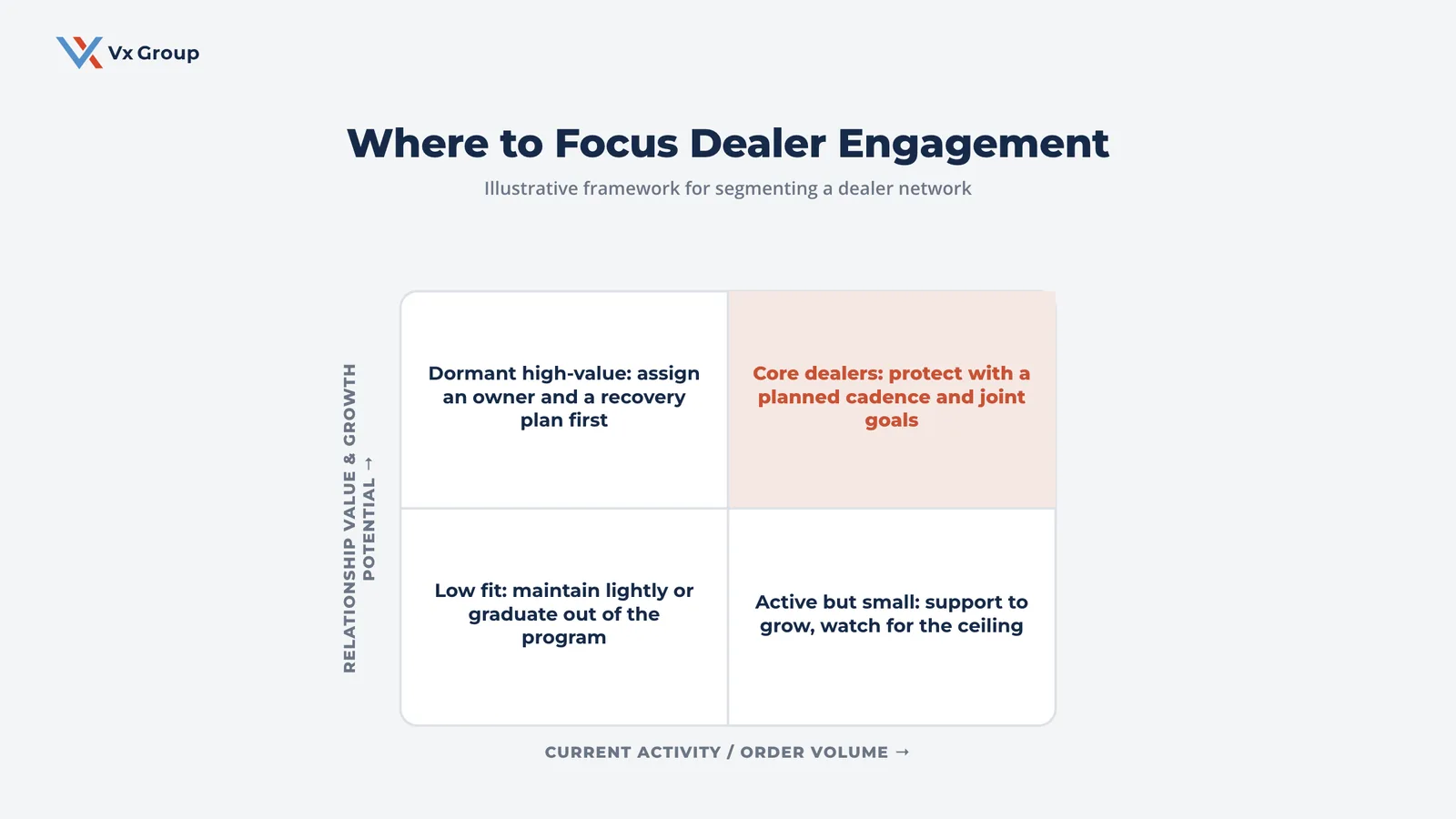
Your core dealers, high value and currently active, get the most deliberate attention. Dormant high-value dealers get a recovery plan and an owner. Active-but-small dealers get support to grow. Low-fit dealers get a light touch or an honest conversation about whether the program still makes sense for both sides.
Step 2: Give every dealer relationship a single named owner
Decide who owns each relationship, and write it down. The fastest way to lose a distributor is to let “everyone” be responsible for the account, which means no one is. When a dealer’s main contact at your company leaves and the relationship lived entirely in that person’s head, you can lose years of trust in a single resignation.
Ownership means one person is accountable for the health of that relationship: they know the dealer’s business, their buying season, the people who actually move product, and what the dealer needs from you next. For your top tier, that owner might carry ten or fifteen relationships, not fifty. For the long tail, one owner can manage a larger book with a lighter schedule. The point is that every dealer has a name attached, and that name is responsible for the relationship continuing whether or not a specific order came in this month.
Ready to grow?
Keep your distribution channel selling for you, instead of hoping dealers remember you between orders.
Step 3: Set a contact schedule and protect it
Build a contact schedule for each tier and treat it as a standing commitment that holds even when the numbers look fine. This is where most distributor engagement efforts fall apart: the plan exists on paper, then the quarter gets busy and the proactive calls are the first thing to go.
Defined Term: Engagement cadence
the planned schedule of meaningful touches between you and a dealer, set by tier, that happens on a calendar rather than in response to a problem. A core dealer might get a monthly check-in, a quarterly business review, and presence at their key events. A smaller dealer might get a quarterly call and a useful email each month.
The schedule should mix formats so it never becomes a hollow ritual. A monthly note that shares a genuinely useful piece of market information lands differently than a “just checking in” call. A quarterly business review where you bring the dealer their own numbers, name a shared goal, and agree on what each side will do next is worth more than ten reactive calls placed after the relationship has already cooled.
Step 4: Give dealers a reason to keep selling you
Make it easier and more rewarding for a dealer to sell your line than a competitor’s. Dealers carry many products and have limited shelf space, attention, and selling time. The ones who stay active are the ones for whom selling you is the path of least resistance and the best return on their effort.
That comes down to enablement and shared marketing. Give dealers sales tools they can actually use: clear product positioning, ready-to-send materials, training that respects their time, and fast answers when they are mid-deal. Dealer and distributor marketing works best when you build campaigns with them rather than at them, co-funding local promotions, bringing leads into their territory, and making their salespeople look good in front of their own customers. A dealer who wins business because of how you support them does not need to be reactivated later.
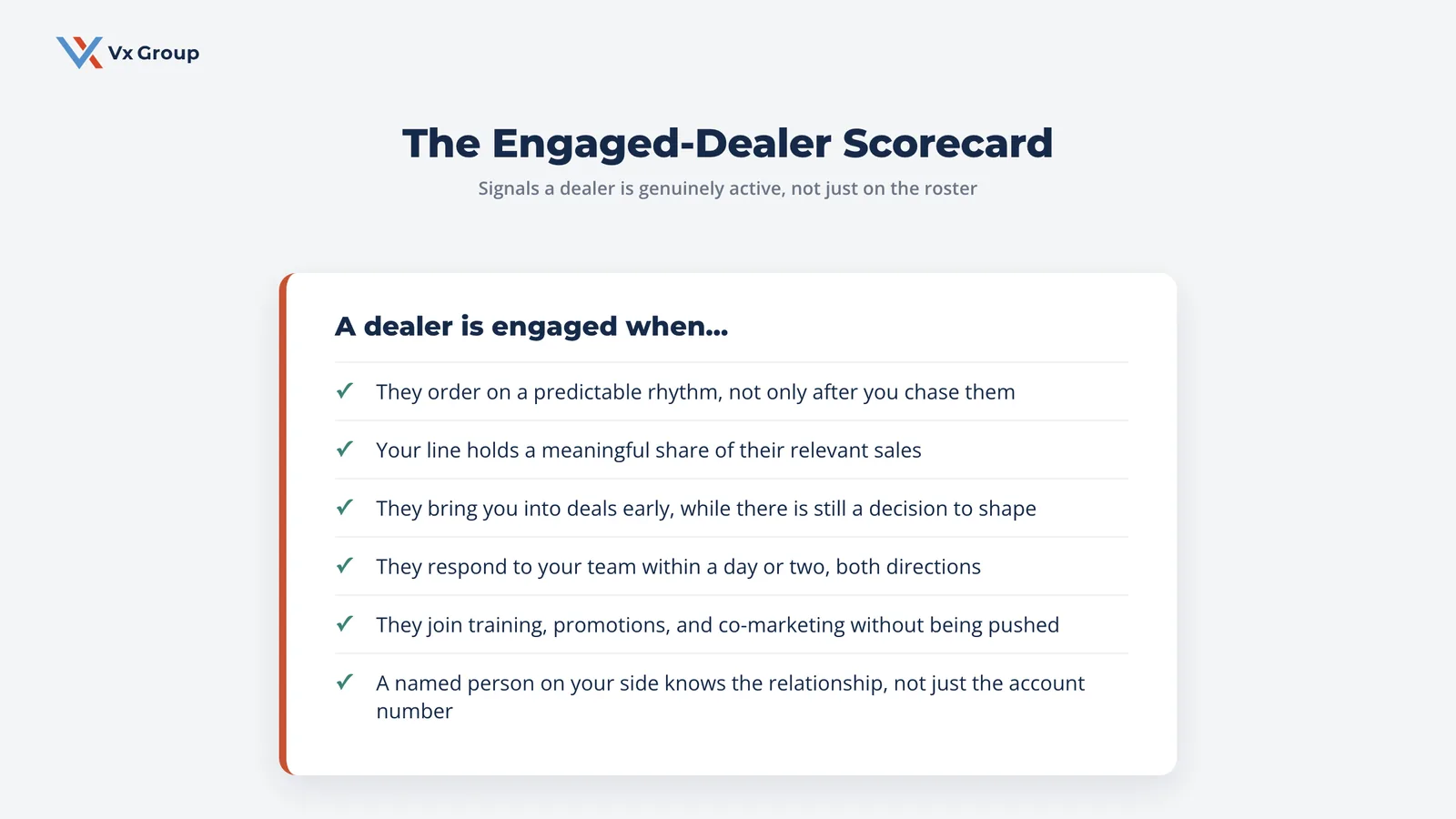
Step 5: Define what "engaged" means in numbers
Write down what an engaged dealer looks like, in measurable terms, so engagement stops being a feeling and becomes something you can manage. If you cannot say whether a specific dealer is engaged this quarter, you cannot catch the ones slipping away.
Ready to grow?
Dealer engagement that depends on whoever made the last call is fixable. Build the system that keeps the channel active on purpose.
Step 6: Catch disengagement early with leading indicators
Watch the signals that move before the revenue does, because by the time order volume drops, the dealer has usually been disengaging for months. Falling revenue is a lagging indicator. It tells you about a decision the dealer made two or three quarters ago.
The leading indicators are quieter: slower responses to your emails, a missed quarterly review, fewer questions during a launch, a buyer who stops looping you in early, a renewal that needs more chasing than last year. Give your owners permission to flag a relationship on these signals alone, and build a simple recovery play for when they do. Reaching out while a dealer is merely distracted is a manageable conversation. Once they have shifted budget to a competitor, you are attempting a rescue, and rescues fail far more often than they succeed.
Keep the channel active on purpose
A dealer network does not stay active because your product is good or your prices are fair. Plenty of companies with strong products watch dealers drift because no one was responsible for the relationship between orders. The manufacturers who keep their channels selling treat engagement the way they treat any other part of the operation: they segment it, assign it, schedule it, measure it, and act on the early signals. That discipline is what separates a channel you can count on from one you keep having to rebuild.
If your dealer engagement runs on whoever made the last call, that is a fixable problem, and it is usually faster to fix than companies expect. Talk to Vx Group → for a clear-eyed look at where your channel is leaking momentum and what to put in place to keep it active.
FAQs
About the Author: David Tisdale
