

Dealer Network Strategy: How to Turn Your Dealer Channel Into a Growth Engine
A dealer network strategy is a documented system for choosing, developing, and growing the dealer relationships that drive your revenue. Strong strategies start with the dealers who already produce your best end customers, define the pattern those dealers share, and build a repeatable development process around it instead of treating every dealer the same.
TL;DR
- Most dealer networks underperform because the strategy lives in a few rep relationships rather than in a system the company owns.
- The villain is the activity illusion: calling on every dealer equally and measuring throughput instead of relationship quality.
- Start with your best existing dealers, find the pattern they share, and define which dealers fit it.
- Rank dealers by the quality of end-customer relationships they produce rather than the volume they move.
- Document who owns each dealer relationship so growth survives a resignation or a territory change.
- Run a relationship development cadence through the channel so trust compounds instead of resetting every quarter.
- A dealer network is a relationship asset, and treating it that way is what separates flat channels from compounding ones.
Most manufacturers and distributors do not have a dealer network strategy. They have a dealer list and a set of relationships that happen to be working, usually because one or two people have spent years building them. When those people retire, change territories, or leave, a chunk of the channel goes quiet, and nobody can fully explain why.
The villain here is the activity illusion in the channel. It looks like this: the team calls on every dealer with roughly equal effort, runs the same promotions across the board, and reports on units shipped and orders booked. The numbers feel like progress. They tell you how busy the channel was last quarter. They tell you almost nothing about which dealer relationships are actually compounding into long-term, high-value end-customer accounts.
This guide lays out how to think about your dealer network the way Vx Group helps Relationship-Driven B2B Companies think about all of their growth: as a relationship asset that can be understood, developed, and grown with intention rather than managed by whoever made the last call.
What is a dealer network strategy?
A dealer network strategy is the documented system a manufacturer or distributor uses to decide which dealers to recruit, which to develop, how to develop them, and how to measure the relationships over time. It connects your best end-customer outcomes back to the dealer relationships that produce them, then builds a repeatable process to create more of those relationships.
A real strategy answers four questions in writing. Which dealer types generate your best end customers? What separates your strongest dealer relationships from the average ones? Who inside your company owns the relationship with each priority dealer? How do you develop those relationships on a consistent cadence so trust accumulates instead of resetting?
When those four answers live only in the heads of your top regional managers, you have institutional knowledge that walks out the door at the worst possible time. When they live in a documented system the leadership team owns, you have a dealer network strategy.
Defined term: Dealer network strategy
The documented system for selecting, prioritizing, developing, and measuring dealer relationships, built around the dealers who produce your highest-value end customers rather than the dealers who simply move the most volume.
Why do most dealer networks underperform?
Most dealer networks underperform because the company treats the channel as a distribution mechanism instead of a relationship asset. Product flows through it, so leadership measures flow. The relationships inside the channel go unmanaged, undocumented, and unprioritized, which means the network grows by accident or not at all.
The strategy lives in a few relationships instead of a system
In most manufacturers, the dealer channel runs on the personal relationships of a handful of long-tenured people. They know which dealer to call when a big project comes up. They know which owner takes the order personally and which one delegates it. That knowledge is real and valuable, and it is also a single point of failure. When that person leaves, the relationship almost always evaporates. Buyers with the longest tenure in a dealer relationship often function as generational customers: the loyalty traces to the individual who built it, and when that person leaves, tenure offers no structural protection.
This is the same pattern Vx Group sees in founder-dependent direct sales, moved one layer out into the channel. The fix is the same. Make the relationship knowledge a company asset, documented and owned, so it survives the person who built it. The same structural fragility runs through customer concentration risk: when the accounts that drive most of the channel revenue are tied to one or two people inside the manufacturer, any leadership change becomes a retention problem the next owner inherits.
Every dealer gets treated the same
When there is no shared definition of which dealers matter most and why, effort gets spread evenly. The team calls on the dealer who will never grow with the same energy it spends on the dealer who could double. Equal effort across unequal opportunities is one of the most expensive habits in channel management, because it quietly starves your best relationships of the attention that would compound them.
Success gets measured by throughput
Units shipped and orders booked are easy to count, so they become the scoreboard. The problem is that throughput tells you what already happened while staying silent on which relationships are building toward the future. A dealer can post strong numbers this year while the relationship erodes underneath, and you will not see it in a volume report until the orders stop.
Defined term: The activity illusion
Measuring channel success by how busy the team and the dealers are (calls made, promotions run, units shipped) rather than by the quality and trajectory of the relationships being built. Activity feels like progress and often hides stagnation.
How do you build a dealer network strategy from the relationships you already have?
You build a dealer network strategy by starting with evidence you already own: your best existing dealer relationships. Identify the dealers that consistently produce your most valuable, longest-lasting end customers, study what those dealers have in common, define that pattern, and use it to prioritize development and recruitment.
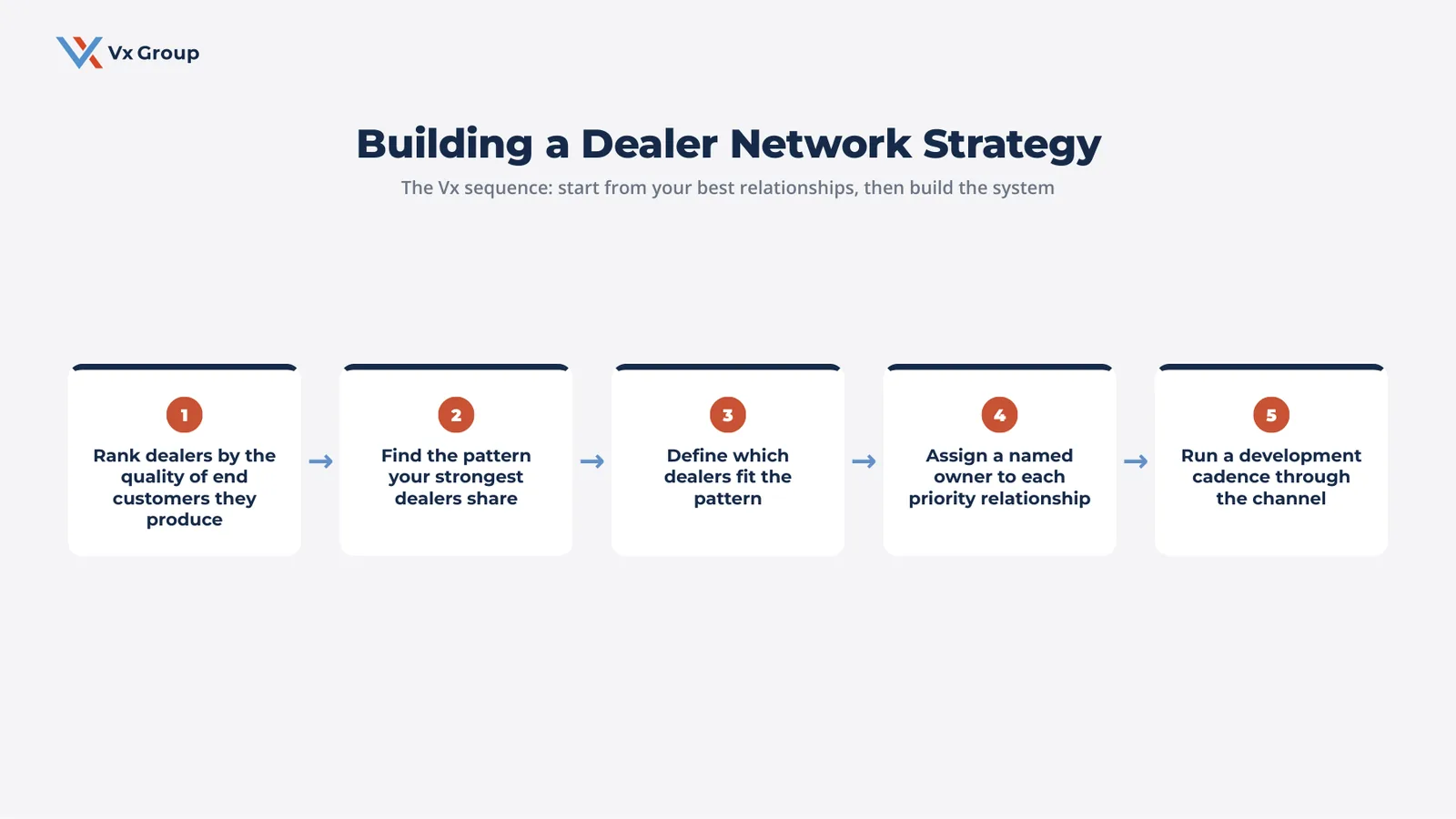
This is the opposite of starting with a dealer recruitment target or a coverage map. A coverage map shows where you have dealers without telling you which ones are worth developing. Your own results already contain that answer.
Rank your dealers by relationship quality rather than revenue alone
Pull your dealer list and rank it by the quality of end-customer relationships each dealer produces rather than by the volume they move. A mid-volume dealer that consistently lands you sticky, multi-year, expanding accounts is often worth more to your future than a high-volume dealer churning through one-time transactional buyers. Revenue rank and relationship-quality rank are rarely the same list, and the gap between them is where your strategy lives.
Find the pattern your best dealers share
Once you know your strongest dealers, look for what they have in common. The pattern is rarely size. It is usually something about how they sell, who they serve, and how they treat the end customer. Maybe your best dealers serve a specific end market. Maybe they lead with technical service rather than price. Maybe they have a particular kind of salesperson, or a particular ownership philosophy. Name the pattern in plain language so the whole team can recognize it.
Define which dealers fit the pattern
With the pattern named, sort the rest of your network against it. Some existing dealers fit the pattern and are underdeveloped, which makes them your highest-priority development targets. Some do not fit and never will, which tells you where to stop overinvesting. And the pattern becomes your recruitment filter: it tells you exactly what kind of new dealer to go find.
Defined term: Relationship-quality rank
An ordering of your dealers based on the value and durability of the end-customer relationships they create, rather than on raw sales volume. It surfaces the dealers most worth developing, which a revenue ranking alone will hide.
How should you segment your dealer network?
Segment your dealer network on two axes: the quality of end-customer relationships a dealer produces and the dealer’s growth potential with you. Plotting your dealers against those two axes turns a flat list into a priority map and tells you where to put your best people.
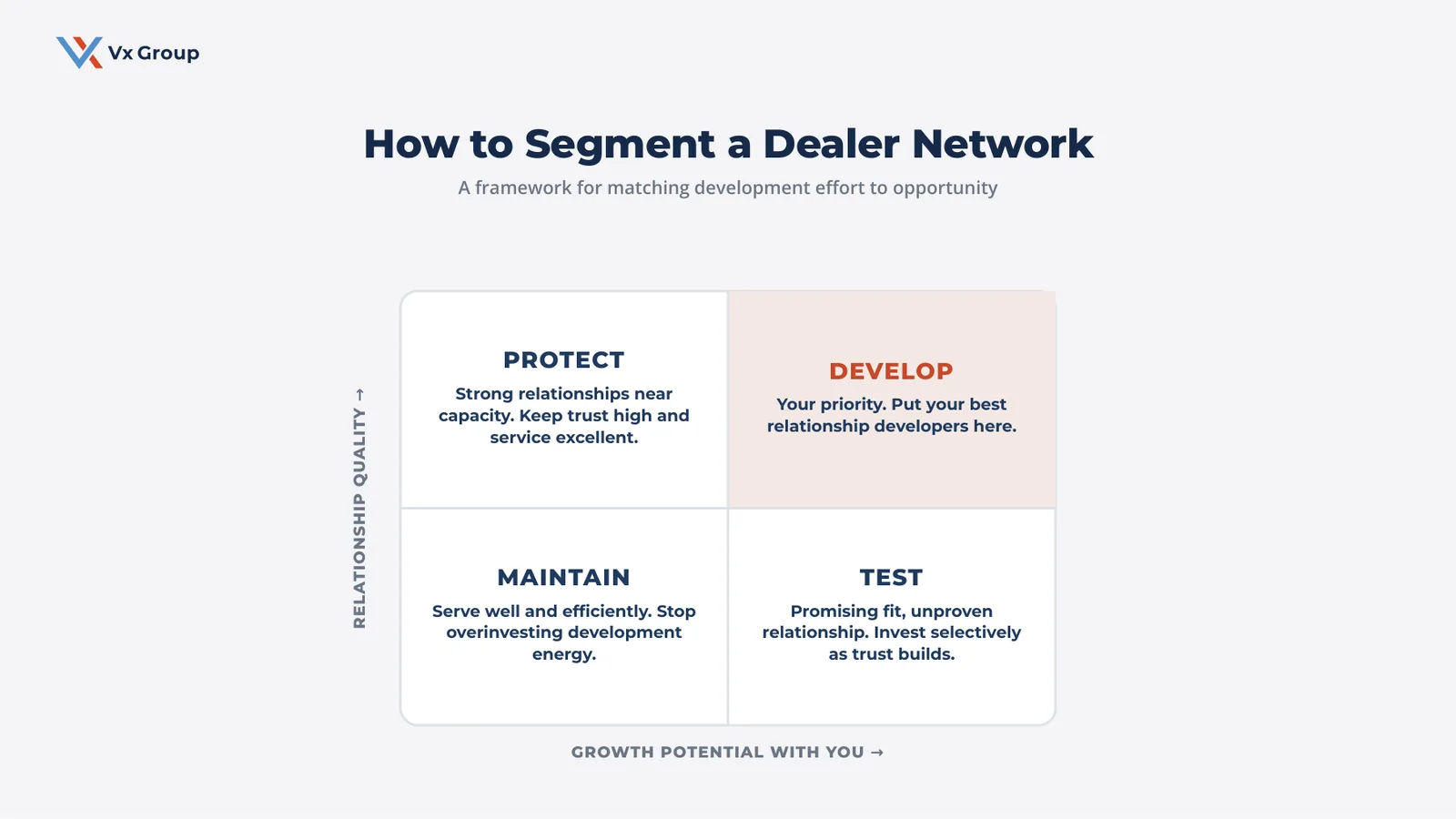
Segmentation earns its keep by forcing deliberate choices about where attention goes. Labeling dealers and filing the list away wastes the exercise entirely. Most manufacturers discover that their effort and their opportunity are badly misaligned, with too much energy going to Maintain dealers out of habit and too little going to Develop dealers who could carry the next stage of growth.
Defined term: Dealer segmentation
Grouping dealers by relationship quality and growth potential so the company can match its development effort to its actual opportunity, rather than spreading effort evenly across a network where opportunity is anything but even.
Ready to grow?
Turn your dealer channel into a documented growth system, instead of a few relationships you hope hold.
Who should own each dealer relationship?
Every priority dealer relationship should have a named owner inside your company, documented and known to the leadership team. Ownership means one person is accountable for the health and growth of that relationship, with a clear backup, so the relationship survives turnover, vacations, and territory changes.
This is where dealer channel management most often breaks. Relationships exist, but ownership is implicit. Everyone assumes the regional manager has it handled, and when that regional manager moves on, the company learns how much was riding on a relationship nobody else understood.
Document the relationship beyond the contact record
A name and phone number in the CRM is contact information, and it falls well short of relationship ownership. Real documentation captures who the decision-makers are, what the dealer values, the history of how the relationship developed, what has been promised, and where it stands today. That is the knowledge that lets a new owner step in without the relationship starting over from zero.
Define growth roles across the channel
Growth roles are the specific responsibilities for developing the channel: who recruits, who develops existing dealers, who handles service and retention, and who owns the leadership-level relationships with your most important dealer principals. When these roles are documented and assigned, the channel runs as a system. When they are not, it runs on goodwill and memory.
Defined term: Growth roles
The documented assignment of who owns each part of channel development: recruitment, dealer development, service and retention, and leadership-level relationships. Clear growth roles make the network resilient to turnover and clear about accountability.
A simple way to think about the segments:
| Segment | Relationship quality | Growth potential | What it means for you |
|---|---|---|---|
| Develop | High | High | Your priority. Invest your best relationship developers here. These dealers fit the pattern and have room to grow. |
| Protect | High | Low | Strong relationships near capacity. Keep trust high and service excellent. Do not lose them to neglect. |
| Test | Low | High | Promising fit, unproven relationship. Invest selectively and watch whether trust builds before you commit heavily. |
| Maintain | Low | Low | Serve them well and efficiently. Stop spending disproportionate development energy here. |
What does a dealer development cadence look like?
A dealer development cadence is a regular, planned rhythm of meaningful contact with your priority dealers, designed to build trust and surface opportunities over time rather than only when an order or a problem appears. It replaces reactive, transactional contact with proactive relationship development.
The cadence should match the segment. Develop dealers warrant frequent, high-value engagement: business reviews, joint planning, end-customer visits, and leadership-to-leadership contact. Protect dealers need consistent, reliable touch that keeps trust high. Maintain dealers can run on an efficient, lighter rhythm. The mistake to avoid is a single cadence applied to everyone, which over-serves the dealers who least need it and under-serves the ones who would respond most.
Make every interaction a trust deposit
Trust compounds through repeated, reliable interactions, and it erodes through neglect and broken commitments. Every business review, every follow-up, every problem handled well is a deposit. Every missed callback and unmet promise is a withdrawal. A development cadence works because it creates a steady stream of deposits with the dealers who matter most, so that when a major opportunity appears, the relationship is already strong enough to win it.
Plan the cadence, then protect it
A cadence that exists only when things are slow is not a cadence. The development rhythm has to be planned into the calendar and protected against the daily pull of reactive work, the same way a disciplined direct-sales team protects its prospecting time. The dealers who feel the consistency are the ones who bring you their best opportunities first.
Defined term: Trust deposit
Any interaction that strengthens a dealer relationship, such as a well-run business review, a kept commitment, or a problem resolved quickly. Trust deposits accumulate over time into a relationship strong enough to win the opportunities that matter.
How do you measure whether your dealer network strategy is working?
You measure a dealer network strategy by tracking the quality and trajectory of your dealer relationships rather than only the volume flowing through them. The right metrics tell you whether trust is building and whether your priority dealers are growing in the direction your strategy intends.
Volume still matters as an outcome. The change is adding relationship-quality measures alongside it, so you can see the trajectory before it shows up in the order book. Useful measures include the share of revenue coming from dealers in your Develop and Protect segments, the rate at which Develop dealers are actually growing, the quality of end customers your priority dealers produce, the depth of relationship documentation across your priority accounts, and whether each priority relationship has a named, accountable owner.
| Common metric (throughput) | Better metric (relationship strategy) |
|---|---|
| Total units shipped | Revenue growth from Develop and Protect dealers |
| Orders booked this quarter | Quality of end customers your priority dealers produce |
| Number of active dealers | Number of priority dealers with a documented, owned relationship |
| Promotion participation rate | Development cadence completion with priority dealers |
| Year-over-year volume | Trajectory of trust and engagement with priority dealers |
The advantage of relationship measures is timing. They let you see a relationship fading and act before it costs you the orders, while a throughput report only confirms the loss after the revenue is gone.
How is a dealer network strategy different from a dealer program or PRM software?
A dealer network strategy is the thinking that decides which dealer relationships to build and how. A dealer program is the set of terms, incentives, and support you offer. PRM software is the tool you use to track it all. The strategy comes first, and without it, the program and the software simply make you more efficient at treating every dealer the same.
Many manufacturers try to fix a struggling channel by redesigning the dealer program or buying partner-relationship-management software. Those moves can help once the strategy is clear. On their own, they automate the activity illusion. A better discount tier or a slicker portal does not tell you which dealers deserve your best people or which relationships are compounding. Only the strategy does that.
Defined term: Dealer program
The structured set of margins, incentives, marketing support, and terms a manufacturer offers its dealers. A dealer program executes a strategy and cannot substitute for one.
Think of it as three layers. The strategy decides where to focus and why. The program creates the terms and incentives that support that focus. The software tracks execution and keeps the relationship knowledge documented and shared. Build them in that order, and each layer reinforces the one beneath it.
Building a dealer channel that compounds
A dealer network is one of the most valuable relationship assets a manufacturer or distributor owns, and most companies manage it like a logistics function. They count what flows through it and hope the relationships hold. The companies that pull ahead do something different. They treat the channel as a portfolio of relationships worth understanding and developing on purpose, starting from the dealers who already produce their best customers and building a documented system from there.
That shift from distribution mechanism to relationship asset is the heart of how Vx Group helps relationship-driven B2B companies grow. The same foundation that builds compounding direct-sales relationships, clarity about who your best relationships are and a system to develop more of them, applies just as directly to the dealers who carry your business into markets you could never reach alone.
If your dealer channel has been flat and you suspect the strategy is living in a few people’s heads, that is a solvable problem, and it is exactly the kind of work Vx Group does with manufacturers and distributors.
Field Notes
A regional building-products manufacturer ran a flat dealer program: same margins, same promotions, same quarterly check-in for all 60 dealers. Growth had been flat for three years. When the leadership team ranked dealers by the quality of end customers they produced rather than by volume, a clear pattern emerged. Their best relationships came from mid-sized dealers who led with installation expertise and served commercial contractors rather than the large-volume retail-focused dealers that topped the revenue report. They redirected their best people toward developing the fourteen dealers who fit that profile and recruited against it. Within four quarters, the channel was growing again, and the growth was concentrated in exactly the relationships the leadership team had chosen to build.
Ready to grow?
Build a dealer network that compounds, with ownership and a cadence that protect every relationship.
FAQs
About the Author: David Tisdale
