

How to Run B2B Market Research Without a Six-Figure Budget

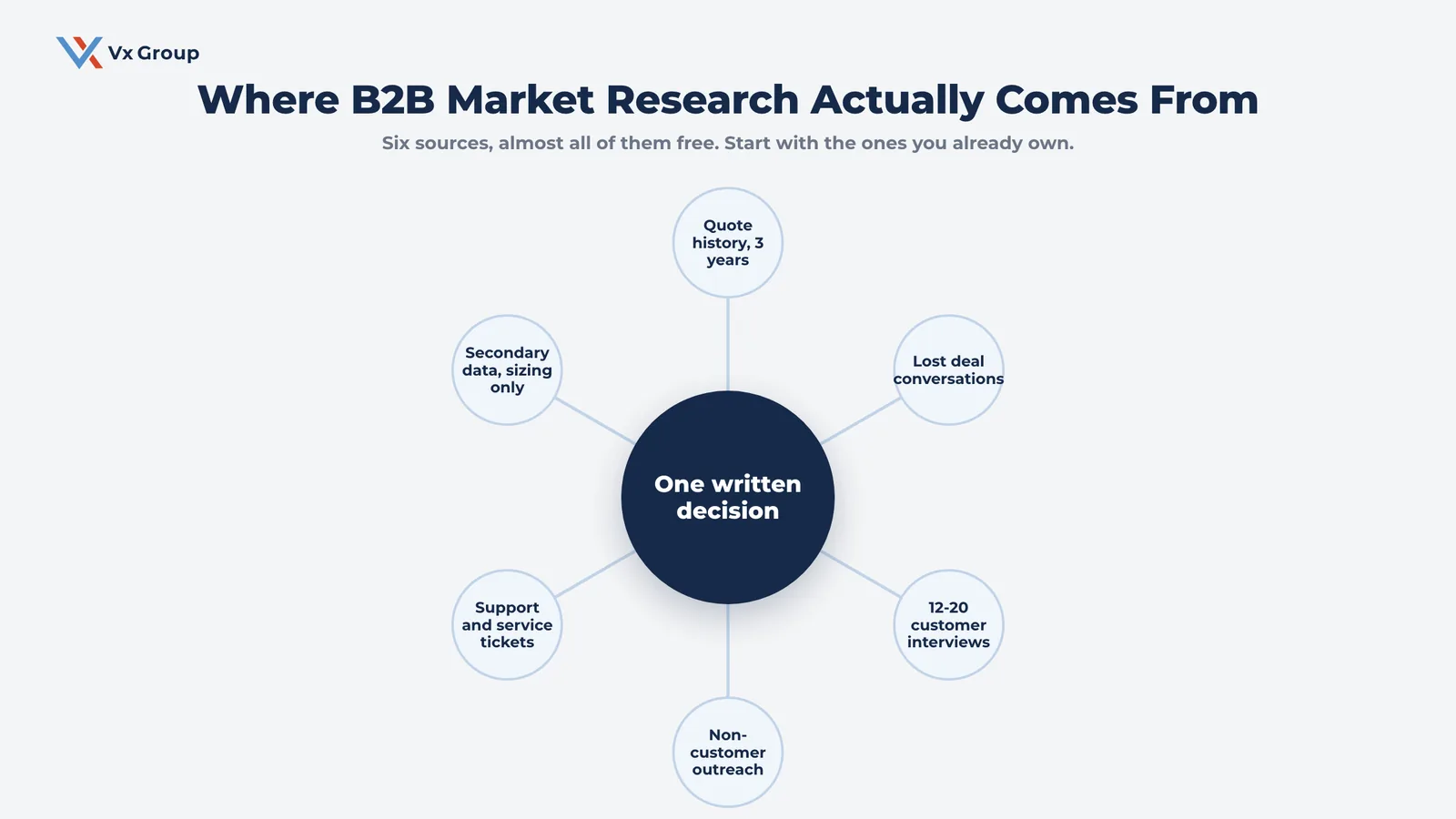
B2B market research means answering a specific business decision using the data you already own, twelve to twenty customer interviews, and a disciplined read of secondary sources. For a company whose total market is a few thousand accounts, conversations beat purchased reports on both cost and accuracy.
TL;DR
- Start with the decision. Research without a decision attached becomes a document nobody opens.
- Your own quote history, win-loss records, and support tickets are the cheapest dataset you will ever get, and almost nobody mines them.
- Twelve to twenty customer interviews produce more usable insight than a purchased industry report, at roughly zero incremental cost.
- The people who did not buy hold the most valuable information and the hardest access. Budget real effort for them.
- Finish by changing something specific: the ICP, the messaging, or a market decision, with an owner and a date.
Why do most mid-market companies skip market research entirely?
Because they think it costs six figures. The word “research” summons a consulting engagement or a syndicated industry report priced for companies twenty times their size, so the whole idea gets shelved, and decisions about which markets to enter and which customers to chase get made on the sales team’s collective hunch.
The hunch is not worthless. It is just unexamined, and it carries the survivorship bias of whoever has been in the room longest. Meanwhile the highest-value data source available to a mid-market B2B company sits completely untouched: thirty conversations with their own customers, their own lost prospects, and their own quote history.
There is a structural reason this works better in B2B than in consumer markets. When your total addressable market is four thousand companies and your top ten customers carry a disproportionate share of the revenue, you do not need statistical significance across a population. You need depth from the twenty accounts that represent the pattern. That is a fundamentally different research problem, and it is one a two-person team can do properly in six weeks.
Defined Term: Primary research.
Information you collect directly from customers, prospects, and lost deals through interviews and your own transaction records. Secondary research is information someone else already published: association data, trade surveys, government statistics, competitor materials.
Step 1: What decision does the research need to inform?
Write the decision down in one sentence before you collect anything. Research attached to a decision produces action; research commissioned to “understand the market better” produces a slide deck that gets praised once and never referenced.
Write the decision sentence
The sentence needs a verb and a stake. Compare these:
| Vague brief | Decision-shaped brief |
|---|---|
| Understand the food processing market | Decide whether to hire a dedicated food processing salesperson by Q1 |
| Learn why we lose deals | Decide which two objections to fix in the standard proposal |
| Look at our customer base | Decide which three segments get named-account coverage next year |
| Explore a new region | Decide whether to appoint a distributor in the Southeast or hire direct |
The right column tells you what to ask, who to ask, and when you have enough to stop. The left column has no stopping condition, which is why that kind of project runs long and lands soft.
Name what would change your mind
Before interviewing anyone, write down what you currently believe and what evidence would overturn it. Two columns, five rows, fifteen minutes. This is the single cheapest guard against confirmation bias, and it turns the eventual findings into something the leadership team has already agreed to act on.
If the honest answer is that no realistic finding would change the decision, stop. The decision is already made, and the research is decoration.
Set the stopping condition
Decide in advance how much evidence is enough. For most mid-market questions: twelve to twenty interviews, or the point at which three consecutive conversations produce nothing you have not already heard. That saturation point usually arrives around interview fourteen, and recognizing it is what keeps a six-week project from becoming a six-month one.
Step 2: What can you learn from data you already own?
More than you expect, and it costs nothing. Your quote history, win-loss records, support tickets, and sales call notes are a proprietary dataset about your exact market, and most companies have never analyzed them.
Pull the four internal sources
Start here, before any interview, because it tells you who to interview and what to ask.
- Quote history, three years. Every quote, the account, the industry, the value, and the outcome. Sort by win rate by segment. The segments where you win disproportionately are your real ICP, whatever the marketing deck says.
- Lost deals. Group by stated reason, then treat those reasons as unreliable and note which are worth testing in interviews.
- Support and service tickets. The recurring complaint is a product or process finding. The recurring question is a messaging finding.
- Sales call notes. Messy and undervalued. Read a hundred and the language customers use to describe their problem will start repeating, which is the exact language your website should be using.
Build the win-rate-by-segment table
This is the highest-yield hour in the entire process. One table:
| Segment | Quotes issued | Won | Win rate | Average value |
|---|---|---|---|---|
| (industry or application) |
Most companies find at least one segment where they win at two or three times their overall rate and have never named it as a target. That finding alone frequently justifies the whole exercise, and it connects directly to the work in what is an ideal customer profile.
Note what your own data cannot tell you
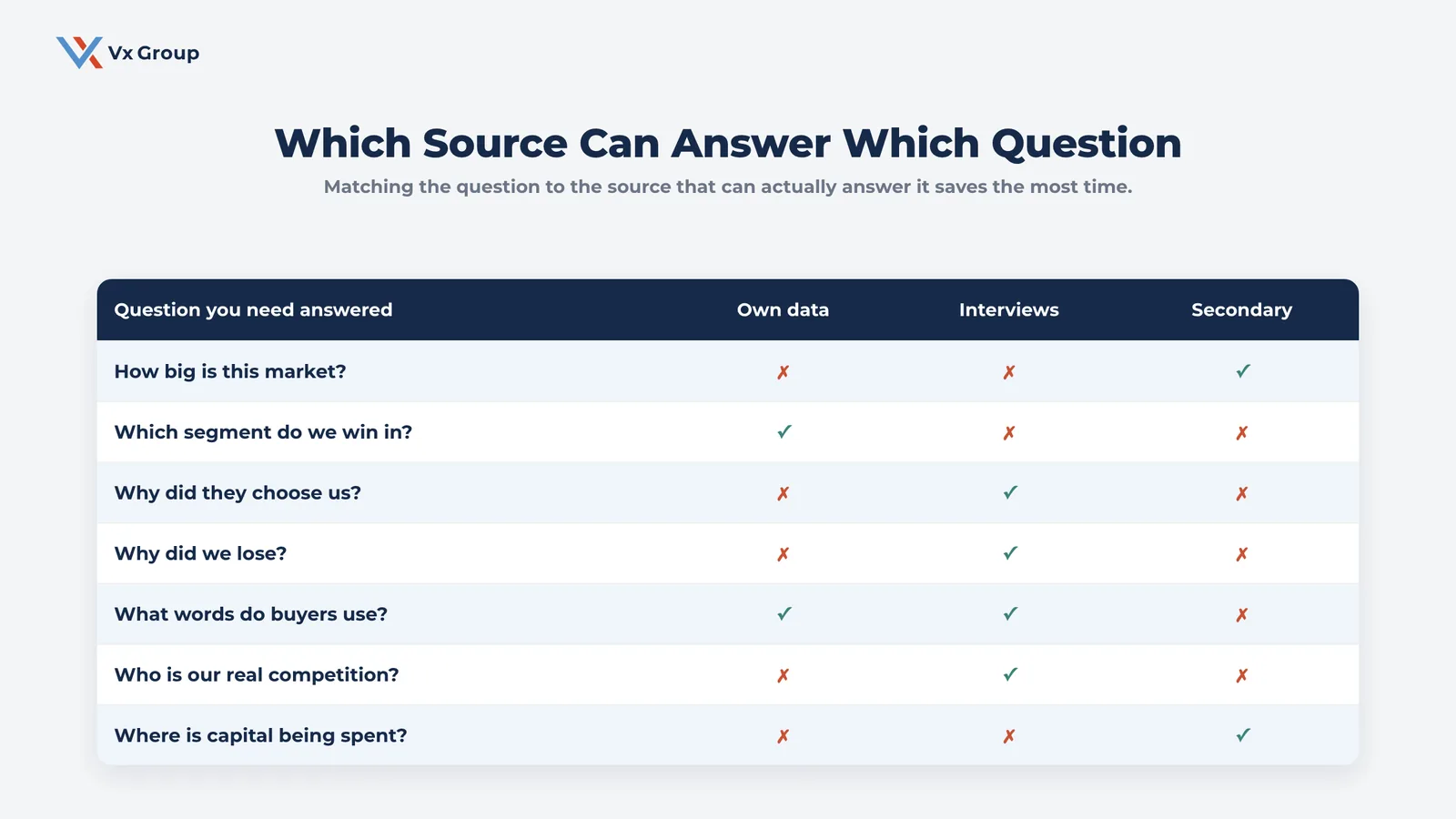
Internal data is complete about the deals you saw and silent about everything else. It cannot tell you about the companies that never invited you to quote, the buyers who chose a competitor without contacting you, or the applications where you are not considered at all. Write down those blind spots. They become the interview questions in step three.
Step 3: How do you run customer interviews that produce something usable?
Interview twelve to twenty customers for thirty minutes each, using a fixed guide, with someone other than their salesperson asking the questions. The fixed guide is what makes the answers comparable; the neutral interviewer is what makes them honest.
Recruit across the full range of accounts
Pick interviewees to cover the range: recent wins, long-tenured accounts, one or two who reduced spend, at least one from each segment you are evaluating. Ask the salesperson for introductions and then ask someone else to conduct the call. Customers tell their salesperson what maintains the relationship, and they tell a neutral third party what they actually think.
Response rates for a thirty-minute call with an existing customer usually run high in B2B, especially when you ask for their advice on a decision you are weighing. “We are making a decision about where to invest next year and I would value your view” opens more calendars than a survey link ever will.
Use this interview guide
Seven questions, thirty minutes, in this order:
- Walk me through how your business has changed in the last two years.
- When you first looked for a supplier like us, what triggered the search?
- What did you evaluate, and what nearly stopped you from choosing us?
- What does a good week with a supplier look like? What does a bad one look like?
- Where do we make your job harder than it needs to be?
- If you were choosing again today, who else would be on the list?
- What would have to change for you to give us more of your business?
Question three surfaces the objection your sales team never hears. Question six is your real competitive set, which is frequently different from the one in your strategy deck. Question seven produces expansion opportunities and doubles as a prompt for the account expansion work.
Record with permission, and write a two-paragraph summary within an hour of each call while the tone is still fresh.
Ready to grow?
We run this process with clients and hand back the interview guide so you can repeat it yourselves.
Ask for a specific example every time
The guide is a floor. The value is in the follow-up, and there is one that outperforms every other: “Can you give me an example?” A customer saying delivery reliability matters is a platitude. A customer describing the Tuesday they had a line down waiting on a part is a finding you can act on.
Step 4: How do you get insight from the people who did not buy?
Ask them directly, quickly, and with no attempt to reopen the sale. Lost prospects and never-quoted accounts hold the information your internal data structurally cannot contain, and access is the hardest part of the whole project.
Contact lost deals inside sixty days
Memory decays fast and goodwill decays faster. Reach out within sixty days of the loss, from someone senior who was not the salesperson, with a specific and honest framing: you are not trying to reverse the decision, you want ten minutes to understand what you got wrong. Expect roughly one in three to say yes, which is enough.
Four questions:
- What made the difference in the end?
- Where were we strongest and where were we weakest?
- Was there a point where we lost it, and when?
- What would we need to change to be a serious option next time?
The gap between what these people say and what your CRM recorded as the loss reason is usually the single most valuable finding in the project. The full method for running this systematically belongs to win-loss analysis, which is worth setting up as a standing process once this project proves the value.
Reach the accounts that never invited you
Harder access, high value. Three routes that work: trade association members you have never quoted, attendees at a show where you exhibit, and referrals from existing customers into their peer network. The outreach patterns in b2b prospecting strategies apply here, with research as the ask instead of a meeting. The question set is shorter, because you are not asking about an experience they never had:
- When you need this kind of product, who do you call first, and why them?
- What would put a new supplier on your list?
- Have you heard of us, and if so, what do you associate us with?
That third question is uncomfortable and it is the point. The answer tells you whether you have a positioning problem, an awareness problem, or a reputation problem, and each one calls for a different response.
Log the refusals too
Note who declined and why, when they say. A pattern in the refusals is itself a signal, particularly if the lost deals from one segment consistently decline to talk.
Step 5: How do you use secondary sources without wasting money?
Use published data for market sizing, industry trends, and regulatory shifts, and stop there. Secondary sources are good at telling you how big something is and bad at telling you why anyone buys.
Work the free and low-cost sources first
| Source | Good for | Cannot tell you |
|---|---|---|
| Trade association data | Market size, member counts, industry direction | Why a specific buyer chooses a supplier |
| Government and census industry data | Establishment counts, geography, employment by sector | Anything about buying behavior |
| Trade publication surveys | Sector sentiment, capital spending plans | Your competitive position |
| Competitor websites and materials | Their claimed positioning and product range | What their customers actually experience |
| Job postings in your market | Where companies are investing, what they are building | Timing or budget |
Job postings deserve a mention on their own: a manufacturer hiring three controls engineers is telling you something about their next capital project that no report will publish.
Buy a report only against a named question
If a paid report is genuinely warranted, write the question it must answer before you purchase, and confirm the report actually addresses it. Most syndicated reports are priced for enterprise budgets and answer questions at a level of abstraction that will not change a mid-market decision.
Triangulate across at least two sources
Where two sources disagree on market size, the disagreement is more informative than either number. Note the definitional difference, pick the one that matches how you actually sell, and record the assumption so the next person understands the basis.
Step 6: How do you turn findings into a decision?
Write one page: what you asked, what you found, what changes, and who owns each change with a date. A research project that ends in a report has not finished; it has stopped.
Code the interviews into themes
Read every summary and tag recurring ideas. Anything appearing in five or more interviews out of twenty is a pattern. Anything appearing once is an anecdote that may still be worth chasing if the stake is large. Count them honestly, including the themes that contradict what leadership expected.
Route each finding to its owner
Findings fall into three buckets, and each has a different home:
| Finding type | Goes to | Typical output |
|---|---|---|
| Who we should target | ICP and segmentation | An updated profile and a revised target list |
| How we should talk about it | Messaging and website | Rewritten positioning in the customer’s own words |
| What we should fix | Product, service, or process | A named operational change with an owner |
The third bucket is where most companies underreact. A recurring complaint in five interviews is a service design problem, and b2b customer experience covers how to treat it as one.
The messaging findings are usually the fastest to act on and the most underused. When customers describe their problem in consistent language, that language belongs on the site, and the customer segmentation models work gives you the structure to apply it by segment. The targeting findings feed straight into ICP marketing.
Update the ICP and put a review date on it
Finish by revising the ideal customer profile against the win-rate table and the interview themes. Use the ideal customer profile template so the output is comparable next time, and set a review date twelve months out. A profile without a review date drifts back into folklore within two years.
What does this cost and how long does it take?
Six weeks of part-time effort from two people, and almost no cash outlay.
| Phase | Effort | Cash cost |
|---|---|---|
| Decision framing | Half a day | None |
| Internal data pull and analysis | 2-3 days | None |
| 15 customer interviews | 15 hours plus scheduling | None |
| 6 lost-deal and non-customer conversations | 6 hours plus outreach | None |
| Secondary source review | 1 day | Usually none |
| Synthesis and write-up | 2 days | None |
The binding constraint is calendar time for interview scheduling. Worth saying plainly to any leadership team that has been deferring this because of a budget line: the budget was never the obstacle.
Common B2B market research mistakes
- Starting without a decision. The single most common failure, and it guarantees the output goes unused.
- Letting the salesperson interview their own accounts. What you collect back is relationship maintenance, politely phrased and largely useless.
- Interviewing only happy customers. The pattern lives in the range, including the accounts that reduced spend.
- Trusting your CRM loss reasons. “Price” is the answer people give when the real reason is harder to say.
- Buying a report to avoid making calls. The report will not answer the question that actually matters to your business.
- Stopping at the findings. No owner, no date, no change means the whole project was a reading exercise.
- Never repeating it. Markets move. An annual cycle of fifteen interviews compounds; a one-off study ages out within two years.
Where to start
Pull the win-rate-by-segment table this week. Three years of quotes, sorted by industry, with a win rate against each. It takes an afternoon with whatever your ERP or CRM will export, and it will very likely show you a segment where you win at double your average rate and have never targeted deliberately.
Then book three customer interviews. Three is enough to start, and small enough that nobody has to approve a project. Use the seven-question guide, have someone other than the account owner run them, and see what you hear. If those three produce nothing you did not know, stop and save yourself the six weeks. In our experience that is not what happens.
Make it an annual habit
The companies that know their market best are rarely the ones that commissioned the biggest study. They are the ones that talk to fifteen customers every year, keep the questions consistent, and write down what they heard. Done annually, that practice compounds into a picture of a market no purchased report can match, because it is specific to your accounts, your applications, and your competitive set.
Start with the win-rate table and three interviews. The rest follows from what you hear.
Ready to grow?
We help B2B companies build a research habit that informs real decisions.
Subscribe to Insights → New articles on relationship-driven B2B growth, roughly weekly.
FAQs
About the Author: Beth Barbaglia
