

Are B2B Trade Shows Worth It for Manufacturers?

Yes, B2B trade shows are worth it for manufacturers with long sales cycles and high-value accounts. They pay when the show puts you in a room with buyers you already want to know, and they fall short when you grade them by badge scans. Add up the full cost first, then compare it with what one new account is worth.
TL;DR
- A trade show usually costs far more than the booth invoice. Travel, staff time, and follow-up often double the total.
- Shows pay off when your sale takes months and one new account is worth tens of thousands of dollars. Your buyers also have to walk the floor.
- Shows rarely pay off for short-cycle, catalog-style sales where buyers order online.
- The best single test is target-account density: how many of the accounts on your list will have someone at the show.
- Judge a show 90 days after it ends, on conversations, meetings with target accounts, and pipeline that moved.
- Owners can run the five-question check in this article on any show before signing the contract.
Most owners we talk to have one or two shows they would never skip. They also keep attending a few because “we’ve always gone.” Both groups usually have no real number for what a show costs or what it returns.
That gap is where the money leaks. A team scans 400 badges, flies home, and calls the show a success because the lead list looks big. Six months later nobody can name a deal it started. We call this the badge scan trap. It treats a trade show as a volume game, and volume is the wrong thing to count when your best customers stay for twenty years.
This guide answers the question owners ask before they sign a booth contract. It covers what a show really costs, when it pays off, when it does not, and how to decide. It is written for owners and presidents of privately held manufacturers, and every section ends with something you can do the same week.
How much does a B2B trade show really cost?
A B2B trade show costs a lot more than the booth invoice. In the example below, the full cost is about 2.4 times the space rental and booth build. Travel, staff time, and follow-up sit on top.
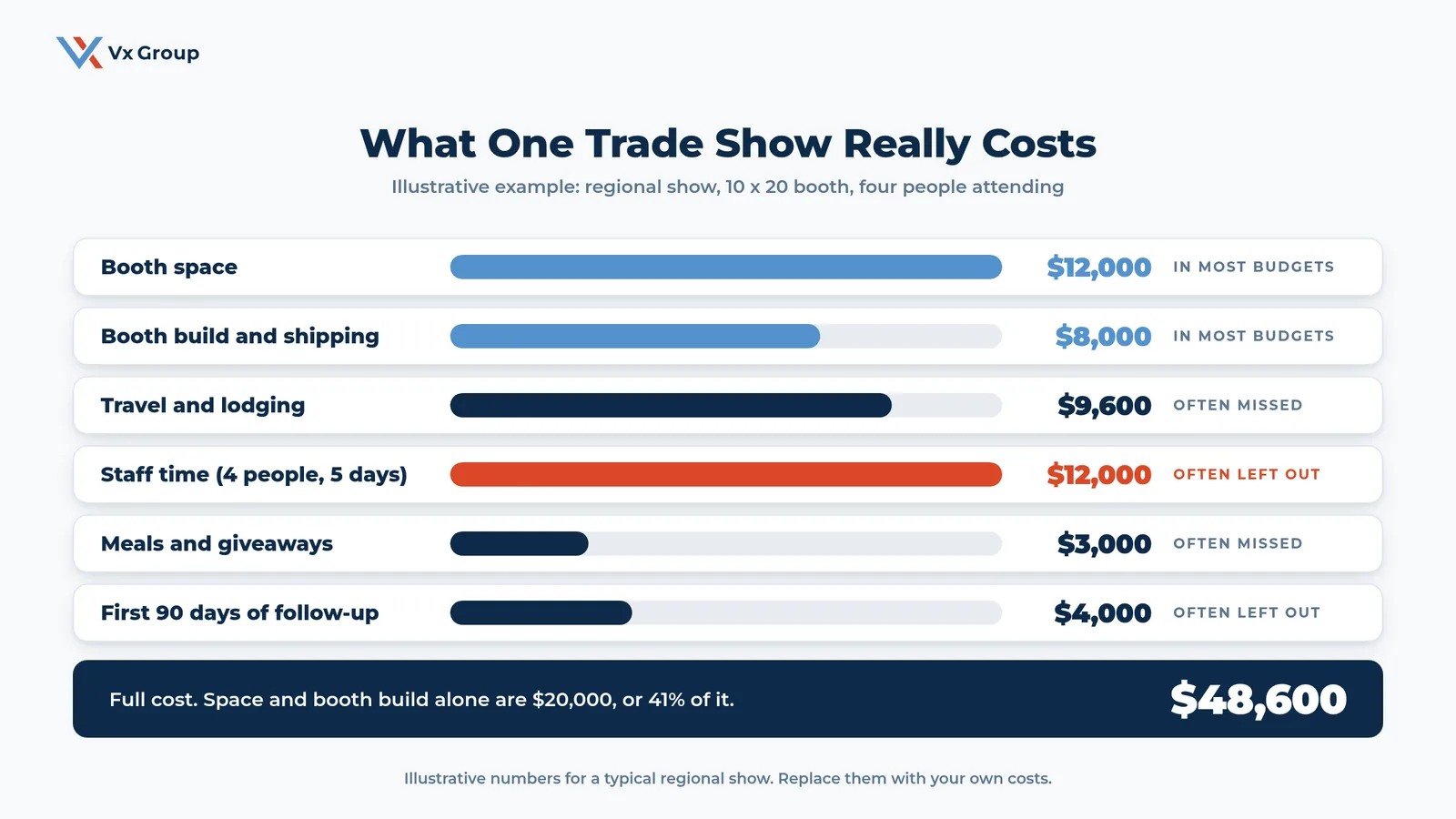
The numbers are illustrative. They describe a regional industry show with a 10 by 20 booth and four people attending. Swap in your own figures. The shape holds for most manufacturers: the two lines everyone budgets are about 41% of the real total.
Add up the costs everyone budgets
Start with the lines that show up on invoices. These are booth space, the booth build or rental, graphics, and freight to and from the show.
In the example that is $12,000 for space and $8,000 for the booth build and shipping. That is $20,000. It is the number most companies have in mind when they say a show “costs about twenty grand.”
Add the smaller invoice items as well: electrical, internet, lead retrieval, drayage, and show-floor labor. They are easy to forget because they arrive as separate bills in the weeks after the show.
Count staff time at its real price
Staff time is the largest line in most shows, and it rarely appears in any budget. Each person you send is away from customers, quotes, and the plant for the full trip plus prep days.
In the example, four people spend five days each, counting travel and prep. At a loaded cost of $600 a day per person, that is $12,000. For an owner or a senior sales leader, the real cost of those days is higher. The account work they skip does not get done by anyone else.
Use your own daily rate. A plain way to set it: take what the person costs you in a year and divide by about 230 working days. Then add the margin on the work they would have done.
Add the cost of follow-up
A show creates work after it closes. Samples ship. Quotes get written. Someone drives to a plant because a buyer at the show said “come see us.”
In the example we set aside $4,000 for the first 90 days. That covers sample freight, travel for two follow-up visits, and a few hours of engineering time. If you leave this line out, you are agreeing in advance not to follow up.
Write the full number down before you sign
Put the total in one cell and the line items beneath it. Travel and lodging in the example is $9,600, meals and giveaways are $3,000, and the full total is $48,600.
Then send the number to the people who will staff the booth. A sales team that knows the show costs $48,600 plans it differently than one that heard “twenty.”
When is a B2B trade show worth it?
A B2B trade show is worth it when your sale takes months and one new account is worth far more than the cost of the show. The buyers you want also have to be on the floor. Those three conditions describe most of our clients, which is why we treat shows as relationship events.
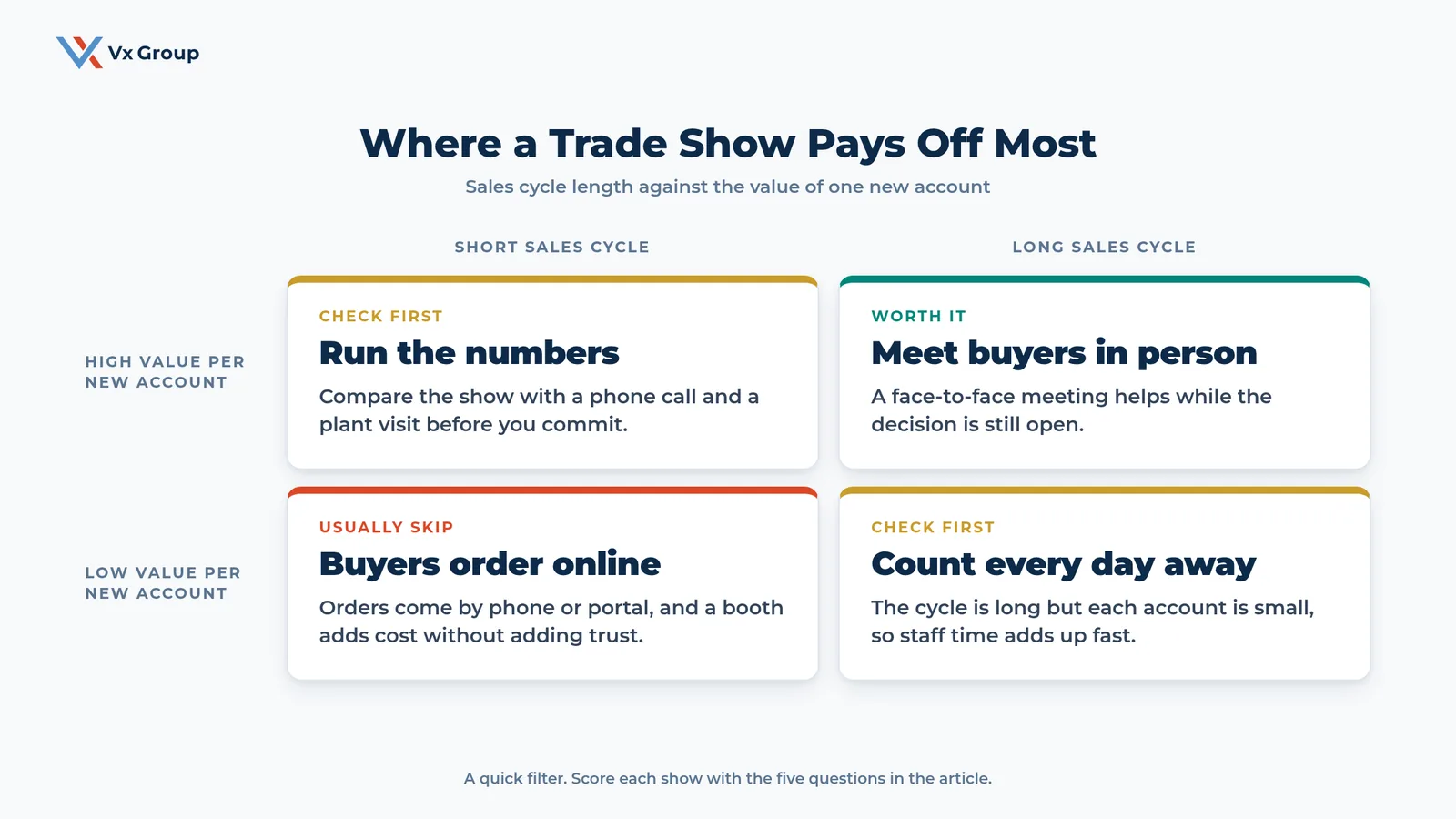
The grid above is a quick filter. A long cycle with high-value accounts sits in the top right and is the case where a show most often pays. The other three squares need a closer look, which the rest of this article gives you.
Check that your sale takes months
Long sales cycles are where a face-to-face meeting does the most work. A buyer who is deciding whether to approve a new supplier wants to meet the people behind the quote. Samples, test data, and references all help, and a handshake helps with the final push.
If your typical order closes in a week after one phone call, a show competes with a phone call. The phone call is far cheaper. Our guide to the stages of a B2B sales cycle lays out the steps most manufacturers go through. Use it to see how long your own cycle runs.
Check that one account pays for the show
Take your total cost and divide it by the gross profit on a typical first-year account. That gives you the number of new accounts the show must produce to break even.
In the example, say a typical new account brings $30,000 in first-year gross profit. The show costs $48,600, so you need two new accounts to break even ($48,600 divided by $30,000 is 1.6, so round up). Once those accounts reorder, the show looks very different. Many manufacturers keep a customer for ten years or more, so first-year profit understates what an account is worth.
If you need ten new accounts to break even, the show is probably wrong for you.
Check that your buyers go to the show
Many shows have a big floor and the wrong crowd. The attendees may be competitors, students, vendors, or buyers from the wrong part of the country. A big attendance number says little about whether your buyers are in the building.
Defined Term: Target-account density.
The share of your named target accounts that will send at least one buyer or influencer to a show. A list of 25 accounts with 8 attending gives a density of 32%.
Our rule of thumb is to look for a density near one in three or better. Ask the show for its exhibitor and attendee lists, and ask your top customers and your distributors and reps whether they plan to go. Then compare the attendee list with your account list by hand. It takes an afternoon, and it is the best use of an afternoon in the whole planning process.
Field Notes:
Here is an illustrative example, a composite built from patterns we see. It describes no single client. A maker of industrial filters had an account that once bought about $400,000 a year. The buyer who owned the relationship retired, and orders slowed to a trickle over 14 months. Nobody at the plant knew the owner. The owner of the filter company checked the attendee list of one annual show. Six of his top 20 target accounts, including that plant, planned to send people. He emailed the new purchasing manager three weeks ahead and offered a 30-minute coffee. He booked six meetings before the show and took two engineers, because the plant’s questions were technical. The coffee led to a plant visit in the following month and a quote request in the month after that. The show cost him about $40,000. The plant is buying again.
The lesson from that composite is practical. The show did the work of putting him in the same building as a person he had been unable to reach for a year. The meetings were booked before the booth went up.
Ready to grow?
Share the shows on your calendar and we will help you pick the ones that fit your accounts.
When is a B2B trade show not worth it?
A B2B trade show is not worth it when your sale closes fast or your buyers order online without meeting anyone. It also falls short when the people you want to see do not attend. In those cases the same budget does more in other places.
Here are the signs we see most often:
- Short cycle, low order value. The buyer decides in a day or two and orders from a catalog or portal.
- The crowd is wrong. Most attendees are competitors, vendors, or people with no buying authority.
- Nobody owns the follow-up. The team can name the booth designer and cannot name who calls the 15 best contacts the following week.
- The booth team cannot answer technical questions. A buyer with a spec question needs an engineer or a senior seller, and the junior sales rep who staffs the booth cannot help.
- The show is a habit. The company has gone for 12 years, and nobody has looked at a result since year two.
If two or more of these sound familiar, treat the show as a candidate to drop. Ask the five questions in the next section before the next contract arrives. Some shows will pass the check and some will fail it.
Visit the show as an attendee first
Walk a show once before you exhibit. The cost is a plane ticket and two days. You will see who attends, how traffic moves, and which exhibitors get real conversations. You can also meet two or three target accounts without a booth between you and them.
Spend the booth budget on your top accounts
If a show fails the density test, take a slice of the budget and use it on your best customers. Visit their plants. Bring two of your engineers. Host a dinner for the people who buy from you in one region. A dinner for 12 target accounts costs a small fraction of a booth, and it gives you hours of attention from each guest.
Our article on Share of Wallet shows why this tends to work. Most manufacturers we work with hold under 5% of the spend at their biggest potential accounts. The room to grow sits inside accounts you already know.
Fix the follow-up gap before you add another show
A show without follow-up wastes the whole budget. If your team does not call back the people it met, a second show will repeat the problem at greater cost. Our piece on why more leads are rarely the answer in B2B sales explains what to fix first.
How do you decide whether to exhibit at a show?
Decide by scoring the show on five questions before you sign. Each question has a green light, and a show that gets three or more greens is a strong candidate.
| Question | What to ask | Green light |
|---|---|---|
| Target-account density | How many of our named accounts will have a buyer there? | About one in three or better |
| Break-even | Does the full cost equal one or two new accounts? | One or two accounts cover it |
| Meetings | Can we book meetings before we ship the booth? | At least 10 booked in advance |
| Follow-up | Who owns each conversation for 90 days? | A named person for every contact |
| Alternatives | Would visits and a dinner reach the same accounts for less? | No, the show reaches people we cannot reach otherwise |
Score the show on the five questions
Print the table and fill it in with your sales leader. Use the attendee list, your account list, and the full cost number from the first section. Do it in one sitting, and do it before the early-bird deadline so the price does not push the decision.
The table is a decision tool for you. A show with four greens and one red is still worth a look. A show with one green is a pass.
Run the break-even math on paper
Write one line: full cost divided by first-year gross profit per account equals accounts needed. In the example that is $48,600 divided by $30,000, or two accounts.
Then ask a second question: how many accounts did our last show produce, and how many did the one before? If the answer is zero twice in a row, change the plan or skip the show.
Ask the organizer for attendee data
Request the exhibitor list, the attendee job titles, and the mix of company types. Good organizers can tell you how many attendees hold buying authority and how many are vendors. If yours cannot answer, treat that as a warning about the show.
Also ask three of your best customers whether they plan to attend. A yes from a customer tells you more than any brochure from the organizer.
Set the rule for a no
Agree in advance that two or more reds mean you pass. Write it in the planning doc. Without a rule, the decision drifts toward “we’ve always gone.” A simple rule gives the owner something to point to when someone asks for one more year.
How do you get more from a show you decide to attend?
You get more from a show by booking meetings before it opens, sending people who can answer technical questions, and planning one event outside the exhibit hall. Most of a show’s value is set in the six weeks before the doors open.
Book the meetings four weeks ahead
Match the attendee list to your account list, then write to each person you want to see. Name one reason to meet, such as a new part, a test result, or a question about their plant. Offer 30 minutes at your booth or at a coffee table nearby. Aim for at least 10 booked meetings before the show starts.
A purchase often involves a group, so ask each contact who else weighs in. Our guide to the B2B buying committee covers who those people usually are.
Send people who can answer the questions
Put at least one engineer or technical seller on the booth team. Add the owner or president for the days your top three accounts are in the building. A buyer who asks about tolerances or lead times wants an answer on the spot, and a junior rep holding a brochure cannot give one.
Plan one dinner or breakfast for target accounts
Pick six to twelve people from your target list and invite them to a dinner near the show. Keep it small enough that everyone talks. Many of the best conversations at a show happen away from the booth, because the buyer is no longer working the floor.
Write the follow-up plan before you leave home
Assign every name on your list to one person on your team. Set the date for each first note. Decide which samples you will ship and who will write the quotes. When the team knows who owns what, follow-up starts the first morning back.
How do you tell if a trade show was worth it afterward?
You tell a show was worth it by reviewing it 90 days after it ends. Use three numbers: conversations that reached a real business topic, meetings booked with target accounts, and pipeline that moved. A review on the flight home mostly tells you how tired the team is.
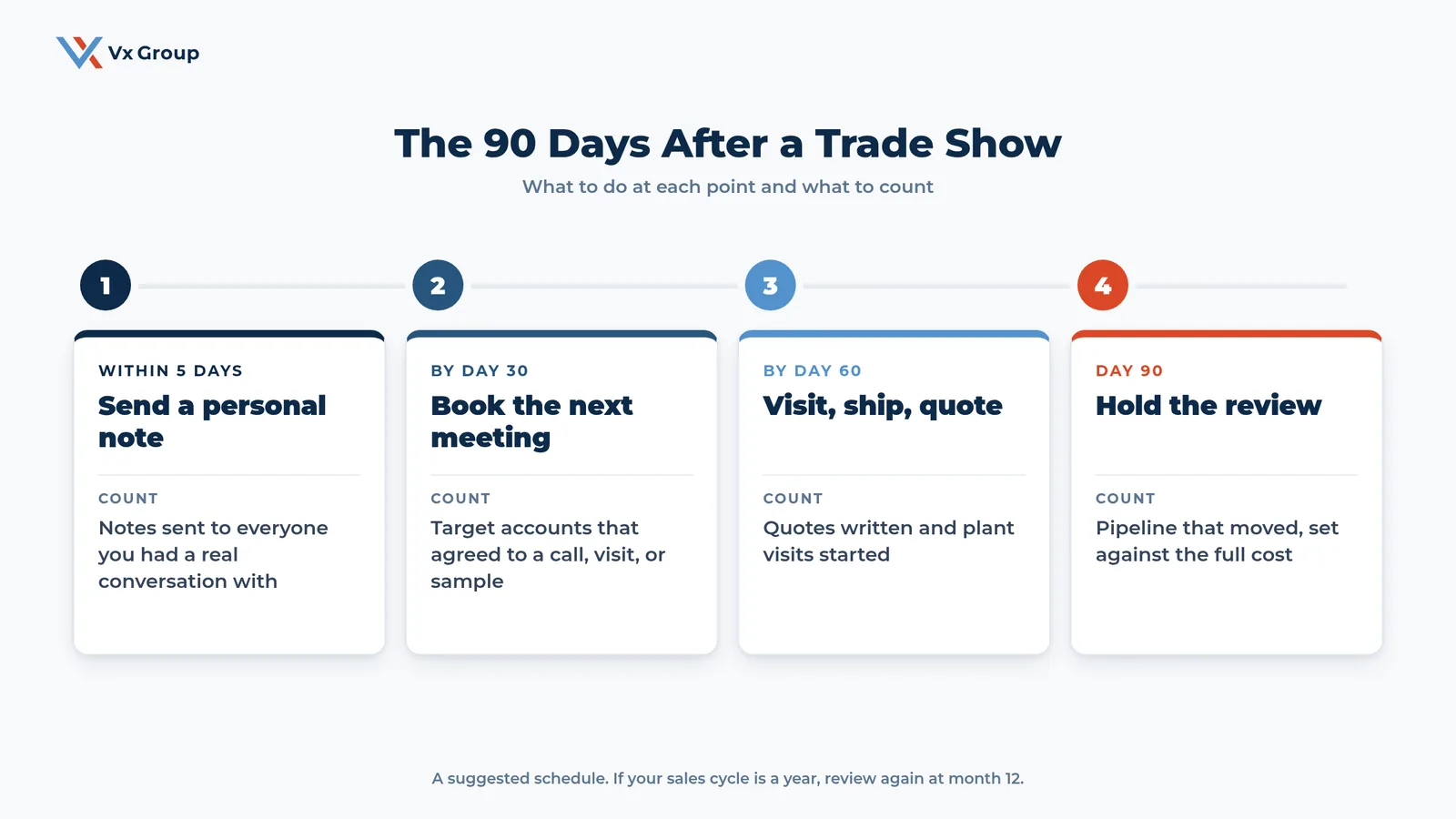
The timeline above matches how long relationships take to move. Do the first step within a week, while the conversations are fresh. Put the review date on the calendar before the show.
Send a personal note within five days
Write a short note to each person you spoke with in a real conversation. Mention one thing they said. Offer the next step you discussed. Skip the group email with a brochure attached.
Our guide to trade show booth ideas covers how to set up the booth so those conversations start easily and get recorded.
Book the next meeting within 30 days
A conversation on a show floor lasts a few minutes. The next meeting is where a relationship moves. Count how many of your target accounts agreed to a call, a visit, or a sample within 30 days. This number tells you more than the badge count does.
Our article on how to measure trade show effectiveness breaks the measures down in more detail.
Hold the 90-day review
On day 90, pull three numbers: qualified conversations, meetings with target accounts, and pipeline that moved because of the show. Compare them with the full cost from the first section.
If you want the math in detail, read how to measure trade show ROI and our list of trade show metrics. For the wider picture of how shows fit into a growth plan, see what trade show marketing is.
Some shows pay back after a year, because a long sale can take that long to close. If your cycle is 12 months, review again at month 12 and count the accounts that closed.
Where should you start this week?
Start with the one show you spend the most on and score it with the five questions. You will have an answer in an afternoon, and it will tell you whether to renew, change, or drop it.
- Pull the full cost of your last show, including staff time and follow-up, into one number.
- Match the show’s attendee list to your top 25 accounts and count the hits.
- Block 90 days on the calendar after your next show for the review, and name one person who owns the follow-up.
Do those three things and you will know more about your shows than most companies in your industry do. Keep the shows that reach your best accounts. Drop the ones that only fill a calendar. Put the savings into visits and dinners with the customers who already trust you.
Ready to grow?
Bring your trade show calendar and we will help you score each show against your accounts.
FAQs
About the Author: Jacob Camhi
