

What Is the EOS Model? A Plain-Language Breakdown
The EOS Model, short for Entrepreneurial Operating System, is a way to run a small or mid-size company with six parts: Vision, People, Data, Issues, Process, and Traction. A leadership team uses a few simple tools and a weekly meeting to keep those parts working. Gino Wickman created it and describes it in his book Traction.
TL;DR
- The EOS Model organizes a company around six parts: Vision, People, Data, Issues, Process, and Traction.
- A leadership team runs it with a weekly meeting, a short scorecard, and priorities set every 90 days.
- It works best when a business has processes that repeat and numbers that move every week.
- A relationship-driven company grows through a few deep, long-cycle accounts, and a weekly scorecard rarely tracks those.
- An owner can keep what EOS does well and add relationship measures to the scorecard.
What is the EOS Model?
EOS stands for Entrepreneurial Operating System. Gino Wickman built it from his work with business owners and laid it out in the 2007 book Traction. Today many owner-led companies run on it, and many owners in manufacturing and distribution run EOS or are weighing it.
EOS gives a leadership team three things: a shared vocabulary, a set of one-page tools, and a meeting rhythm. The goal is simple. Leaders agree on direction, know who owns what, watch a few numbers, solve problems quickly, and finish what they said they would finish.
Defined Term: EOS.
The Entrepreneurial Operating System is a set of tools and meeting habits that helps a leadership team run a company. It covers six parts of the business: Vision, People, Data, Issues, Process, and Traction.
Some teams learn EOS from the book and run it alone. Others hire a certified EOS Implementer to coach them through sessions. Our article on the EOS Implementer covers what that role involves.
Owners like EOS for a practical reason. It gives a leadership team a regular place to disagree and decide. Many teams meet only when something breaks, so priorities get set by whoever speaks loudest. A fixed weekly meeting, a short scorecard, and a quarterly reset replace that habit with a steady routine.
The tools take little time to learn. A team can start using the V/TO and the Level 10 agenda within a few weeks. The early gain in clarity is the main reason the model spreads from one owner to the next.
What are the six components of the EOS Model?
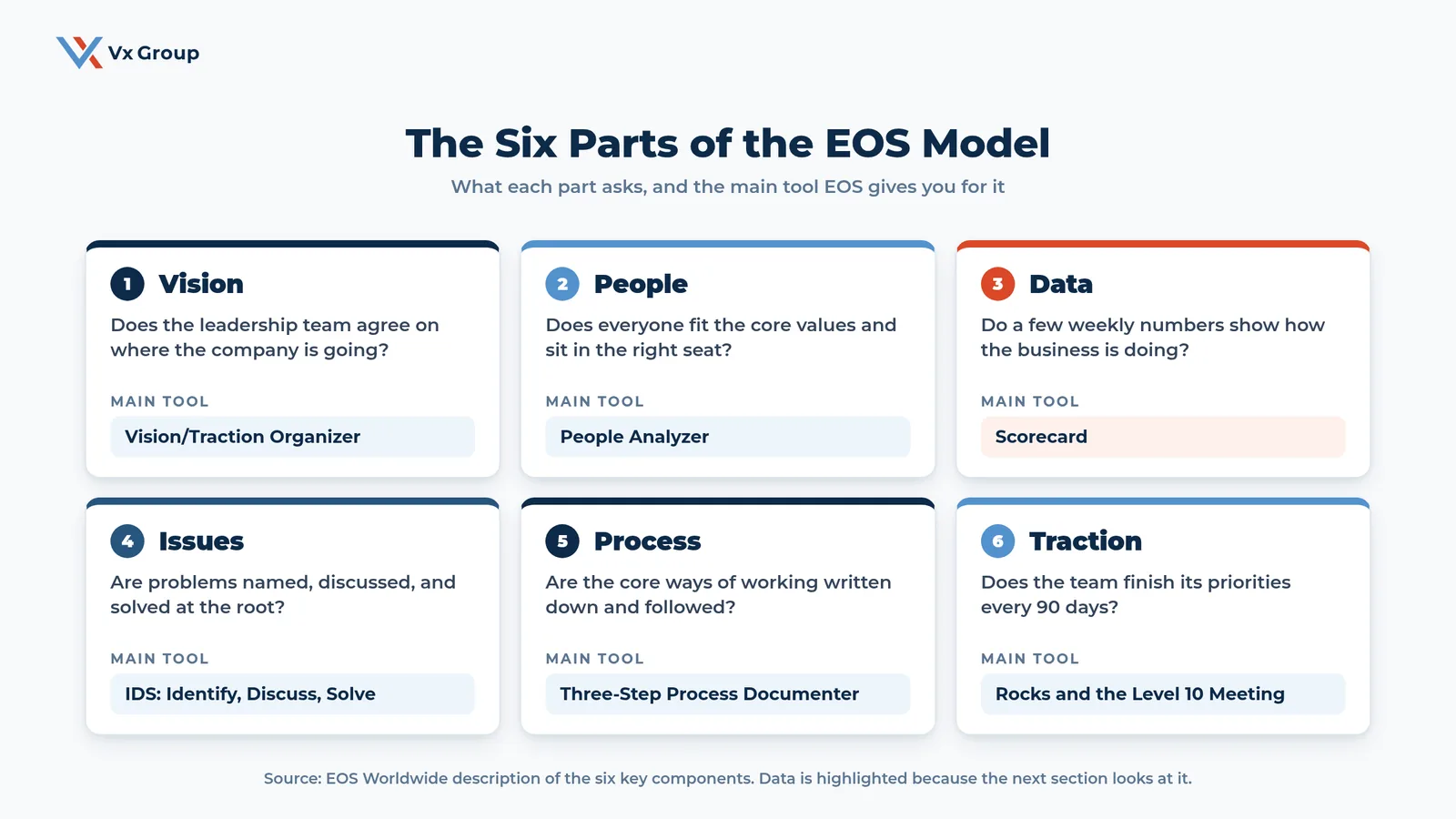
The six components of the EOS Model are Vision, People, Data, Issues, Process, and Traction. The graphic above lists the question each part asks and the main EOS tool for it. Data is highlighted because that is the part where a relationship-driven business feels the most strain, as the later sections show.
Set the Vision so the leadership team agrees on direction
The Vision component asks whether every leader gives the same answer to the question “Where is this company going?” The main tool is the Vision/Traction Organizer, called the V/TO. It is a two-page document the leadership team fills out together.
The V/TO holds the company’s core values, its core focus, a long-term target, a three-year picture, and a one-year plan. Writing these down forces the team to settle disagreements that usually stay unspoken for years.
Put the right people in the right seats
The People component asks two questions about each person. Does this person share the company’s core values? Does this person fit the role they hold? The People Analyzer rates each person against the core values.
EOS also uses an Accountability Chart, which shows each seat in the company and who owns it. For role fit, EOS asks whether a person gets the job, wants the job, and has the capacity to do it.
Pick a few weekly numbers for the Data component
The Data component asks whether a short list of numbers shows how the business is doing each week. The main tool is the Scorecard. Each number on it has an owner and a goal.
The leadership team reviews the Scorecard at the start of every weekly meeting. A number that misses its goal for several weeks becomes an issue to solve.
Solve problems at the root with the Issues component
The Issues component asks whether the team names its problems and solves them for good. The main tool is IDS, which stands for Identify, Discuss, and Solve.
The team keeps one running list of issues. In each meeting it ranks the list, takes the biggest issue first, and finds the root cause. Every solved issue ends with a to-do that has an owner and a due date.
Write down the core processes for the Process component
The Process component asks whether the few core ways the company works are written down and followed by everyone. The main tool is the Three-Step Process Documenter.
EOS keeps this light. A company lists its core processes, writes each one in simple steps, and trains people to follow them. The aim is consistent results from different people.
Finish priorities every 90 days with the Traction component
The Traction component asks whether the team finishes its most important priorities. EOS calls those priorities Rocks and sets them every 90 days. The weekly Level 10 Meeting keeps the team on track between quarters.
Defined Term: Rocks.
Rocks are the handful of most important priorities a person or team commits to finishing in a 90-day quarter. Each Rock has one owner and is reviewed as done or not done at every weekly meeting.
How does the EOS Model run week to week?
The EOS Model runs on three kinds of meetings: a weekly meeting, a quarterly session, and an annual planning session. Each one has a fixed agenda, so the team spends its time on decisions and skips the debate about how to run the meeting.
| Meeting | How often | Typical length | What the team does |
|---|---|---|---|
| Level 10 Meeting | Every week | About 90 minutes | Reviews the Scorecard and Rocks, then solves issues |
| Quarterly session | Every 90 days | A full day | Reviews the last quarter and sets the next Rocks |
| Annual planning session | Once a year | Two days | Updates the Vision and the one-year plan |
Run the weekly Level 10 Meeting with the same agenda each time
Defined Term: Level 10 Meeting.
The Level 10 Meeting is the weekly leadership meeting in EOS. It follows a fixed agenda, runs about 90 minutes, and ends with each person rating the meeting out of ten.
The agenda has seven parts, in this order:
- A short check-in where each leader shares one piece of good news.
- A review of the Scorecard.
- A review of the Rocks, marked done or not done.
- Headlines about customers and employees.
- A review of last week’s to-do list.
- IDS on the biggest issues.
- A wrap-up where each person rates the meeting.
Hold the quarterly session to reset the Rocks
Every 90 days the leadership team meets for a full day. It looks back at the quarter, checks the V/TO, and sets Rocks for the next 90 days. Teams that skip this session tend to drift back to whatever feels urgent.
Hold the annual planning session to update the Vision
Once a year the team meets for two days to review the long-term target, the three-year picture, and the one-year plan. The output is a new one-year plan and a fresh set of first-quarter Rocks.
Ready to grow?
Bring your scorecard and we will look together at where your top accounts show up on it.
What does the first year of the EOS Model look like?
A company that adopts the EOS Model usually spends its first year building habits. The tools are simple and the habits take time. Knowing what to expect keeps a leadership team from quitting in the first quarter.
Expect a rough first quarter
The first few Level 10 Meetings run long and feel stiff. Leaders argue about which numbers belong on the Scorecard and which priorities count as Rocks. This is normal. Keep the agenda fixed and keep meeting every week, because the habit matters more than the first version of any tool.
Expect the Scorecard to change twice
Most teams start with too many numbers or the wrong ones. After one quarter, cut any number that nobody acts on. After two quarters, add the numbers the team wishes it had watched. A relationship-driven company often adds its top-account rows at this point, and it can add them on day one.
Expect the quarterly session to get easier
The first quarterly session takes real effort because the team is deciding how to decide. By the third or fourth session, the review of the old Rocks and the choice of new ones moves quickly. By the end of year one, the V/TO usually reads like a plan the whole leadership team owns.
What does the EOS Model quietly assume about your business?
Three conditions make the tools of the EOS Model work best. Each one is easy to check, and the answers show whether EOS fits your company as written or needs additions.
Check whether the same work repeats
Documented processes pay off when the same work happens again and again. A plant that runs the same product lines every week gets real value from writing down each step. A company that wins five large custom projects a year has fewer repeatable steps to write.
Check whether your customers look alike
Scorecards and shared processes assume that one customer behaves much like the next. When a company has hundreds of similar customers, an average number tells the truth. When a company has fifteen deep accounts that each work differently, an average hides the facts that matter.
Check whether the weekly numbers move
A weekly Scorecard makes sense when something changes every week, such as orders, shipments, or quotes. In a business with a twelve-month sales cycle and customers who stay for twenty years, most weekly numbers change very little. The numbers that decide next year’s revenue move on a slower clock. Owners who feel growth flatten at this stage will recognize the pattern in why owner-led companies stall.
Where does the EOS Model strain in a relationship-driven company?
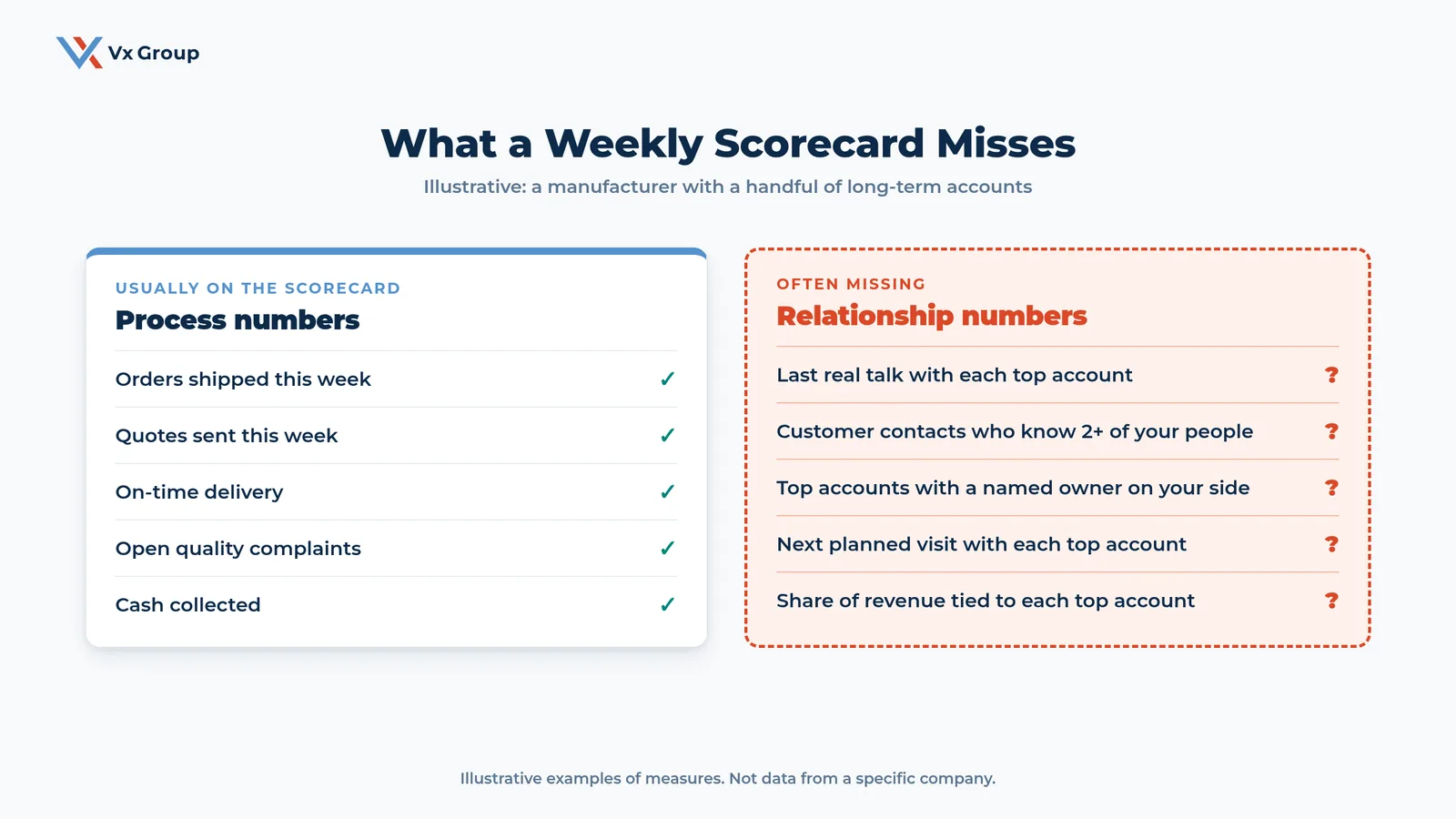
A relationship-driven company can run EOS well and still miss its biggest risk. The graphic above shows five process numbers a weekly Scorecard usually holds next to five relationship numbers that often have no row at all. The examples are illustrative.
The villain here is a process model applied to a business that grows through trust. The weekly numbers look healthy while the relationships that produce next year’s revenue go unwatched. Four changes fix most of the gap.
Add relationship rows to the Scorecard
Pick three to five measures about your top accounts and give each one an owner and a goal. Good starting rows are:
- Days since the last real conversation with each top account.
- Number of people at each top account who know two or more people at your company.
- Top accounts with a named owner on your side.
- Share of revenue tied to each top account.
A real conversation covers the customer’s plans and priorities. Write that definition on the Scorecard so every owner counts the same way.
Name an owner on your side for every top account
Every top account needs one named person at your company who owns the relationship and one backup. When the relationship lives in a single head, a resignation or a retirement can undo years of trust in a month. Our article on customer concentration risk shows how to measure how much revenue sits behind that risk.
Give your top accounts a Rock each quarter
Set one Rock per quarter that moves a top relationship forward. Examples include a visit to the customer’s plant, an introduction between your engineer and their engineer, or a planning conversation about their next three years. Each Rock has an owner and gets reviewed every week like any other Rock.
Add a top-account check to the weekly meeting
The Level 10 agenda already includes customer headlines. Use that slot to report on one top account each week, rotating through the list. Over a quarter, the team hears from every top account at least once. The article on using your top 10 customers as strategy explains how to pick which accounts belong on that list.
Field Notes:
Picture a hypothetical $20 million machine shop that runs EOS well. Its Scorecard tracks shipments, quality complaints, and cash. Its largest customer, a buyer of many years, has a new plant manager who has never met anyone on the shop’s team. Nothing on the Scorecard turns red until the first order slips. A relationship row for “people at the customer who know two of our people” would have shown the gap a year earlier.
Why do some EOS rollouts stall?
EOS rollouts stall when the weekly rhythm breaks. Five causes show up most often, and each has a plain fix.
- Meetings get skipped. One cancelled Level 10 Meeting turns into three. Fix it by holding the meeting on the same day and time every week, even when the owner is out.
- Too many Rocks. A team that sets ten Rocks finishes few of them. Fix it by cutting the list to the few that matter most this quarter.
- Scorecard numbers have no owner. A number with no owner never gets fixed. Fix it by giving each number one name.
- The owner exempts themselves. If the owner skips the agenda, the team follows. Fix it by having the owner follow every rule first.
- The team treats EOS as a one-time project. Fix it by putting the quarterly and annual sessions on the calendar a year ahead.
Which companies get the most from the EOS Model?
The EOS Model fits best when a leadership team needs shared direction and a steady meeting habit. The table shows how common situations line up. It is a judgment guide based on how EOS tools work and does not come from a study.
| Your situation | Fit with EOS as written |
|---|---|
| The leadership team disagrees on priorities | Strong fit |
| Work repeats and numbers move every week | Strong fit |
| Meetings run long and decisions stall | Strong fit |
| A few long-term accounts produce most revenue | Good fit with relationship rows added |
| Sales cycles run a year or longer | Good fit with slower measures added |
| The company needs a plan for finding new markets | Partial fit, needs a growth plan alongside |
Use this rule to decide quickly. If your leadership team spends most of its time on disagreements about direction and priorities, adopt EOS as written. If the team already agrees on priorities but revenue depends on a handful of long-term accounts, adopt EOS and add the relationship rows. If the main question is where new growth will come from, EOS helps with the running of the company and a growth plan has to cover the rest. Our article on why B2B companies grow by accident explains what that plan replaces.
How much does EOS cost, and do you need an implementer?
Cost depends on how you run EOS. A team can learn it from the Traction book and run its own meetings. Other teams hire a certified Implementer who facilitates sessions, and the fees depend on the Implementer and how many sessions the company books.
An outside facilitator helps when the leadership team struggles to hold itself to the agenda. Our article on the EOS Implementer covers the role, the typical engagement, and how to decide.
How does the EOS Model compare with a growth system?
EOS manages how a company runs. A growth system manages how a company grows over time. Both matter, and they answer different questions: EOS asks whether the company runs well, and a growth system asks whether the company has a repeatable way to win and expand relationships.
Many relationship-driven companies run both. They use EOS for meetings, roles, and priorities, and they use a growth system to decide which markets and relationships deserve the most attention. Measured in Millions® is the growth system Vx Group uses with owner-led companies.
Three articles go deeper on this choice:
- What Is a Business Growth Operating System? defines the growth side.
- How to Pick the Right Operating System for Your Business helps you decide where your constraint sits.
- EOS Alternatives compares seven other systems.
Where should an owner start with the EOS Model?
An owner can start in a few weeks without any outside help. This order keeps the effort small and shows quickly whether EOS fits.
- Read Traction, or take the EOS Organizational Checkup, to see how your leadership team scores on the six parts.
- Hold a half-day leadership session to fill out the V/TO together.
- Build a Scorecard with a short list of weekly numbers, and add the relationship rows from the section above.
- Start the weekly Level 10 Meeting with the full agenda and keep it for 90 days.
- Set the first Rocks, with at least one Rock aimed at a top account.
After 90 days, review what changed. If the meetings saved time and the team agrees on priorities, keep going. If the numbers on the Scorecard look healthy and growth still feels uneven, look at the growth side.
The EOS Model and your top accounts
If your company already runs EOS, the next step is small. Pick three relationship rows, add them to the Scorecard this month, and give each one an owner. If your company is weighing EOS, run the checks in this article first. Companies with repeating work and similar customers can adopt it as written. Companies built on a few deep accounts should add the relationship rows from day one.
Ready to grow?
See how your top accounts would show up on a scorecard built for a relationship-driven business.
FAQs
About the Author: David Tisdale
