

Selling a Manufacturing Business: What Buyers Look For and What They Discount

A buyer of a manufacturing business is paying for profit that keeps showing up after the owner leaves. The plant and equipment support that profit, but the price rests on three answers: who owns the customer relationships, what happens to revenue when the owner steps back, and how much of last year’s profit repeats.
TL;DR
- Buyers of manufacturing companies pay for profit that repeats and relationships that transfer. Equipment matters, but it ranks behind both.
- Four kinds of buyer show up: a larger company in your industry, a private equity platform, an add-on buyer, and your own management team. Each wants something different and pays differently.
- The biggest price cuts come from five triggers: too much revenue with one customer, an owner who holds every key relationship, deferred maintenance, undocumented processes, and a salesperson who owns your top accounts.
- A marketed sale usually runs nine to twelve months, after a year or two of preparation that decides most of the outcome.
- Deal structure changes what you take home. Stock versus asset sale, earnouts, rollover equity, and escrow all move the real number.
- Document who owns each customer relationship before you talk to any buyer. That one piece of work answers the questions buyers press hardest.
- Start with a conversation with your CPA and one trusted advisor, and do it before you sign anything with a broker.
What this guide covers
- What a buyer is actually buying
- Who buys manufacturing businesses and what each wants
- What earns a premium
- What draws a discount
- What the price difference looks like in practice
- How the sale process runs and how long it takes
- What to fix in the 24 months before you go to market
- How deal structure changes what you take home
- Who belongs on your sale team
- The mistakes that cost owners the most
- Where to start this month
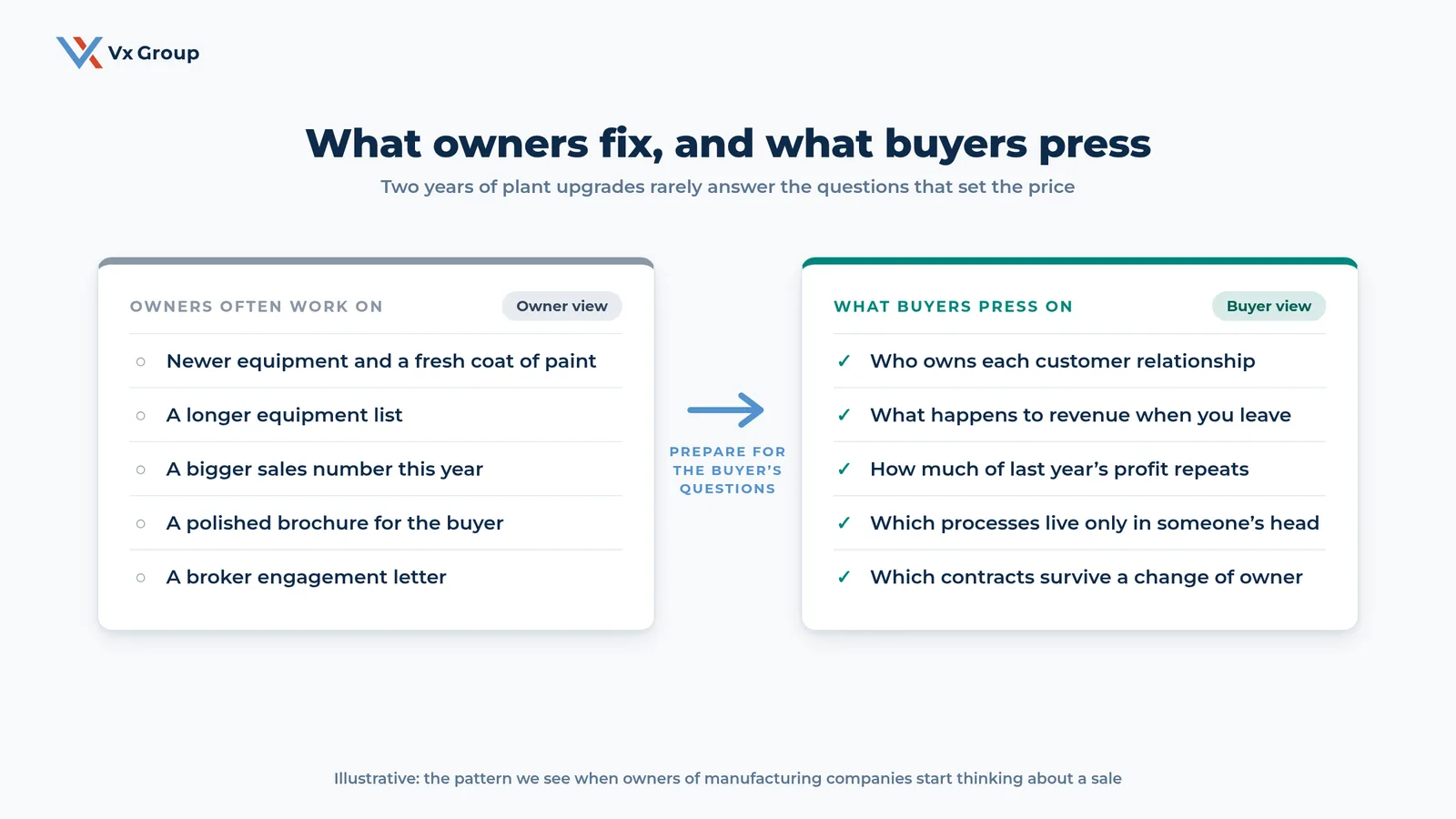
Here is a pattern I see often. An owner decides in January that the company will be sold in a couple of years. For the next twenty-four months, the money and attention go into the plant. A new CNC line goes in. The roof gets fixed. The equipment list grows, the floor gets painted, and the brochure gets redone.
Then a buyer shows up and asks different questions. Who owns the relationship with your top ten customers? What happens to revenue when you step away? How much of last year’s profit will repeat next year? The owner has spent two years improving everything except the answers.
That gap between what owners prepare and what buyers press is the villain in most sales that disappoint. It costs real money, and almost all of it is avoidable. This guide covers what buyers of manufacturing businesses look for, what they discount and why, how a sale runs, and what to work on while you still have time.
I wrote it for the owner of a manufacturer or distributor in the $5 million to $50 million revenue range who is thinking about a sale, whether that is next year or in ten. You do not need to be ready to sell to read it. Most of what follows makes the business stronger whether or not you ever sell.
What is a buyer actually buying when they buy a manufacturing business?
A buyer is buying a stream of future profit and the confidence that it will continue without you. The building, the machines, and the inventory are the base that makes that profit possible, and a buyer values them, but the price is set by how believable the profit stream is.
Three questions drive that belief:
- Who owns the customer relationships? If the honest answer is “I do,” the buyer sees revenue that may leave when you do.
- What happens to revenue when the owner steps back? A buyer wants evidence from the last few years that the business grew, or at least held, when you were not in the room.
- How much of last year’s profit repeats? Repeat orders, contracts, and standing agreements count. One-time projects, a single large order, and a price spike do not.
Defined Term: Owner dependence.
The share of a company’s revenue, decisions, and relationships that would be at risk if the owner stepped away. A buyer measures it by asking who holds each key customer relationship, who makes pricing and quoting decisions, and who solves problems when something breaks.
Answer the three questions in writing before the buyer asks
Open a blank document and write one page per question. For the first, list your top ten customers, the revenue each one produced last year, and the name of the person at your company who talks to them most. For the second, list the last three times you were out for a week or more and what happened to orders and quotes. For the third, split last year’s revenue into repeat, contracted, and one-time.
Most owners learn something from that first page. A customer they assumed was shared across the team turns out to run through them alone.
Check your answers against a skeptical reader
Hand the three pages to your CFO, your controller, or an outside advisor you trust, and ask one question: where would you push if you were buying this? Whatever they push on first is where a buyer will push first. Fix or explain that item before you go to market.
Who buys manufacturing businesses, and what does each buyer want?
Four kinds of buyer pursue manufacturers in this size range, and they differ on price, speed, and what they ask of you after closing. Knowing which one you are talking to changes how you prepare and how you read an offer.
| Buyer type | What they want | What they usually pay for | What worries them | Often a fit when |
|---|---|---|---|---|
| A larger company in your industry (sometimes called a strategic buyer) | Your customers, products, or capacity added to what they already do | Overlap they can combine with their own operation, sometimes at a higher price | Customers who leave after the combination, culture clash, your key people leaving | You have a product line or customer base they cannot easily build |
| A private equity platform | A first company in your industry that other acquisitions can be attached to | Steady profit, a management team that stays, a clear plan to grow | Owner dependence, thin management, customers that could walk | You have a team below you and want to stay involved for a while |
| An add-on buyer (a company owned by a private equity firm that is buying smaller companies in the same field) | A bolt-on that fits an existing business | Profit that adds to what they have, plus savings from combining | Systems that will not merge, relationships that sit with you | You want a faster process and a buyer that already understands your market |
| Your management team (a management buyout) | To run the company they already know | A price they can finance, usually with a seller note or outside money | Having to pay for growth they helped build, financing risk | You want continuity for employees and are willing to take part of the price over time |
Each of these buyers asks the same three questions from the last section. They weight the answers differently. A larger company in your industry cares most about the customers. A private equity platform cares most about the team. An add-on buyer cares about fit. A management team cares about whether it can finance the price.
Rank your own goals before you meet a buyer
Write down what you want from a sale in order of importance. Typical goals include the highest price, a clean exit in twelve months, a legacy for employees, a role for family members, staying involved for two or three years, and keeping the company in town. You rarely get all of them. A buyer who offers the top price may close the plant. A buyer who protects employees may offer a lower price and part of it later.
Put the ranked list somewhere you will see it. When offers arrive, it keeps you from taking the largest headline number when the terms behind it do not match what you wanted.
Ask each buyer the same five questions
Use the same list with every serious buyer so you can compare answers side by side:
- What do you plan to do with the plant, the brand, and the people?
- How have you handled companies like mine before, and may I speak with one of those owners?
- What role do you want me to play after closing, and for how long?
- How is the price paid: cash at closing, a note, an earnout, or equity in the new company?
- What would stop you from closing?
Compare offers on total value and the odds of closing
A headline price tells you little until you see the terms. Subtract what is held in escrow, what depends on future results, and what you will owe in taxes. Then ask how likely each buyer is to actually close. An offer a few percent lower from a buyer with committed financing and a record of finishing deals can leave you better off than a higher one that falls apart in month four.
What do buyers pay a premium for in a manufacturing company?
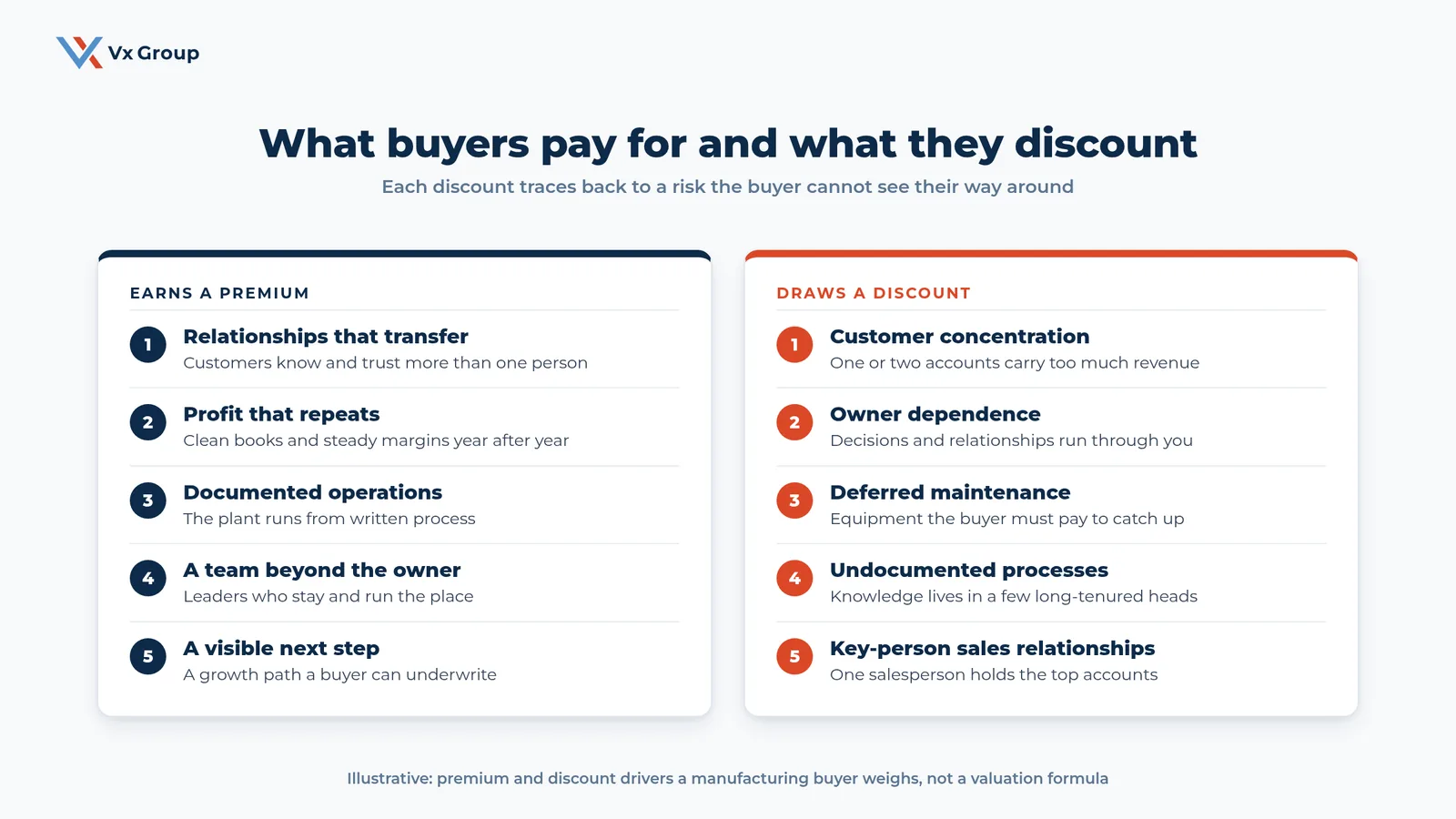
Buyers pay more for five things: relationships that transfer, profit that repeats, operations written down, a team beyond the owner, and a visible path to growth. Published guides on selling manufacturers commonly cite a wide range of earnings multiples, roughly 3x to 10x EBITDA depending on size and position, and the five items below are a large part of what moves a company within that range.
Show that customer relationships transfer to a new owner
A buyer wants to see customers who know and trust several people at your company, and who would keep buying if you retired. Build a one-page relationship map for your top fifteen accounts. For each one, list the owner of the account at your company, a second person who also knows the customer, and the date of the last in-person visit. Aim for two names on every line before you go to market.
If the second name is blank on many lines, you have found your first project. Introduce a second person to each of those customers, in person, over the next six months.
Show that profit repeats
Separate your revenue into three buckets for each of the last three years: contracted or standing orders, repeat orders from existing customers, and one-time work. A buyer pays the most for the first two. Put the percentages in a simple table and be ready to explain every swing.
Clean books matter here too. A buyer will check whether the profit you report matches tax returns and bank records, and will adjust for owner expenses that run through the business. Our article on sell-side due diligence walks through how to run that check on yourself first.
Put how the plant runs into writing
A buyer wants to know the business runs from process and does not depend on memory. Start with the five tasks where a mistake costs the most: quoting, order entry, scheduling, quality checks, and shipping. For each, write a one-page procedure that a competent new hire could follow, and have the person who does the work review it.
The goal is to show a buyer that when a veteran retires in year one, the plant’s know-how stays behind.
Show leaders who will stay and run the place
Buyers talk to your second layer of management, usually early. Name the three to five people below you who run the business day to day, and write down what each owns: a function, a customer group, a plant area. If you have not had a retention conversation with these people, have it before a buyer does, and consider a stay bonus that pays out after closing.
Show where the next dollar of growth comes from
A buyer pays for growth they can see. Write a one-page growth view: two or three customers or markets with room to expand, what it would take to win them, and what you have already done to start. It does not need to be a forecast. It needs to be specific enough that a buyer can picture the next three years.
Ready to grow?
If you want an outside read on how a buyer would see your customer relationships today, this is a good first conversation.
What do buyers discount, and what triggers each discount?
Buyers discount five things in manufacturing companies: too much revenue with one customer, owner dependence, deferred maintenance, undocumented processes, and sales relationships held by one person. Each discount is a price for a risk the buyer cannot remove on their own.
| Discount | What triggers it | What the buyer does | How you reduce it |
|---|---|---|---|
| Too much revenue with one customer | A single account above roughly 10 to 15 percent of revenue, or the top five above roughly 50 percent | Lowers the price, shifts part of it into an earnout, or asks for that customer to be contacted before closing | Grow the next tier of customers and lock in a multi-year agreement with the big one |
| Owner dependence | Pricing, quoting, and key relationships all run through you | Requires you to stay for a long transition, and pays part of the price later | Hand off named accounts and decisions to others, and show it working for a year |
| Deferred maintenance | Equipment past its life, a building needing major repair, a safety or compliance gap | Subtracts the catch-up cost from the price, often with a margin on top | Get an independent equipment assessment and fix or plan for the worst items |
| Undocumented processes | Know-how lives with a few long-tenured people | Assumes a productivity dip after the transition and prices it in | Write the procedures for the five costliest tasks and have them tested |
| Sales relationships held by one person | One salesperson owns most top accounts and has no backup | Asks for a retention agreement with that person or discounts the price | Pair that salesperson with a second contact on each account and document the history |
The thresholds in the first row come from the ranges we use in our article on customer concentration risk. They are rules of thumb. A buyer who knows your industry may be comfortable with more or may want less.
Count how much revenue sits with your top customers
Pull a list of revenue by customer for the last three years. Calculate the share of the largest customer, the top five, and the top ten. Look at the trend as well as the number. A customer at 18 percent that has bought for twenty years and has a contract through 2030 looks very different to a buyer than a customer at 18 percent that arrived last spring.
Map who owns each key relationship
For your top ten accounts, write the name of the person who owns the relationship at your company. If the owner column reads “me” for most of them, a buyer will price that in. Our article on founder-dependent sales describes the pattern in detail, and the piece on your top ten customers as a growth strategy shows how to build a second layer of contact around each one.
Walk the plant the way a buyer's inspector will
Hire an outside person who knows your equipment to walk the floor and write down what is near the end of its life, what is out of compliance, and what would cost real money in the first two years of new ownership. Deferred maintenance is easy to see and easy to price, so buyers subtract it from the offer in full. You will almost always do better by deciding yourself what to repair before a sale and what to disclose.
Write down the processes only your veterans know
Ask your longest-tenured people what would go wrong if they left tomorrow. Their answers become your list. Pick the five most expensive items on it, write them up, and ask someone newer to run the procedure while the veteran watches. Where the new person gets stuck, the writing needs another pass.
Check where your sales relationships actually sit
If one salesperson carries a large share of your top accounts, a buyer will worry that the person leaves after closing and takes the accounts along. Sit down with that person and the owner of each account at your company and build a plan: a second contact on each account, a shared notes system, and an introduction from you to the customer’s decision-maker. Consider a retention agreement as well. A buyer will usually ask for one anyway.
What does the price difference look like in practice?
Two manufacturers of similar size and profit can receive very different offers, and the gap usually traces to how well the business runs without the owner. The example below is an illustrative composite built from patterns we see, and it describes no single client.
Field Notes:
A family-owned maker of industrial components had steady profit and a modern plant. The owner, who had run sales for thirty years, held the relationship with almost every top account. Early conversations with buyers produced low offers and a request that the owner stay for several years with part of the price paid later.
The owner took six months before the next round. A second person was introduced to each of the top fifteen customers in person. The two most important accounts moved from handshake arrangements to written multi-year agreements. The company wrote up its quoting, scheduling, and quality procedures. None of this involved new equipment or new capital.
The next round of buyers saw the same plant and the same profit. They also saw two named contacts on every key account, written agreements on the largest ones, and documented procedures. The offers improved, and more of the price came at closing. The business had not changed much, but the buyer could now see that it would keep running after the owner left.
The lesson I take from cases like this is that relationship documentation costs far less than a capital project, and it answers the exact questions buyers press. Buyers will pay for evidence that customers stay.
What does the sale process look like, and how long does it take?
A marketed sale of a manufacturing company usually runs about nine to twelve months from the first conversations with buyers to closing, according to guides from several advisory firms, and that follows a year or two of preparation. Smaller or simpler deals can move faster, and complicated ones take longer.
| Phase | What happens | Typical length | Your job |
|---|---|---|---|
| Preparation | Clean up the books, document relationships and processes, fix what you can | 12 to 24 months before going to market | Do the work in the earlier sections of this guide |
| Packaging | Your advisor builds the information package and a list of buyers | 1 to 3 months | Review every number and every claim |
| Outreach | Buyers sign confidentiality agreements and receive the package | 1 to 3 months | Take calls, answer questions, protect confidentiality |
| Offers | Interested buyers submit indications of price and terms | 1 to 2 months | Compare offers on total value and closing odds |
| Letter of intent | You pick a buyer and sign a letter that sets price and terms | 2 to 4 weeks | Negotiate terms before you grant exclusivity |
| Buyer’s review | The buyer checks financials, customers, contracts, and operations | 2 to 3 months | Respond fast and keep the business performing |
| Closing | Lawyers finalize documents and money moves | 1 to 2 months | Stay available and keep operating |
Treat the lengths as ranges. They vary with buyer type, deal size, and how organized your records are.
Hire the team in the right order
Start with your CPA and a deal attorney who has done manufacturing transactions. Bring in an advisor to run the sale once you know your goals and your numbers. An owner who signs with a broker first often finds out later that tax or structure issues should have shaped the plan.
Build the information package once and keep it current
Your advisor will ask for financial statements, customer and contract data, employee information, and operating details. Gather them into one organized folder before outreach starts. Every time a buyer asks for something new, add it to the folder so the next buyer gets the answer immediately.
Run a controlled set of conversations
Meet buyers in a sequence your advisor sets, and give each the same information. Your job in these meetings is to answer plainly and show curiosity about the buyer’s plans. A buyer who feels they are talking with a straightforward person tends to offer more and to close.
Protect the business while the sale runs
The most common way a sale falls apart is that results slip during the process because the owner is distracted. Pick someone below you to keep daily operations on track, and keep a regular weekly meeting with your leadership team. If a buyer sees a bad quarter in the middle of their review, they will reopen the price.
Plan the first year after closing before you sign
Ask what your role will be, who you will report to, how long you stay, and what happens to your team. Write the answers down and agree on them in the documents. A lot of owners find the first year after a sale harder than expected, because the company they ran for decades now belongs to someone else.
What should you fix in the 24 months before you go to market?
Spend the last two years before a sale on the items buyers press hardest: customer relationships, profit quality, owner dependence, and written process. We cover that readiness work in a separate piece on preparing a business for sale. The short version follows.
- Months 1 to 6: Pull revenue by customer, name the owner of each top account, and run your own review of the numbers. Hire your CPA and a deal attorney.
- Months 6 to 12: Introduce a second contact to each top account. Move your largest customers from handshakes to written multi-year agreements where the customer is willing.
- Months 12 to 18: Write the procedures for the five costliest tasks. Have an outside person walk the plant and give you a repair list.
- Months 18 to 24: Step back from daily decisions so a buyer can see the business run for a few quarters without you. Meet your advisor and finalize the information package.
If your timeline is shorter, do the first two items first. They cost the least and move the price the most.
How does deal structure change what you take home?
The price in a letter of intent and the money that reaches your bank account are two different numbers, and the structure of the deal is the reason. A few terms deserve your attention before you sign anything.
Defined Term: Earnout.
A portion of the purchase price paid after closing only if the company hits agreed targets, usually for revenue or profit, over one to three years. An earnout shifts risk to the seller, because the new owner’s decisions affect whether the money gets paid.
Defined Term: Working capital peg.
The amount of working capital (cash, receivables, and inventory minus payables) the buyer expects the company to deliver at closing. If the actual number comes in below the peg, the price drops by the difference.
Compare a stock sale and an asset sale with your CPA before you sign a letter of intent
In a stock sale, the buyer takes ownership of your shares or membership interests. In an asset sale, the buyer picks the assets and liabilities it wants. Buyers often prefer asset deals for tax reasons, and sellers often prefer stock deals for the same reason. Which works better for you depends on how your company is organized and taxed. Ask your CPA to model both before you negotiate, and ask what each is worth to you in after-tax dollars.
Decide how much of the price you will accept later
Buyers often propose part of the price as an earnout, a note you hold, or equity in the combined company. Each carries risk. Write down the most you would accept in each form, and ask yourself whether you would still be comfortable if the future payments came in at zero. If the answer is no, negotiate for more cash at closing.
Read the working capital and escrow terms line by line
Ask your attorney to explain the working capital peg and any escrow, which is money held back for a year or more to cover claims after closing. Sellers who skip this are the ones surprised by a smaller check on closing day. Ask your CPA to calculate the peg using the same method the buyer will use, so you know in advance whether your own numbers support it.
Who belongs on your sale team?
You need four to five people, and the order you hire them matters.
| Role | What they do | When to bring them in |
|---|---|---|
| CPA or tax advisor | Models stock versus asset sales, reviews structure, and estimates your after-tax proceeds | First, 18 to 24 months out |
| Deal attorney | Reviews contracts, negotiates documents, advises on risk and escrow | First, with the CPA |
| Sale advisor (investment banker or broker) | Builds the package, finds buyers, runs the process, and negotiates price and terms | 6 to 12 months out, once your goals and numbers are clear |
| Quality of earnings provider | Reviews the financials the way a buyer’s accountant will | 6 to 12 months out, before the package is built |
| Personal financial planner | Plans what you will do with the proceeds | Early, so the plan shapes your goals |
Interview at least two candidates for the sale advisor role, and ask each for references from manufacturing owners they have worked with. Ask how many deals they have closed in your size range and what share of their listings sold.
What mistakes cost owners the most when they sell a manufacturing business?
Most expensive mistakes come from starting late, hiding problems, or letting results slip. Seven come up again and again.
- Preparing the plant and ignoring the relationships. Equipment is the easy project to start, and customer ownership is the one that sets the price.
- Hiring a broker before talking with a CPA. Structure and taxes decide how much you keep, and they should shape the plan from the start.
- Going to market with the owner as the main salesperson. A buyer will discount for it or ask you to stay for years.
- Letting a buyer find the problem. A known issue you disclose early becomes a conversation about terms, and the same issue discovered in week eight tends to reopen the whole price.
- Letting results slip during the process. A weak quarter in the middle of a buyer’s review is expensive.
- Taking the highest headline price. The terms behind it can leave you with less than a lower offer from a buyer that closes.
- Having no plan for life after closing. Decide what you want your days to look like before you sign.
Where should you start this month?
Start with the three pages from the first section and a conversation with your CPA. That is a small amount of work and it tells you where you stand.
- Write down your ranked goals for a sale.
- Build the revenue-by-customer list and name the owner of each top account.
- Separate last year’s revenue into contracted, repeat, and one-time.
- Ask your CPA to explain how a stock sale and an asset sale would affect your after-tax proceeds.
- Pick one customer relationship and introduce a second person from your company in person within thirty days.
Conclusion
A manufacturing business sells for the most when a buyer can see that profit repeats and relationships stay after the owner leaves. Every section above comes back to that idea. The plant, the books, the team, and the customer list all matter because they make that picture easier or harder to believe.
You can start improving that picture today, long before you talk to a single buyer. Each relationship you share across your team and each procedure you write down makes the company worth more to a buyer and easier for you to run.
Ready to grow?
If you are thinking about a sale in the next few years, bring your top ten customer list and we will walk through how a buyer would read it.
If you had to name who owns the relationship with each of your ten biggest customers, could you do it without using your own name more than once or twice? And if a buyer asked you that question next month, what would you say?
About the author: Eric Zoromski is the founder and CEO of Vx Group, where he works with the owners of relationship-driven B2B companies to build growth systems that hold up when a buyer, a lender, or a board looks closely. He has spent more than two decades helping owners see their own businesses the way an outsider eventually will.
Related reading
- How to Run Sell-Side Due Diligence Before a Buyer Runs It On You
- Commercial Due Diligence: What Buyers Actually Check
- Customer Concentration Risk: What It Is and How to Reduce It
- Founder-Dependent Sales
- Your Top 10 Customers Are a Growth Strategy
FAQs
About the Author: Eric Zoromski
