

What Is Trade Show Marketing? A Guide for Relationship-Driven B2B Companies
Trade show marketing is the full cycle of relationship work a company builds around an industry event: the accounts it plans to see, the conversations it prepares, the booth that hosts them, and the ninety days of follow-up that convert those conversations into revenue. The booth is one component of a program that runs about six months.
TL;DR
- Trade show marketing covers the whole cycle around an event. Most companies budget for the booth and staff the floor, then leave the two phases that produce revenue unowned.
- The show floor is one of the few places in B2B where thirty of your most valuable relationships walk past you in three days, which is the asset worth planning around. Badge volume is a distraction from it.
- Book meetings before you build the booth. A program with twenty confirmed conversations on the calendar behaves differently from one hoping for traffic.
- Follow-up decays fast. What goes out in the first ten days, personally and specifically, determines what the show was worth.
- Measure the program on relationships advanced and pipeline created over the full sales cycle, and hold the number against the same show next year.
What does trade show marketing include?
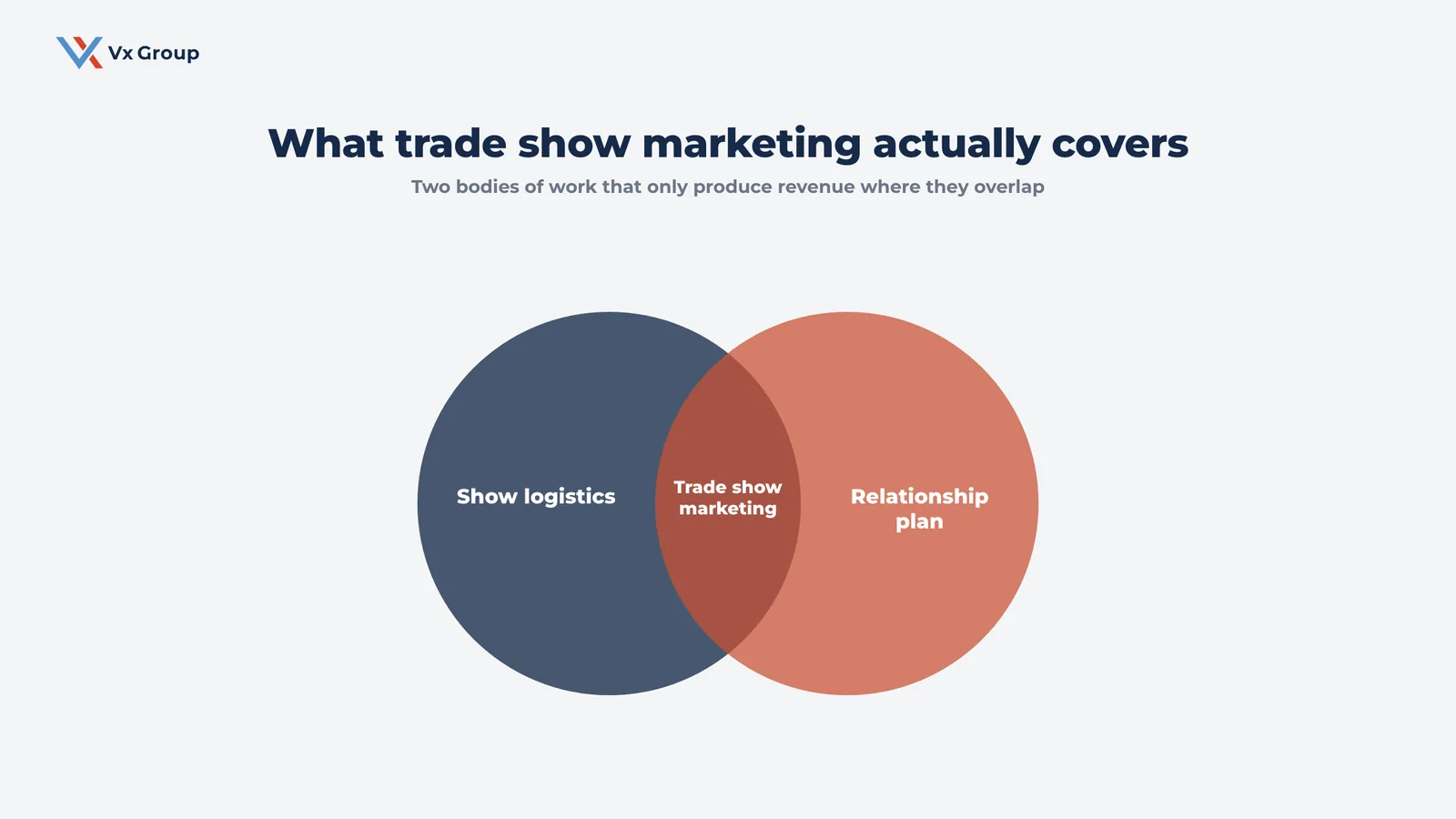
Trade show marketing includes six bodies of work: choosing which shows to attend, building a named target list of people to see, booking conversations in advance, designing a booth and floor experience that supports those conversations, following up in a documented sequence, and measuring the program against the pipeline it created.
Two of those six get most of the budget and attention. Show selection and booth design are visible, they have vendors attached, and they carry a deadline that forces action. The other four are quieter, they live with the sales team, and they are where the return actually comes from.
For a company selling equipment, components, or engineered services into a defined industry, the trade show is a compressed version of the whole market. Your best customers are there. Your prospects are there. Your competitors are there, and so are the distributors, specifiers, and engineering firms who influence which supplier gets on a short list. Three days of concentrated access to a market that otherwise takes a year to cover by car.
Defined Term: Trade show marketing.
The coordinated set of activities a company runs before, during, and after an industry event to advance specific commercial relationships. It includes show selection, target account planning, pre-show outreach, booth and conversation design, structured follow-up, and measurement against pipeline.
That access has an expiration date. A conversation on Tuesday afternoon in Chicago is worth something specific for about two weeks, and then it becomes a business card in a drawer. The companies that get real returns treat the event as the middle of a program, with real work on both sides of it.
Why do most trade show programs produce so little?
Because they are run as one-off lead-generation pushes. The team books the space, builds a booth, staffs it for three days, scans as many badges as possible, ships the list to marketing, and moves on. Twelve weeks later, nobody can say what the show produced, so the following year the argument about whether to attend gets made on instinct and a booth invoice.
Badge scanning is the clearest symptom. A scan records that someone walked close enough to be scanned. It carries no information about whether that person specifies, buys, or influences anything, and it produces a list that a sales team will rationally ignore, because the list is mostly strangers with no context attached. Meanwhile the twelve conversations that mattered are in someone’s head and three pages of handwriting.
The pattern shows up on the cost side too. A company will approve thirty thousand dollars for space, build, freight, and travel, and approve zero hours for the eight weeks of outreach that would fill the calendar during those three days. Anything with an invoice attached gets funded. Outreach hours carry no invoice, so they never reach the budget conversation.
There is a deeper version of the problem. Trade shows are one of the last channels in B2B where a relationship can start face to face and move quickly, which makes them enormously valuable to companies whose growth runs through relationships. Running them as a volume exercise takes the one channel built for depth and measures it by the metric best suited to a channel built for reach.
What are the four phases of a trade show marketing program?
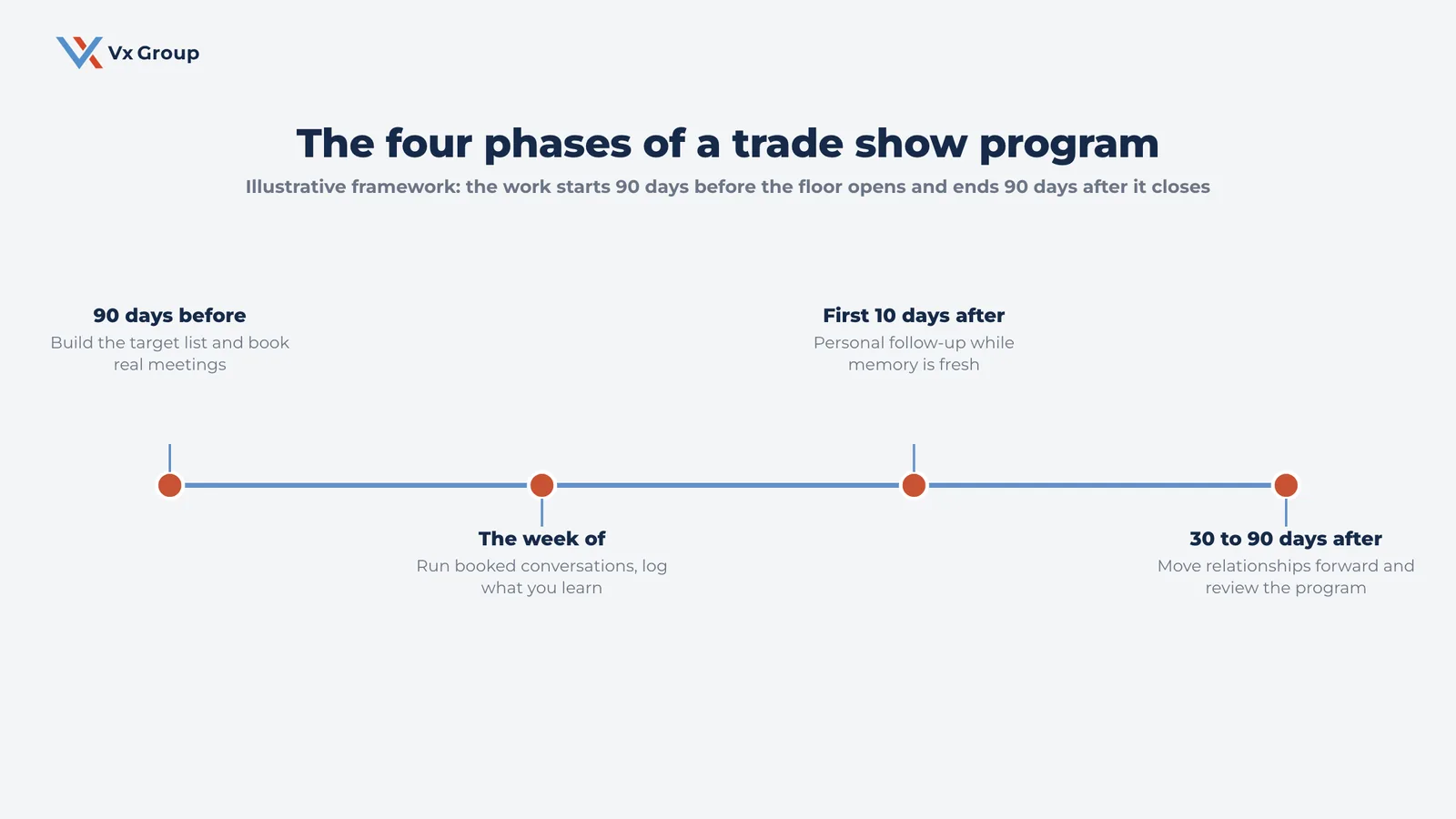
A trade show program runs in four phases: ninety days of preparation, the week of the show, the first ten days after, and the thirty to ninety day window where conversations become pipeline. Each phase has a different owner and a different definition of done.
Build the target list ninety days out
Ninety days before the show, write the list of people you intend to see. Name them. Company, person, role, why they matter, and what you want to be true after the conversation. Three tiers works well: your top twenty existing accounts who will attend, the ten to fifteen prospects where a face-to-face conversation would move something that email cannot, and the influencers who shape short lists in your market.
The list has a natural size limit. Three show days, two people staffing, thirty-minute conversations, and realistic gaps put the ceiling somewhere between twenty-five and forty real conversations. Build the list to that number and stop. A list of two hundred names is a wish, and it produces the same behavior as no list at all.
Book the conversations before you build the booth
Six to eight weeks out, start outreach with a specific ask: a thirty-minute conversation at a set time. Personal notes, sent by the person who owns the relationship from their own address. For existing accounts the ask is easy and the acceptance rate is high. For prospects, name a reason worth the walk: something you have built, learned, or solved that connects to a problem they have.
Target twenty confirmed meetings before you finalize the booth layout, because what you learn while booking changes what the booth needs to do. Twenty confirmed conversations turn the booth into a host space for work that is already on the calendar. That is a different asset from a booth waiting on foot traffic.
Staff the floor for conversations you already scheduled
During the show, protect the calendar. Assign each booked conversation an owner and a slot, keep two people free for walk-up traffic, and have somewhere quieter than the aisle to sit for the meetings that deserve twenty uninterrupted minutes.
Log every conversation the same day it happens, in the same format, with four fields: who, what they are dealing with, what you agreed to do next, and by when. Same-day capture is the difference between a program and a pile of business cards. Anything logged on the flight home has already lost the specifics that make follow-up feel personal.
Run the follow-up as a documented sequence
The first ten days after the show carry most of the value. Every conversation gets a response referencing what you actually discussed, from the person who had the conversation, with the specific next step attached. Send what you promised. Book the site visit. Route the quote request. Make the introduction.
Then plan the second touch at thirty days and a third at ninety, because a twelve-month sales cycle does not close on show momentum. The follow-up sequence belongs in writing before you leave for the show, with owners assigned, since nobody designs a good sequence during the week they return to two hundred unread emails.
Ready to grow?
We help manufacturers and distributors build a trade show program that produces pipeline instead of a badge list.
Which accounts should you plan to see at a show?
Prioritize the relationships where a face-to-face conversation changes something. That is usually a mix of your largest existing accounts, the prospects stuck in a long evaluation, and the specifiers who decide which suppliers get considered before you ever hear about a project.
| Who they are | Why the show matters for them | What to plan |
|---|---|---|
| Top 20 existing accounts | Highest revenue at risk, easiest meeting to book, most likely to mention a project nobody told you about | A scheduled sit-down with the person who owns the relationship, plus one new contact inside the same account |
| Stalled prospects | A year of email has produced politeness. Twenty minutes in person produces a decision or a clear no | A named reason to meet and a specific next step you can offer on the spot |
| Specifiers and engineering firms | They shape the short list before a project reaches you | Technical conversation, capability documentation, and a follow-up route that does not run through procurement |
| Distributors and channel partners | Three days of access to partners you usually reach by phone | A working session on their pipeline, not a product update |
| Lost deals from the last two years | The switching window may have opened, and nobody else is asking | An honest ten-minute conversation about what has changed on their side |
Two of these categories get systematically underweighted. Existing accounts get skipped because the team assumes those relationships are secure, which is exactly the assumption that lets a competitor with a booth two aisles over start a conversation your customer never mentions to you. The concentration risk in a handful of large relationships is worth taking seriously, and the reasoning behind that is worked through in top 10 customers as strategy and what is a generational customer.
Lost deals get skipped for a more human reason. Nobody enjoys walking up to the account that chose someone else. It is also the single most informative conversation available on the floor, and eighteen months into a disappointing supplier relationship, some of those buyers will tell you things they would never put in an email.
How do you follow up after a trade show without losing the room?
Send the first response inside forty-eight hours, from the person who had the conversation, referencing something specific that was said. Then work a documented sequence at ten days, thirty days, and ninety days, with an owner on every account.
Write the first touch the same night
The best follow-up gets drafted at the hotel that night, while the conversation is still fresh. Two or three sentences: what you talked about, what you said you would do, when it will arrive. No brochure, no template, no “it was great connecting at the show.” Specificity is the entire point, and the specifics are perishable.
Deliver what you promised before you sell anything
If you said you would send the spec sheet, send the spec sheet. If you said you would check lead times, check them and report back with a real number. Much of the trust available from a show conversation is earned in the week after it, by doing the small thing you said you would do while the other person still remembers you said it.
Set the second and third touch before you go
Write the sequence in advance: day two personal note, day ten substantive follow-up with whatever was promised, day thirty a check-in tied to their timeline, day ninety a reason to talk again that is genuinely about them. Assign every account an owner and a date. The follow-up that never happens is almost always the one nobody was specifically responsible for.
Get the conversation out of one person's head
Every logged conversation belongs in the system where the rest of the relationship history lives, in the same format, whether or not it turns into a deal this year. A show conversation that lives only in the sales rep’s memory disappears the day that rep changes jobs, and in a business with a twelve-month cycle, that is a real loss. The mechanics of building that habit are covered in sales pipeline management.
Field Notes:
A components manufacturer we worked with attended the same regional show for nine consecutive years and could not answer what it produced. The ninth year they changed one thing: eight weeks before the show, the two salespeople each wrote a list of twelve accounts and sent personal notes asking for twenty minutes. They booked nineteen meetings. Booth spend was identical. The following spring, five of those nineteen conversations had turned into quoted projects, and one became the largest order that division wrote that year. Nothing about the booth changed. The calendar changed.
How do you measure whether trade show marketing worked?
Measure a trade show program on relationships advanced and pipeline created over the full sales cycle, tracked against the same show in prior years. Lead counts and badge scans tell you about floor traffic and predict very little about revenue.
Four measures carry most of the signal:
- Meetings held with named target accounts. Count against the list you wrote ninety days out. This is the only number available on the Friday the show ends, and it is a reasonable early read.
- Conversations logged with a next step and an owner. A conversation without a next step is a pleasant memory. Track the percentage that carry one.
- Pipeline created and advanced, attributed to show conversations. Track quotes issued, projects entered, and deals moved forward where a show conversation was part of the path. This number matures over the following twelve months.
- Revenue from show-sourced relationships over three years. In a business with long cycles and long customer tenure, the honest measure of a show is what those relationships produced by year three.
The uncomfortable part of this is patience. A show that produced eleven quality conversations in March may show almost nothing in June and a strong number the following February. Companies that judge shows on a sixty-day window systematically undervalue their best channel and cut it first. For the full measurement approach, including how to handle attribution across a long cycle, see trade show ROI, trade show metrics, and how to measure trade show effectiveness.
What should a trade show program cost?
Budget the program, not the booth. For most mid-market manufacturers and distributors, the visible costs run between fifteen and sixty thousand dollars per show, and the highest-return line item is usually the cheapest one on the list.
| Line item | Typical share of spend | What it buys |
|---|---|---|
| Floor space | Largest single line | The right to be there and be found |
| Booth build, freight, and drayage | Second largest | A space that looks like a company worth buying from |
| Travel, lodging, and staff time | Substantial and usually underestimated | The people who have the conversations |
| Pre-show outreach and meeting booking | Often zero | The calendar, which determines what the other lines are worth |
| Follow-up execution | Often zero | Whether any of it converts |
Two lines in that table are frequently funded at nothing, and they are the two that determine the return on everything above them. Eight weeks of part-time outreach effort has no invoice attached, which is precisely why it never makes the budget conversation. Fund it as hours with an owner and it happens.
How a company shows up on the floor matters too, and for reasons that go past aesthetics. A booth that looks a decade behind the competition tells a buyer something about the business, fairly or not. That first-impression problem is the subject of brand modernization.
Common trade show marketing mistakes
- Funding the booth and not the calendar. The most expensive mistake in the category, and the most common. Thirty thousand dollars of space and zero hours of outreach.
- Measuring by badge scans. The number rises when floor staff chase brief interactions with strangers, and the resulting list is one your sales team will quietly ignore.
- Skipping existing customers. The relationships with the most revenue at risk are the easiest meetings to book and the first ones cut from the plan.
- Sending the sales team without a list. Capable people with no named targets default to standing in the booth and waiting, which is the least productive use of the most expensive resource at the show.
- Letting follow-up wait for the office. The specifics that make a follow-up feel personal are gone by Thursday of the week you return.
- Treating every show the same. A regional distributor show and a national industry show call for different targets, different staffing, and different definitions of success.
- Never comparing year over year. Without last year’s numbers, the annual attend-or-skip decision comes down to whoever argues hardest in the room.
Where to start
Pick your next show and write the target list this week. Twenty-five to forty names, three tiers, with a reason attached to each one. It takes two people about two hours, and it is the single change that most reliably moves a program.
Then send ten personal outreach notes eight weeks out and count how many convert to a booked conversation. Ten notes is small enough that nobody needs to approve a project, and the response rate will tell you what the full version is worth. Companies doing this for the first time are usually surprised by how willing their existing customers are to put twenty minutes on the calendar.
Make the show a standing channel
Companies that get the most from trade shows tend to look the same from the outside and behave differently for eight weeks beforehand. Same floor space, same signage, same three days. The difference sits in a target list written in advance, a calendar filled by people who own the relationships, and a follow-up sequence that runs whether or not anyone feels energized when they get home.
Start with one show and one list. The rest of the program builds itself once the team sees what a full calendar does to the value of three days.
Ready to grow?
We build trade show programs for relationship-driven B2B companies, from target list through follow-up.
Subscribe to Insights → New articles on relationship-driven B2B growth, roughly weekly.
FAQs
About the Author: Jacob Camhi
